1 January 2019 Jolly Harbour to Gorda Sound, BVI (Day 1)
The alarm went off at 06:30 and we were on our way at 07:00. It took us an hour to clear the wind-shadow of Antigua, but we were soon out into the 20 knot north-east wind. Our course was roughly north-west, so we were on a beam reach all day. The sea state was horrible with 2 metre steep, confused waves coming from the north-east, making us bounce about. Glenys made the mistake of trying to sit down below at the laptop and, after 10 minutes came up looking a little queasy, so she went back to bed for a couple of hours.
In the afternoon, the wind dropped down to 15 knots and the waves settled down a little, making it a more pleasant motion. We scooted past Nevis, St Kitts, St Barts and by nightfall, we were passing by Saba doing 6-7 knots with the wind just abaft the beam.
We had a very pleasant star-lit night until 01:00, when the first shower hit us. I was on watch and alarmed to see the wind suddenly jump from 15 knots to 25 knots in the space of 15 seconds. Fortunately, we’d already put two reefs in the main, so I ran downwind for a few minutes and then rolled away some of the genoa.
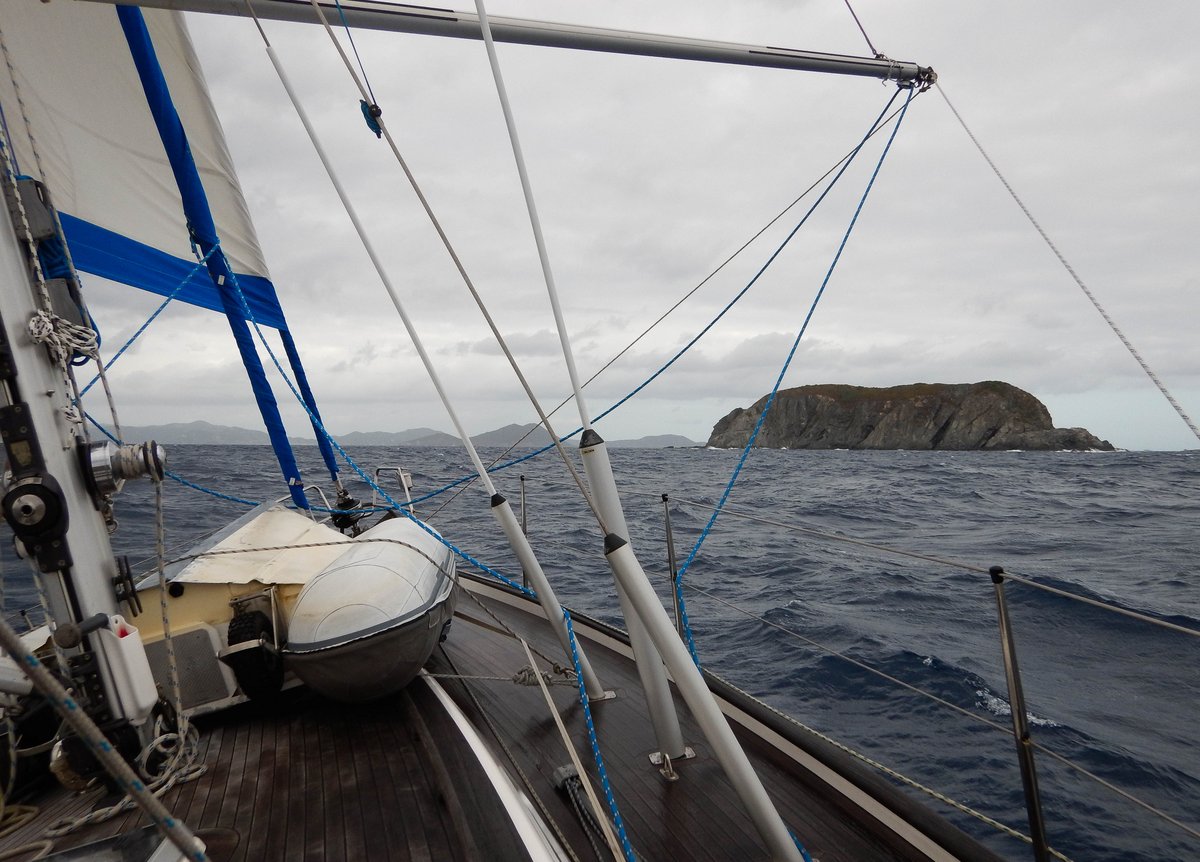
The clouds built up for the rest of the night and the wind picked up to 20-25 knots, so by day break we only had a small scrap of genoa.
2 January 2019 Jolly Harbour to Gorda Sound, BVI (Day 2)
At dawn, we could see land and passed through the Round Island passage at 08:45 having averaged 6.5 knots over the 170 miles. It took us a further 45 minutes to motor-sail into the wind to Spanish Town. The anchorage is covered with moorings, so we picked one up – I believe that the moorings are free for day-time use and you only get charged for staying overnight.
It took us an hour to sort ourselves out and get the dinghy back into the water – not my favourite job after a tiring passage. We zipped into the marina and walked to the customs building, where the clearance was fairly straightforward – customs, immigration and the treasury departments are in one room at separate windows. It cost us $38 US to clear in.
We wanted to buy a permit for the Marine Park moorings, but the nearest place to buy a permit is at The Baths, which is too far to walk. The customs officer said that we can pick up a mooring and pay when a park office comes along. They didn’t know how much the fees are.
Now that we were legal, we did our usual task of buying a SIM card, so that we’ll have internet access. The Digicel office was a 10 minute walk up the main road from the customs office. I’m still annoyed that we have to buy a new Digicel SIM card in every country that we visit – this one cost us $55US for 3 GB for 30 days.
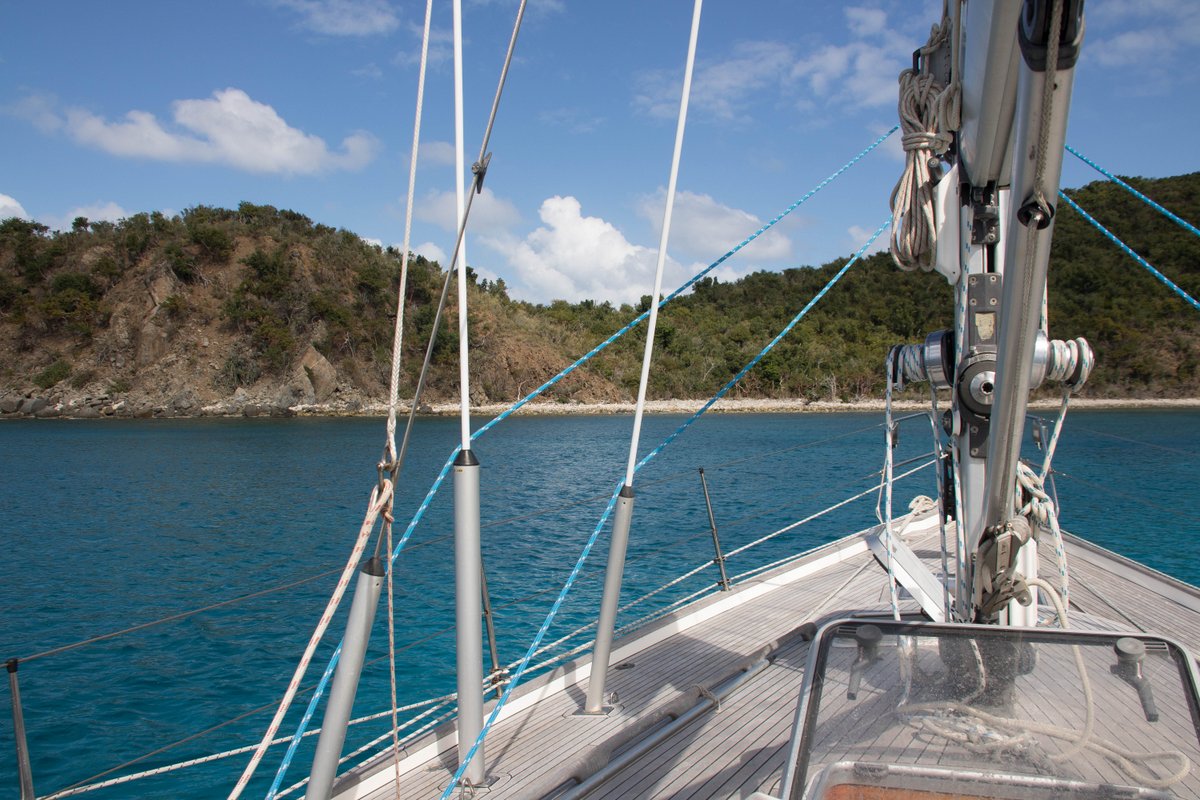
(I recently found out from another cruiser that you can purchase a €40Euro per month contract in Martinique, which gives you 40 GB of data and works in every island including the Bahamas and Puerto Rico. Apparently, you can cancel the contract after only one month. Of course, it’s too late for us, so we have to carry on buying a SIM card in every country…)
With our chores completed, we motored 6 miles upwind around to Gorda Sound, where we anchored at 18°30.37N 064°22.36W in 5 metres on good holding sand. We collapsed for the rest of the afternoon and had a quiet night.
3 January 2019 Gorda Sound, BVI
After breakfast, we took the dinghy upwind to The Bitter End Yacht Club only to find that it (and the Saba Rock bar) was wiped out in Hurricane Irma last year. Glenys chatted to the owner and she said that they hope to be back in business next year. We were planning to go for a 2 mile hike to the lighthouse on the island, but the paths have been neglected and are now too overgrown to use.
We returned to the boat, where we spent the morning planning what we’re going to do here in the BVI, which is mostly scuba diving. In the afternoon, I filled our dive tanks and ran the water maker, so we’re all ready to go diving tomorrow.
I read up on the Marine Park mooring system – it looks like Red moorings are for general use, Blue moorings are for dinghies, and yellow moorings are for commercial dive boats. We’ve still not been able to get a permit yet.
4 January 2019 Gorda Sound to Mountain Point, BVI
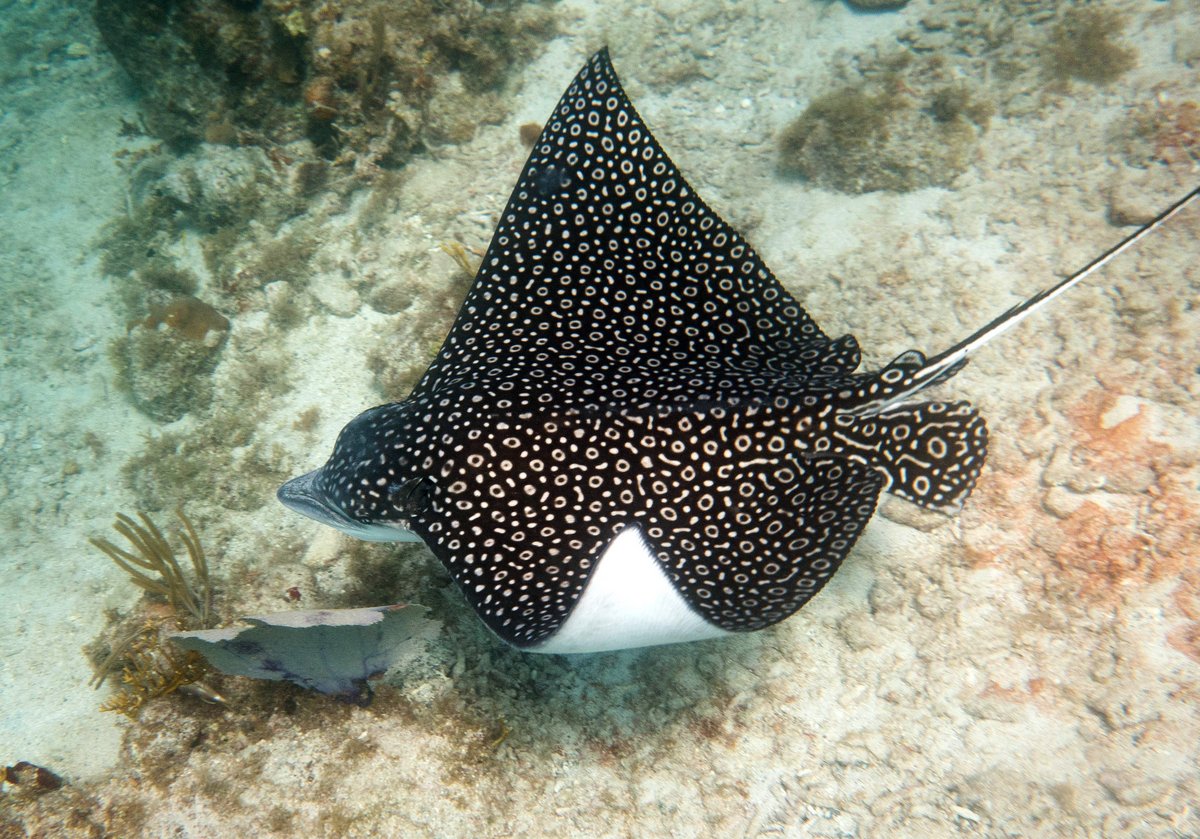
After breakfast, we upped anchor and motor-sailed the 6 miles around to Mountain Point where we anchored at 18°29.95N 064°24.81W in 10 metres on good holding sand. 30 minutes later, we picked up a red dive mooring just off the cliffs at Mountain Point and had a pleasant dive. We headed west down to 20 metres where the reef met the sand and then followed the edge of the reef heading north. At 100 bar, we headed back at 12 metres depth. We saw a large Spotted Eagle Ray, 4 nurse sharks and lots of friendly snappers – a nice easy first dive.
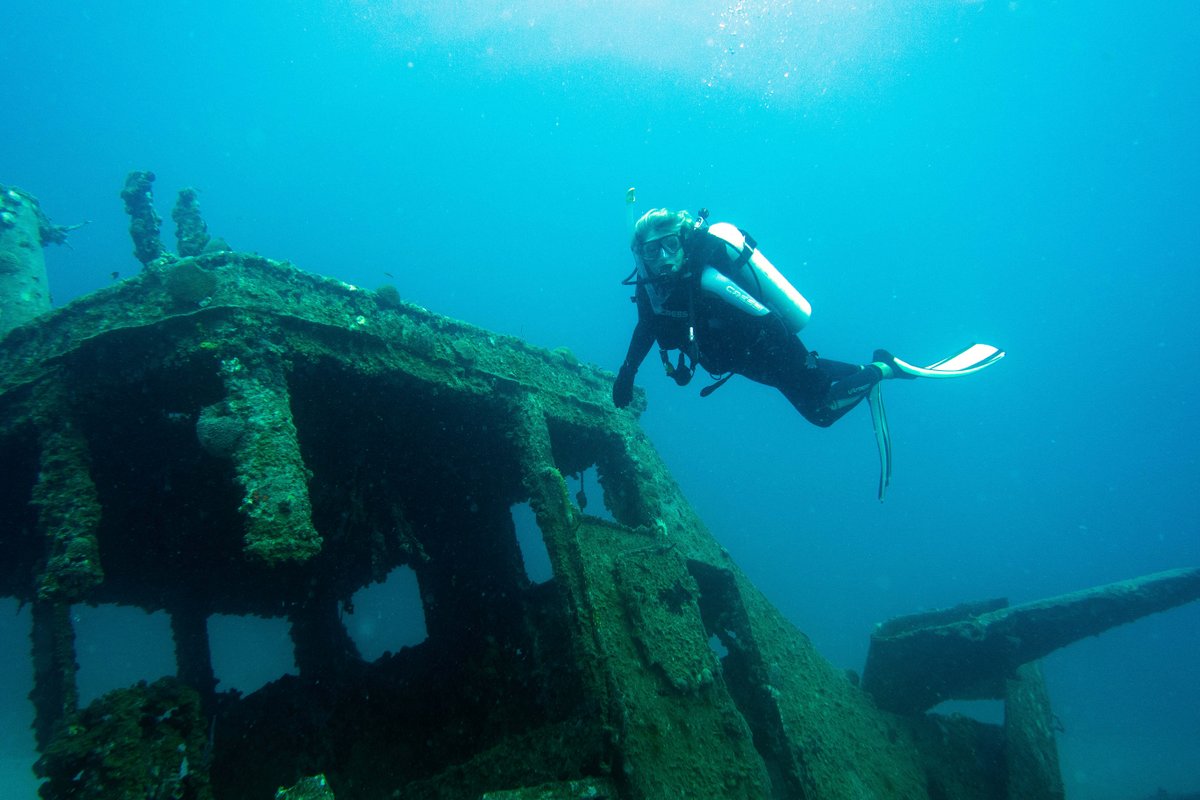
After lunch, we filled the dive tanks and made some more water – we’re using lots of water with washing down the dive gear and having multiple showers. We then went for a snorkel on the wreck of the Kodiak Queen. This was sunk by Richard Branson, who commissioned a huge, wireframe sculpture of a Kraken, which is grappling the bow of the ship. The ship was only sunk in 2016, so there hasn’t been much time for any coral growth, but it should be good in 20 years’ time.
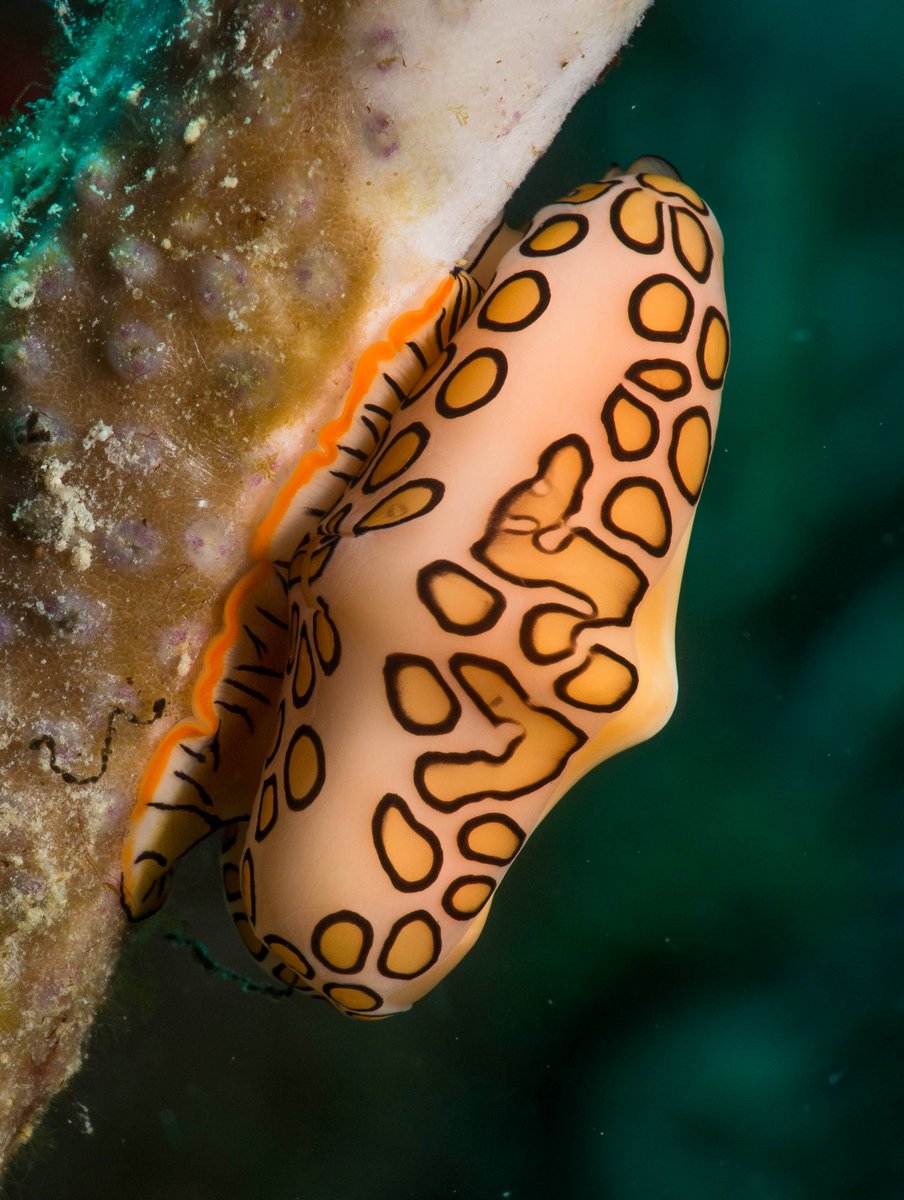
The top of the wreck is at about 10 metres, so it was too deep to spend a lot of time there. After five minutes, we’d decided that it wasn’t worth doing a scuba dive on the wreck and went to have a look at the snorkelling over by the cliffs. We picked up a yellow dive mooring and swam to the shallower water by the cliffs which was interesting, with lots of fish and small molluscs called Flamingo Tongues.
5 January 2019 Mountain Point, BVI
After a quick breakfast, we headed over to the Dog Islands and picked up one of the two red moorings in the lee of George Dog Island. We assembled our dive gear and took the dinghy to a yellow “commercial dive” mooring at the south side of Cockroach island to do the dive called “The Visibles”.
We descended the mooring line down to 12 metres and then headed North West descending to 20 metres, until we came to the steep rocky reef of the Visibles pinnacle. We then followed the reef to the right, swimming into a slight current. The visibility was poor because of the poor light with overcast skies and there was a lot of particles in the water – not very good for photography, but there were dozens of Great Barracuda hovering in the current waiting to pounce on the huge shoals of grunts.
We had a nice encounter with four or five African Pompano, who swam circles around us for a couple of minutes. When our tanks were half empty, we retraced our route back to the mooring. I believe that you can come back via shallower water at the north side of the pinnacle, but I didn’t feel too confident in my navigation in the poor visibility.
After washing and stowing the dive gear, we toddled over to look at the moorings on Great Dog island. There are four red moorings and a yellow one at the Chimneys on the west coast and four red moorings and a yellow one at the south side. The south side is very exposed to the prevailing winds and waves, so looked to be very uncomfortable, which is a pity because there’s a sunken aeroplane there, which would be interesting to dive on.
We headed back to the anchorage at Mountain Point and anchored at the same place. It’s a lovely, well protected anchorage with a huge area of good holding white sand and thankfully no moorings other than the Marine park ones for snorkelling and diving. The main charter boat fleet doesn’t seem to come here because it’s nice and quiet, with no restaurants or bars, but huge power boats come and anchor further off.
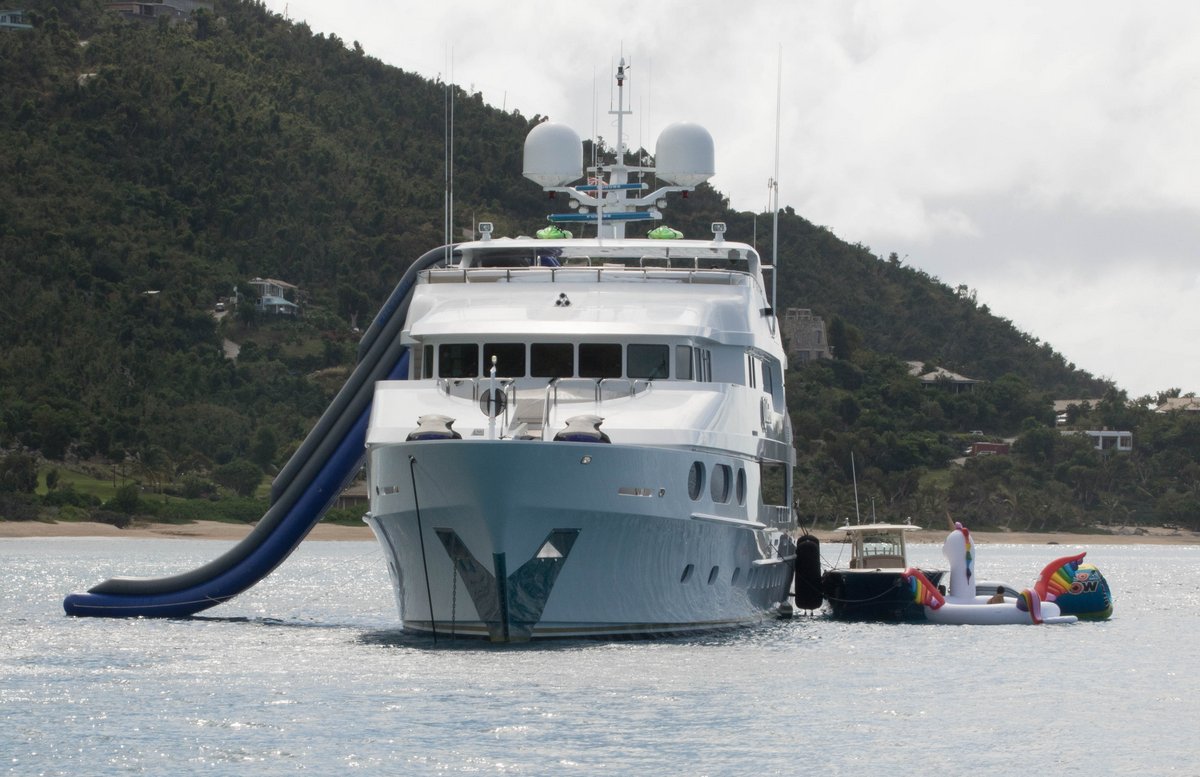
It would be nice to say that the power boats come so that their guests can enjoy the peace and tranquillity of the anchorage, but unfortunately, they bring their toys with them. Huge inflatable slides are rigged, plunging 40 foot down into the sea and inflatable paddling pools shaped like “My Favourite Pony” float behind these huge gin palaces. Of course, smaller 30 foot tenders zoom about with guests wake-boarding or kids hanging onto inflatable tubes.
The latest fad seems to be motorised hydro foil wake boards – it looks like a lot of fun when you get the balance right and the board rises out of the water on the hydrofoil, zipping along at over 20 knots. They only cost $12,000US, maybe a belated Christmas present for me?
6 January 2019 Mountain Point, BVI
We woke to a grey, drizzle, but the sun soon came out and it turned into a lovely day. I filled our two dive tanks and we then dived on the nice reef off Mountain Point.
After running the dive compressor again, Glenys ran the water-maker, while I went for a snorkel near the cliffs. And then the day was over. This is a lovely anchorage and I’d quite happily stay here for another week, but we ought to explore more of the Virgin Islands.
7 January 2019 Mountain Point to Benures Bay, BVI
After breakfast, we sailed down to the Baths, which is a section of coast line where hundreds of giant boulders are packed together, creating passageways and caves. We had a look at anchoring in Spring Bay, but the sea bed looked to be all rock and rubble, so we picked up a Marine Park mooring. The Baths is a “must-see” in all the cruising guides, so there were about 50 boats hanging on moorings and scores of dinghies full of expectant tourists flocking ashore.
We joined the throng and took our dinghy to the dinghy mooring line - there are so many people visit The Baths that the Park Authority has banned any dinghies from going closer than 50 metres from the shore. This means that after tying up, we had a 50 metre swim to the beach. The beach was packed with people enjoying themselves, but rather than opting for a Pina Colada at one of the bars, we chose to walk along the trail which weaves its way through the boulders and visits a couple of lovely beaches.
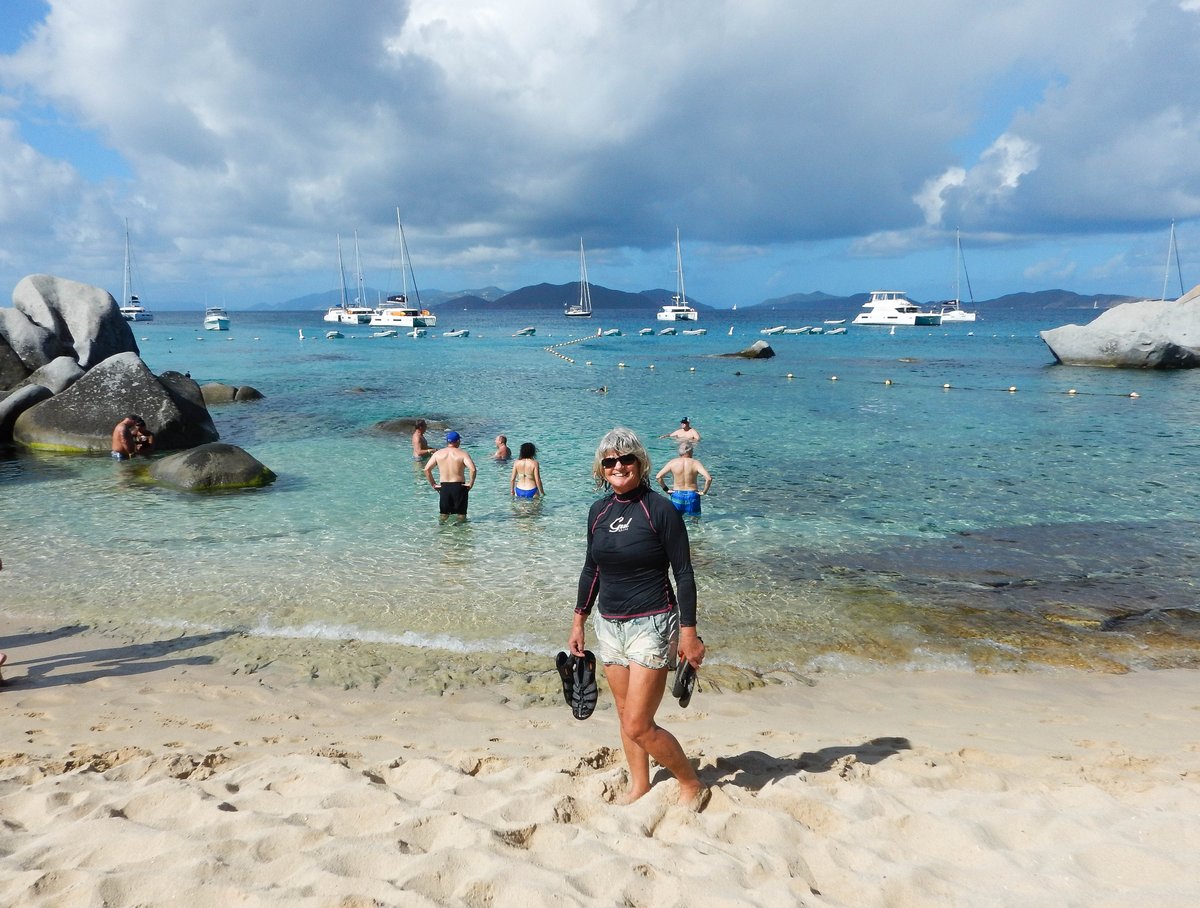
We had a fun couple of hours ashore and then sailed across to Cooper Island to anchor in Haulover Bay, which is a spectacular spot next to some impressive cliffs. We dropped the anchor at 18°22.52N 064°30.66W in 8 metres on good holding sand. Unfortunately, there was a large swell hooking around the corner making us rock and roll, so after 30 minutes, we upped anchor and set off towards Tortola.
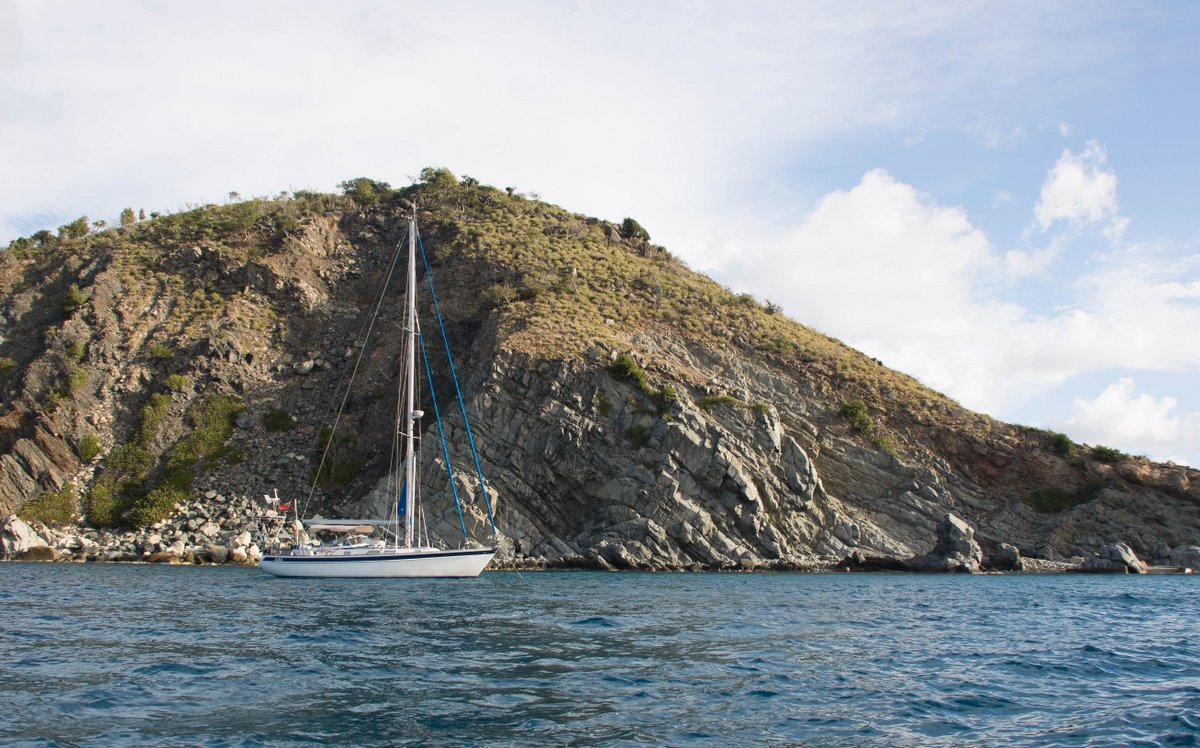
One of the great problems with the British Virgin Islands is that all the best anchorages are covered in moorings that cost between $25US and $35US per night. We don’t intend to pay anything, so we headed for Buck Island, where we last anchored in 2012 and remember it being very pleasant. We anchored at 18°25.53N 064°33.73W. Unfortunately, it was also very rolly. By this time, we had 3 hours of daylight left, so we immediately pulled up the anchor and headed for Peter Island six miles away.
Key Cay was one of our favourite anchorages in 2012 and we had high hopes. We arrived at 16:10 and anchored at 18°20.75N 064°35.82W in 6 metres of water over good sand. Unfortunately, the swell was worse than the other two anchorages. With less than 2 hours of light remaining, what were we to do? We could stay and roll our guts out all night or move again.
We pulled up the anchor with the intention of motoring back to Buck Island, which was the least rolly of the three anchorages, but then spotted that there weren’t many boats in Benures Bay on Norman Island. As it was only a mile away, we scooted over and slammed the anchor down in the middle of the bay at 18°19.35N 064°36.33W in 13 metres of water. I dumped 50 metres of chain out, it rumbled a bit, but held firm, which was good enough for us. It’s a lovely peaceful anchorage, so exhausted, we cracked open a cold beer.
8 January 2019 Benures Bay, BVI
After our frenzy of anchorages yesterday, we decided to stop and chill out for a day. Mid-morning, we nipped around the corner and picked up a dive mooring on “Spyglass Wall”. We descended to 20 metres and headed east, following the bottom of the reef. When we had half tanks, we retraced our route at 12m.
The visibility was very good although there were enough particles in the water to make photographing fish a challenge. We saw about half a dozen large lobster and lots of fish. There were a few varieties of Hamlets, so I concentrated on trying to photograph them –
In the afternoon, we ran the dive compressor and the water maker and then chilled out. It’s a very nice, peaceful anchorage away from the charter boats.
9 January 2019 Benures Bay to Haulover Bay, BVI
We motored upwind to have a look at the dive site for the RMS Rhone, but all moorings taken and the sea state was rough, so we carried onto Haulover Bay, dropping the anchor at 18 22.5259 N 064 30.6617 W in 7 metres of water on good holding sand. Despite the light winds, a swell was still hooking around into the bay, so it was rolly, but we decided to tough it out.
After lunch, we took the dinghy across to the dive mooring for “Wreck Alley”. We descended the mooring line and then headed west down the reef and across 50 metres of sand to two tug boat wrecks. There was some big fish including a friendly Dog Snapper and a shy Reef Shark.
We looked around for five minutes and then swam north across a 100 sand patch to another two wrecks. One was upside down and of little interest but the other one was very good with an interesting cargo hold and cabins. Our friendly Dog Snapper had followed us over and was amusingly possessive, chasing away other fish when I was trying to photograph them. The Reef Shark also came over and did a few close passes.
When we were down to 5 minutes of no decompression time, we returned to the reef and ascended to 12 metres for our return to the dive mooring. It was a very, very nice dive – much better than the busy RMS Rhone.
Back on the boat we filled the dive tanks, ready for tomorrow. We had a few rain squalls come through and unfortunately, the swell didn’t die down, so we had a very rolly evening.
10 January 2019 Haulover Bay to Key Cay, BVI
It was one of the rolliest nights that we’ve had for a while, so we upped anchor after breakfast; motored around to Ginger Island and picked up the only general purpose buoy at 18 23.1977 N 064 28.9134 W . Our intention was to dive “Alice In Wonderland”, but a charter catamaran picked up the dive mooring. There used to be two moorings, but one has gone missing.
Instead, we went to the south-west corner of the bay and picked up the dive mooring for “Ginger Steps”. We headed south-west from the dive mooring and after passing a couple of ridges, descended to 20 metres. We didn’t stay long at that depth because the reef was very dull and ascended back to 12 metres, following the reef heading south-east. At half tanks, we turned north east and then followed a lovely reef back to the mooring.
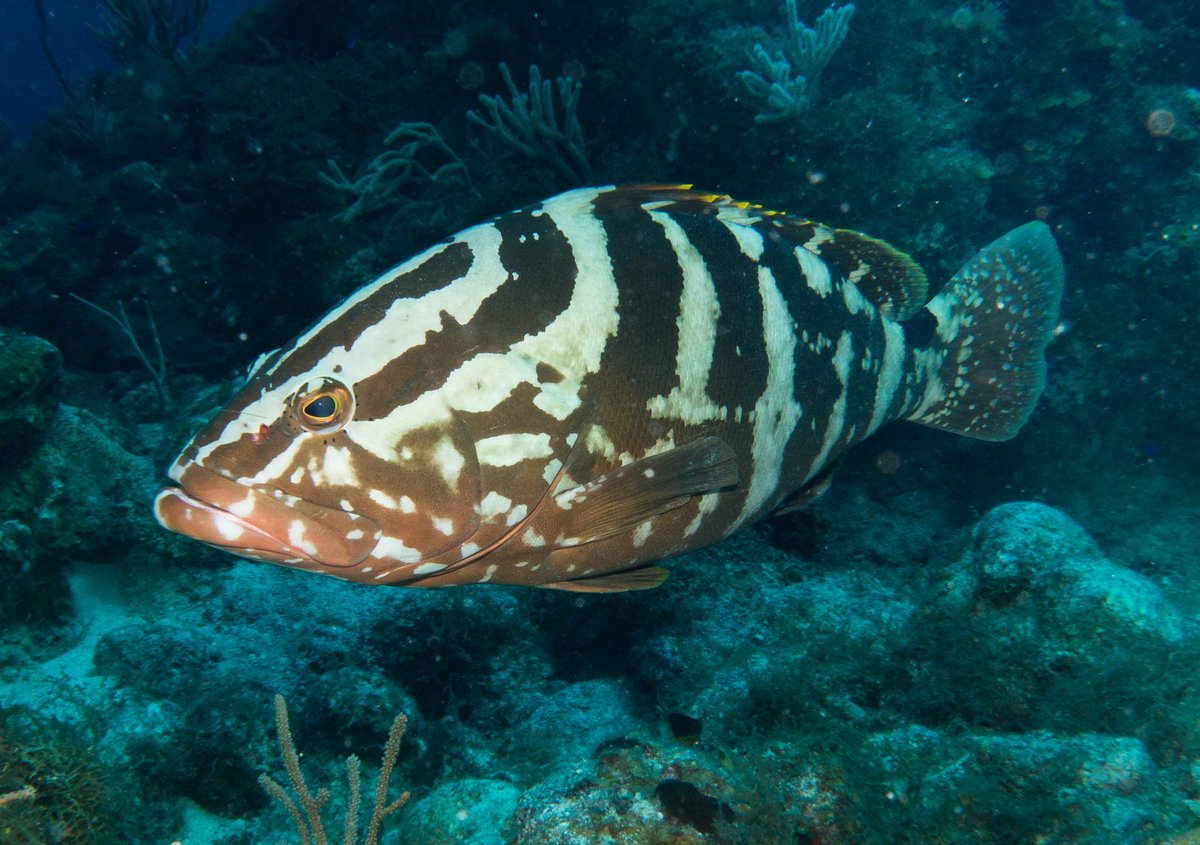
It was a pleasant reef dive, with lots of friendly fish, including a large Nassua Grouper, who followed us for 10 minutes coming within a few feet of me at times.
Back on Alba, we stowed the dive gear and headed for Tortola island. Our intention was to stay in the anchorage at Buck Island, but when we arrived at the channel, we could see a boat rocking and rolling. Instead, we headed into Road Town and picked up a mooring at 18°25.48N 064°36.72W just outside the breakwater.
We nipped ashore and tied the dinghy up alongside a wooden dock just past the BVI Yacht Charters marina at the north-east corner of the bay. After sneaking our two bags of garbage into the marina skip, we walked across the road to the Riteway supermarket, where we bought a few bags of provisions. I walked back to buy petrol at the convenient garage, so we’re fully fuelled and provisioned ready for Puerto Rico next week.
It was a short 5 mile motor across the sound to Key Cay, where we anchored in 6 metres depth on good holding sand. I dived down to have a look at the anchor and found that we’d backed over some large rocks, which I thought might snag our anchor chain, so we moved ten metres further in and a bit to the north. We finished up at 18°20.74N 064°35.81W. It’s a lovely anchorage, but again, there’s a bit of swell hooking around the corner making us roll.
11 January 2019 Key Cay, BVI
It was a little rolly last night, but nothing too bad, so we decided to have a quiet day and stay. Mid-morning, we went for a snorkel over to the headland, which has some dramatic rocky canyons to swim around. I spent ten minutes trying to photograph four, shy Caribbean Reef Squid – they gradually let me get closer, but they jetted off when I pushed their boundary.
We filled the dive tanks and ran the water maker in the afternoon and had a quiet evening – there’s only one other boat in the anchorage.
12 January 2019 Key Cay to White Bay, BVI
We motored around to The Caves on Norman Island and picked up a Marine Park mooring at 18°18.88N 064°37.46W. After assembling the dive gear, we headed over to Carval Rock and did a scuba dive called “Angelfish Reef”. The dive had a splendid review, but it looked very bleak to us, with the only interesting parts in 10 metres of water close to the rocky point. It was very disappointing.
Back at boat put gear away and then went for a snorkel around The Caves. This is a huge tourist attraction and a very popular stop for the day-tripper boats. It was okay – there are some large caves that you can swim into, but the scores of tourists and the copious amounts of Sargassum Weed made it unpleasant. The only highlight was spotting a huge lobster – if there hadn’t been so many people around, it would have been in a bag, despite it being a Marine Park.
A huge rain squall passed over us, so we stayed on the mooring for lunch and then motored around to White Bay on Peter Island. We anchored at 18°20.88N 064 34.52W in 10 metres of water. It’s a fabulous anchorage in a huge wide bay. There’s only one other boat in here and best of all there are no charter catamarans – bliss…
13 January 2019 White Bay, BVI
We had a very peaceful night, so we decided to stay and do some chores. Glenys dragged out her sewing machine and did some repairs, replacing Velcro on the bimini side panels and re-stitching some seams on the dinghy cover. I pottered about keeping out of the way, filling our dive tanks and getting on with some admin.
14 January 2019 White Bay to Jost Van Dyke, BVI
We love the anchorage at White Bay, but it’s time to move on – we only have six weeks to get to Georgetown in the Bahamas, which is 800 miles away. Our son, Craig is meeting us there and before he arrives, we want to spend a few weeks cruising Puerto Rico and the southern Bahamas.
There was hardly any wind, so we couldn’t be bothered to pull out any sails and motored the 12 miles across to Great Harbour on Jost Van Dyke. The anchorage is now a mass of moorings, so rather than stressing out trying to anchor between them, we picked one up – we only want to clear out of customs.
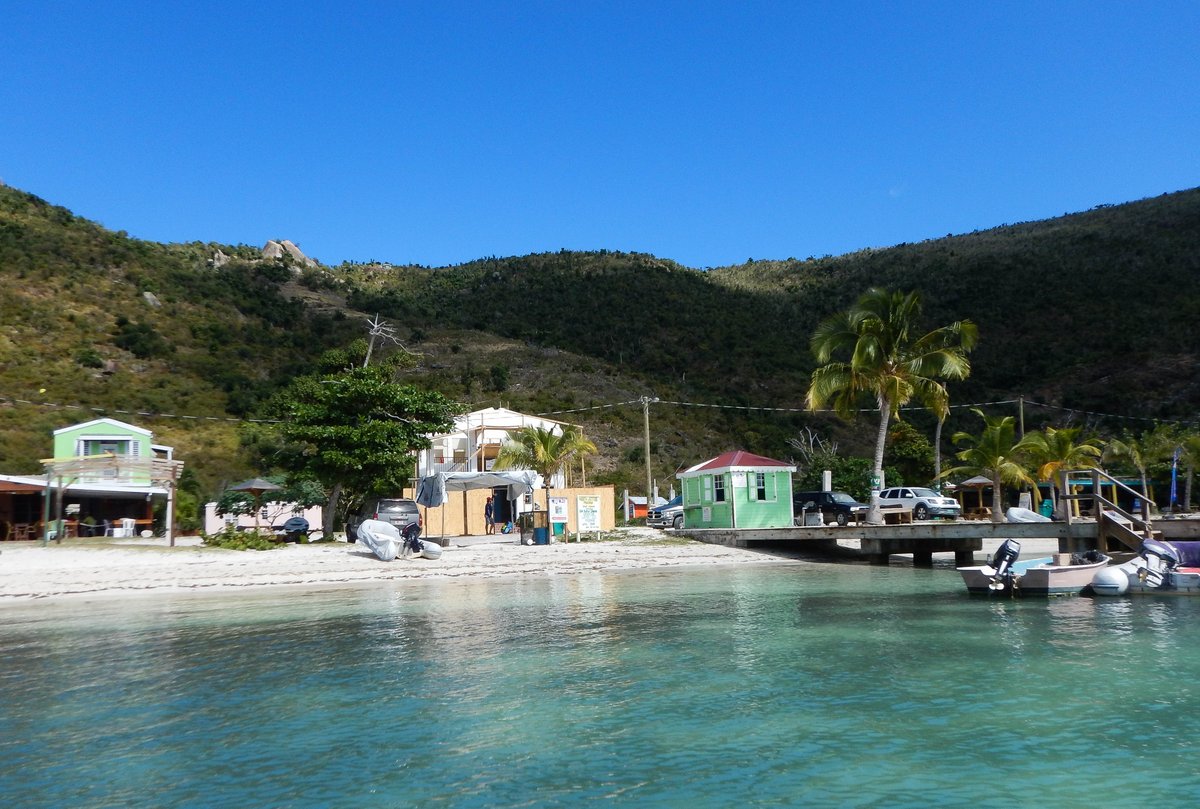
We arrived in the bay at 11:30, so decided to rush into the customs office and try to clear out before lunch. After tying up the dinghy on the wooden dock, we found the Police Station and customs at the end of the dock. Five minutes later, we’d cleared out – it’s a miracle. The customs and immigration officers simply took one copy of the triplicate form that I’d filled out when we arrived in the BVI and handed me back the yellow copy – job done.
Great Harbour is the major settlement on the small island of Jost Van Dyke. It’s a single sand street with the police station, a couple of small shops and half a dozen restaurants, which are filled with day-trippers paying high tourist prices. We didn’t stay.
After dropping the mooring, we were clear of the bay by 12:10 – a very short 40 minute stop-over. We motored around to the east end of the island and looked at anchoring by Green Cay, but it’s very deep water and looked very rolly. Instead, we back-tracked a little and went into the bay next to DiamondCay – no surprise that the best anchoring spots are covered in moorings. We anchored right in the middle of the bay at 18°27.01N 064°43.34W in 14 metres on sand and thick weed.
15 January 2019 Jost Van Dyke to Culebra, Puerto Rico
With 40 miles to go to Isla Culebra, Puerto Rico, we left early. Unfortunately, there was only 10 knots of wind, which was more or less directly behind us, so we had to motor most of the way.
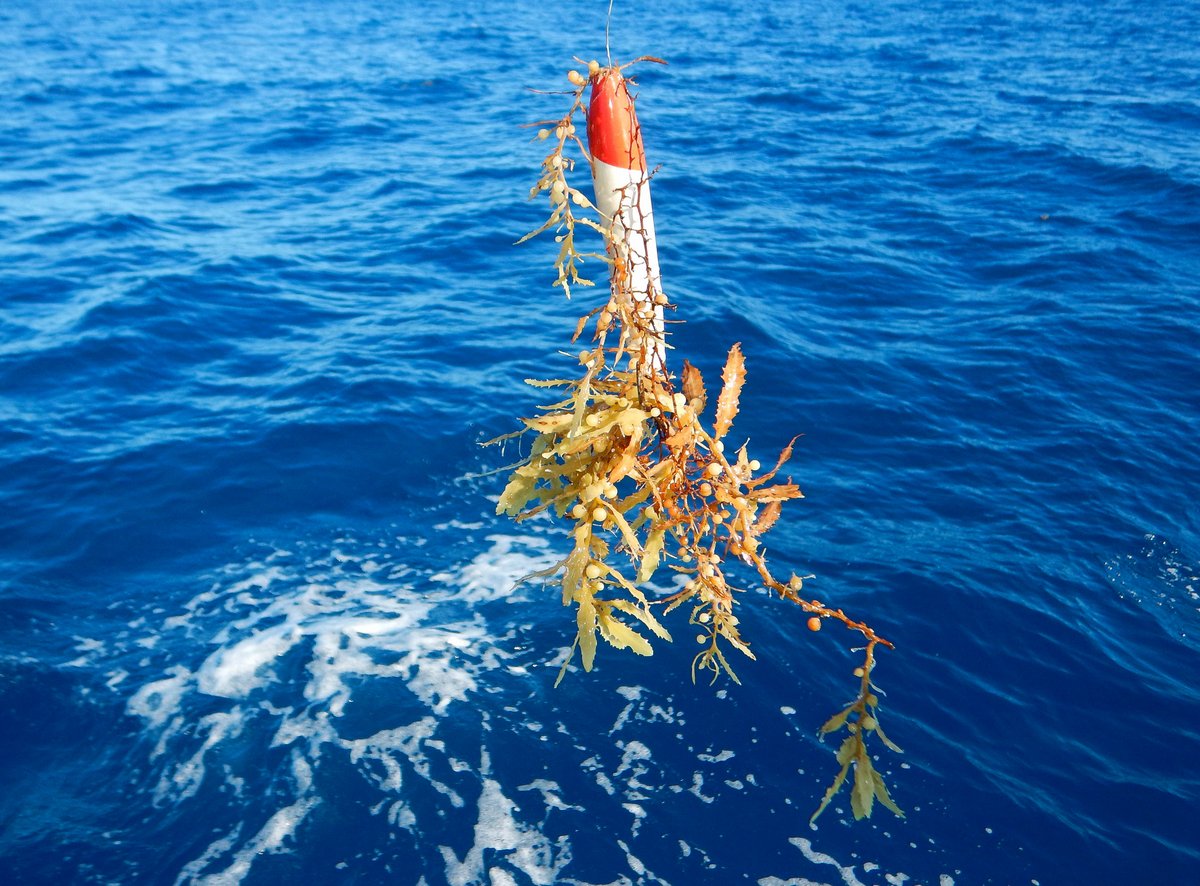
During the first hour, I hooked a Barracuda, which I managed to release after an epic struggle involving hooking our gaff into the gills and then using a pair of pliers to remove the hook, while avoiding the thrashing and snapping teeth. Fifteen minutes later, I hooked a small Bonito, but it dropped off the hook as I was lifting it on deck. Then the dreaded Sargassum Weed appeared and after clearing the hooks four times, I gave up – no fish for dinner tonight.
After lunch, the wind picked up and we were able to sail the last eight miles. We safely negotiated the channel passing the shallow reefs into Ensenada Honda and anchored at 18°18.31N 065°17.88W in 6 metres of water over good holding mud.
Puerto Rico is part of the USA, who can be very strict about their border controls. The regulations state that incoming vessels MUST ring a particular telephone number as soon as they arrive. The call centre will then give further instructions on the rest of the procedure. This is all very good, but we don’t have a USA SIM card for our telephone, so it’s Catch 22 – we can’t go ashore and we can’t ring them.
I popped over to another boat and found out that the US Border Protection Agency is based at the airport, about 1 mile away. There was nothing else that we could do apart from walk to the airport and report in. By this time it was nearly 15:00, so, worried that the might close at 16:00, I frog-marched Glenys to the airport.
The uniformed (and armed) lady at the Border Protection Office immediately asked if I had rung the telephone number as required. With some trepidation, I explained that we didn’t have a telephone, and to my great relief, she didn’t whip out her black shiny gun, but smiled and said that’s okay, she can sort it out.
The process was very painless – only two forms to be filled in and a few questions while she entered our details into the computer system. At the end of 20 minutes, we had been cleared through customs & immigration; and had been issued with a Cruising Permit that is valid for 12 months and is useable on mainland USA.
We had been a little concerned about our visas. Foreigners entering the USA on private vessels have to have a B1/B2 visa. We had obtained these visas in 2012, which expire in 2022, but the visas were in our old passports, which had been cancelled a few years ago. It appears that this is a regular occurrence and the officer didn’t bat an eyelid, when we showed her the visas in our old passports – phew!
Having cleared in, we walked the hot road back into town and had a quick stroll around. Culebra is a small island and the town is also small with a couple of (err) small supermarkets. There’s a ferry port which brings tourists across from mainland Puerto Rico and a number of restaurants and guest house to accommodate them. The preferred mode of transport is that locals have huge pickup trucks and tourists putter around on motorised golf carts.
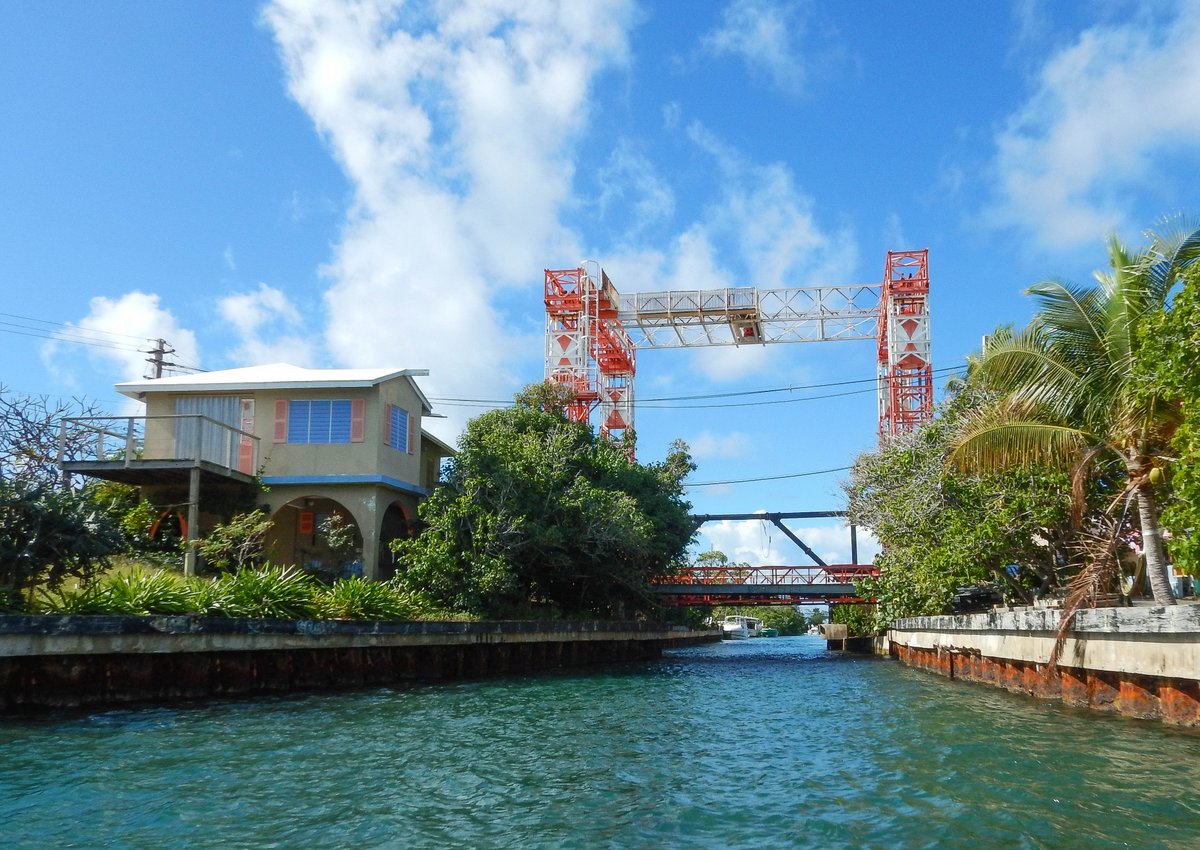
A narrow canal leads from Ensenada Honda to the ferry dock side of the island, passing under an old steel lifting bridge. The mechanism no longer works, but it must have been an impressive sight because a whole section of road was lifted vertically supported by four huge lattice pillars.
In the evening, we went to the Dinghy Dock bar for a couple of beers at tourist prices ($3.50 for a small beer). We were planning to stay for a burger, but burgers are only served at lunchtime and the cheapest thing on the evening menu was $20US. We retired back to the boat and Glenys rustled up Heuvos Rancheros for dinner.
16 January 2019 Culebra, Puerto Rico
Glenys had a bee in her bonnet about going to see Playa Flamenco, which is a beach on the north side of the island and reputably one of the best beaches in the world. We trudged along the tarmac road, past the airport for 2½ miles in the beating sun.
I was expecting an isolated beach, but there are lots of little souvenir stalls, snack bars, toilets and camping grounds. There’s a guard house at the entrance, stopping vehicles and charging each tourist a $2US entry fee. However, the guard never stopped us as we walked past - he probably couldn’t believe that anyone had walked all the way from town.
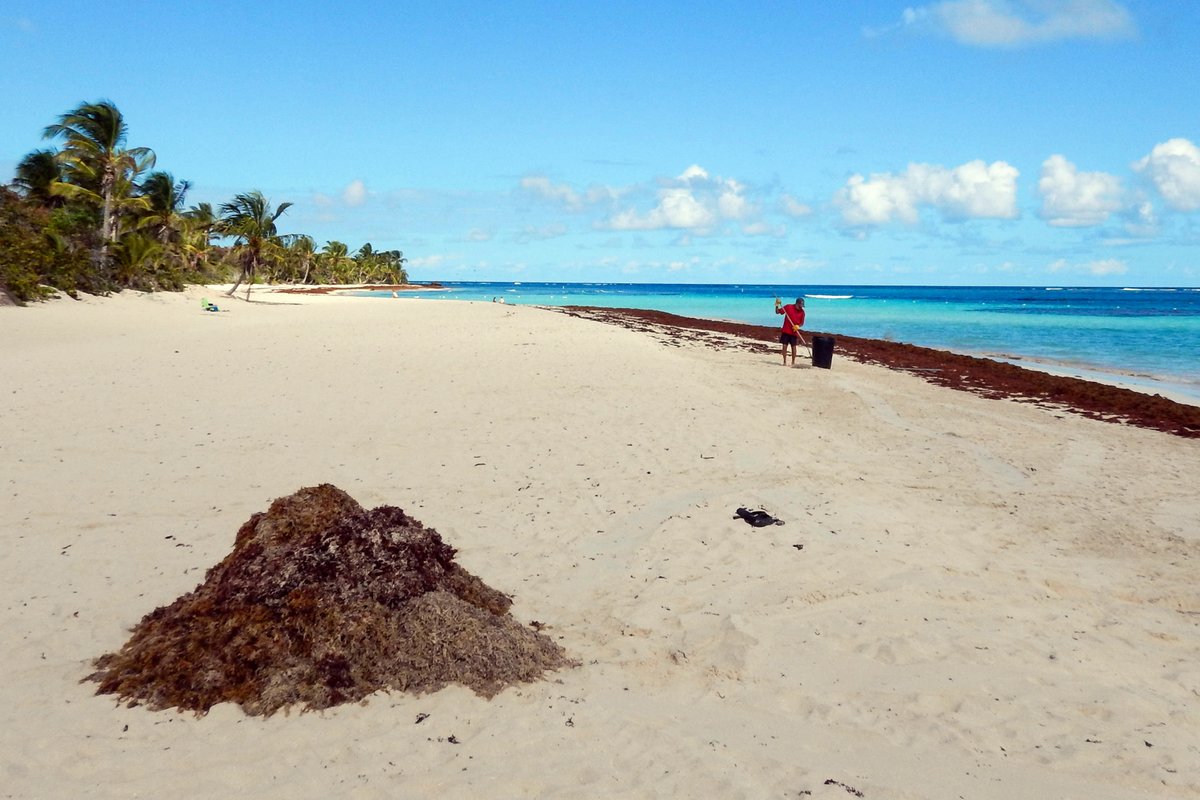
The beach is indeed very lovely, with azure seas and white sand fringed with coconut palm trees. Unfortunately, in the past few days and huge amount of Sargassum Weed has been blown onto this tropical paradise. There was one lone guy working with a lawn rake, scraping up the seaweed – a daunting task when faced with a mile long shore line and the seaweed 6 foot wide and 1 foot thick. We had a chat to him and he was very philosophical about the job – he has been camping at the beach and is doing this work as a gesture of good will – a lovely bloke.
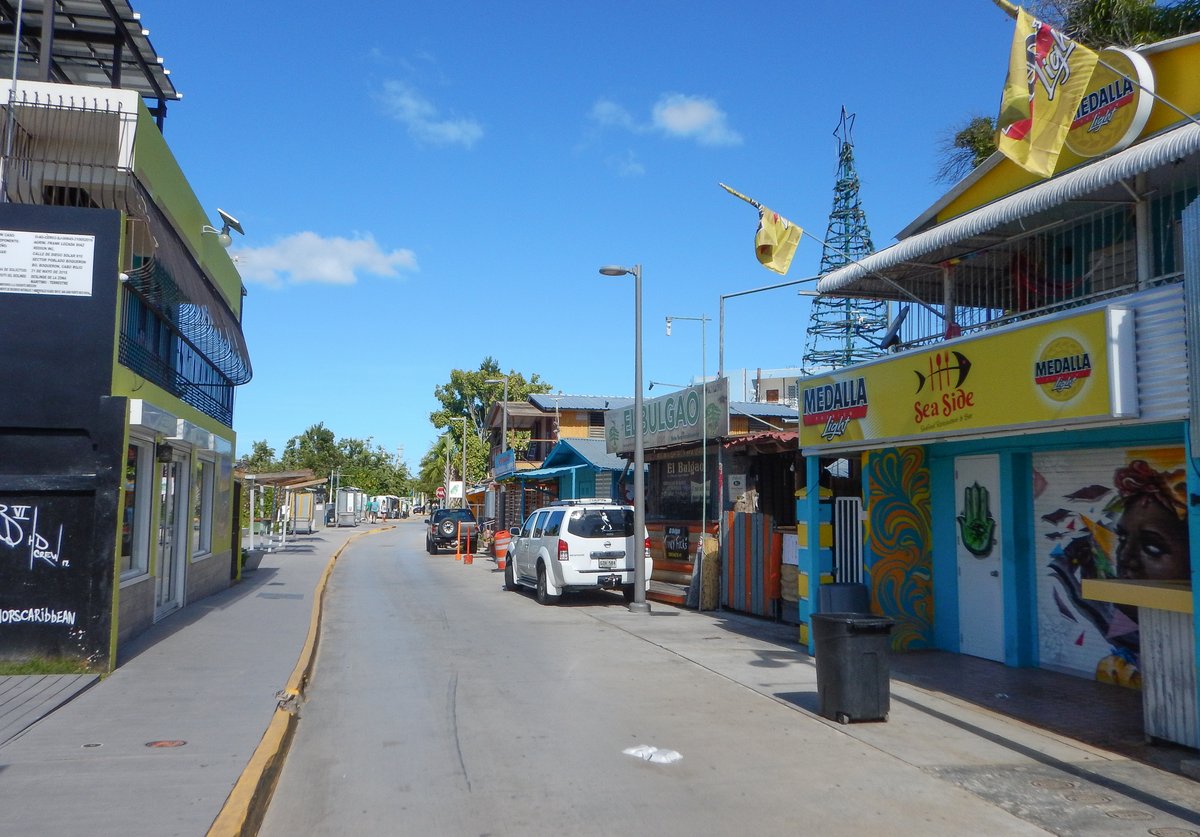
After a fifteen minute stroll along the beach, we walked back into town and called in at the supermarket next to the small canal to stock up on beer and a few other things – there’s a convenient dock next to the supermarket which makes it ideal for buying heavy stuff. I bought a couple of cases of local Medella beer, but unfortunately, I didn’t notice that it was the Lite version until we were back at the boat – Lite Beer, what’s that all about?
In the evening, Reg and Nicky from “Blue Velvet” came over for a beer and an hour later, Jean-Francoise and Silvie from a Canadian boat stopped by. We’ve been unable to buy a SIM card in town and I discovered that they are going to the BVI. I have a BVI SIM card with some credit left on it and Silvie has a USA SIM card with credit left on it, so we did a swap.
17 January 2019 Culebra, Puerto Rico
Mid-morning, we jumped in the dinghy and went through the canal to go snorkelling on the south-west coast. We went around to Pta Tamarind Chico, but there was a wicked current ripping past the headland, so we didn’t stay long. The visibility was poor making photography difficult, but there were a lot of fish hanging around in the current including a huge shoal of Southern Sennet, who swirled around me when I dived down.
We returned to Pta Melones and anchored in the lee of the headland out of the current. The reef was rocky and of little interest until I found 10 lobster lurking under a ledge on a small coral outcrop. Unfortunately, I’d left my snare back on Alba, so I was furious with myself. I tried to catch a few by hand, but even when I pushed them out into the open they were too quick to grab. Remind me never to go snorkelling without a snare.
Back on Alba, we had a quiet afternoon and in the evening, we popped out to a Mexican restaurant, where we stuffed ourselves full of Burrito, Taco and Quesadilla – I could hardly walk afterwards. Unfortunately, Glenys lost a filling from one of her molars, but it’s not causing her any pain, so we’re hoping that she can wait to get it fixed in the city of Ponce in a few days’ time.
18 January 2019 Culebra, Puerto Rico
After breakfast, we pulled up the anchor and moved out to the anchorage next to Pta Colorado, dropping the anchor at 18°17.50N 065°16.87W in 5 metres on good holding mud/sand. We jumped in the dinghy and went snorkelling off the west side of Pta del Solado. It was very rocky reef and there wasn’t a lot to see apart from a lovely encounter with a Spotted Eagle Ray, which did a couple of circuits past us. Alas, there were no lobsters.
We had a quiet afternoon and evening – we have a long 50 mile passage tomorrow.
19 January 2019 Culebra to Puerto Patillas, Puerto Rico
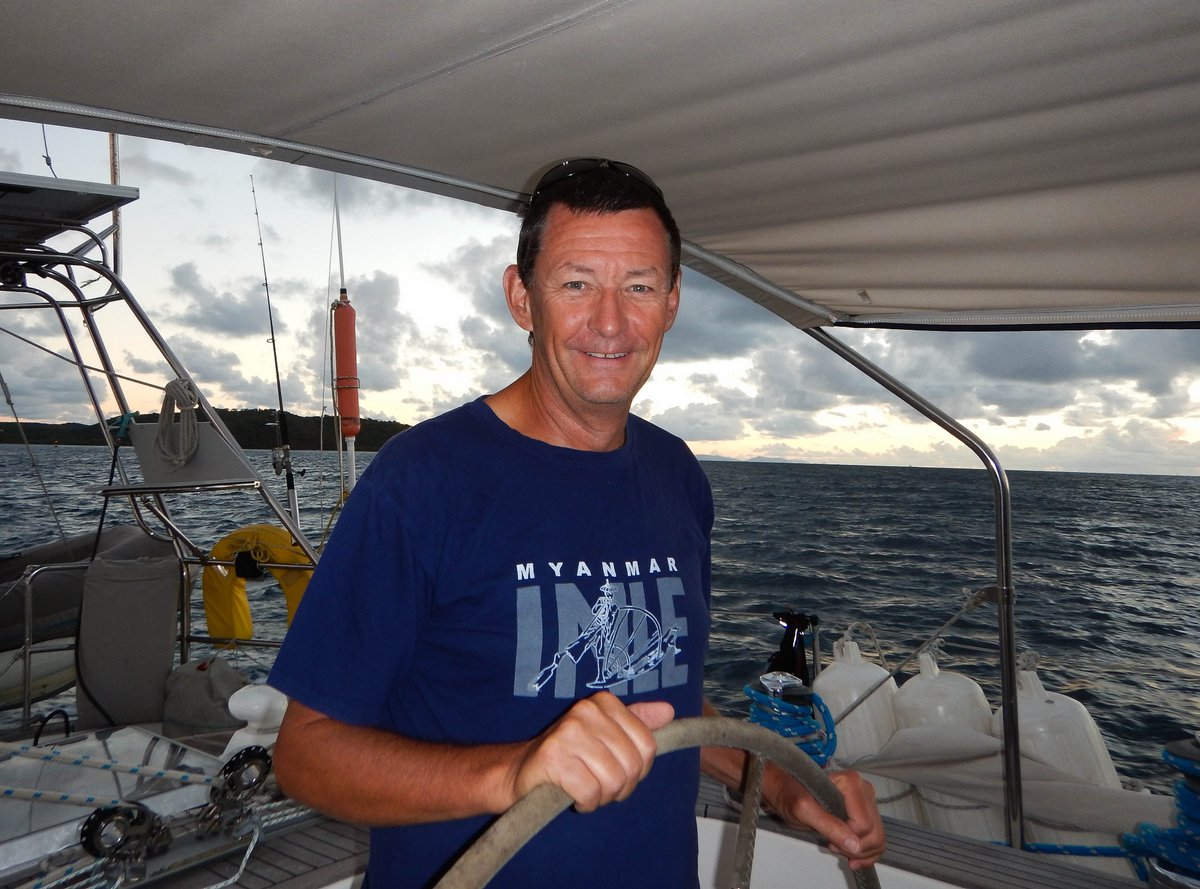
The alarm went off at 06:00, at which time it was surprisingly dark – there wasn’t enough light to leave until about 06:40. The wind was directly behind us at only 10 knots true and I was too lazy to put up the spinnaker pole, so we motor-sailed for the first 3½ hours. At around 10:00, we rounded a large shallow spit and went onto a broad reach, which increased the apparent wind and allowed us to turn off the engine.
The rest of the passage was frustrating because the wind kept backing and making the genoa collapse, but we managed to sail all the way to Puerto Patillas. We dropped the sails as we rounded the shallow reef off the headland and motored towards the anchorage.
The approach to the shallow anchorage was a little fraught because the charts showed a few shoaling patches and I couldn’t see their locations properly in the murky water. Whenever the depth dropped below 4 meters, we were very concerned. A few times, we went around in a circle while we tried to suss it out. Eventually our bottle went and we dropped the anchor at 17°58.52N 065°59.73W in 3 metres of water on good holding mud/sand.
We’re about ½ mile from land, but the bay seems to be well protected from swell running west along the coastline.
20 January 2019 Puerto Patillas to Isla Caja de Muertos, Puerto Rico
We had a pleasant night’s sleep with gentle rocking. After breakfast, we cautiously weaved our way out of the anchorage. Our waypoints were: 17°57.89N 065°59.75W; 17°58.39N 065°59.8156W; and 17°58.52N 065°59.73W. To our relief, the depth gradually increased from 3 metres at our anchorage to 6 metres and more as we left the bay.
Our plan was to sail 16 miles to Cayos De Barca and we nearly dropped the anchor at 17°55.18N 066°14.84W, but it wasn’t that attractive. There’s a series of small mangrove islands, which provide some shelter, but I was worried that a swell would hook into the anchorage and we’d be rolling when the wind dropped in the evening.
We carried on a further 18 miles to Isla Caja De Muertos and anchored at 17°53.20N 066°31.77W in 4 metres depth on white sand. The anchorage is fairly well protected, but some swell comes across a shallow reef and hooks around the headland.
21 January 2019 Isla Caja de Muertos, Puerto Rico
We rolled a fair bit over night, so we were sleeping in the recover position and had a restless night. After breakfast, we went for a stroll on the island. Isla Caja de Muertos is the number one tourist attraction in this area, so there’s an excellent gravel path leading up to an abandoned lighthouse.
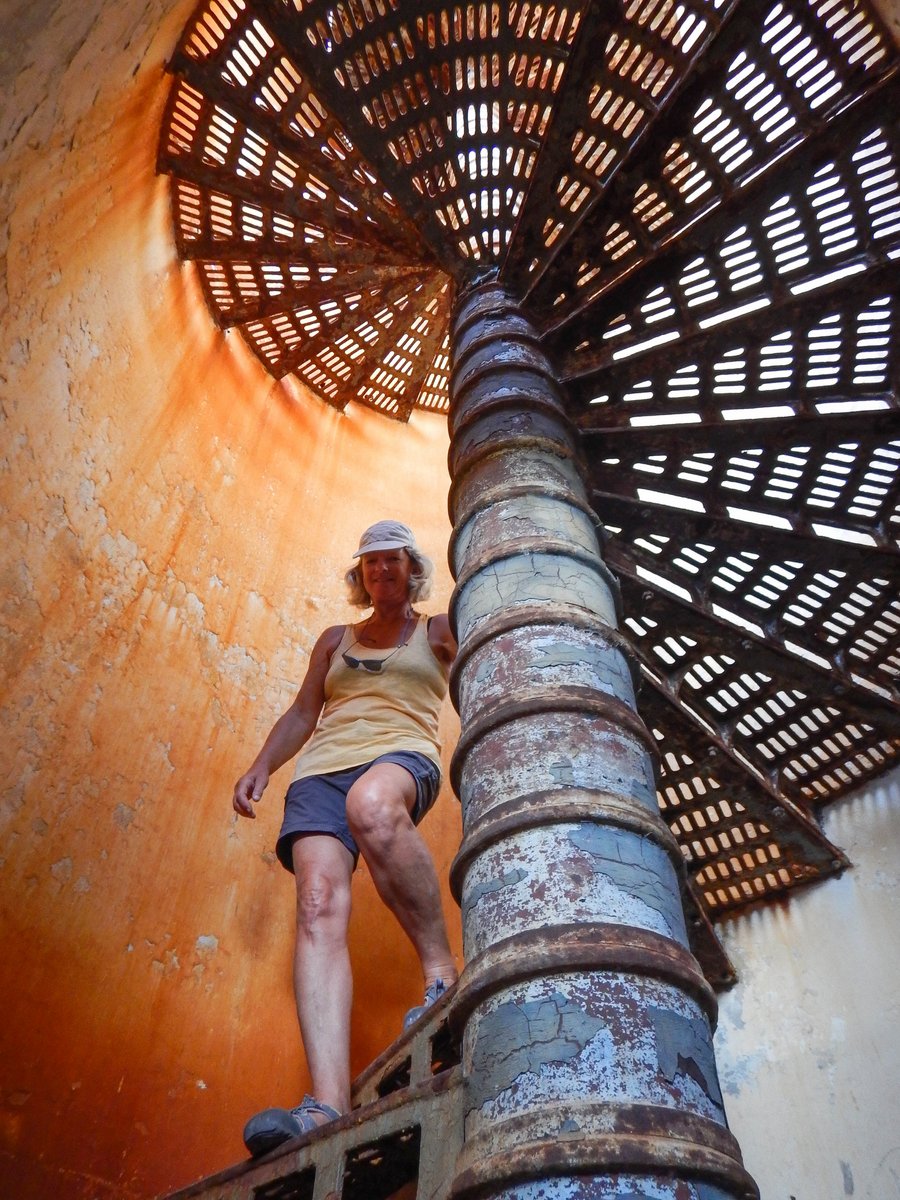
The lighthouse is all sealed up with notices forbidding entry, but someone has knocked a hole in the wall. Of course, we had to go in and climbed up the rusty spiral staircase, taking care to put our weight as close as possible to the solid edge of the steps. There’s a nice view from the top.
Back at the boat, we pulled up the anchor and moved ½ mile along the shore to get out of the swell. We anchored at 17°53.93N 066°31.36W in six metres on good holding sand and it was nice and calm. We tried to go snorkelling at the north end of the island, but there was nothing but broken coral and rock, so we gave up. I ended up spending 20 minutes scraping the propeller.
22 January 2019 Isla Caja de Muertos to Ponce, Puerto Rico
As usual in the morning, there wasn’t a lot of wind, so we had to motor across to Ponce, where we anchored in the small harbour at 17°57.95N 066°37.07W in 9 metres on good holding mud/sand. There’s a huge marina/yacht club here, which we’ve heard is expensive and unfriendly to yachties who anchor in the harbour - they used to charge $10US per day to leave your dinghy there.
I popped ashore to the marina office and, sure enough, they were very stuffy, saying that we couldn’t leave our dinghies there; we couldn’t use their laundry facilities; and they won’t even let us go to their bar restaurant for a beer or a meal in the evening. Their one concession is that we can buy fuel from their fuel dock…
After lunch, we dinghied over to the Club de Pesca in the east corner of the harbour. They have a small marina for private fishing boats and were incredibly friendly. Most of the local people predominantly speak Spanish, but we eventually found Luis who spoke very good English. He told us that it was no problem to leave our dinghy on one of their docks and gave us the telephone number of a dentist in Ponce town centre. While we were sorting ourselves out, we met Damien and Rebecca, a couple of Swiss cruisers.
The harbour is in a commercial dock area called La Guancha and there’s not a lot there apart from a row of food kiosks along the waterfront. The Ponce town centre is 5 kilometres away and I was struggling to get an internet signal to call an Uber taxi, so Luis kindly gave us and the Swiss, a lift into town, dropping us off at the dentist.
The dentist was very good and only kept Glenys waiting for ten minutes, before taking an x-ray and sorting out the problem. Part of her tooth had pulled away with the filling and there was some decay, so he drilled it out and put in an amalgam filling which he said would be less prone to come out than a modern hard white filling.
We went looking for a laundry, which was supposed to be opposite the post office, but we couldn’t find anything. Like most town centres in the 1st world countries, the building of big shopping malls, has forced the shops out of business and there are lots of closed shops amongst the colonial architecture.
We met up with Damien and Rebecca, who shared an Uber with us back to the port - they came on-board Alba for a few beers.
23 January 2019 Ponce, Puerto Rico
A few months ago, I fitted a brand new Volvo water pump onto our engine, but unfortunately, the damn thing started to leak a couple of weeks ago. We’re now in a very secure anchorage, near a large city where I can get mechanical assistance if required, so I reluctantly removed the pump and stripped it down to replace the seal.
It’s a scary job, requiring the shaft to be pushed out of the housing. There are two bearings in the pump and one of them was very rusty and needed to be replaced. The bearing is pressed into a 30mm deep bore, so I used a hammer and a punch to try to knock it out. There’s only a 1mm wide lip that is accessible, so it took me ten minutes of hammering to move the bearing about 10 mm.
Then the middle fell out of the bearing, leaving a steel ring inside the pump bore. I couldn’t get access to knock the ring out, so I started to despair. Eventually, I made a small puller bar by cutting up a large washer, so that it just fit inside the bore. Using a bolt and other backing washers, I was able to fit the puller bar behind the bearing ring and by tightening a nut on the bolt I was able to pull the bearing ring out of the bore – phew!
After that it was a fairly simple job of rebuilding the pump with a new bearing and seal. While I was at it, I changed the pump impellor. The whole job took six hours, so I’m hoping that I won’t have to do it again – ever!
24 January 2019 Ponce, Puerto Rico
Glenys dragged me off into Ponce Town to be a tourist. An Uber taxi dropped us off at the Museo Castillo Serrallés, which is the number three tourist attraction in Ponce. It’s an old colonial house owned by the Serrallés family, who built a Cane sugar empire in the 1800s. The house was built in the 1930’s and is built on a hill with a fabulous view over the city.
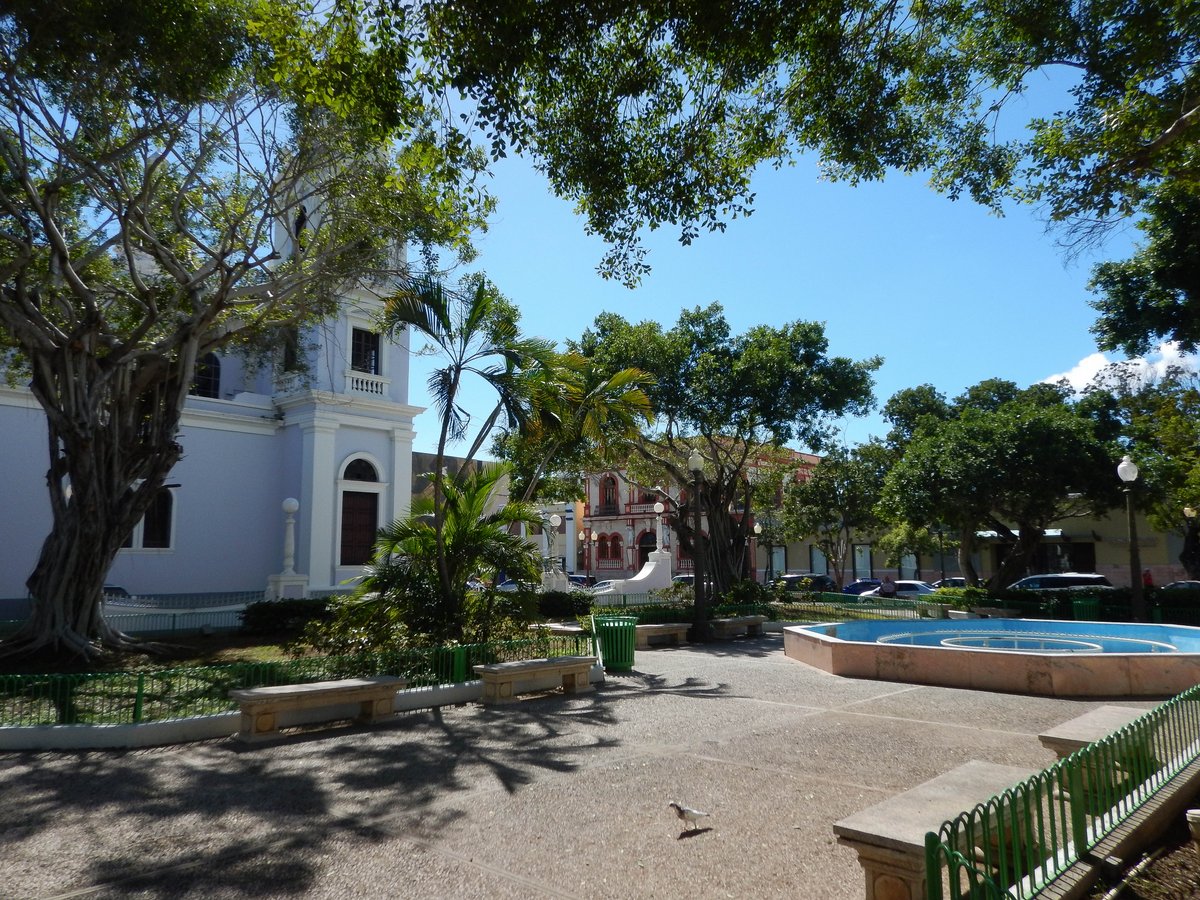
We paid for an hour long tour, which was interesting, but a bit rushed with a guide who spoke English four times faster than I could ever do. After a tot of rum, we climbed a 50 metre high cross – 102 steps and had another view of the city. The grounds also contains a Japanese Garden, which is about the size of three tennis courts; and the formal gardens of the house, which were okay.
The property also has a small butterfly house, with several species of butterflies. The highlight of the visit was the endearing old man who gathers the caterpillars and raises them to butterflies in plastic cups. Despite not speaking any English, he was able to show us the process of hatching the butterflies. It was a pleasant couple of hours and, even better, we obtained old-age pensioner tickets, so the whole thing wasn’t too expensive at $6 US each.
The taxi driver and a guard at the Castillo had told us that the area around the Castillo was very dangerous, but we ignored them and had a nice one kilometre stroll back into town. The dogs in the posh houses at the top of the street were scary, so we armed ourselves with a couple of stout sticks. The neighbourhood at the bottom of the hill looked very suspect, but everyone we met was polite and smiled when we said “Ola”.
Back in the safety of the town centre, Glenys took us to a small local restaurant called “El Barril de la Mulata”. It’s a little rough and ready, but was full of locals enjoying lunch. There were four options, which we ordered at the bar ($5US each) and then grabbed a table. The meals were huge – chicken for me and beef for Glenys accompanied by rice, beans, plantains, etc. We were stuffed - when will we learn to share a meal?
We waddled to a supermarket a few blocks from the central square and did a two-trolley shop. Our plan is to sail to the Bahamas at the end of next week, so we’ve stocked up here thinking that getting provisions in Boqueron (our departure port) will be more challenging. We caught an Uber back to Alba and collapsed. In the evening, we were treated to some of the famous Puerto Rico ear-drum-bursting music, which carried on into the small hours.
25 January 2019 Ponce to La Parguera, Puerto Rico
At 09:00, we pulled up the anchor and went alongside the fuel dock, only to find that it was all closed up. I walked to the marina office and was told that the pump attendant was on his breakfast break and would be with us in 20 minutes. After 40 minutes, there was no sign of him, so I went back to the office where they called him on the VHF and told him to get back to work.
He’d obviously been chilling out with his mates and was incredibly surly when he shuffled back ten minutes later. I was fuming by this time, but there was no point in ranting and raving because he didn’t speak English and would probably refuse to serve me. Thankfully, we were out of there by 10:00.
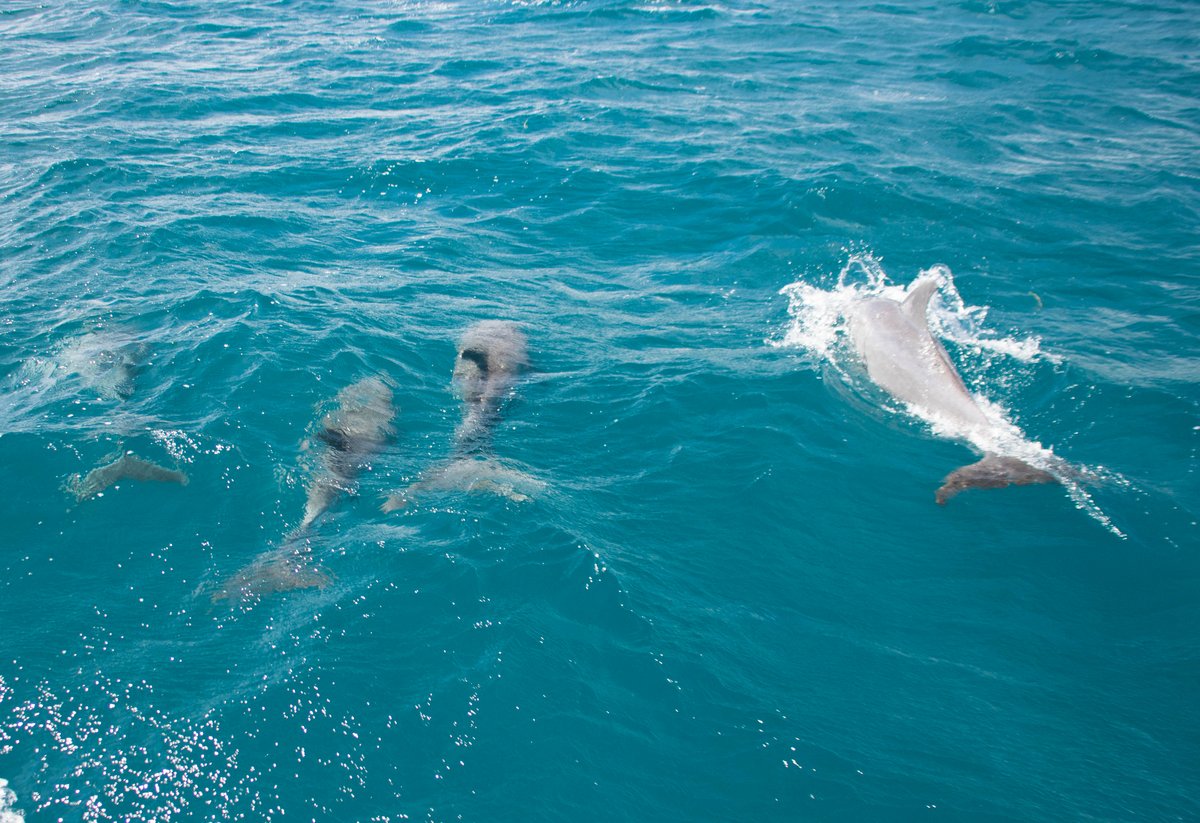
As usual, there wasn’t a lot of wind, so we motored for the first two hours rolling in the five foot seas. The wind picked up at lunchtime and we had a pleasant sail for the remaining three hours – made even better by a pod of Bottle-nose Dolphins, who joined us for fifteen minutes.
We negotiated the narrow channel into the shelter of the tiny islands of La Parguera and anchored at 17°58.06N 067°02.38W in 6 metres depth on good holding sand. We’re tucked behind a small island with roosting Pelicans an Frigate birds– it’s a nice anchorage, hopefully far enough away from the Friday night revelry.
26 January 2019 La Parguera, Puerto Rico
Surprisingly, there wasn’t any loud music last night and we slept well. Mid-morning, we grabbed our snorkelling gear and took the dinghy over to a reef called “El Mario” where there are three moorings. Unfortunately, the visibility was about 3 metres, so that dashed our intentions of doing a scuba dive in the afternoon.
There wasn’t a lot to see apart from soft corals sweeping majestically in the strong surge, so we ran away after 20 minutes. On the way back, we stopped off to have a look at Cayo Caracoles, where we could see about 20 boats on moorings. The locals seem to love the place, but there didn’t seem much special – a scrubby mangrove island with lots of moorings on a patch of white sand. I guess that it popular because it’s sheltered in the lee of the island and only a mile from town.
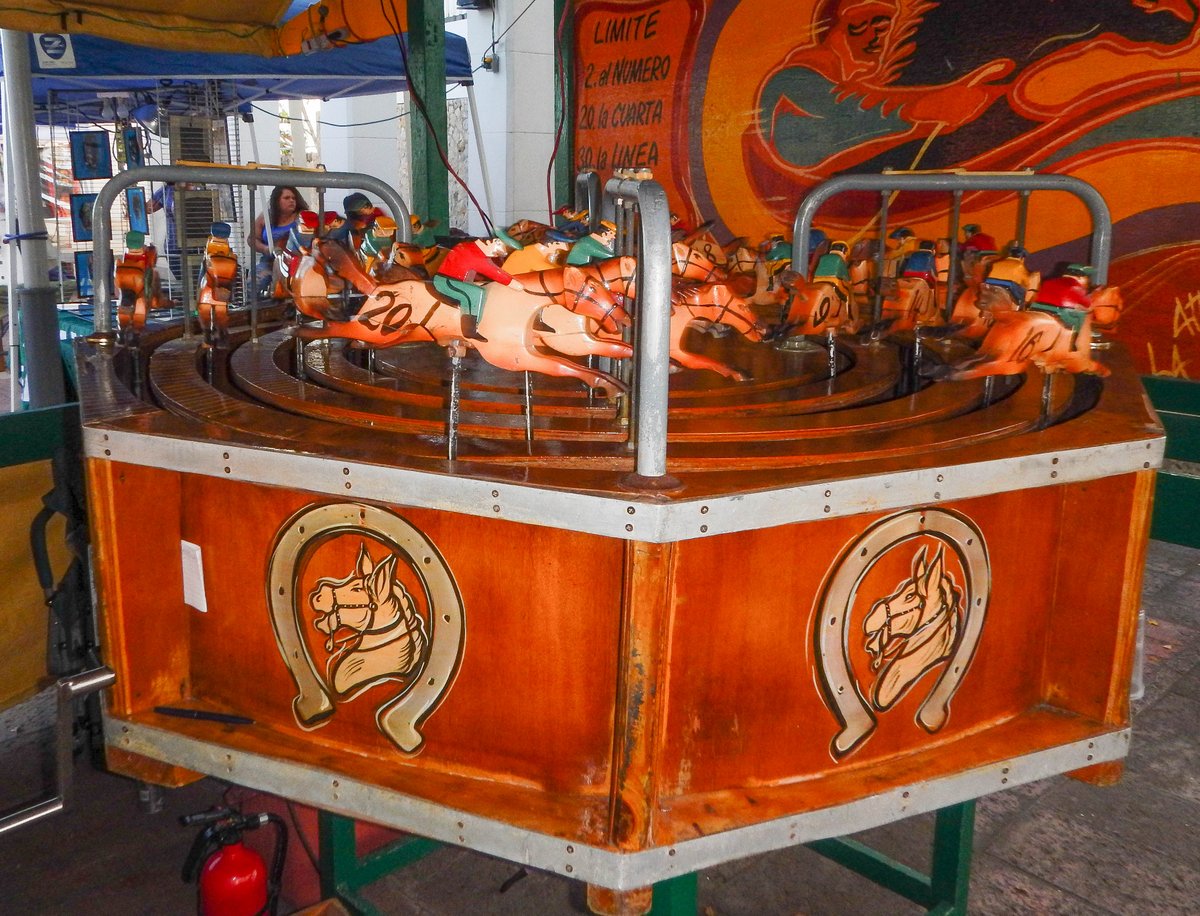
Later in the afternoon, we went to have a look at the nearby Yacht Club marina, but it’s all private berths with no place to leave a dinghy. There’s a restaurant on the shore, but nowhere that we could tie up. Just past the marina, we found a small dock with about ten boats tied up. I chatted to the owner and he’s quite happy for us to leave our dinghy there. Even better, he says there’s a launderette across the road.
We carried on towards town, passing small wooden houses packed along the shore line – every single foot of the waterfront is private. It’s the same in town – there’s no public dock. We chatted to a local on a moored yacht and he suggested that we continue along to a small fishing boat marina, where he thought we’d be able to leave our dinghy. As we headed there, a local guy, Juan called us over from a house on the waterfront and let us tie up to his dock.
It was only a few hundred yards to the town square, which is very touristic with bars, restaurants and touts trying to sell boat trips. We found a dive centre and found out that a two tank dive cast $125 US – no thank you… There’s a small well-stocked supermarket and a bakery up a side street. After 15 minutes, we’d seen enough, so we wandered back to Juan’s house, where he kindly gave us a glass of wine, while we had a chat.
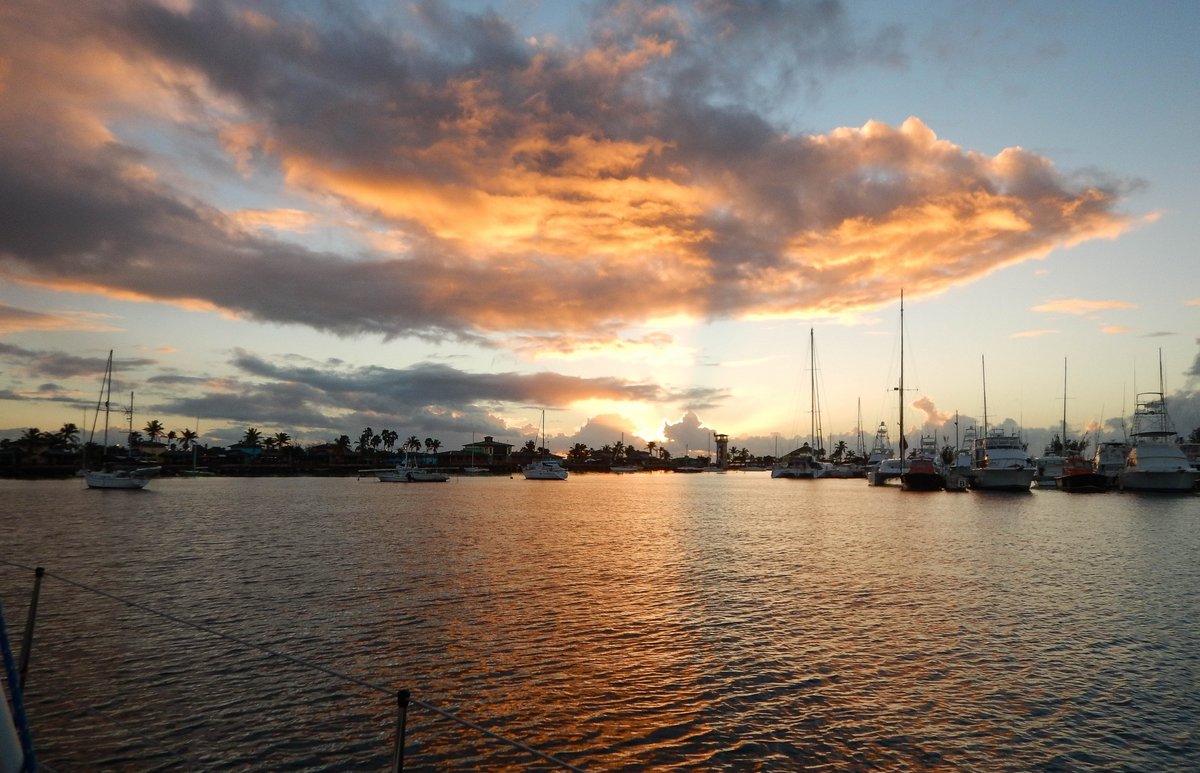
We were back on the boat in time to see the sunset and then had a quiet night in.
27 January 2019 La Parguera, Puerto Rico
After breakfast, I set up our satellite phone so that we can receive emails while at sea an in remote places. I’ve just bought 75 minutes of Iridium airtime which only lasts for one month and costs a staggering £180. I’ve also had to buy a 6 month subscription for Mailasail email compression service, which cost another £90. I’m treating it as a £270 insurance policy…
Mid-morning, we went ashore and made use of the launderette. It’s in a private compound opposite a small marine store. The place is very run down, but we found two machines that worked and for only $2US per wash it was a bargain.
28 January 2019 La Parguera to Boqueron, Puerto Rico
Weather looks good to go to the Bahamas on Thursday 31st. It’s a passage of 450 miles to Mayaguana, so if we leave on Thursday, we should get there on Sunday late afternoon or possibly Monday morning. There’s a cold front stalled over the Bahamas, which stretches down to Mayaguana, but it’s expected to dissipate on Saturday 2nd. After the front clears, there should be a week until the next front comes down off the East Coast of the USA.
I rang the Border Protection Agency and told them that we will leave on Thursday. They said that they could send us a clearance by email, which is good of them. The clearance is only valid for 48 hours and officially they shouldn’t issue it until tomorrow, but the officer said “What the hell” and we received it within the next hour.
We left the anchorage at 10:00 and had a lovely downwind sail to Boqueron using just the genoa in the steady 20 knots winds. Just after lunch, we rounded Cabo Roca and 90 minutes later, arrived in Boqueron. It’s a very shallow bay and our Navionics charts showed some isolated rocks, close to the beach, so we bottled out and anchored at 18°01.39N 067°10.64W in 5 metres of water on mud/sand.
We decided to leave the excitement of going ashore until tomorrow and had a quiet afternoon on board.
29 January 2019 Boqueron, Puerto Rico
We went for a walk around town, which didn’t take long. The main street along the waterfront is lined with restaurants, bars and food stalls – this is tourist town. We were told that the nearest supermarket is 4 miles away, but we found a mini-mart where we were able to buy some essentials – eggs, beer and bread.
After a short walk along the pleasant beach, we were back aboard Alba for lunch and had another quiet afternoon, mentally preparing ourselves for a four day passage. I checked the tension on our steering cables and gave the engine a good inspection.
30 January 2019 Boqueron, Puerto Rico
The weather forecast looks good to sail to the Bahamas tomorrow. The front is still forecast to dissipate from Saturday 2nd, so we’re hoping to have light winds and good weather for our arrival on Sunday. The pay-as-you-go contract on our phone runs out tonight, so we’ll have to hope that today’s forecast is accurate.
With nothing to do in town, we had a quiet day on board, running the watermaker and preparing for the four day passage. I put the dinghy on deck in the afternoon and we were all ready to go.
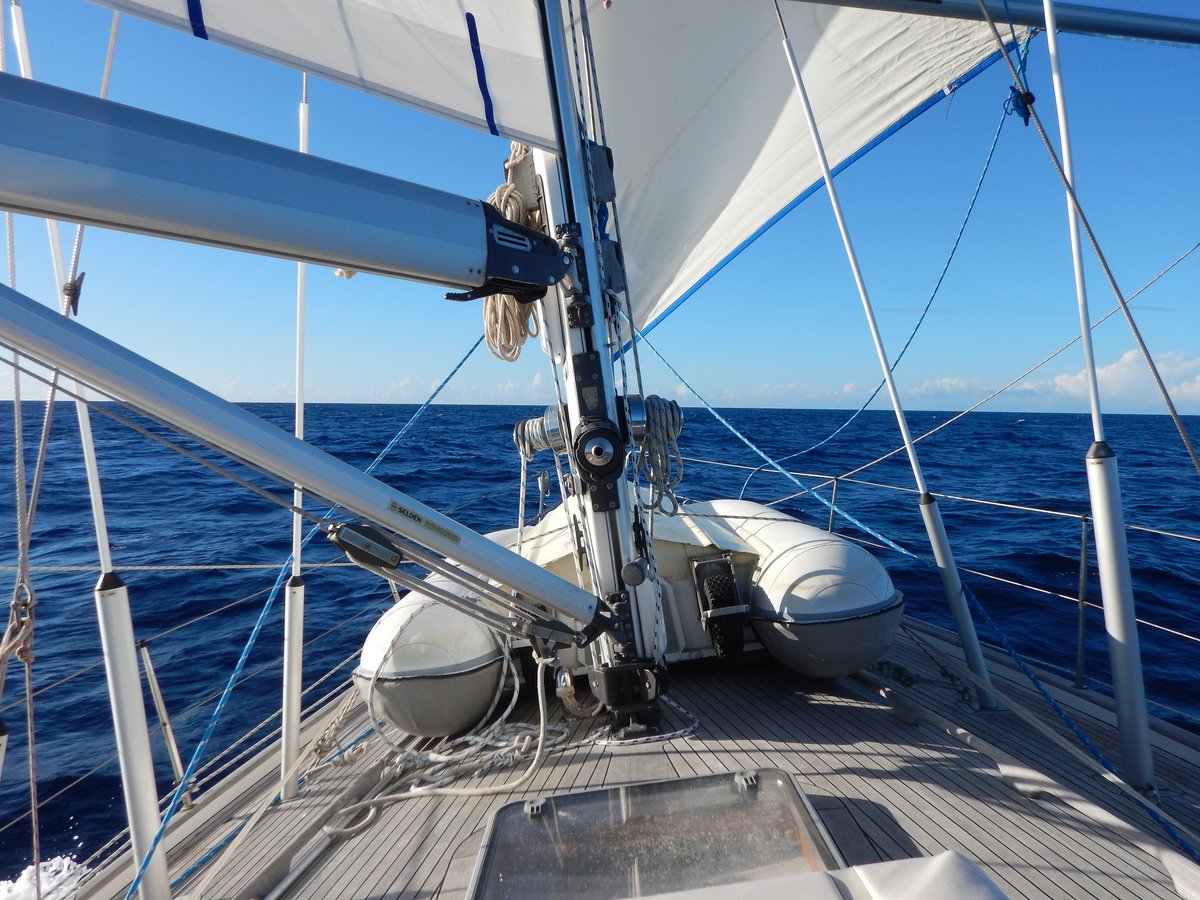
31 January 2019 Boqueron to Mayaguana, Bahamas (Day 1)
The alarm went off before dawn and we were underway at 07:00. There was no wind at all, so we motored north, hugging the coast until we’d worked our way through the shallow reef that stretches a few miles out to sea off the town of Mayaguez. The wind was fluky until 14:00, by which time we had cleared the north-west corner of Puerto Rico and had lost the land effect.
The skies were overcast, with showers passing through, which brought very variable winds veering from East to North-east and varying in strength from 10 knots to 25 knots. To make matters worse the sea was 4-6 feet high and very confused. It was hard work all afternoon, having to reef a fair few times.
As darkness fell, the skies remained overcast with a 12 knot wind from the north-east, putting us close-hauled with the wind 60 degrees off the starboard bow. We had two reefs in the main with full genoa and staysail and waited with some trepidation for what the night might bring.
Despite there being no moon, it turned out to be a pleasant night. The clouds slowly cleared and by midnight, we had an impressive display of stars. The wind slowly veered until it was 120 degrees on the starboard side, so we were able to pole the genoa out to starboard and gently roll downwind.