1 January 1996 Isla Cochinos, Honduras
We had a lie in until half past nine. It’s the first day of a new year and as usual we’ve got hangovers. We took the boat over to check the other anchorages for somewhere a little more protected from the SE wind. The whole island group is a National Park and anchoring is forbidden anywhere. We found moorings by Cochinos Pequeno, but they were in a worse place. We looked at the other Cays which looked gorgeous, but no bloody moorings. Very frustrating! We ended up back at Cochinos Grande.
After lunch, we went ashore and walked along a trail to the lighthouse on the top of the island. The resort’s dog “Nikey” came along to guide us. It was a nice 30 minute walk up to the lighthouse, but unfortunately we couldn’t see any view through the rain forest trees. We walked back down and went for a snorkel. Well, Brett, Glenys and I did – it’s really hard to get Craig to come snorkelling with us.
At about six o’clock, just after the sun went down, Harry who is looking after “Our House” called across and said that he was going over to Cochinos Pequeno because the wind was NW15. Three nights ago, he was trapped in this anchorage with wicked NW waves. We were a bit apprehensive before he called and were worried after he left. We decided to stick it out. We had a New Year chicken dinner with Christmas pudding which was great. By the time we went to bed, the wind was down to 10 knots and had backed to the west, thank goodness!

2 January 1996 Isla Cochinos to French Harbour, Roatan
We had a very peaceful night. There wasn’t a breath of wind and we had blue skies as we motored across to Roatan. There was a big 2 metre swell from the east. The strong cold front is still expected in the Yucatan Peninsula tonight and will affect us tomorrow, so we want to be somewhere a little more protected than the Cochinos.
All the same yachts were in the anchorage at French Harbour. Glenys and I went for a dive, which was spectacular. The visibility was wonderful and the scenery is very alpine with vertical cliffs and sand gullies filled with white sand. As I swim off the edge of the vertical cliffs, it makes me want to go skydiving. We had a quiet evening in the very peaceful, protected anchorage.
3 January 1996 French Harbour, Roatan
We were woken at three o’clock in the morning by a banging noise. I went up on deck to discover that the boat in front of us had swung very close to us and the guy was banging on our pulpit. He had 40 metres of rope out compared to my 25 metres of chain and consequently had an incredible turning circle and was wandering about the anchorage (bloody Americans on their pieces of string.)
We were the last to anchor, so I said that we would move. I went to start our engine, but it wouldn’t start! I guessed that there must be air in the fuel system so I set about bleeding it – not the nicest thing to do at three o’clock in the morning! It took me 10 minutes, by which time the other boat had decided to re-anchor. We went back to bed, but the boys were wide awake and Craig kept padding into our cabin and telling us that he couldn’t sleep.
At half past six, I had to get up to listen to the weather – this two hour time difference with the West Indies is a pain in the neck. I learned that the cold front was still heading our way. At eight o’clock, the cold front hit with torrential rain and 30 knot winds. Boats were dragging all around us, but we were OK. I felt fairly smug that I had bothered to drop the anchor in a sandy patch clear of the thick weed that covers the rest of the anchorage.
We filled our water tanks with rain water. We did school work and then had a quiet afternoon. Barry and Carol from “Pipe Dream” (Can) came for a beer. Glenys foolishly opened a 1.5 litre bottle of red wine, which we polished off between the two of us.
4 January 1996 French Harbour, Roatan
Yet Another Hangover this morning – will we ever learn? We did school work in the morning. I walked down to the fishing port to check out the fuel dock. They didn’t have any diesel - what sort of fuel dock is that? However, they did point me over to the west end of the fishing port. I went back to the boat and we had a quiet evening.
5 January 1996 French Harbour, Roatan
Went round to the fishing port to get fuel. It took us a while to find the fuel dock. We motored back to the anchorage and I went straight into Coxen’s Hole to clear out. It cost me $40US to clear out – what a rip off! I had lunch in a small café with Earle and Kandy from “Sticky Bunz”. A bit of an odd couple – well she is anyway. (Kandy was the person who annoyed me on Christmas Day). I went back to Glencora and played the clarinet while Glenys took the boys to the supermarket.
In the evening, we went to the Yacht Club for a Mexican buffet, which was good food for only $7US a head. Most of the other cruising folk were there which was fun. The Californians did nothing but winge that the Mexican food wasn’t authentic! We enjoyed it anyway.
6 January 1996 French Harbour to Utila, Honduras
Up early and set off for Utila. There is another front due tomorrow night, so we decided that we’d better leave today or we might get trapped in French Harbour for another 3 or 4 days. It was a very bouncy beam reach with 25 knot winds and 2-3 metre seas. As we approached the island, I was beginning to doubt that we would be able to get into the anchorage through the reef. In the event, it was very straightforward and we anchored off a hotel called Utila Lodge. The anchorage is nice and big, but the town’s electricity generator is incredibly noisy.
We went ashore and were collared by Harry from “Our House” who insisted on introducing us to the owners of the Dive Lodge. We walked along the main street to the airport. There are 15 dive centres and about 100 instructors working on this tiny island. The dive centres pay commission of $30/person/OW Course and $3/person/dive. A lot of the business comes from backpackers who come over from the mainland. It’s $5/night for a room and an OW course is only $150. Two tank dives only cost $30! There are loads of scruffy, young, fit instructors wandering about and they sell dive courses like people sell timeshare in Tenerife – they meet people at the airport or the ferry and try to persuade them to do a course. It’s fascinating to watch.
7 January 1996 Utila, Honduras
The wind is from the SW this morning, bringing a bit of a chop into the bay. The wind will probably swing to the NW as the front comes through tonight, so we decided to hang on where we are. We did school work in the morning which took us up to half past one - we needed to do a lesson and a review ready for a test tomorrow. A pod of dolphins came into the anchorage, so I went in the water to swim with them, but they didn’t want to play.
The wind was from the west by lunchtime and we had a pleasant afternoon on the boat with 8/8 cloud cover but no rain. After night fell, the first squall hit us with 25+ knot winds and lashing rain. We had a very disturbed night with up to 35 knot gusts and lots of rain. The air temperature dropped dramatically (down to 75°F) and we had to huddle together in bed under our thin sheet – it’s a long time since we had to do that! Miserable night – I must have got out of bed about 10 times. This front apparently dropped a huge amount of snow on Washington DC and shut it down for 24 hours!
8 January 1996 Utila, Honduras
Miserable morning – cold, NNW wind 20 knots, 8/8 cloud cover and occasionally drizzle. The forecast is for this front to head quickly SE to Porto Rico, so hopefully it will start clearing up soon. Brett came in at nine o’clock and asked if he could start his test. He knows that he’s got a lot of work to do and wants to finish it today. The boys both did well in their tests and we went out in the afternoon to watch “Amadeus”. I enjoyed it but the boys were confused by it and it went on too long. We had a peaceful, if cold night (with a blanket!)
9 January 1996 Utila, Honduras
Overcast morning with NW10 winds. Still cold. We did school work and then Glenys and I went for a dive which was OK, but bloody freezing on the way back. I filled 3 tanks. We are wandering around in sweaters and long trousers because it’s so cold. I can’t believe the difference in weather between here and the West Indies. The sky looked clear to the west, so in anticipation of leaving tomorrow, we went out for a pizza and spent our last Lempira.
10 January 1996 Utila, Honduras
During the night the wind came from the SW. Not very strong but enough to cause an unpleasant chop in the bay, making us pitch all night. By morning, it was overcast low cloud, with a depressing constant drizzle. It was cold and we lounged in bed, under the blanket until half past nine. When I say cold, it’s actually 74°F inside the boat but 65°F out on deck. We have definitely acclimatised to 80°F weather and are going to die back in England. To add to all this we had to do school work.
The pitching was getting really bad by lunch time, so we ate the remains of last night’s pizza and went ashore to go to the movies. They were showing Part 2 of Pride and Prejudice so we decided to skip that! Instead we went for a walk up some very muddy paths until the mosquitoes drove us back. We met Barry and Carol from “Pipe Dream” in town and we went back to the Utila Lodge for a beer, watching Glencora pitching like mad. We went back, had dinner and snuggled down into our duvet. The boys hid in their sleeping bags.
11 January 1996 Utila, Honduras
Nice morning. There is another cold front expected late tomorrow, so we abandoned the idea of sailing to Guatemala tonight.
We are starting to get very nervous about the entrance to the Rio Dulce. There’s a sand bar which guards the approach to Livingston. It’s about a mile wide and is very shallow with some parts drying out. There’s a dredged channel from a seaward buoy on a bearing of 225° True, but there are no buoys marking the actual channel. It’s supposed to be dredged to 6’0” at low tide with high tide adding an additional 12 inches. I reckon that we draw about 6’7” now that we are fully loaded with gear, so if we go in at high tide then we will have 5 inches of water beneath our keel for half a mile - that means 20 minutes of total fear that we will go aground.
To make things worse, we listened to the NW Caribbean Cruisers Net at eight o’clock on 4054 kHz and heard a conversation about a yacht with a 7ft draft that was dragged over the bar at Livingston by his spinnaker halyard – that doesn’t sound too good for the rigging! (I found out later that it was “Cortica”. )
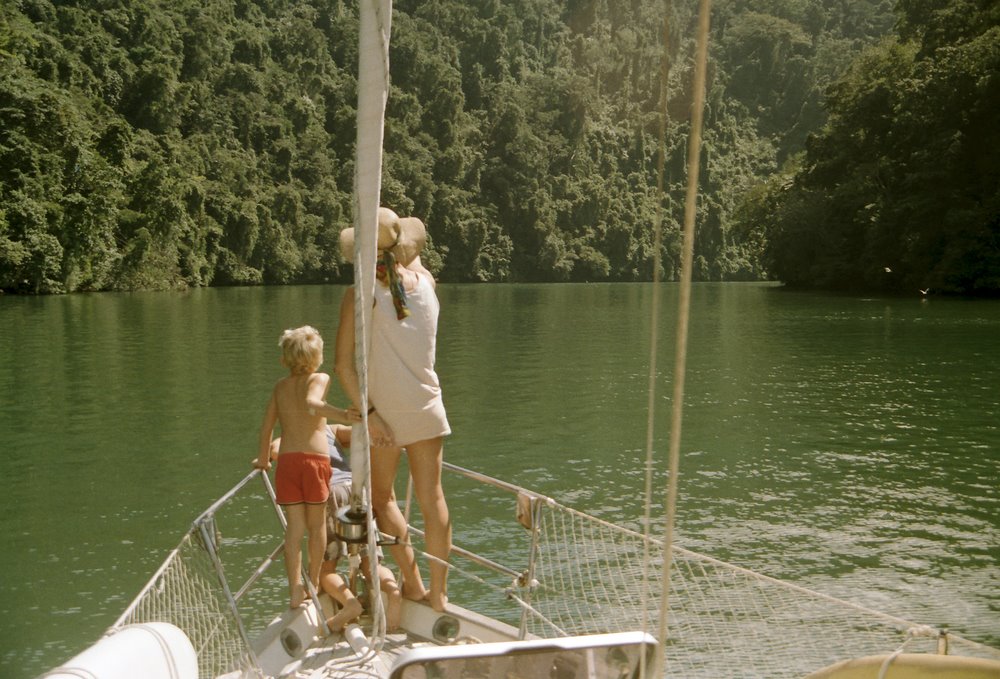
We decided that we would still give it a go and if we can’t make it then we’ll go to Belize! I sent some faxes off to our accountant and Carol, because we’ll be here until this next front goes through. We motored to the SW end of the island to the Water Cays and anchored in a beautiful spot between two small cays. I tried to go spear fishing, but the reef is devoid of fish and the coral is 80% dead. I managed to catch a spider crab, but there wasn’t much meat on it – only in the legs and claws. We had a very pleasant day out (it felt like a holiday) and then returned to Puerto Este to wait for the next front.
12 January 1996 Utila, Honduras
A bad hangover this morning. Glenys, at my suggestion, opened a second bottle of wine last night ...
The weather was pretty awful with a SW10 causing a nasty swell in the anchorage (again!). I couldn’t stand the motion so, at about ten o’clock, I went ashore for a walk. I rescued the others at half past eleven and we went to the Movie Café for lunch and watched “You Only Live Twice”. By the time we got back to Glencora it was blue skies and NW10 winds. We had a quiet evening and then the front arrived at midnight with mild NW 15-20 winds and the odd bit of rain.
13 January 1996 Utila, Honduras
An overcast morning with NW10 winds. It would appear that the front has gone over and we might have 2-3 days to get to Guatemala. We did school work in the morning. After lunch, I took the boys out for a walk and spent the last of our Lempira (again!). Glenys stayed aboard and wrapped Brett’s birthday presents.
When we returned to the boat, I decided to go spear fishing (mostly because Glenys was threatening to make bean enchiladas again and I don’t think that my bowels can take it!) I managed to spear a big Hog fish which was very tasty. I’ve been a lazy slob for the last couple of days – it’s been a combination of the bad weather, the rough anchorage, the trapped feeling and the fact that I’m reading a book that I want to finish. Glenys has been getting annoyed at me today.
The sky cleared at dusk and we had a beautiful, clear, starry evening. Looks good for going to Guatemala tomorrow. I went to bed worrying how to tackle the sand bar at Livingston.
14 January 1996 Utila to Livingston, Guatemala (Day 1)
Bloody awful weather – overcast SW10 wind and drizzle. God knows what this weather is – it should be a nice day with NE winds. After an hour of agonising, we decided to go anyway. As they say, time and tide waits for no man and the high tide into the Rio Dulce is at twenty past three tomorrow afternoon – a good time for us.
I went over to chat to “Helles Belles” (USA) who we last saw in Hog Island at the beginning of March ’94! We took the dinghy down and got ready to sail overnight (all in a steady drizzle). We were finished by mid morning and motored out of Utila straight into a light SW wind. There was a bright line on the west horizon which gave us some hope of better weather.
Its Brett’s birthday today, so we had the present opening first thing this morning and the birthday cake when we were underway. The sun came out at about two o’clock until half past four when I brilliantly decided to take down the awning and put up the main sail – it then rained for an hour. The night was clear with light winds so we had to motor all the way. It was pretty cold, so it was a matter of full foul weather gear including socks and wellies!
15 January 1996 Utila to Livingston, Guatemala (Day 2)
We timed the passage perfectly and arrived off Cabo Tres Puntas at day break. We motored the last 10 miles and anchored off the entrance buoy. We had been following another boat all night which turned out to be “Pipe Dream”.
While we were approaching the buoy, I listened to the Rio Dulce Net on 68 and asked for help on the location of the bar. I just got a few smart arse cracks like “go slow” and “watch the ferries”. I called Barry on “Pipe Dream” on CH68, which is the local hailing frequency, and made some suitably sarcastic comments myself. Immediately after I stopped talking to Barry, “Katie G-2” called me up and gave me some GPS coordinates. Outer 15° 49.97N 88° 43.95W, inner 15° 49.26N 88° 44.78W. This track is 200 yards NW of the buoy to a pink roofed house on a bearing 225°M.
I hitched a lift on “Pipe Dream” and went in with them. They draw only 5ft and I wanted to see how their depth gauge changed as they went in. Unfortunately, their depth gauge stopped working half way in, probably because of silt in the water. It wasn’t a totally wasted trip, because I went over to another boat which had just gone in (on 0.1 metre low tide) and had registered a minimum depth of 6½ ft.
We had to wait until one o’clock for ¾ rising tide. “Kalida” arrived at half past twelve and bravely decided to go straight in with their 6’2” draft. They tried to find a way through for about an hour, but couldn’t find a way in and went aground at least 10 times. At one o’clock, “Boo” with Neil and Chris turned up and anchored next to us. They have a 6’6” draft - we discussed the problem and I gave them the GPS coordinates.
At half past one, we couldn’t stand the suspense any longer. I steered the boat and Glenys stood down below calling out the GPS cross track error and course over the ground. It took us 25 minutes of high stress and worry to get through. About 20% of the time the depth gauge was registering 6.4 ft – 6.6 ft and I’m sure that I ploughed a fair furrow in the mud. I must admit to an immense feeling of euphoria (and release of tension) when we got through – it was like winning a competition. Me against the elements!
“Boo” and “Kalida” followed us about 10 minutes later. We anchored and waited for the officials to arrive. It was quite amusing. The Port Capitan, the Customs, the Immigration, the Health Officer and the Police arrived in a pirogue and came on board. To my amazement, they immediately went below and arranged themselves around our saloon table. They filled in forms and took our passports ashore. An hour later, we had to go ashore and collect our passports from Immigration, a zarpe from the Customs and a clearance from the Port Captain. Total cost 330 questals (£39). The Port Captain had a dead iguana tied onto a branch, drying out in the sun – weird!
We bought some training shoes for the boys and had a stroll around town. A pleasant little town with an amazing number of cafes and restaurants – for tourists I assume.
16 January 1996 Livingston to Cayo Grande, Guatemala
Glenys nipped ashore after breakfast. I dropped her off because we had a bit of hassle from people wanting a tip for looking after our dinghy. We didn’t give them one! I put 23 litres of diesel in the tank from a jerry can.
We were all excited as we motored into the steep sided river gorge. We had a fantastic trip – lush green jungle with snowy egrets, pelicans and cormorants fishing around us. There were locals paddling by in their dug out canoes, hugging the shore to stay out of the current. At the first major bend in the river, about 10 small fishing boats were laying nets across the current, beneath towering vertical cliffs of nearly white rock. Flocks of pelicans crowded around the boats as the fishermen pulled up the nets.
On the next bend of the river, visitors have painted and carved their names and dates onto the rock faces which come down to the water. I find this really irritating – it’s just graffiti. Cruisers seem to like doing this in places like Porto Santo, Funchal and Los Testigos. As we looked at this desecration, the engine stopped...
Oh my God! It started again immediately, but a quick check of the gauges showed that the engine had overheated. We dumped the anchor down in 4 metres of water on the inside of the bend. Fortunately, “Boo” were only about 200 metres upstream and I managed to attract their attention. They very kindly towed us down to Rio Tatin where we anchored.
I spent an hour panicking, refilling the fresh water system and waiting for the engine to cool down. The sea water pump is working OK because we are still getting water out of the exhaust. The fresh water system appears to be the problem – when I fill the system up, a dribble of water comes out of the heat exchanger overflow pipe. I removed the thermostat and cleaned the radiator cap and it seemed OK. We decided to carry on to the anchorage at Cayo Grande. Everything looked good for the first two miles, but then the temperature started to creep up. We back tracked a little and anchored just as the temperature reached 90°C.
We decided to forget about the engine for today and went to visit a hot water spring about ½ mile back down river. It was really interesting to feel the very hot water just coming out of the rocks by the edge of the river. We then motored up the small river opposite the springs which is very pretty. We chatted to another yachtsman, who thought that my problem may be a blockage in the heat exchanger. Nigel Calder says in his Boat Maintenance book that “scale in engines caused by sea water can swell when coming in contact with fresh water”, this simple comment makes me think that the heat exchanger is blocked – perhaps it has something to do with the fresh water going through the system. We had a lovely quiet evening with the sound of frogs, crickets and other jungle creatures around us.
17 January 1996 Cayo Grande to Rio Chacon Machaca, Guatemala
We awoke this morning to a beautifully calm anchorage with blue skies overhead and mist shrouded jungle all around. At half past seven, I turned on the Local Cruisers Net – all Americans of course. They have a string of adverts for the local marinas, then an “open forum” for info, gear sales and then ….. I couldn’t believe it …….. they actually have a trivia quiz! One of the marinas even has aerobic classes after breakfast – they all sound very settled down here.
I had a look at the engine cooling system. I took off various parts of the salt water system before and after the heat exchanger to check for scale – nothing major. I had a quick look at the heat exchanger bores – look OK. I put it all back together again and we motored to the West of Cayo Grande and anchored by “Kalida”. Derek came and had a look at the engine and the only thing he could think of was that the fan belt was a bit loose. I changed the fan belt and put the thermostat back in, and all seemed to be OK.
We dinghied over to the Manatee Conservation Centre and went on their pretty nature trail. On the way back we watched some Indians using a cast net from their dugout canoe. We then motored up the lake (El Golfette) to the Rio Chacon Machaca. It was fairly difficult to find the narrow river entrance and a little nerve-racking to enter. Once inside we turned left and headed down to the end where we anchored bow and stern in 2.8 metres of water. On the way down the river, Glenys and I caught a fleeting glimpse of an otter.
After we anchored, we took the dinghy out through a shallow gap, through lily pads and water hyacinths to the lake for a swim. We dinghied back through the river entrance and drifted back to the boat. We saw trees being shaken by monkeys, but couldn’t actually see them. The anchorage is so peaceful, with a pleasant breeze through the gap in the islands. We look across lily pads, with waders, moorhens and snowy egrets looking for food, to the lake with lush green mountains in the distance – you can tell I like this place!
On the way here, the engine seemed to behave itself. The temperature went up to 75°C. After about 15 minutes water started to come out of the radiator overflow pipe, but after I fiddled with the radiator cap it stopped dribbling. I now suspect the radiator cap.
18 January 1996 Rio Chacon Machaca to Mario’s Marina, Guatemala
Glenys got up very early at quarter past six and went up into the cockpit for a nature watch. She was rewarded by two sightings of a pair of otters. The wind picked up from the SW at seven o’clock and, twenty minutes later, Glenys got me out of bed because the stern anchor was dragging. I pulled it up and we swung through 180°.
I went down to check the engine. When I released the radiator cap, lots of water spurted out of the overflow pipe. I “assumed” that the water system was still full and pressurised, so I shut the cap and started the engine. The anchor was dragging, so we motored out of the river. As we got to the river entrance, the temperature was up to 80°C, by the time we were 200 metres into the lake it was 90°C, so I decided to stop the engine and we anchored.
I took off the radiator cap and got loads of steam and water gushing out. Five minutes later, I put about 6 pints of water in the heat exchanger and ran the engine for 30 seconds – the temperature came down to 70°C. I’m at a loss to know what the problem is. It would appear that the fresh water system is becoming over pressurised at some point or is the water boiling and creating steam somewhere? Could it be a leaking head gasket or a faulty water pump? Or is the radiator cap not pressurising the system enough and allowing water to boil in the engine block?
We had breakfast and prepared the boat for sailing and then had a good upwind sail towards Mario’s Marina. We made it to within a mile of the marina before we ran out of wind. We anchored off the marina and went in to have lunch and check the place out. We decided we liked it and took the yacht in. It’s a pretty marina with a TV room, a bar/restaurant, a little shop, a small pool and pleasant grounds. Barry and Daphne are an English couple who have been running the place for 8 years. Everyone we have met here has been very friendly, so we should have a good time.
I spent the afternoon checking out where everything is. Where to get gas, fuel, etc. Barry has a battery charger that I can use to keep our batteries charged which will be useful. We went out to the bar for dinner and had a good evening with “Pipe Dream”, Earle and Kandy from “Sticky Bunz” and “Boo”.
19 January 1996 Mario’s Marina, Rio Dulce, Guatemala
I woke up at six o’clock, thinking about all the things that I’ve got to sort out – engine, cooking gas, maybe a trip inland and faxing the UK to sort out my non-resident status.
Sending and receiving a fax from here is a pain. There’s a company called Riotel, who send and receive faxes via SSB to Guatemala City – there are no phones in the Rio Dulce. If a fax is not complicated then they dictate it over the SSB. Anything more complicated has to be sent from Guatemala City to here (100 miles) which can take a few days. An alternative is to go to Livingstone or a town called Morales (which is a 30 kilometre bus ride) to go to a Guatel Office.
At half past six, I suddenly realised that “Boo’s” guests were flying back to the UK today. I leapt out of bed and frantically started to write letters to our accountant, Carol and the guy who runs my offshore trust. Glenys heard me and wrote a letter to her mum. Glenys dropped the letters off at “Boo” to be told that their guests weren’t leaving until midday! Oh well! At least they will be posted in the UK in 3 days time.
I checked the sea water intake strainer and found a bit of plastic sheet and some weed – could this be it? I tied a rope from our bow to a handy tree so that I could run the engine in reverse without destroying the rather rickety dock. I ran the engine out of gear at 1400 rpm and the temperature stayed about 70°C. I then ran it at 1100 rpm in reverse and the temperature went up to 80°C and water was coming out of the radiator cap overflow. Damn!
I decided to go to Fronteras to try to find a radiator cap – no luck, but what an interesting place! The town is spread along a main road which crosses the Rio Dulce over a big bridge. There is a small vegetable market with lots of Indians wandering about – the men in jeans, cowboy boots and cowboy hats and the women in their brightly coloured, woven skirts. The main road is a hive of activity with big single-decker buses and pick-up trucks jostling for space and a way through the people and parked cars.
I went back to the marina and chatted to Keith, Tina and Tom (2) from “Gooseberry” (Can). Keith rebuilds motorbikes and cars as a hobby and kindly came over to look at our engine. He was as baffled as me and we came down to an air pocket, a faulty radiator cap and (God forbid) a blown head gasket. We retired to the bar at seven o’clock and had a fish and chip dinner there. Mickey from “Vaya Con Dios” gave me a list of causes of overheating which was nice of him.
20 January 1996 Mario’s Marina, Rio Dulce, Guatemala
Glenys did school work in the morning while I worked on the engine. I removed the thermostat and heated it up in a pan of water with a spare thermostat to check that they both work OK – they did! I put the original thermostat back with a new gasket. I removed the fresh water pump and checked it. It was fine. I removed the end caps from the heat exchanger and shone a torch through one end while I sighted down the other end – all the tubes looked clear to me.
I disconnected the domestic hot water heater pipes and removed a t-pipe so that I could re-site the temperature sensor directly in the cylinder head. I refilled the system, taking care to put a screw driver at the top of the uppermost hose to vent the system. I re-attached my rope to my handy tree and started the engine. It ran for about 5 seconds and stopped. Oh my God!
I rushed down below and turned the crankshaft pulley with a spanner. It seemed OK – at least it wasn’t seized. I suspected air in the diesel system and noticed air bubbles around the bolt head of one of the diesel fuel filters. I cracked open the bleed screws and found air. I managed to scrounge a new O-ring from Barry at the Marina Office and the engine started OK.
I ran a fairly scientific test, monitoring temperature and the amount of water coming out of the overflow pipe. I first ran the engine at 1400 rpm with no load. The temperature climbed to 71°C after 25 minutes by which time 0.3 pints of water had come out of the overflow. I ran the engine for a further 30 minutes and the temperature stayed constant at 71°C and no further water came out. I then put the engine into reverse and ran it at 1000 rpm. (I found that the revs wouldn’t go above 1100 rpm regardless of how much I opened the throttle, presumably something to do with the propeller being in reverse?) After 3 minutes the temperature had shot up to 82°C and water had started to come out of the overflow pipe again. After 40 minutes under load I lost a further pint of water, and it was still dribbling out. The water loss was more or less linear. I then ran the engine at full throttle (1100 rpm) for 8 minutes. The temperature didn’t budge, the smoke from the exhaust was slightly black and I lost a further 0.3 pints of water. There doesn’t appear to be anything drastically wrong, but I am losing fresh water slowly but steadily. I’m back to the radiator cap – I hope!
The boys are loving it here. They can get on and off the boat whenever they want to. They can go in the pool, watch satellite TV – heaven. Glenys bought some prawns today, so we had a quiet dinner and went and watched a Disney film “The Fox and the Hound”.
21 January 1996 Mario’s Marina, Rio Dulce, Guatemala
First thing in the morning, I opened the radiator cap – no water spurted out. I tried to pour the 1.6 pints of water back into the heat exchanger but could only get about a cupful in. I opened the top hose to vent it and could then pour all of the lost water back. An air pocket had definitely been created. Where was this air coming from?
I borrowed a torque wrench from Randy on “Rights of Man” and re-torqued the cylinder head bolts to 110lbs. A couple of the bolts moved a fraction but nothing significant. I checked the sea water intake strainer again – OK. I checked the sea water pump impellor – OK. I checked and cleaned the muffler – OK. I cleaned up the seal in the radiator cap hole with 400 wet and dry and then 800 wet and dry. I borrowed a radiator cap from “Boo” – he has the same engine as me. My radiator cap is 75 KPa (12lbs/sq.in) while “Boo’s” is 50 KPa (8lbs/sq. in) but the rubber seal looked in much better condition. I ran the engine with no load at 1400 rpm. After 5 minutes it was 63° and 0.2 of a pint came out. After 10 mins the temperature was at 83°C and about ¾ pint had come out. After 11 mins the temperature was 88°C with 1 pint of water, drastically overheating, so I stopped the engine.
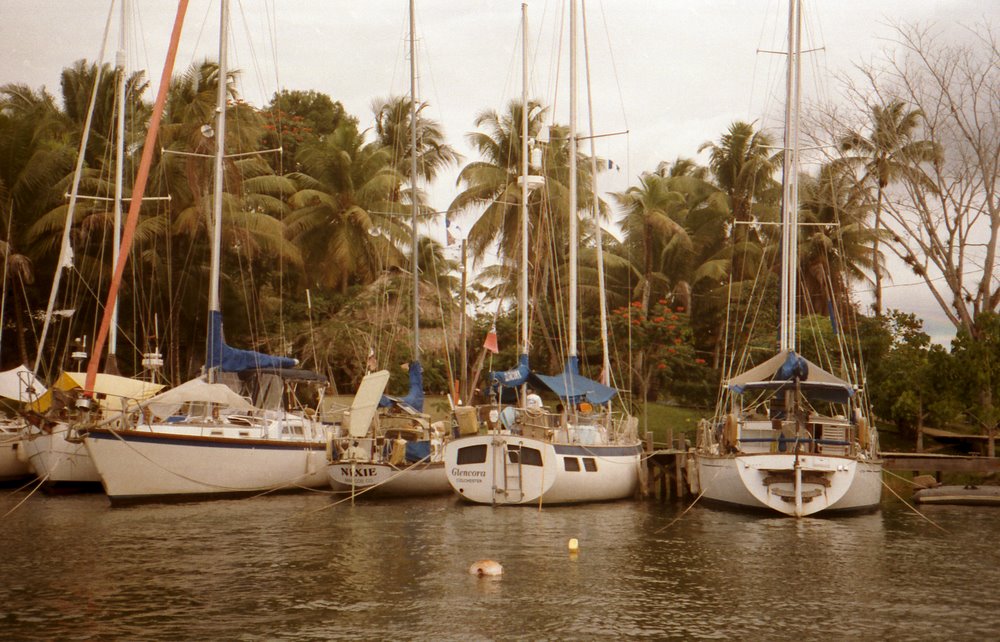
As I took the radiator cap back to “Boo”, I pondered the problem – was it just the lower pressure cap that caused such a rapid overheat or had the head gasket finally blown? When I got back to Glencora, I remembered that I hadn’t opened the sea cock – idiot! I decided to try again using my radiator cap, but first I smeared some silicone grease on the radiator cap seal. I ran the engine for 20 mins with no load at 1400 rpm – temp 73°C, no water loss! I ran it under load at 1000 rpm for another 20 mins – temp 83°C, no water loss. I then ran it for another 5 mins at full throttle – temp 83°C, no water loss, it worked!
It must have been the radiator cap seal. There must have been a bit of scale or dirt on the seat or the seal is damaged which allowed a dribble of water out – the more temperature, the more pressure and the greater the water loss. I think that during our passage from Utila (when we motored for 23 hours), most of the water escaped from the heat exchanger. The morning we left Livingstone, I remember opening the radiator cap and getting water gushing out of the overflow pipe. At the time, I assumed that water came out because the engine water was still hot and under pressure. I think that there was very little water in the heat exchanger at that time – hence the overheat one hour later. The overheat on the way to Cayo Grande was due to an air pocket (30 mins). We made it to Rio Chacon Machaca OK but lost water (2.5 hrs). The next morning, I got a gush of water out of the rad cap and didn’t refill the system which is why we overheated after 10 minutes – no water in heat exchanger. It all seems to be logical – now!
We went out to the bar in the evening for a potluck barbeque – I’m afraid that I over indulged in beer. Glenys had a relaxing day and cut the boys hair – they look like convicts!
22 January 1996 Mario’s Marina, Rio Dulce, Guatemala
We went to Fronteras in the dinghy and caught a “chicken” bus to Morales, a town about 35 km away. The bus was pretty rough, but at least the roads were in good condition. We arrived in the town centre in the rain and wandered back out of town to where the banks and hardware stores are. The road out of town follows an old, disused railway line – the first railway line that I’ve seen for years!
We cashed some travellers cheques and I gamely tried to find a radiator cap – no bloody chance! We walked back into the centre of Morales and went to the biggest “Supermarket”. They have all the food displayed on shelves that tower 20 feet into the air, protected by a glass display counter which keeps the customer from the product. Shop assistants climb ladders on your command to get the goods that you desire – it’s like stepping back in time about 50 years. We were there just as they were closing for lunch and the staff were busy putting up 10 foot high shutter boards to cover the lower shelves – presumably to protect the goods from light fingered employees!
We wandered around the central market that has tiny 4 foot wide passageways between the market shops – reminded me of a Tunisian Kasbah. There were stalls selling clothes, shoes, beans and spices, groceries, small food stalls and butchers. There was even a photographer on the street using an ancient looking box camera. As in Tunisia, the butchers appear to slaughter the animals on the premises – there are big drain holes in the middle of the floor!
We went to a communal café (in spanish, “comidor”) for lunch. There were at least 20 huge concrete tables with 12 concrete seats each, lined up in front of 10 individual cooking “establishments”. We had a very tasty soup followed by a beef dinner, reminiscent of goulash, rice, potatoes and salad all for 26 quesales including drinks ($5US). Great! We caught a bus back to Fronteras and retired to Glencora to get ready to go to Copan for 4 days. I put a new strip of packing in the stern gland and ran the engine for 1 hour with no load – lost about an eighth of a pint but OK. We had a quiet night packing and getting ready for tomorrow.
23 January 1996 Mario’s Marina to Copan, Honduras
Up early at quarter past six to catch a lift with the marina’s launch to Fronteras. We caught a bus to Morales and by eight o’clock we were standing at a crossroads waiting for the next bus. We caught an express bus to Chiquimula which was a pleasant 3 hour trip on a bus with comfortable seats.
Chiquimula is a big bustling town with a large market, similar to the one at Morales. Glenys took us all on a hunt for a toilet – she’s paranoid about toilets when travelling. She makes sure that everyone only drinks small amounts of liquids and she is desperate to find a toilet when we arrive somewhere. I don’t blame her, having seen some of the local public toilets – the boys and I can always pee against a tree!
We eventually found one deep in the market place. I went in for a pee and found that all toilet paper had to go into a bin - similar to Greece where toilet paper blocks the narrow drains. There was no flushing mechanism for the toilet, so I just walked out and started to leave the building. I was stopped by the toilet attendant babbling at me in Spanish and pointing at a huge barrel of water. I shrugged and dipped my hands into the water to wash them. She babbled away again and pushed past me. She grabbed a jug, filling it with water from the barrel and tipped it down the toilet to flush it. I apologised in my pigeon Spanish and fled.
We walked to the bus station to catch a bus to El Florida which is on the Guatemala-Honduran border. The bus station had clean, flushing toilets! We sat in the bus station eating cheese and tomato sandwiches that Glenys had made the night before, while wonderful cooking smells drifted out of the market. (Isn’t it weird how tomatoes taste metallic in old sandwiches) .
The bus up to El Florida was heaving. We were all jammed onto one seat with people standing in the aisle, sacks of corn on the floor and boxes of chicks chirping. The dirt road was extremely dusty, but in fairly good condition. The bus stopped in a small town, half way through the 2 hour journey which gave us a chance to stretch our legs.
We arrived at El Florida to find that it is a dirt road with two customs posts separated by a 100 metre no man’s land. We were given a temporary exit stamp from Guatemala and a temporary entry stamp from Honduras, which cost about $5. We then had to get the six miles to Copan. There was a pick-up truck waiting for us and the guy wanted 300 lempira ($30US) to take us to Copan. I knew that the local rate is 10 Lempira! There was a Spanish speaking family who had been on the bus from Chiquimula who had already agreed 300 lempira – I managed to knock the driver down to 250 lempira, but he wouldn’t move any more. It was four o’clock, we were tired and there was nothing else around so I agreed. I hate getting ripped off – it’s not the money it’s just the principle of it! To cap it all, when we got to the Hotel Brisas, the driver wanted to pick us up for the return journey for the same price! I managed to get him to agree to 50 lempira which I thought more reasonable.
The Hotel Brisas gave us a pleasant room with two double beds and a colour TV, for $25US/night. We had a quick shower and went out for a beer and a stroll before going out for a nice meal.
24 January 1996 Copan, Honduras
We went out for breakfast (Huevos Rancheros - my favorite breakfast ever) and then went to the museum. The museum was fairly interesting but all the explanations of the exhibits were in Spanish so we had to guess a lot of it.
We then walked to the main Copan ruins, stopping at a couple of Stellas on the way. We wandered around the ruins for about 4 hours trying to figure out what it all meant. The main plaza has a beautifully manicured lawn with lots of Stellas and some small temples. The Stellas are beautifully carved and quite impressive. The Acropolis, where the nobles lived, was equally impressive with big temples and altars. There is a great deal of archaeological work going on, which fascinated me. They have dug tunnels into the pyramid temples and found more temples inside. The Mayans apparently just built bigger structures over old buildings. The archaeologists have found up to 4 other temples inside some pyramids, some of which are beautifully preserved, having been protected from the weather.
We walked back to our hotel and watched some TV before going out to dinner.
25 January 1996 Copan, Honduras
We hired a couple of horses and, with a guide, went for a two hour ride up into the mountains to visit a Mayan “maternity hospital”. We were shown some carved rocks where the babies were born and then sacrificed so that their blood could be used for religious rites - nice!
On the way back to town, we rode through the river and along a very nice trail. We had lunch in a comidor and retired to the hotel to watch a film and sleep off the beer we had at lunch. We then went out for another huge, but cheap, meal.
26 January 1996 Mario’s Marina, Rio Dulce, Guatemala
We got up early and caught the pick-up truck at seven o’clock. The bus left El Florida at twenty past eight. The trip was pretty uneventful. The bus driver stopped on the road into Chiquimula because he saw the bus to Morales. We got straight onto it and were in Morales by half past one. We took our time and had lunch in the market comidor because we knew that we didn’t have to be in Fronteras until four o’clock, at which time we could get a lift back in the marina’s launch.
We got on the bus to Fronteras at twenty past two, but it didn’t leave until three o’clock. They then stopped to pick up a battery, and then called at a garage to get some diesel. We arrived, panicking, at Fronteras with 5 minutes to spare – I ran down to the Holly Mar bar and managed to call the marina in time. I was glad to see that the boat was still floating when we got back - this is the longest that I have been away from Glencora for four years. We had dinner in the bar.
27 January 1996 Mario’s Marina, Rio Dulce, Guatemala
I ran the engine with no load and it was OK. I cleaned up and then repaired the exhaust muffler with steel epoxy. I took two of the domestic batteries out so that I could get them recharged. I filled 1 tank. Brett and Craig found a new friend Eric (aged 9) from “Viking”, so they had a great day running around.
I heard that there were a couple of people playing jazz in a bar in Fronteras, so I packed my clarinet and went along. The keyboard player was Herb Payton from “Red Shoes” who has written quite a few sailing books and articles for Yachting Monthly. The other guy was Bill, a very good trumpet player. They played 4 tunes with me “Stranger on the Shore”, a very fast “I’m gonna Sit right Down” (I couldn’t play that fast!), “Misty” and “Stormy Weather”. It was interesting when we played Stormy Weather, I had my music, but they said that it was in the wrong key! There was no way that I could play in a different key so they played in my key and switched to the correct key for their solos - amazing. I really enjoyed it and it’s given me motivation to practice harder!
I got back to the marina and went to a party that Dane and Debbie from “Cortiza” had organised. I got very drunk and didn’t get to bed until after one o’clock!
28 January 1996 Mario’s Marina, Rio Dulce, Guatemala
Very serious hangover. I took two paracetamol and decided to kill or cure myself by going for a run. Glenys and Brett came with me and it nearly killed us! After a 10 minute run my pulse was up to 180+ and I thought I was going to throw up! A cooling dip in the pool when we got back and then spent the morning moping about.
I received a fax from our accountant saying that he’s got verbal confirmation that the Inland Revenue have agreed our non-resident status. He says wait for a week and he will send another fax with more details and should have written confirmation by then. Great news. I got another fax from the people who run my Trust saying that it will be very quick and easy to shut the Trust down. More great news!
I borrowed the marina’s battery charger and put two of the domestic batteries on charge. We had lunch in the bar and I ran the engine with no load for an hour with no problems. At four o’clock, I retired to the bar to watch “The Super Bowl”. It’s the first time that I’ve watched a whole game of American football and I enjoyed it. Fortunately, I had Americans nearby to explain the rules to me!
29 January 1996 Mario’s Marina, Rio Dulce, Guatemala
I put two more batteries on charge for the day. I then put the temperature sensor back on the domestic hot water system and ran the engine. I did 45 minutes on no load and 15 minutes at 1000 rpm in reverse and didn’t lose any water – It’s got to have been the radiator cap. It’s interesting that the temperature sensor reads about 12°C lower in its original (and permanent) position – the maximum temperature recorded today was 70°C as compared to 83°C last week.
We spent the afternoon getting ourselves ready to go on a 4 day visit to Antigua, which is up in the mountains. Neil and Chris from “Boo” came back from there today, so we got a lot of first hand information about the place – sounds like it will be a good trip. Glenys managed to force the boys to do school work which was a major achievement.
30 January 1996 Antigua, Guatemala
Up early to catch Mario’s launch to Fronteras, where we caught an “Especiale” bus to Guatemala City (Guate). It was a very noisy and hot bus, but at least we had a seat each. The six hour bus trip was broken up by short 5 minute stops every so often so that the driver could stretch his legs and we could buy snacks off the local hawkers. Crisps, peeled mangos with salt, fried plantain chips, tacos and tortillas with chicken, beans or egg, ice cream, oranges (already peeled) – we enjoyed ourselves.
We arrived at the bus terminal in Guate at half past two and had a ½ mile walk to the next bus station to catch a bus to Antigua. Glenys went to buy a snack for our lunch and got a bit crinkly because we jumped on a bus and she didn’t know which one! She found us and we had a very cramped, one hour journey in a jam-packed bus.
When we arrived at the Antigua bus terminal, we were “adopted” by a local “guide” who insisted on taking us to a hotel. The first one ($6/night) was fortunately full. The second one was $8/night and didn’t have an en-suite toilet, so Glenys rejected that one. We told our “guide” that we wanted to try the “Hotel San Vincente”. He found the right street but didn’t know where the hotel was – we had to point it out to him! I think he got a few quesales commission from the hotel. The hotel room had 3 x 3’ beds and our own bathroom for $20/night which was great. We were settled by five o’clock.
We went out for a stroll and had a beer in a café across the street from a Burger King. Fortunately, the sign was very discrete and we managed to hide it from the boys. The town is very nice with cobbled streets and one storey buildings. There is a huge volcano which reaches up to the sky and dominates the skyline. The town reminds me of Portugal. We went to a restaurant for dinner and met Graham and Suzanna from “Boston Scrod” – we had dinner with them.
31 January 1996 Antigua, Guatemala
We had breakfast in a restaurant – huevos rancheros with tortillas and beans – even the boys like that. We then went to the Tourist Office where a very nice, old man told us about the things to see in Antigua. He was very clever and talked to Brett and Craig rather than us which held their attention for ten minutes!
We walked around an Art Museum which was full of old church paintings – very dark and dismal scenes from the bible. The building was beautiful though. Quite a number of convents, churches and monasteries were destroyed in 1773 by an earthquake which accompanied an eruption of the volcano. The ruins of these buildings are one of the main tourist attractions of the town. We went to three sites, but only went in one because the other two wanted Q10 per person – tourists pay Q10, Guatemalan nationals only pay Q2! It’s racial discrimination!
We went to the central square and ate tortillas and sandwiches on a bench. There are lots of Indian women and girls, dressed in colourful traditional outfits who sell shirts and other textile goods to tourists. Their sales technique is fascinating to watch. The main sellers are young girls who are very charming and very persistent. I noticed that they were very “tactile”, especially with men, which enhanced the feeling that they were our friends. The older women stay in the background and let their children do the bartering. They sell embroidered tablecloths, shirts, trousers, napkin sets, sunglasses strings, etc. The starting price for a shirt is Q30 and the lowest we could get them was Q19. They are very good at bartering and make it a fun game. I tried to take some photographs of them but as soon as they see a lens they immediately turn away – they then demand Q3 for a photo!
After buying a few small things, we strolled down to one of the “Tourist Markets” and looked at the goods. We decided to “reconnoitre” and buy tomorrow. On the way back to the hotel, we stopped at an Amusement Arcade and I took a picture of one of the Indian girls (aged about 8) playing “Space Invaders” in her traditional outfit. She spotted me as I took it and quick as a flash turned away and demanded Q3! She called me “Malo” (Bad) when I wouldn’t give her anything! We went back to the room to change into warmer clothes (because it gets cold up here at night) and went out for a Mexican dinner.