11 January 2016 Thailand to Mandalay, Myanmar
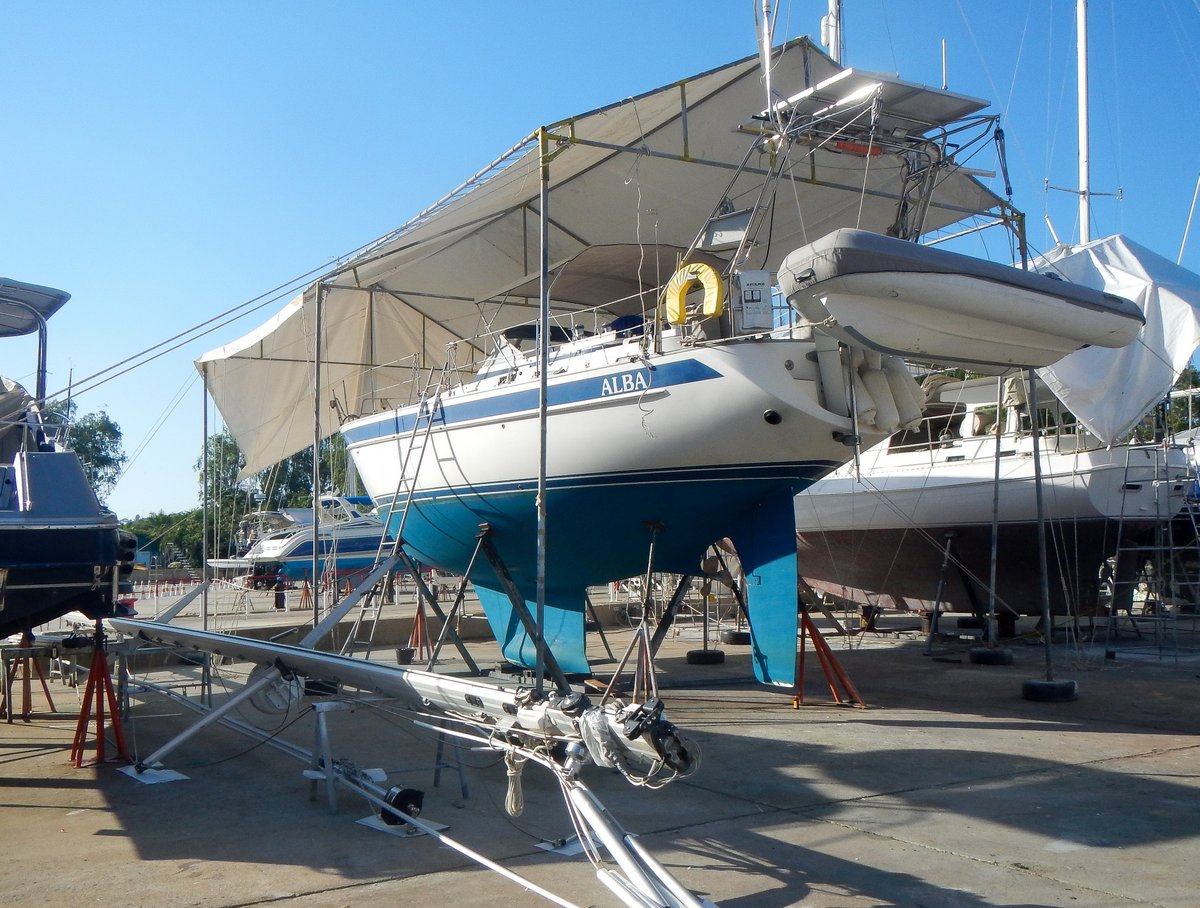
Having hauled Alba out of the water at Boat Lagoon in Phuket, Thailand, we spent the night in a room in the Marina’s hotel.
The alarm clock woke us up at half past four; we caught a cab and were in the airport at the ungodly time of half past five. There was a little bit of confusion at the immigration desk because I had documents saying that I was signing off a boat as crew, but we were soon politely escorted into a small office where it was all sorted out with smiles.
The flight to Bangkok was only about an hour long and, because we had a connecting flight with the same airline, we were escorted from the arrival lounge to the departure lounge and processed through a special fast track immigration desk, which worked well, but we felt a bit like unaccompanied minors.
The Myanmar currency is not available outside Myanmar and apparently ATM’s are as common as rocking horse droppings, so we were advised to take US Dollars. We had $500 on board Alba, but needed another $500 and couldn’t obtain any US dollars in normal Thai banks - we were told that the only place to buy US dollars was at the airport.
So, once we were in the departure lounge, we went to one of the many money changers and were told that we couldn’t get US dollars by using a credit card. There were no ATMs in the departure lounge, so we couldn’t even get Thai Bahts and change them.
We went to an information booth and they confirmed that there were no ATMs this side of the security and we couldn’t go outside unless we cancelled our flights. Hmmmm! We kept asking the same questions in different ways and eventually found out that one of the banks had a small money changing desk and they might give us cash from a credit card. Fortunately, that all worked out and we managed to get our $500US, but were stung for a handling fee PLUS a pounds sterling to Thai Baht exchange rate PLUS a Thai Baht to US dollar exchange rate. At least we’ll have enough money eat in Myanmar.
The flight from Bangkok to Mandalay was only two hours long and we breezed through immigration and customs. A lovely guide called Moe Moe was waiting for us at the arrivals gate to take us to our hotel, but we first stopped off at a money changer to get some Myanmar Kyats. The exchange rate is 1,289 Kyats to 1 US dollar, so for 500 dollars, I was given 645,000 Kyats. The largest denomination that they had was a 5,000 Kyat note, so we ended up with a one inch wad of cash.
Moe Moe chatted almost non-stop on the one hour drive from the airport to our hotel, bombarding us with history and interesting facts about Myanmar, so we didn’t get much chance to do much staring out of the window, but my first impressions are that there are a LOT of Buddhist temples around – there was always at least one golden Pagoda in sight, glinting in the sun.
The Yuan Sheng Hotel is at the edge of downtown Mandalay and is nice. Our room had an en-suite bathroom, air-conditioning and wireless internet, so it’s not as backward as I feared. We arrived at the awkward time of 14:30, so we ordered room service meals, which were tasty and spicy and only cost $3US per meal.
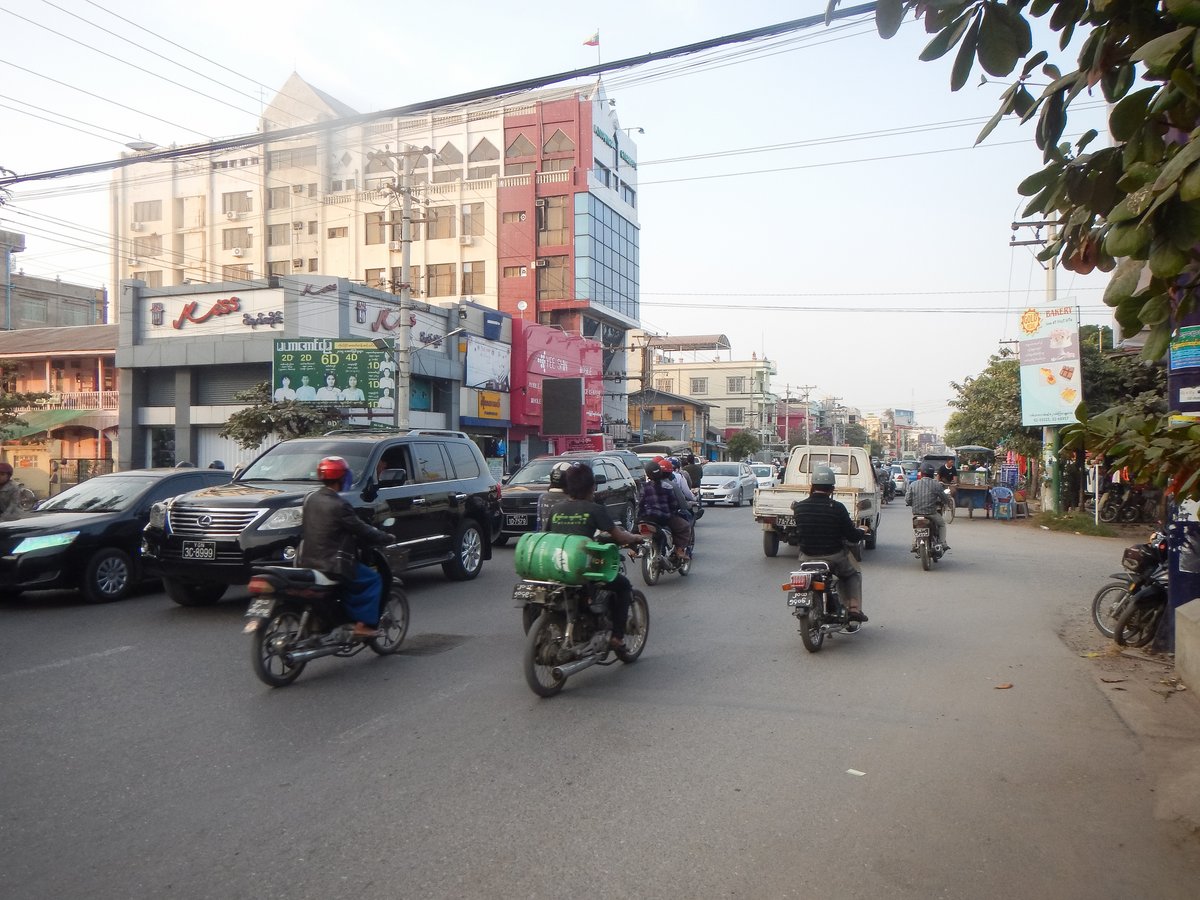
After chilling out for a couple of hours, we went for a walk around the local area. Mandalay is a bustling Asian city, teeming with motorbikes and cars. Pavements are few and far between, so we hugged the side of the road and kept eyes in the back of our heads, watching out for the motorbikes that all seemed intent on killing us.
We walked down 78th Street, which has some modern glitzy stores dotted amongst the rougher local shops and, as we usually do in new town, we popped into a supermarket to what sort of things they were selling. It was a very flashy modern supermarket with a good selection of food and also a large range of clothes. I bought a bottle of Myanmar rum for 1350 Kyat ($1US), which was 45% proof. It tastes okay, but will probably cause premature blindness.
After our consumer fix, we headed west going past the railway station. Here we saw a seedier part of Mandalay life with very poor families living at the edge of the railway line in shacks – filthy kids running around in rags with bare feet, while their parents sort through piles of plastic bottles and aluminium cans.
Back at our luxury hotel, we cracked open a couple of cold beers from the reasonable mini-bar fridge and had dinner in the hotel restaurant, where we watched a traditional puppet show.
12 January 2016 Mandalay, Myanmar
It’s very unusual for us to be on an organised holiday, but Glenys has arranged a custom tour package with a company called Santa Maria Tours (www.santamariatours.com). Normally, we’d arrange everything ourselves, but things are relatively cheap in Myanmar, so the 20 day holiday comes out at $1,475 USD per person including transport, guides and hotels.
A driver called Win met us at the hotel reception and drove us all over Mandalay during the day. He spoke enough English to be able to tell us where we were going next, which was good enough. Our guide Moe Moe wasn’t with us for the day, but she had had already given him a list of places to visit, which covered more than we were expecting.
Our first stop was at a gold leaf workshop. Buddhist believe that they will progress towards enlightenment by gaining “Merit” which can be obtained by doing good things; and a good thing to do is to donate food or wealth to a monastery. Over thousands of years, the practice of plastering gold leaf onto statues of Buddha or famous monks has become a popular way to gain Merit. So gold leaf production is big business.
They start by putting a one-inch wide strip of gold through a mechanical rollers. This makes the gold thinner, but also work-hardens the metal, so they roll the gold into a coil and put it into a charcoal fire for a minute. Using a pair of tongs, the gold is removed and plunged into a bowl of cold water, which quickly cools it and makes the metal soft again. They continue to roll the gold thinner and thinner until it’s only 0.025mm thick.
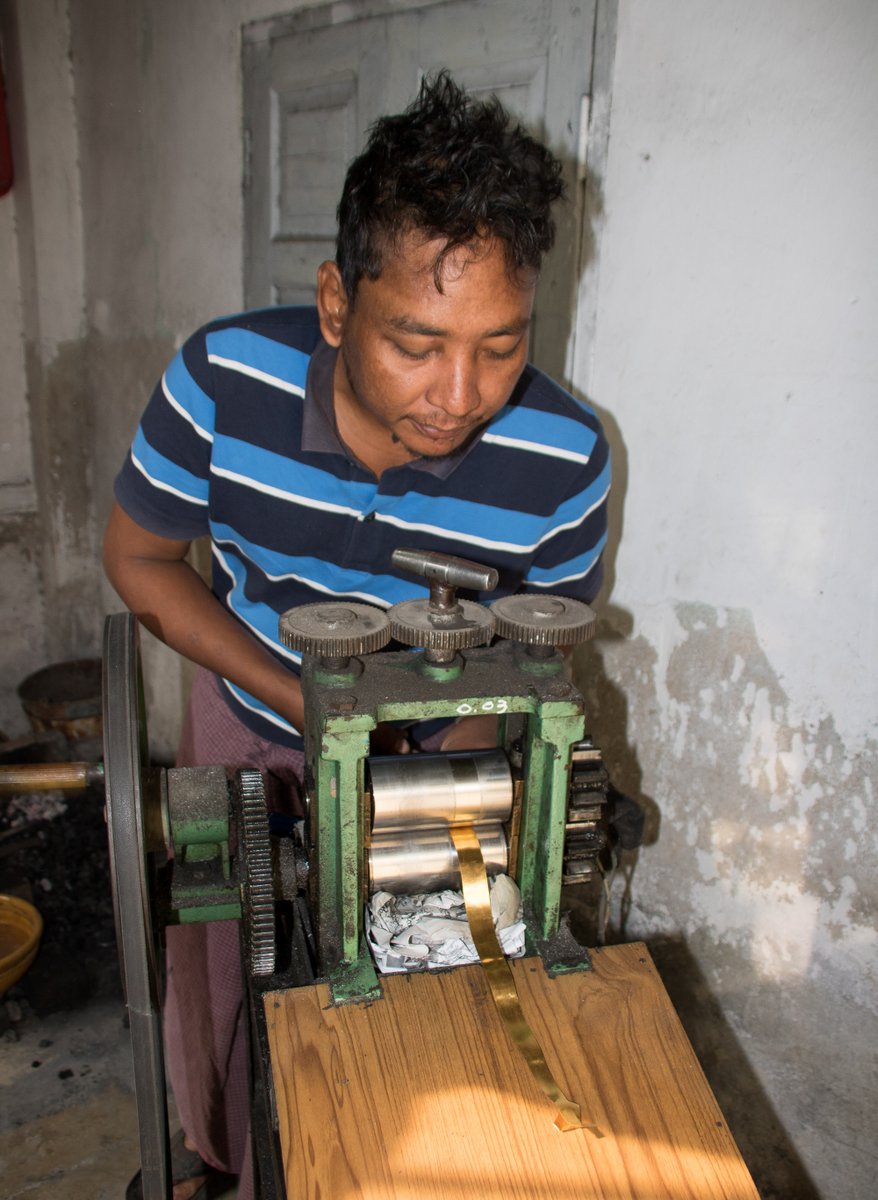
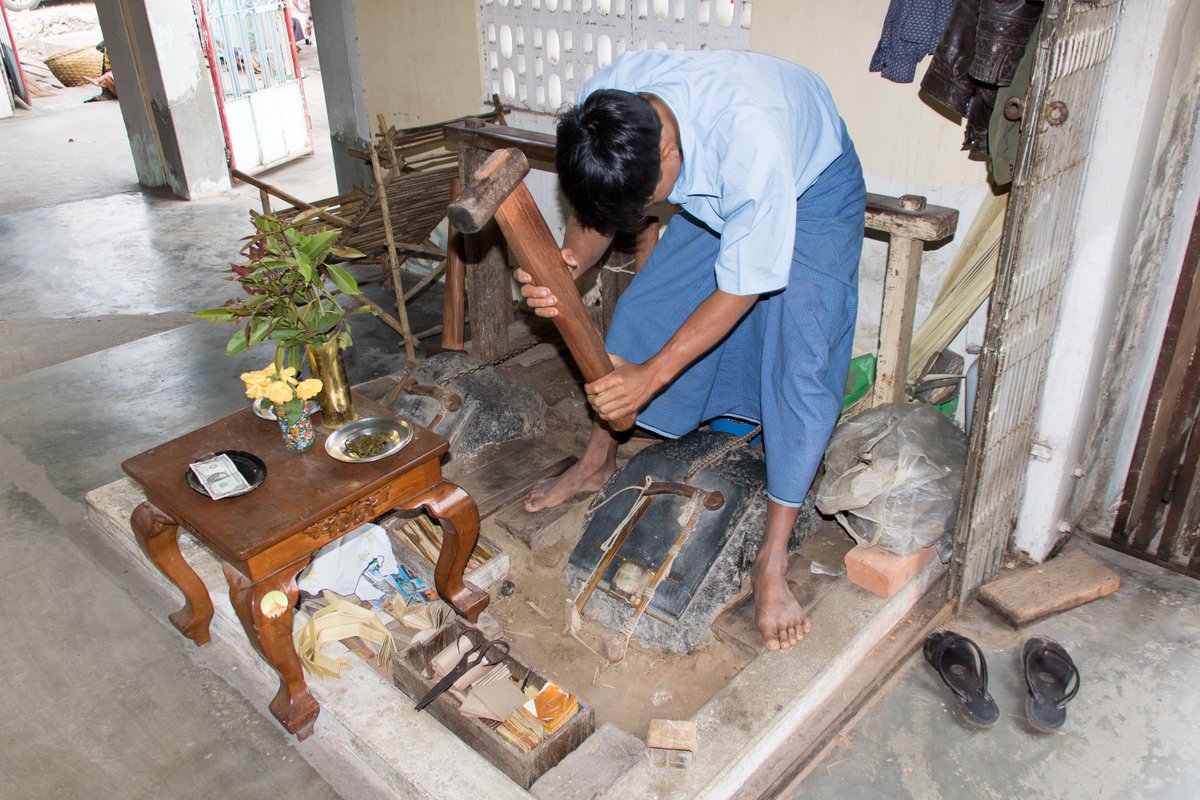
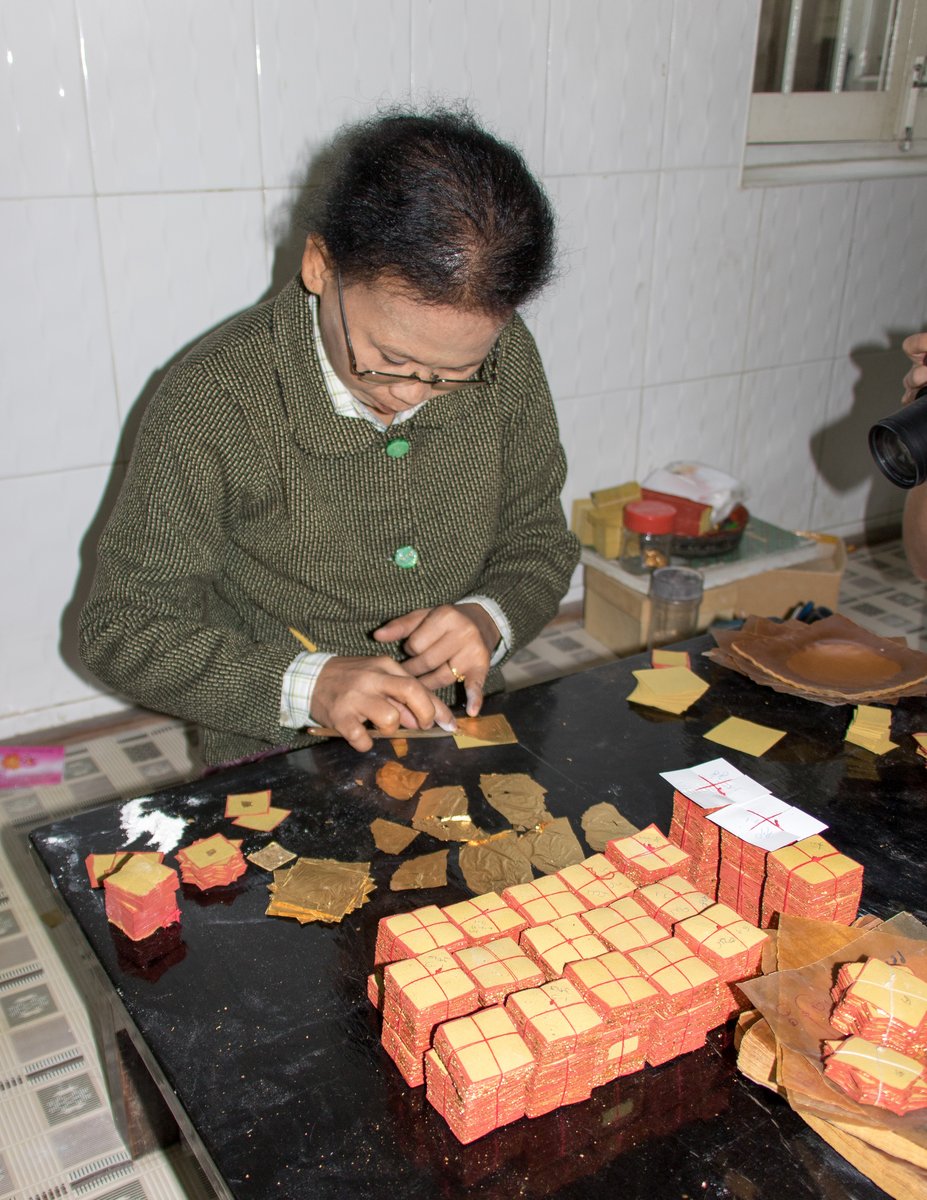
The long foil ribbon is then cut into small one inch square pieces and stacked with a piece of bamboo paper between each piece of foil. A half inch stack is placed on a thick steel plate and the whole package is hammered with a sledge hammer, wielded by fit young men, for 30 minutes. This causes the gold foil to spread out to 3 inches in diameter and become thinner.
The foil pieces are cut smaller again and the process is repeated with six hours of manual hammering until it becomes a piece of gold leaf about four inches in diameter and only 0.0001mm thick.
The gold leaf is then carefully placed between squares of bamboo paper and then placed into small plastic bags for sale. We bought a small package of eight, 5cm*5cm squares of gold leaf for 6,000 Kyat ($6US). Not only do they make the gold leaf, but they also make their own bamboo paper which involves soaking bamboo fibres in lime & water for three years.
Having purchased our gold leaf, we were taken to the Mahamuni Paya, which is one of Myanmar’s most famous Buddhist sites. It’s visited by more locals than tourists, so the approaches to the main temple are more like a market bazaar than a religious building. Nevertheless, we had to remove shoes and wear respectable dress – no short shorts or armless shirts allowed. Glenys put on a Balinese sarong and I went to one of the many stalls to buy a traditional Myanmar “Longhi”.
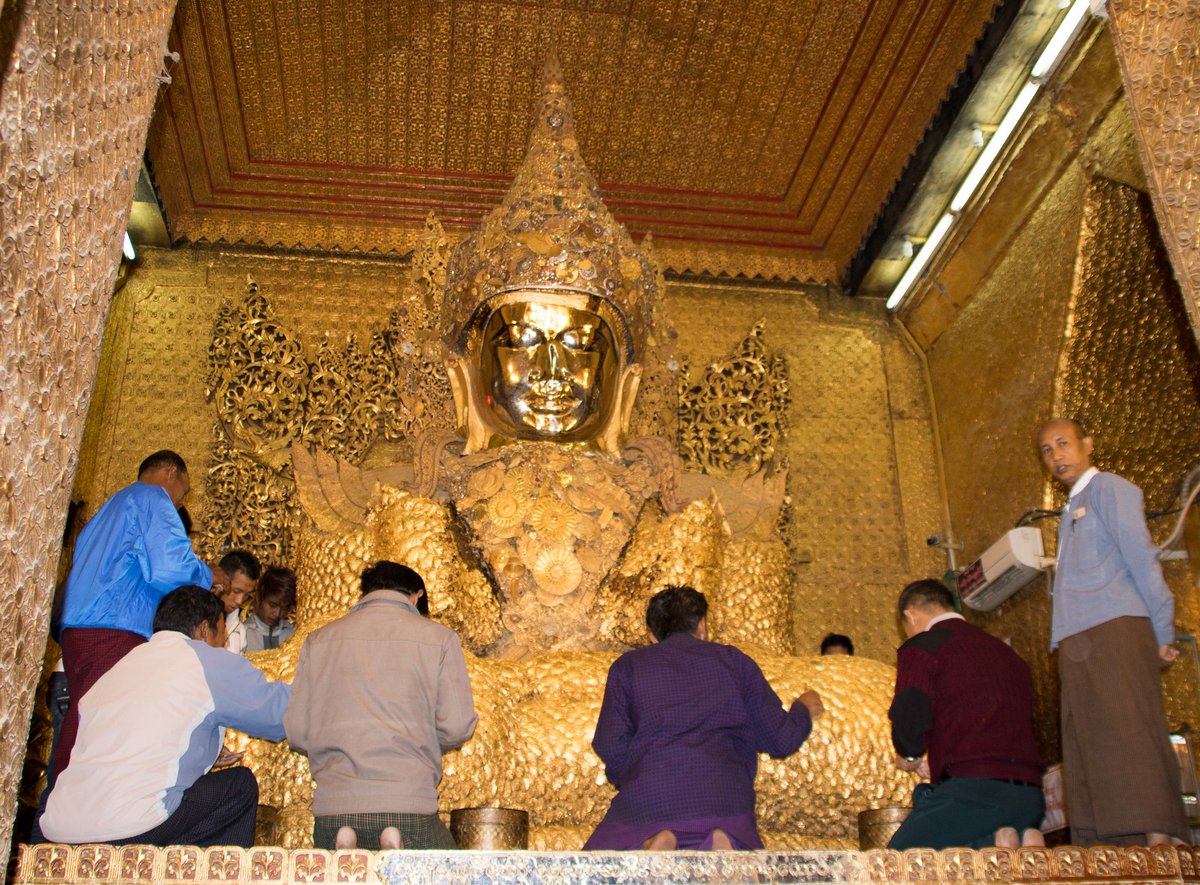
The Mahamuni Paya temple is famous for a 4 metre high bronze Buddha believed to be 2,000 years old. The statue was installed in the inner shrine in the late 1700s and, since then, hundreds of thousands of devout Buddhists have applied gold leaf to it. The base of the figure is coated with over 15cm of solid gold.
Only men are allowed close to the Buddha, so Glenys stayed below with the ladies, while I climbed the steps and applied one patch of gold leaf – I won’t get much Merit, but it was interesting to do it at the side of a Buddhist monk and watch his technique. The monk must have applied 20 or 30 pieces in a couple of minutes and will have gained much Merit.
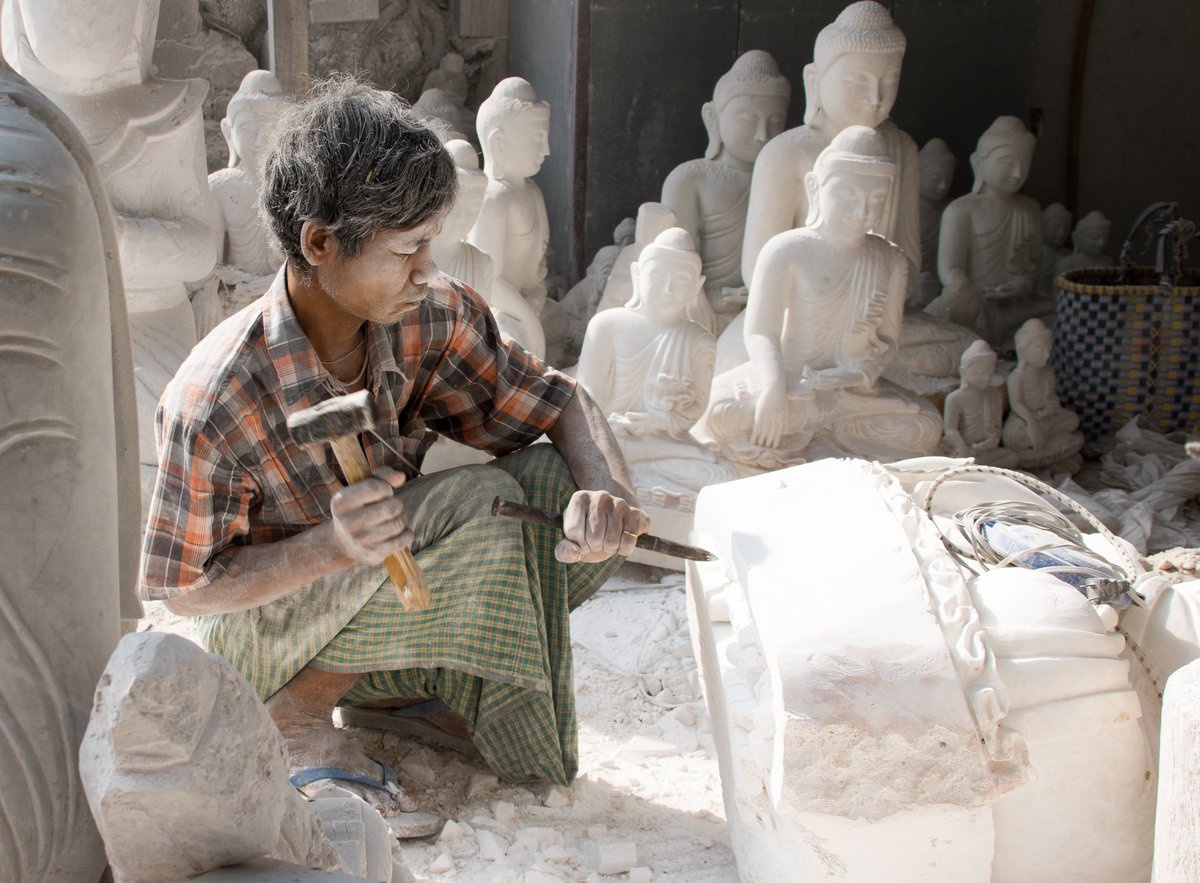
We were taken to the Stone Carvers quarter of the city, where scores of small businesses create Buddhas and other carvings from white stone (which I think is local marble). The whole area is covered with a fine white dust and the air appears foggy as the dust is raised in clouds as traffic sweeps past. The carvers use hand grinders for the roughing-out work, but then resort to hand chisels for the finer work. Ladies sit on the floor in pairs, hand polishing the completed statues with emery paper.
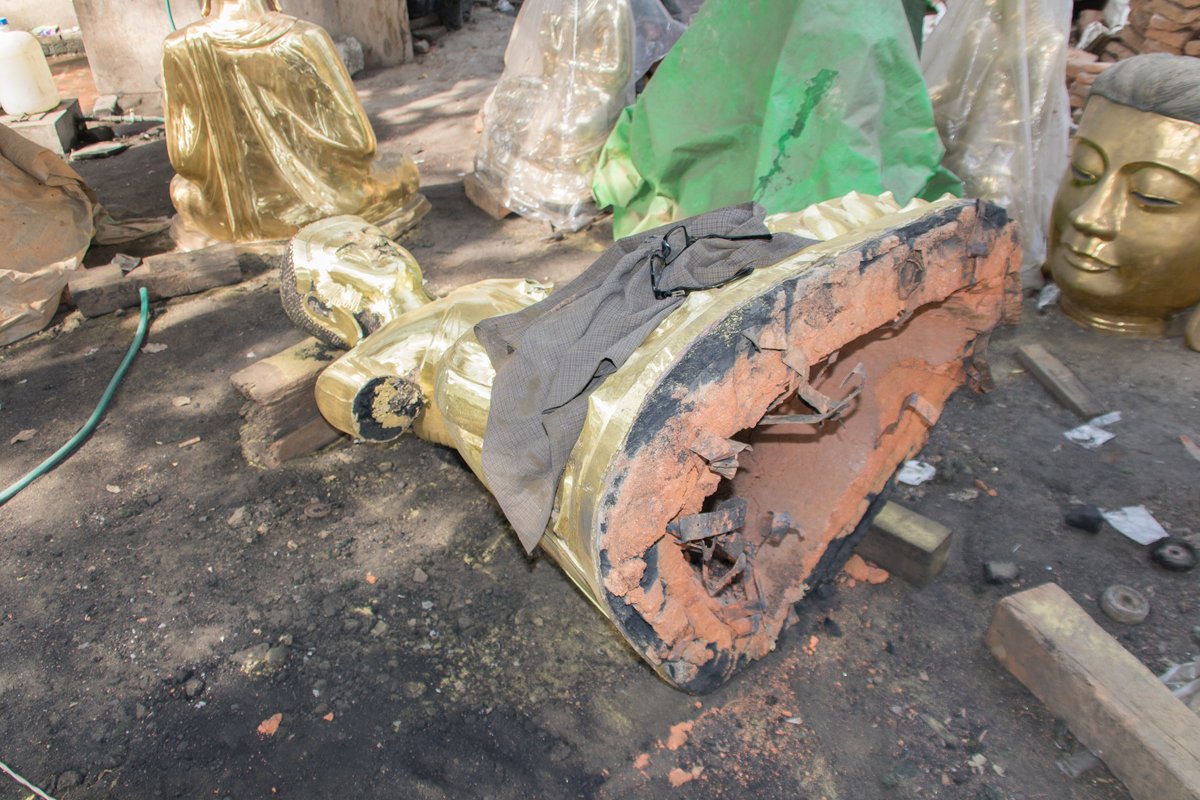
Workmen in the city gather together in various “quarters” – gold leaf makers, stone carvers, wood carvers, etc. Our next stop was at an area that specialises in bronze casting. Being an ex-Production Engineer, I was fascinated to wander around the outdoor foundry watching men casting using a “lost-wax” technique. They work in very basic conditions, but produce beautifully detailed and polished statues.
The process starts with a rough clay model of a Buddha around a metal frame – typically a couple of metres high. On top of the dried clay, they place a 6mm layer of wax and then carve the wax to have all the fine features of the required statue. Another layer of clay is placed over the wax and held in place by strong metal bands.
When the clay has hardened, the whole assembly is placed in to a pit in the ground and molten bronze is poured into it. The clever bit is that the hot metal melts the wax, so the bronze flows into the gap between the two layers of hardened clay and makes a 6mm thick bronze casting with all the fine detail of the wax carving. They repair any defects by welding, then grind and polish the final statue – very skilled.
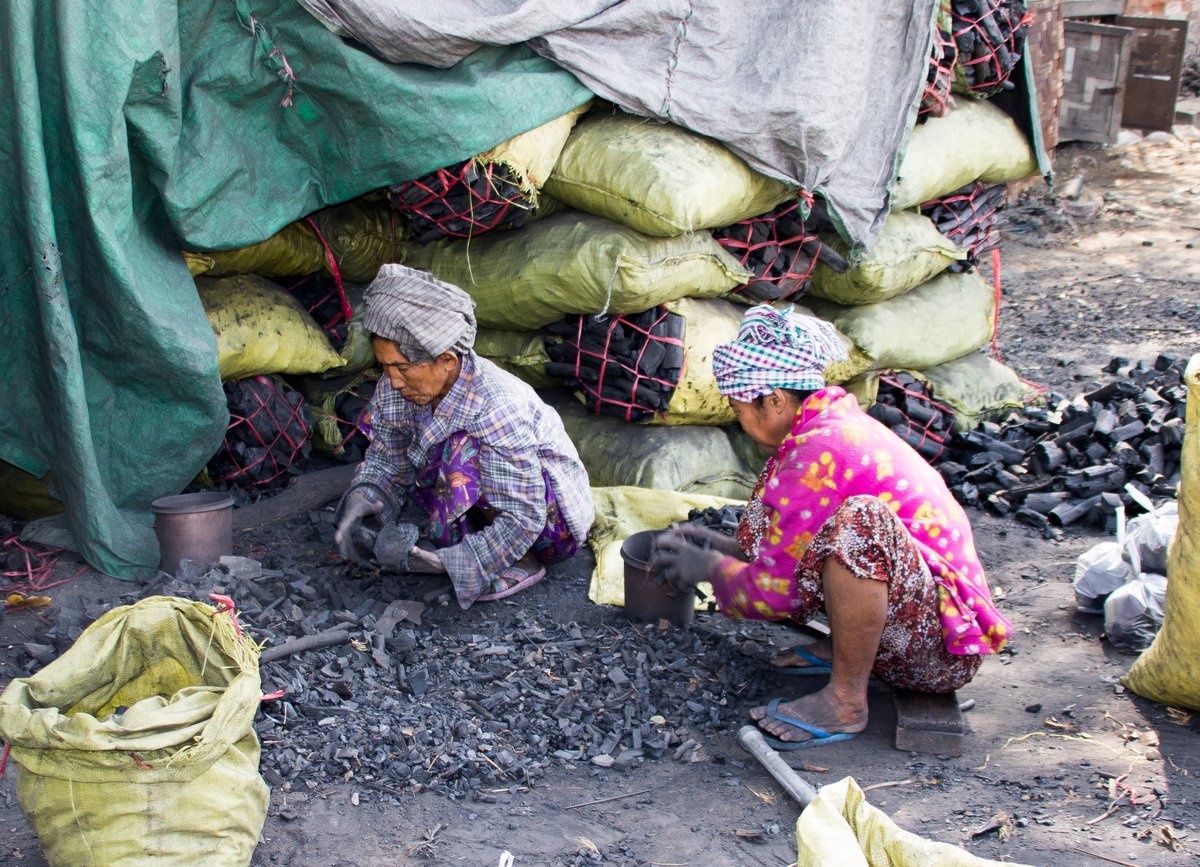
I love to take pictures of people doing everyday activities, which are unusual to our western eyes, but mundane to the eyes of local people, so Win was surprised when I suddenly asked him to pull over to the side of the road.
Charcoal is used by many households for cooking on “smokeless” stoves, similar to the ones that we’ve seen at many places on our travels. I’d spotted two elderly ladies squatting on the side of the road, sorting charcoal from large sacks that they’ve had delivered from outside the city. They were grading it into different sizes, for resale in local shops.
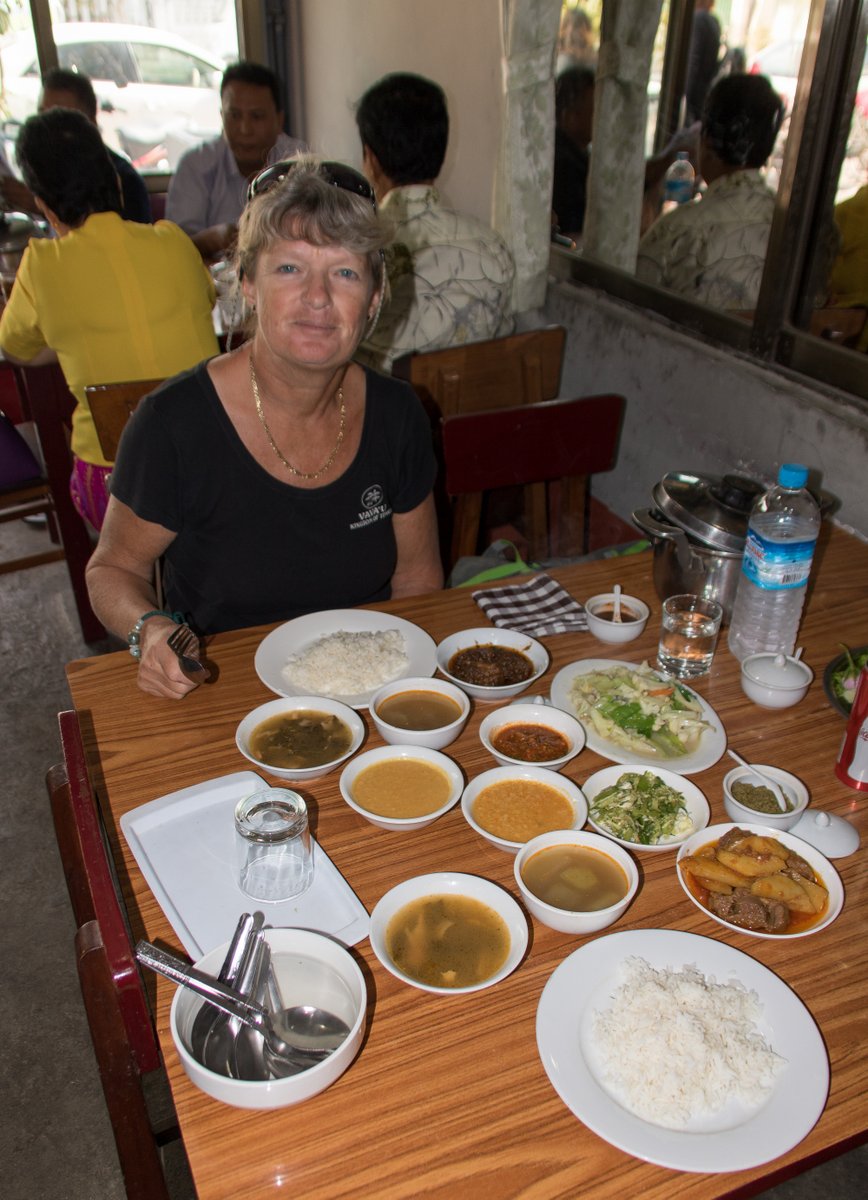
We had lunch at a traditional Myanmar restaurant called De Daw Lay May on 73rd Street between 27th and 28th Street. It was excellent, but a little different to anything else we’ve seen. On arrival, we were asked to choose a single dish each – I had a Mutton Curry and Glenys had Pork with Dried Mango. Once seated at a table, we were brought many small bowls containing other dishes including a bowl of soup, green bean curry, lentil curry, hot sauces and a plate of stir fried vegetables. The meal covered the table, was tasty, filling and only cost 10,000 Kyat ($10US) for both of us including drinks.
We were driven to the Mandalay Palace was built in 1857 by King Mindon Min and was a walled city within the main city of Mandalay. Unfortunately, the British invaded and captured the city in 1885, so its glory was short lived. Then the Japanese controlled Mandalay for much of the Second World War and the palace was burnt down in 1945, amidst fierce fighting as the British and Indian forces advanced – only the 12 kilometre long, tall brick walls surrounding the palace survived.
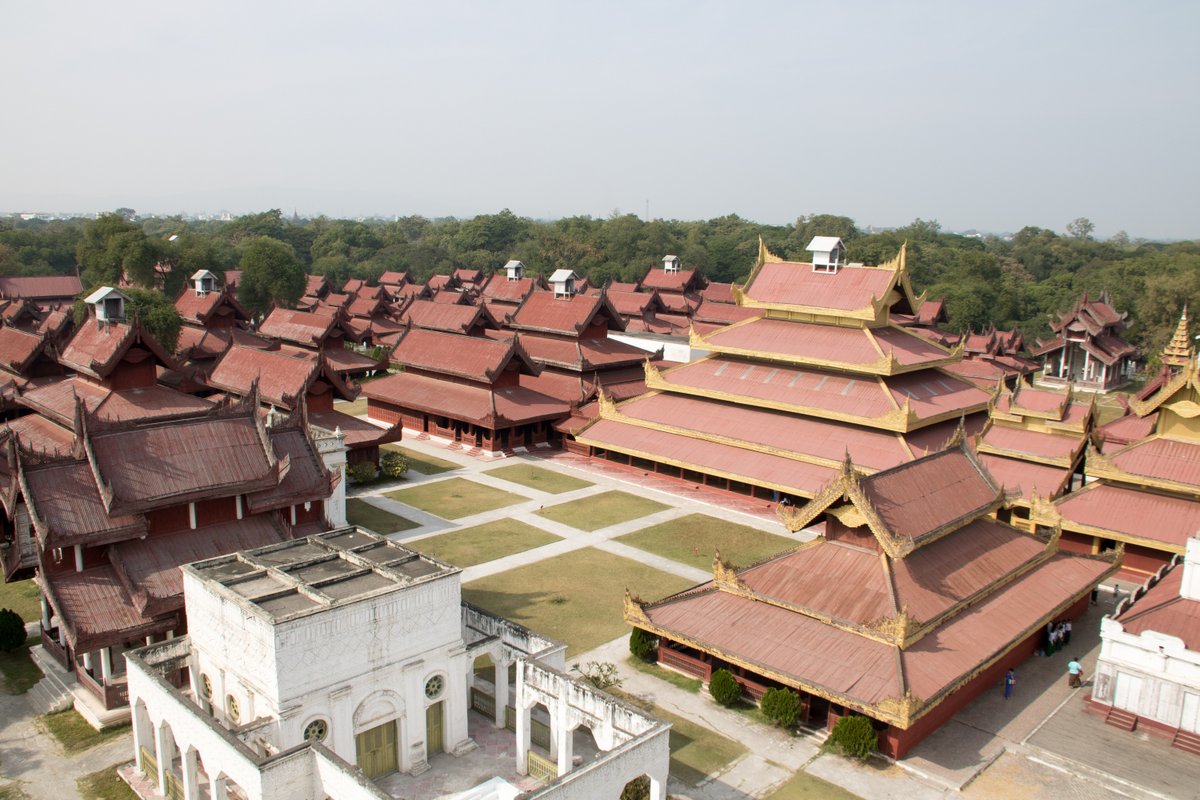
The central crimson and gold palace and a large number of surrounding buildings were reconstructed in the late 1990s. Unfortunately, the building work was done by prison and forced local labour – most of the young men in Mandalay were forced to contribute one day’s labour every month. It’s pleasant enough to wander about, but it looks too clinical and new to be of much interest. Mostly because of the forced labour, the locals avoid the place.
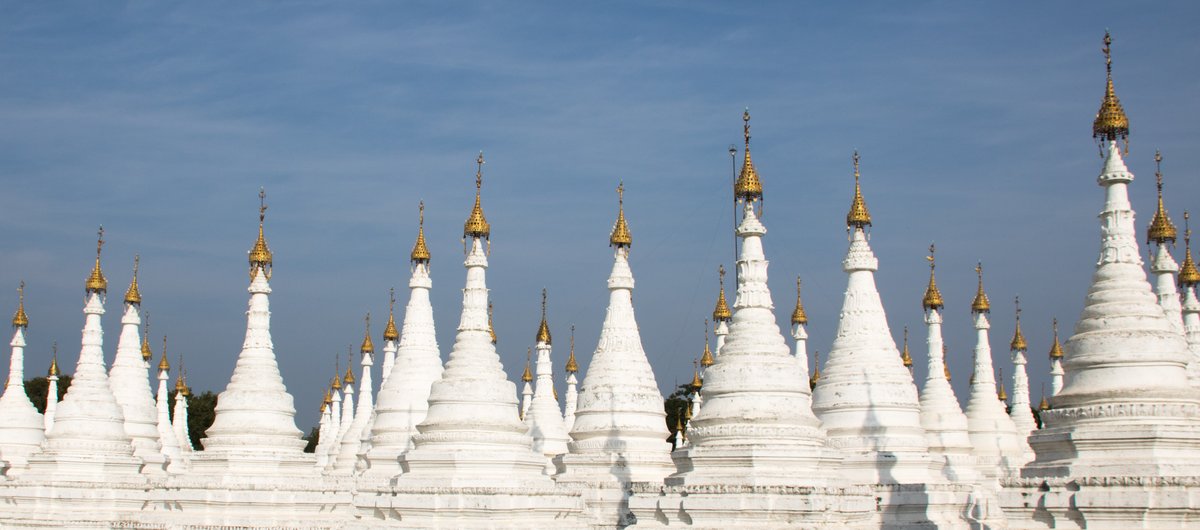
We spent the rest of the afternoon looking at various temples. The golden topped Pagodas and the golden Buddha’s that they contain are beautiful to look at and interesting, but it’s the small differences and local customs that strike me.
At the Kuthodaw Paya, there are 729 marble slabs, each in its own little white painted Stupa, which hold the entire 15 books of the Tripitaka (Buddha’s teachings). It’s an amazing achievement to build the place and it’s very photogenic.
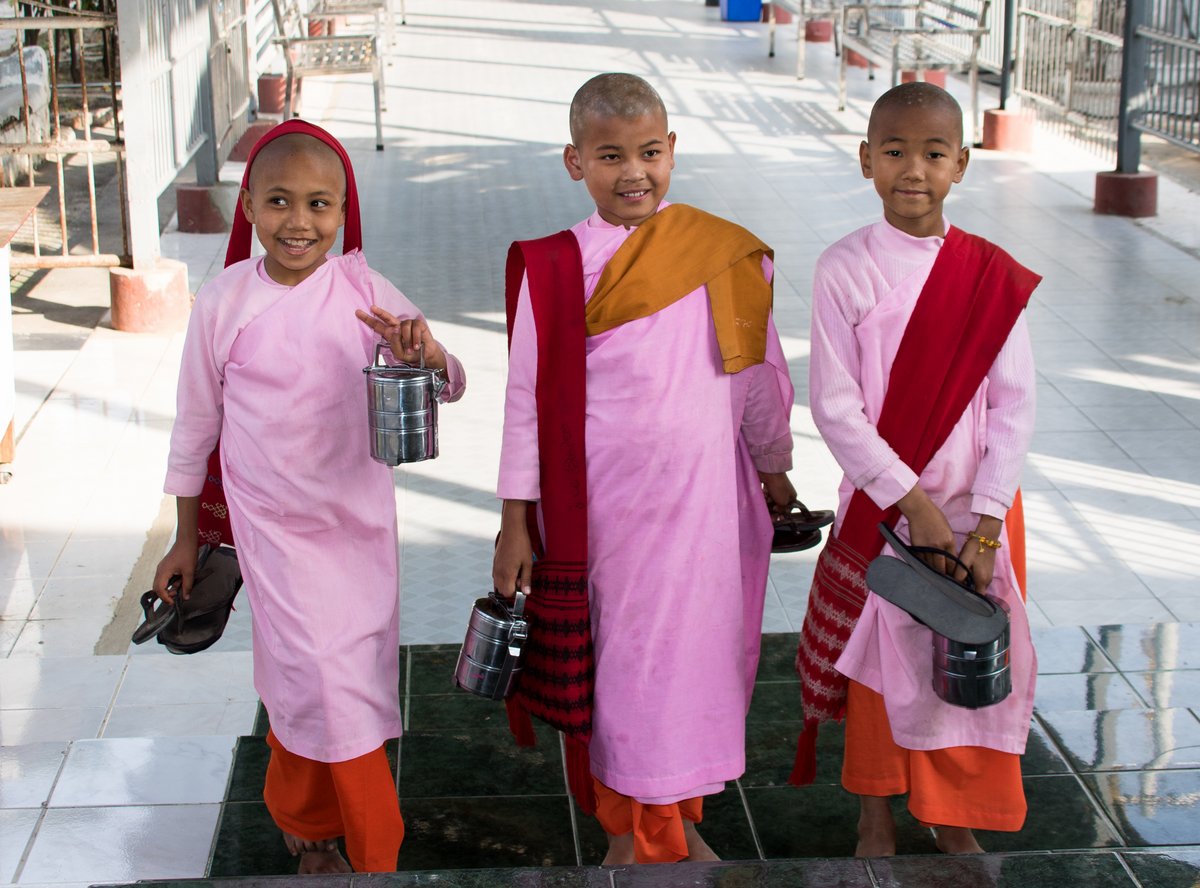
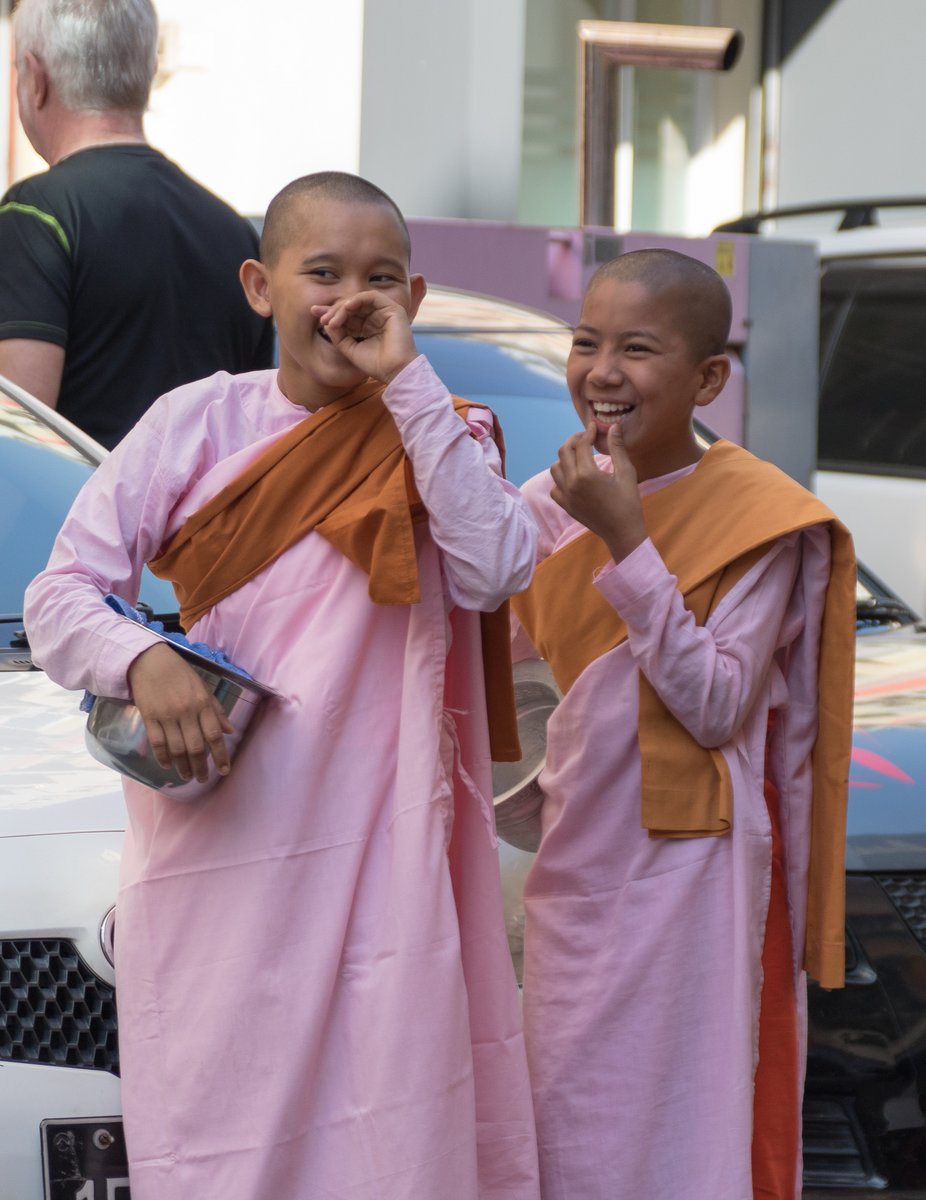
We came across a large group of young nuns who had just finished their Initiation Ceremony. Most Myanmar people spend at least seven days in a Monastery or a Nunnery. It’s a tradition to do this before they are married and the majority go through the process before they are eighteen. The Initiation Ceremony takes between 3 and 5 days and involves inviting relatives and friends around for snacks to meet the young person.
On the last day of the celebrations, the novice’s hair is shaved off (both boys and girls), they don their robes, pick up their begging bowls and go off to the Monastery or Nunnery, where they may stay for the minimum seven days or their whole lives. The Nuns are very picturesque in their pink robes.
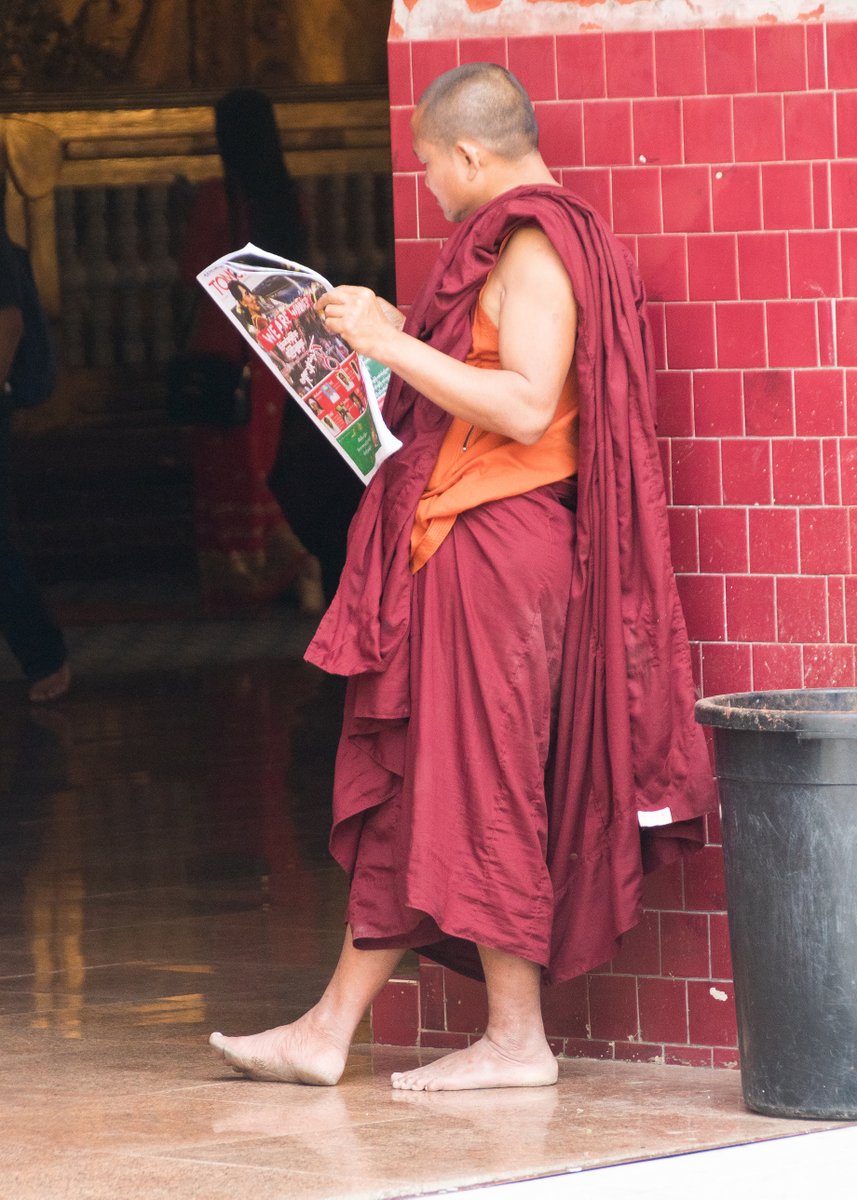
Buddhist Monks are everywhere and are both photogenic and fascinating. I’m ashamed to say that I’ve started to stalk them. In their purest form, Monks are supposed to own nothing apart from a robe and a begging bowl, but many have flashy mobile phones and I’m trying to get a picture of one taking a “selfie”. Also, I think that it’s interesting when they are doing normal things like smoking or reading a newspaper – Buddha help them if I see one heading for a toilet.
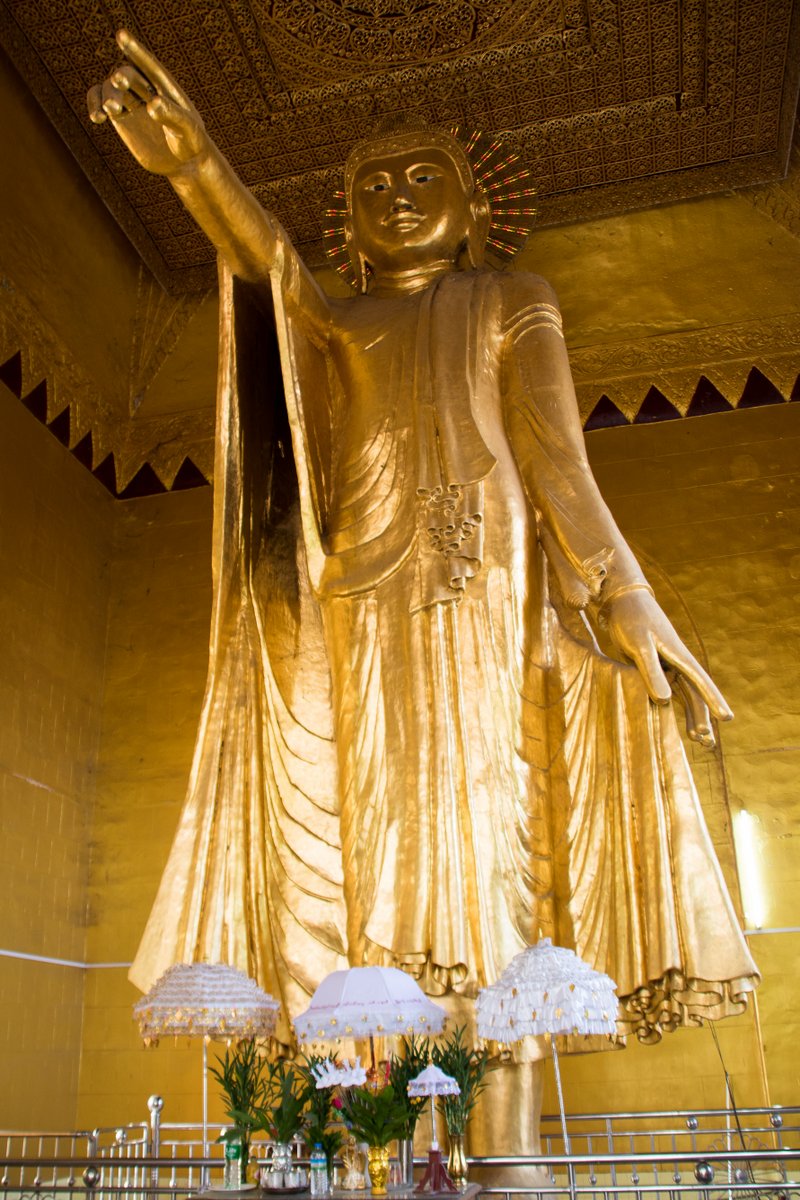
By the end of the day, we’d visited lots of temples and we were grateful for the opportunity to stretch our legs and walk up the 230 metre high Mandalay Hill. There’s a series of steps that wind up the side of the hill, passing vendors selling drinks and snacks. At several points there are shrines, on which has a huge standing Buddha pointing down at the city of Mandalay – Buddha apparently visited Mandalay Hill and predicted that a great city would be founded below the hill.
At the top of the hill is another temple, where hundreds of tourists flock each day to watch the sunset. There’s a car park 50 metres below the hilltop and most tourists are driven there, then take an escalator up to the top – we’re glad that we walked. It was mildly interesting to watch the tourists, but the sunset wasn’t the highlight of my life.
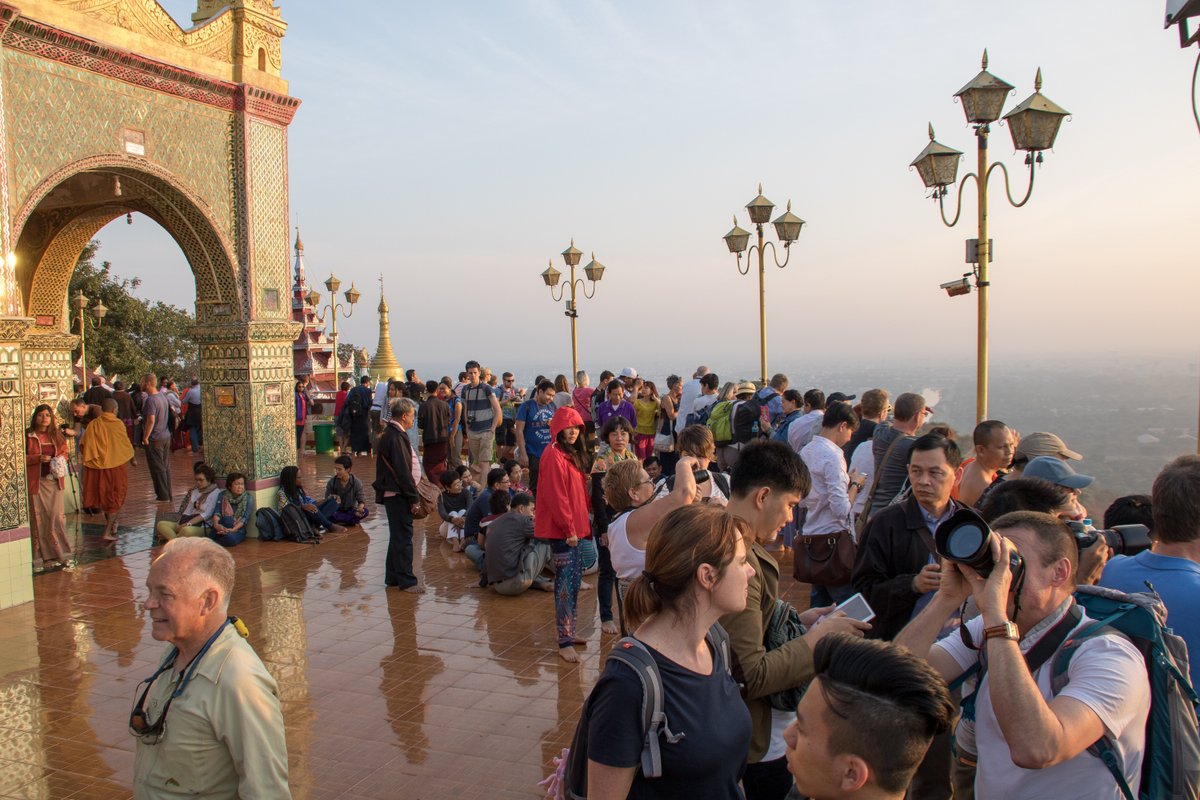
We had a full-on day and we were all templed-out, so we had a quick meal in the hotel and had an early night.
13 January 2016 Mandalay, Myanmar
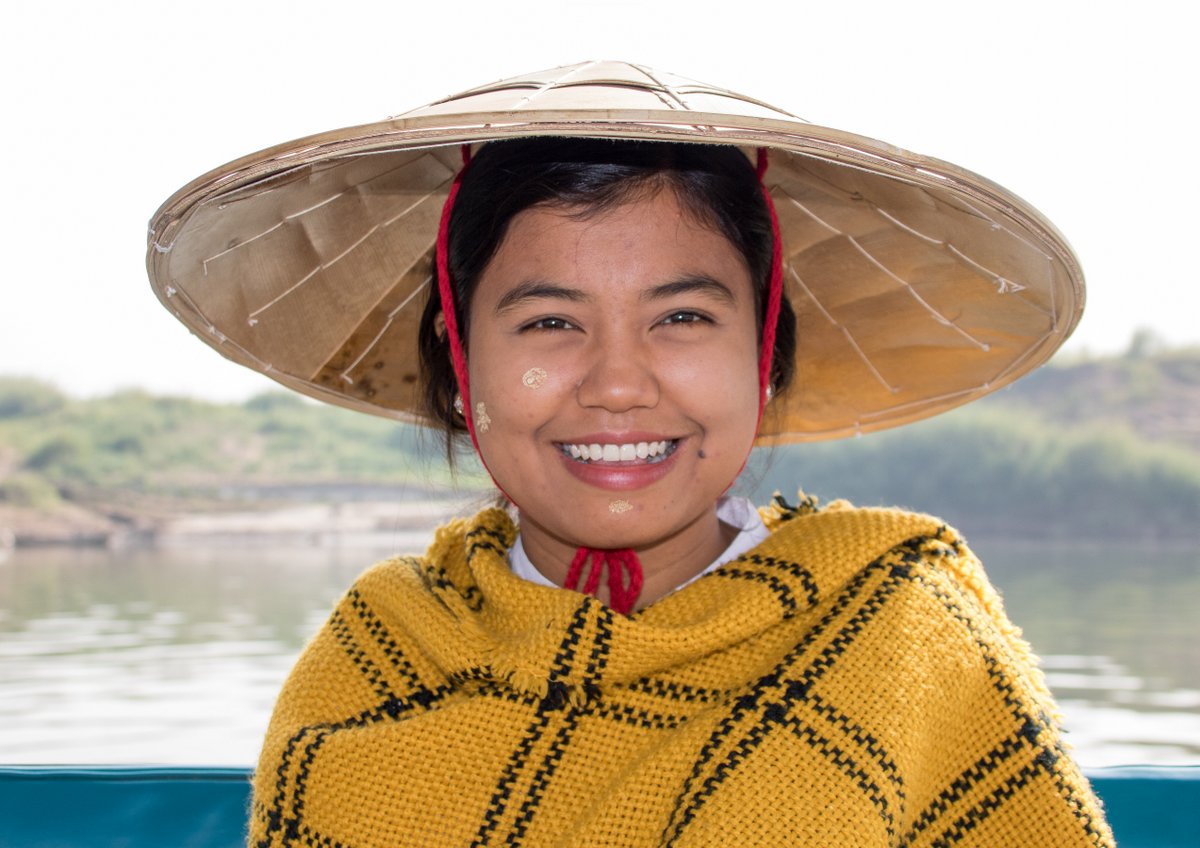
Moe Moe met us in the hotel reception and insisted on showing Glenys how to prepare Thanaka, which is a yellowish-white cosmetic paste made from ground bark. It’s a distinctive feature of the culture of Myanmar - most women & girls have it applied to their faces and sometimes their arms. It is also used by some men and boys.
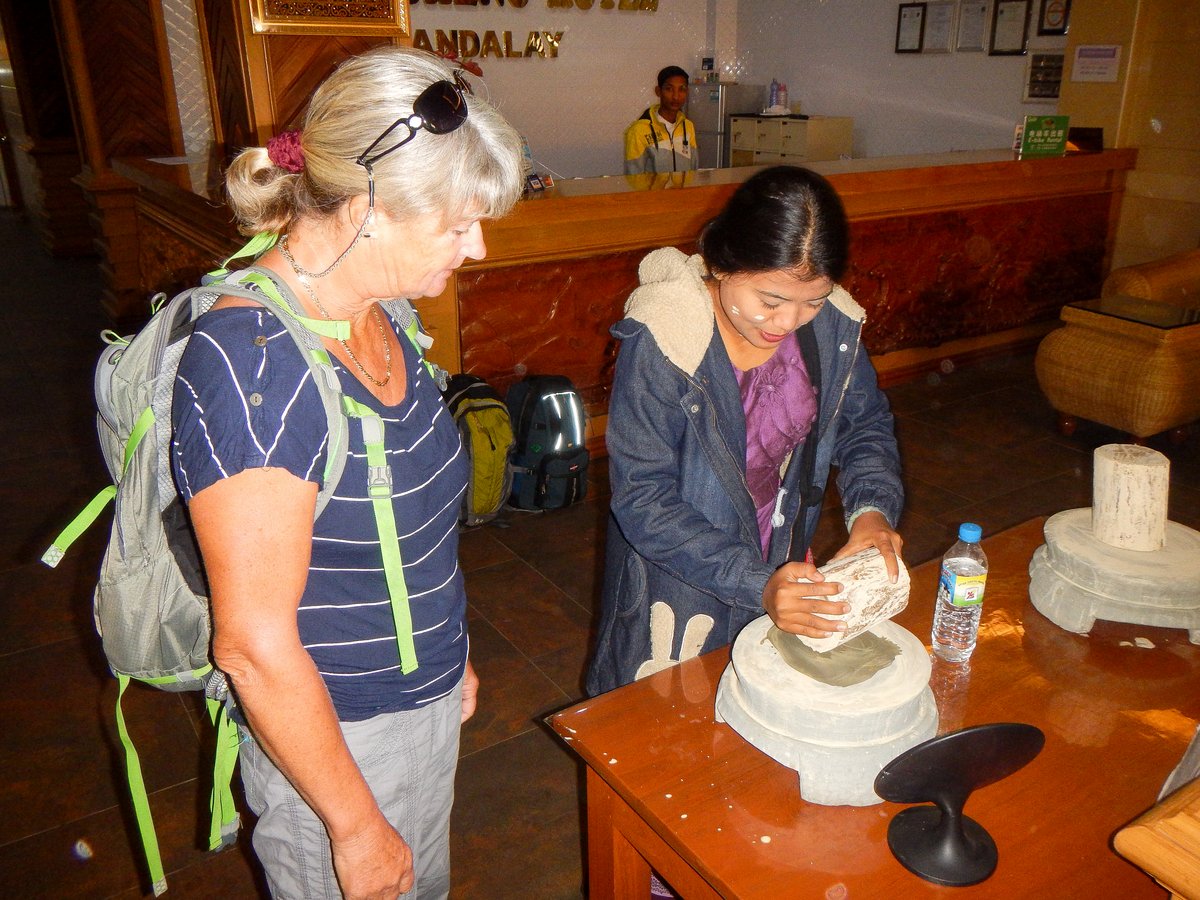
Thanaka cream has been used by Burmese women for over 2000 years. It has a fragrant scent somewhat similar to sandalwood. The creamy paste is applied to the face in attractive designs, the most common form being a circular patch on each cheek, nose, sometimes made stripy with the fingers or patterned in the shape of a leaf, often also highlighting the bridge of the nose with it at the same time.
Apart from cosmetic beauty, Thanaka also gives a cooling sensation and provides protection from sunburn. It is believed to help remove acne and promote smooth skin.
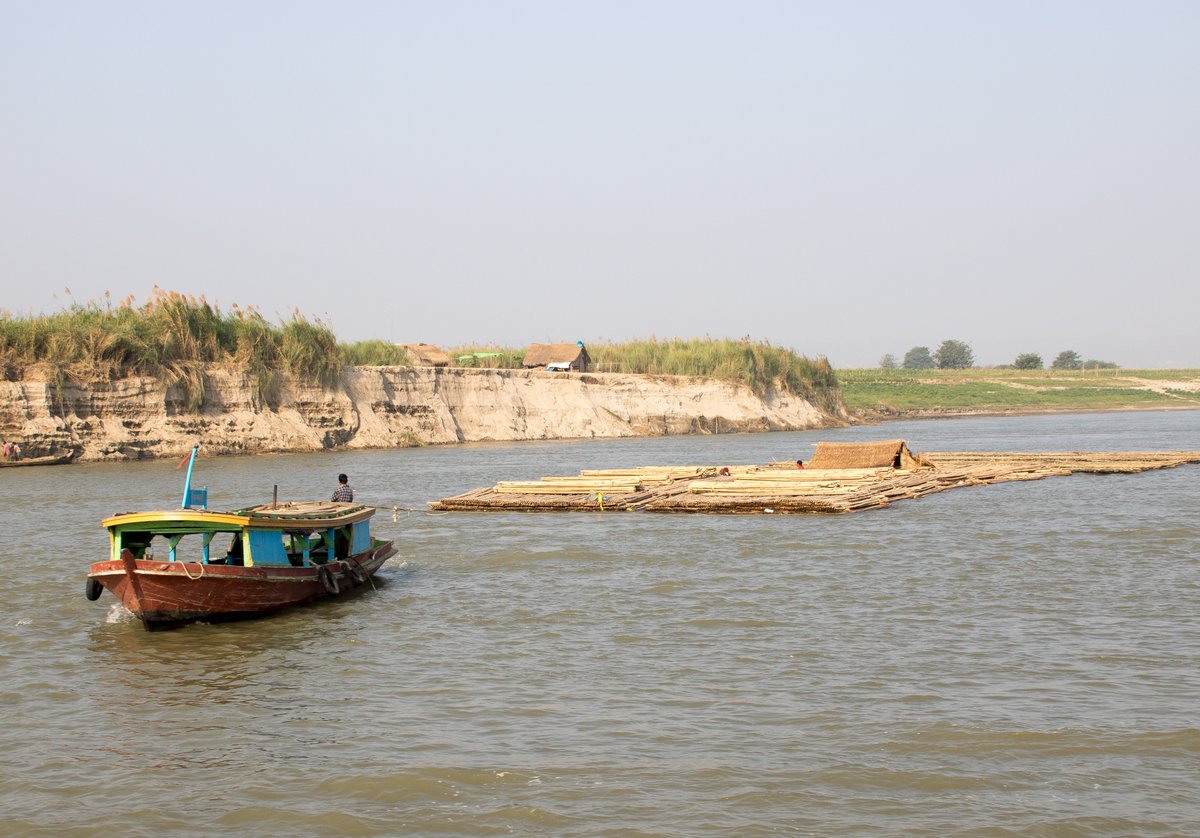
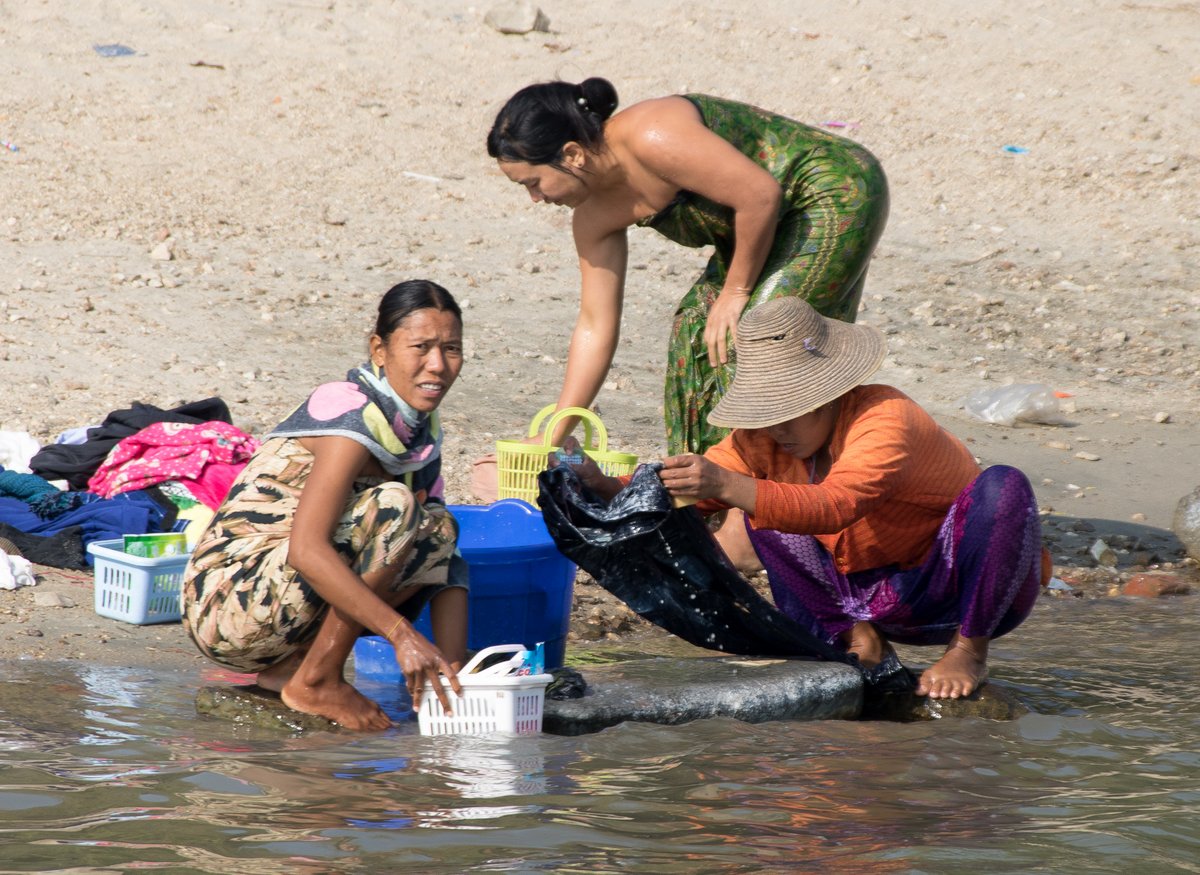
We were driven down to the Irrawaddy River, where Moe Moe led us on-board a 50 foot river boat, which, to our surprise, was just for us. The trip up the river to Mingun took over an hour and it was very cold, which we weren’t really prepared for. On the way, we saw huge rafts of bamboo being floated down the river. Moe Moe said that they sometimes have illegal teak tree trunks hidden beneath the bamboo. Another enterprise on the river is digging sand from the river banks and transporting it back to Mandalay for building materials. The river is part of life with ladies washing clothes at many places along the river bank.
The main attraction at Mingun is a huge stupa that King Bodawpaya started to build in 1790s - it was intended to be 150 metres high. He used thousands of slaves and prisoners of war and the local people were taxed heavily to raise money for the massive project. The work halted in 1819 when the king died. They had only completed the rectangular base to a height of fifty metres and it is massive. We saw a replica of what it would have been and it would have been very, very impressive.
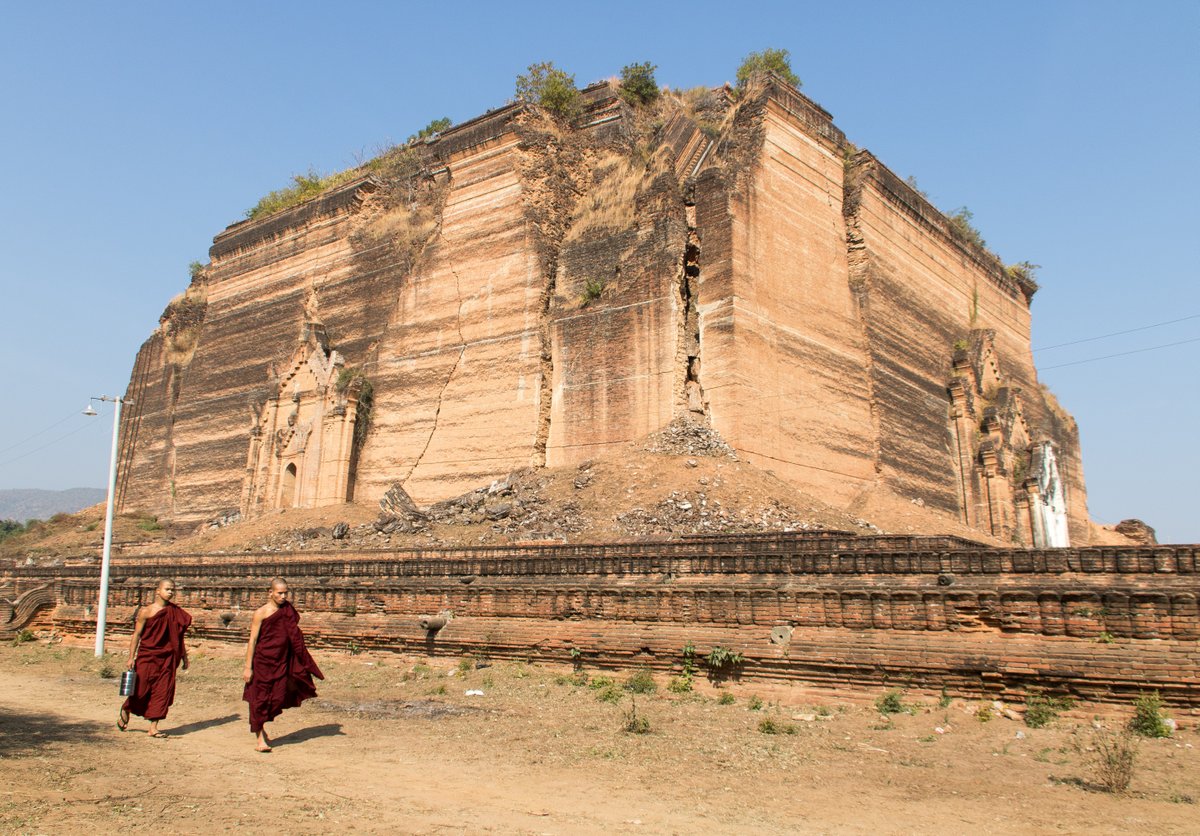
Unfortunately, an earthquake in 1838, put large splits in the structure and it’s now a little unstable. We walked around the base which is about 100 metres on each side and then arrived at a set of steps with a very large notice forbidding everyone from climbing to the top of the structure. In a typical Myanmar contradiction, the steps next to this forbidding notice are very well maintained with a gleaming stainless steel hand rail.
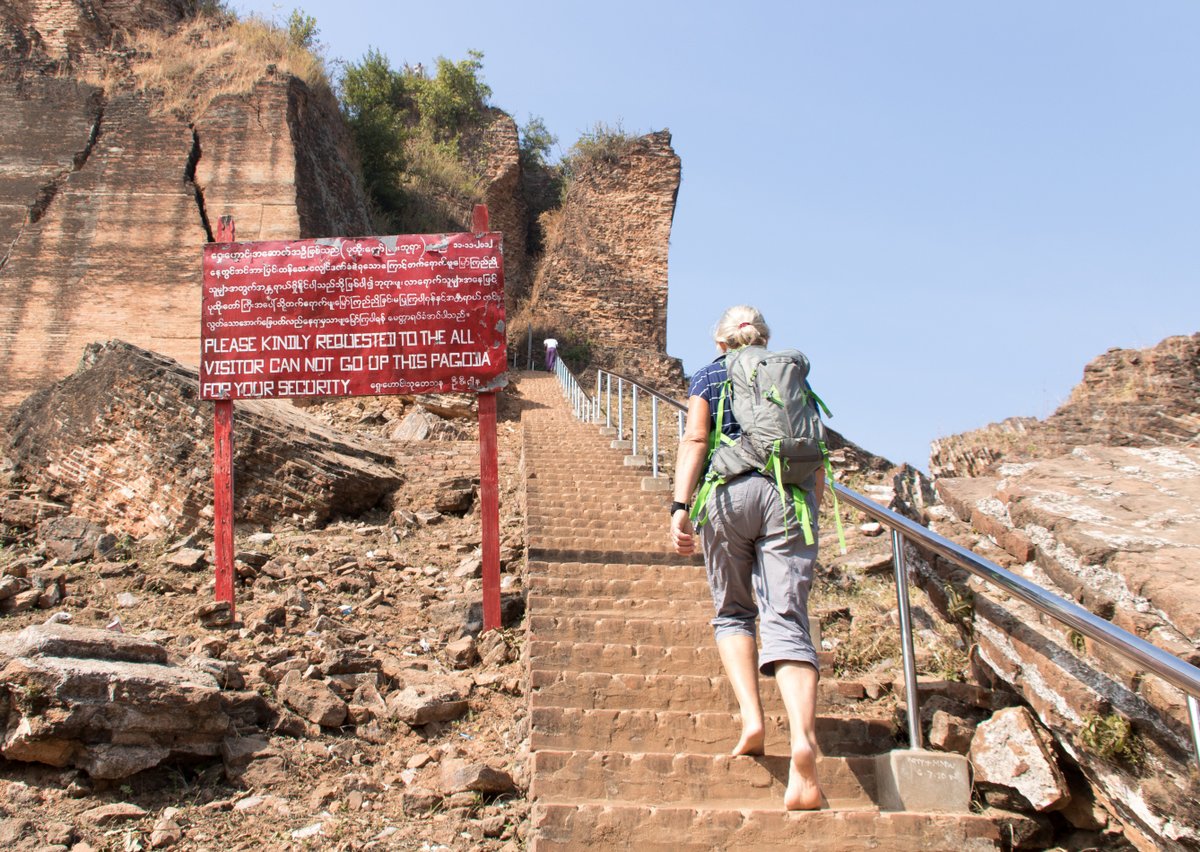
Of course, we just had to go up, leaving Moe Moe at the bottom guarding our shoes – one always has to go bare-foot when entering religious places. It was a steep climb and we were surprised to find about a hundred other intrepid law breakers at the top including a large group of Buddhist monks. There’s a great view from the top of the surrounding Temples and Stupas.
For your edification: A Temple is a place to meditate that may have Pagodas or Stupas within its compound. A Pagoda is a building, often with an odd number of overlapping roofs and often contains a Shrine. A Stupa is a solid structure often with a pointed top; some contain Buddha Relics or other religious artefacts. A Buddha Relic is a part of Buddha’s body, which was taken after his death - examples are hair, teeth and bones. A Shrine is a small a holy place dedicated to Buddha (or a Nat) at which they are worshipped or venerated. A Nat is a spirit – not really connected to Buddhism, but most Myanmar people believe in Nats and have shrines in their homes.
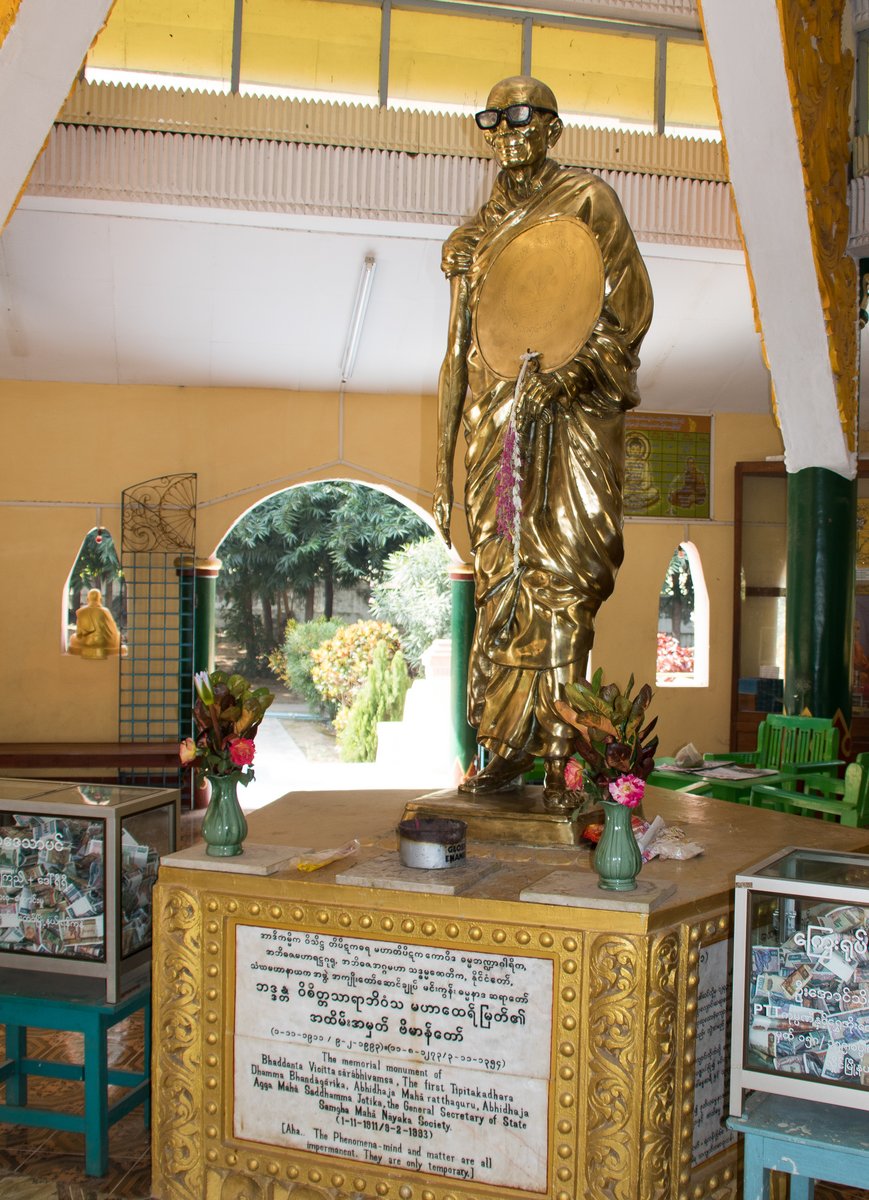
We were taken to see the world’s largest “uncracked” bell – apparently there is a larger bell in Moscow, but it is cracked… Further along the road, we visited a Shrine/Temple which commemorates a monk who could recite the whole Tripitaka (Buddha’s teachings) from memory. I guess that the monk is venerated in a similar way that the Catholics treat their saints.

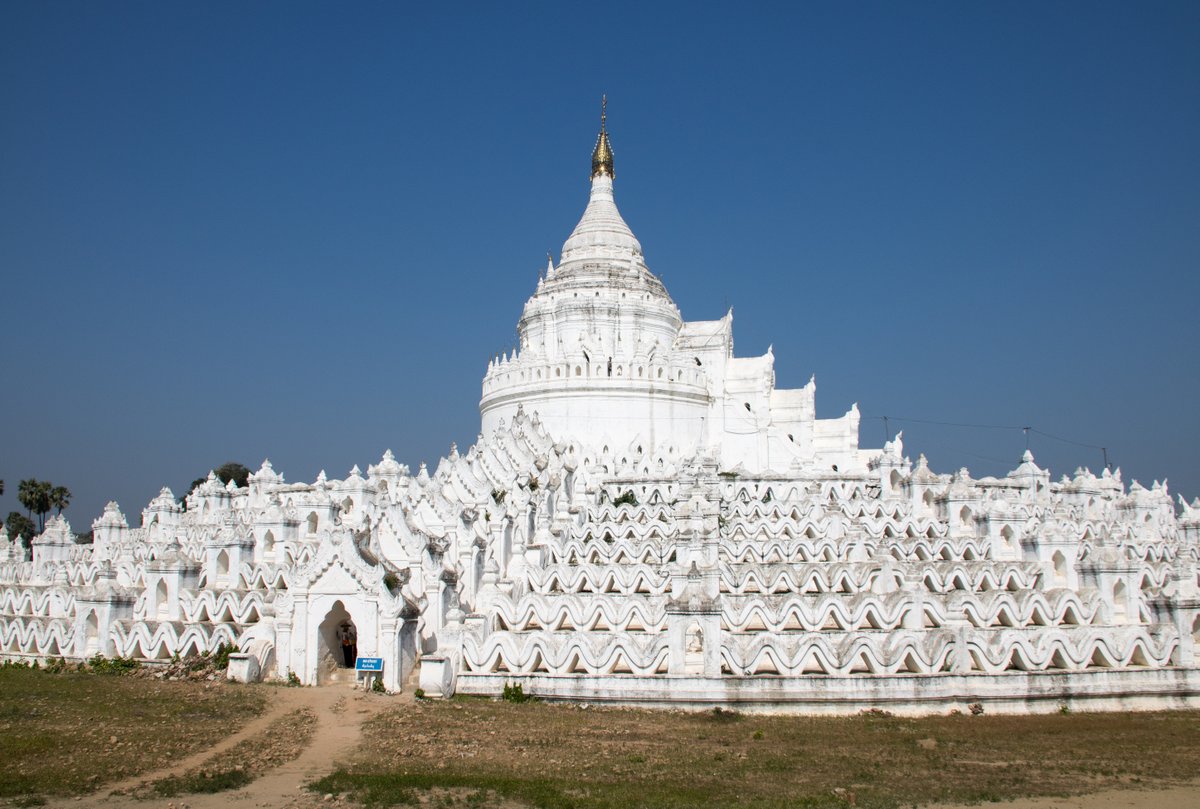
We visited a large temple called the Hsinbyume Paya, which is an impressive white-washed building with seven wavy terraces. This is supposed to represent the seven mountains around Mount Meru (the mountain that stands at the centre of the universe.) It’s very photogenic.
After a slightly shorter (and warmer) boat ride back to Mandalay, we had a meal at a restaurant called Mingalabar on 71st street between 28th and 29th streets. It was similar in that we had lots of Myanmar dishes, but it was more touristy and the food wasn’t as good as yesterday.
Moe Moe took us to her Aunt’s house, which is the sandal making district. It was a nice simple wooden house with two stories - jam packed next to other homes. Moe Moe showed us the two family shrines – one for the Nats (spirits) and one with a statue of a Buddha.
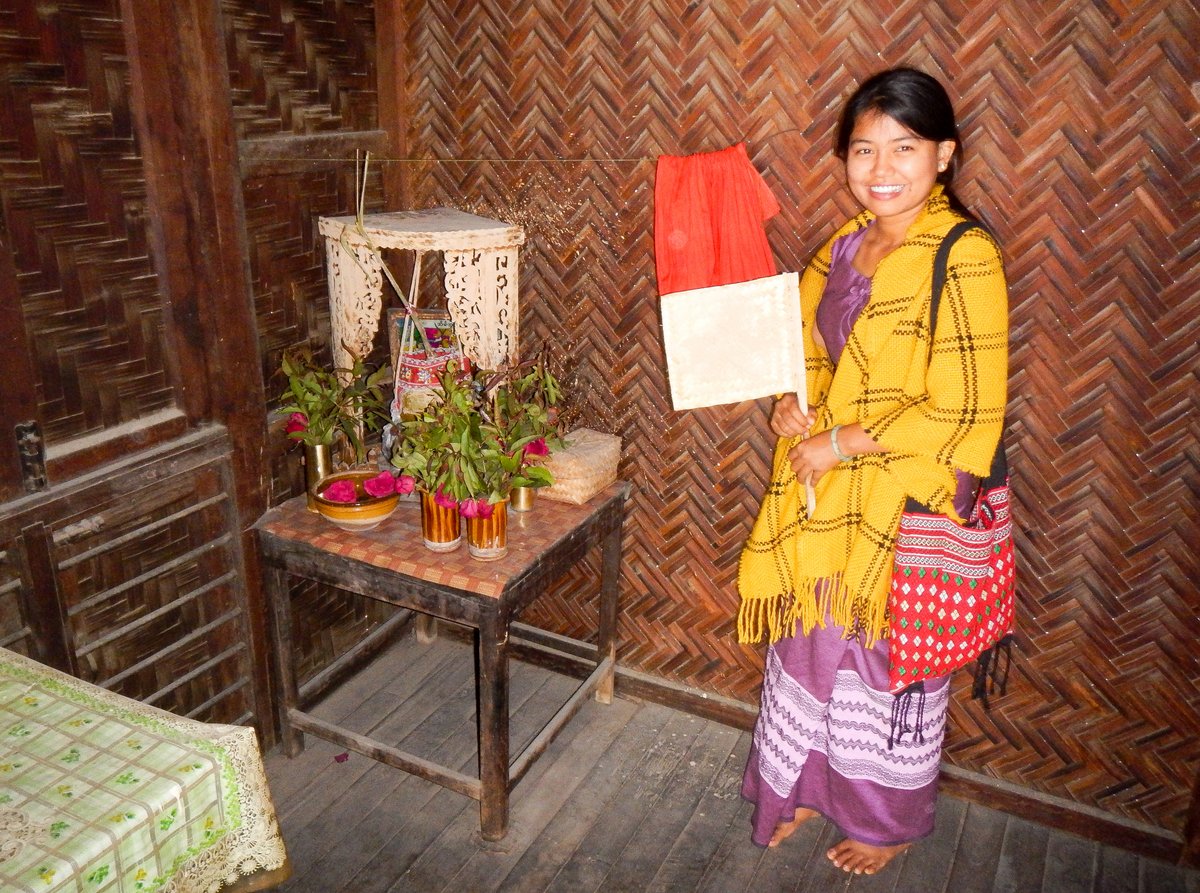
We had a walk around the local area, looking at people manufacturing sandals by hand. Whole families work for each business, with some businesses making the finished product while other families concentrate on making components such as straps and even shoe boxes. There’s a nice feeling of a community that helps each other.
We were driven to Amarapura, which used to be the royal capital of King Bodawpaya, (the guy who started building the huge Stupa at Mingun.)
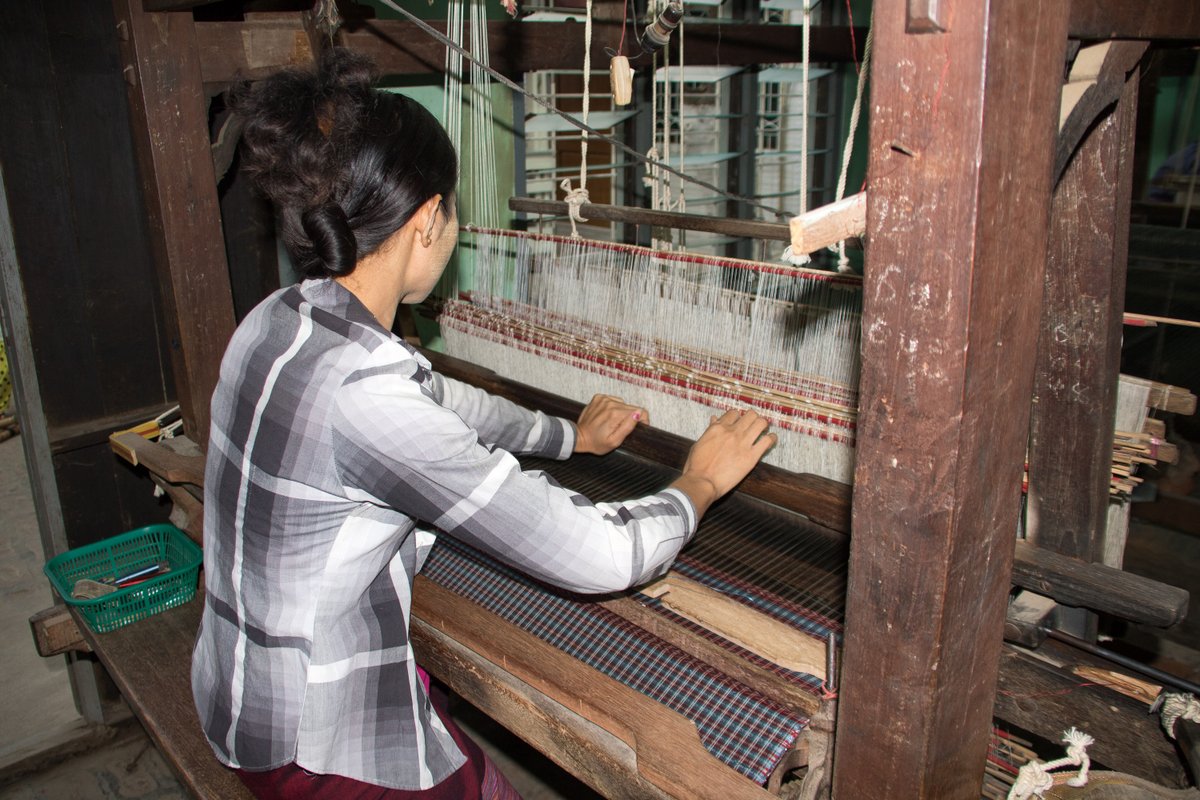
Our first stop was at a weaving operation where they make silk longhis. The looms are all hand operated and the women get paid when they complete a longhi, which for the more complicated ones may take three months. They produce some beautiful material and a hand woven silk bridal outfit can cost $1,000US. Thankfully, Glenys restrained herself.
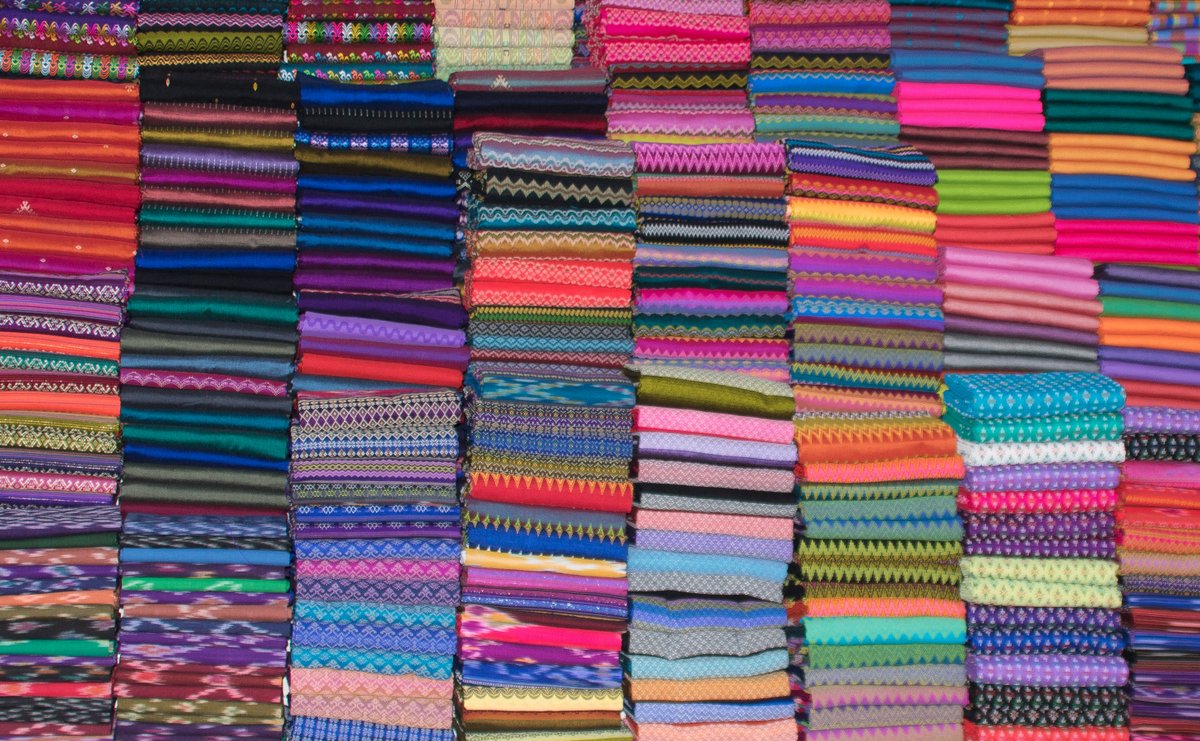
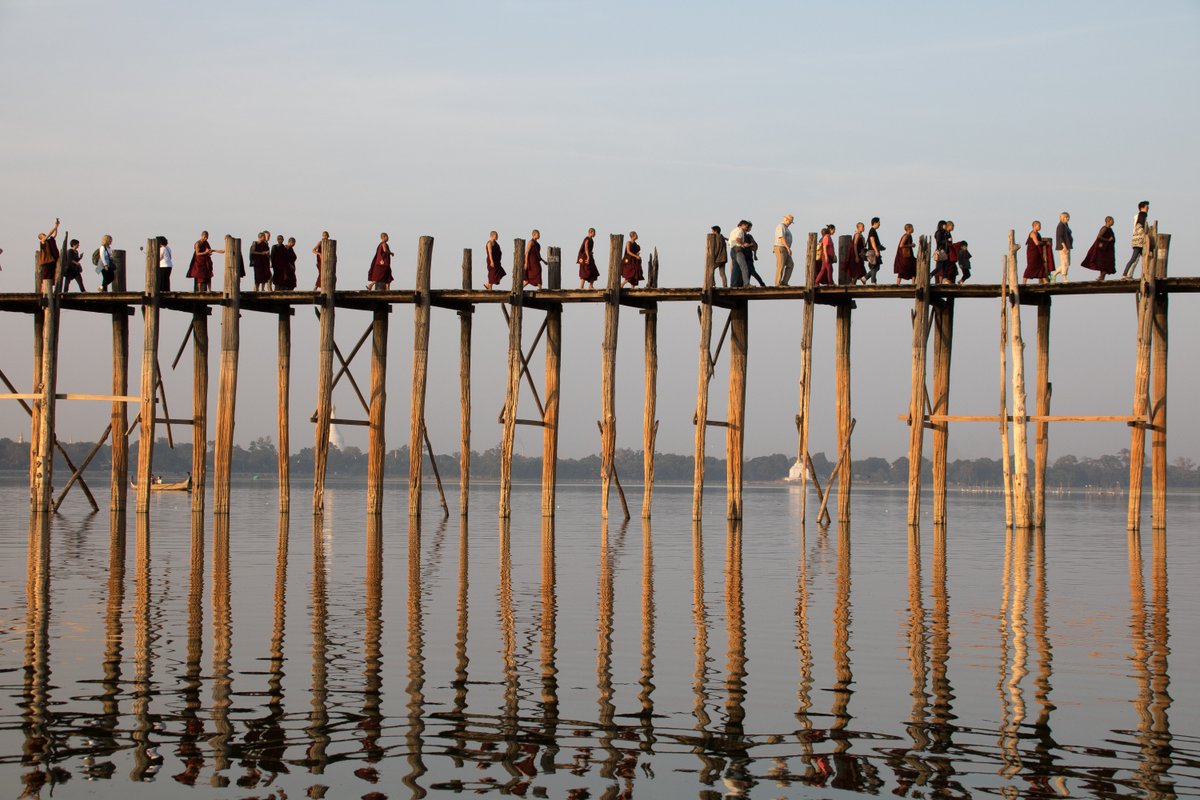
U Bein Bridge is one of Myanmar’s most photographed places. It’s a 1.2 kilometre long bridge over the shallow Lake Taungthaman, and it’s completely made of teak. After 200 years, most of the 1,000 teak poles supporting the bridge are original. The bridge is famous for the saffron robed monks who wander back and forth between the two monasteries on either side of the lake. However, now-a-days, it’s 2,000 tourists who wander across the bridge each day and I suspect that the monks that we saw were all tourists as well.
It was a pleasant place to stroll and I did some productive Monk-stalking. Just before sunset, we hired a small boat and along with a hundred other boats, we jostled for position to take the perfect sunset shot. Thank goodness we took a cold bottle of beer with us because it was a long wait on a hard wooden seat.
I’m starting to come down with a bad cold and we were both feeling a bit weary, so when we got back to the hotel, we ordered room service and had an early night.
14 January 2016 Mandalay, Myanmar
We have been woken each morning to a faint, irregular, but persistent chink-chink-chink, which sounds like a badly made clock. It’s take us a couple of days to find out that the noise is the sound of people hammering gold leaf in the streets behind the hotel.
Breakfast here is an odd, but pleasant affair. There’s normally a cauldron of Mohinga, which is a soup made from fish and is the traditional breakfast of Myanmar. Dotted around the cauldron are small bowls containing rice noodles, chopped hard boiled eggs, lime and an assortment of other titbits to spoon into the soup - it’s delicious.
In addition, there are a range of noodle dishes and curries and, for western tastes, scrambled eggs and tomatoes. There’s bread, butter and jam, but the bread is very sweet and only suitable for the “dessert” after the rest of the huge breakfast. It all tastes so good that I find it hard to stop and, combined with the huge meals at lunchtime, I expect to be 16 stone by the end of our holiday.
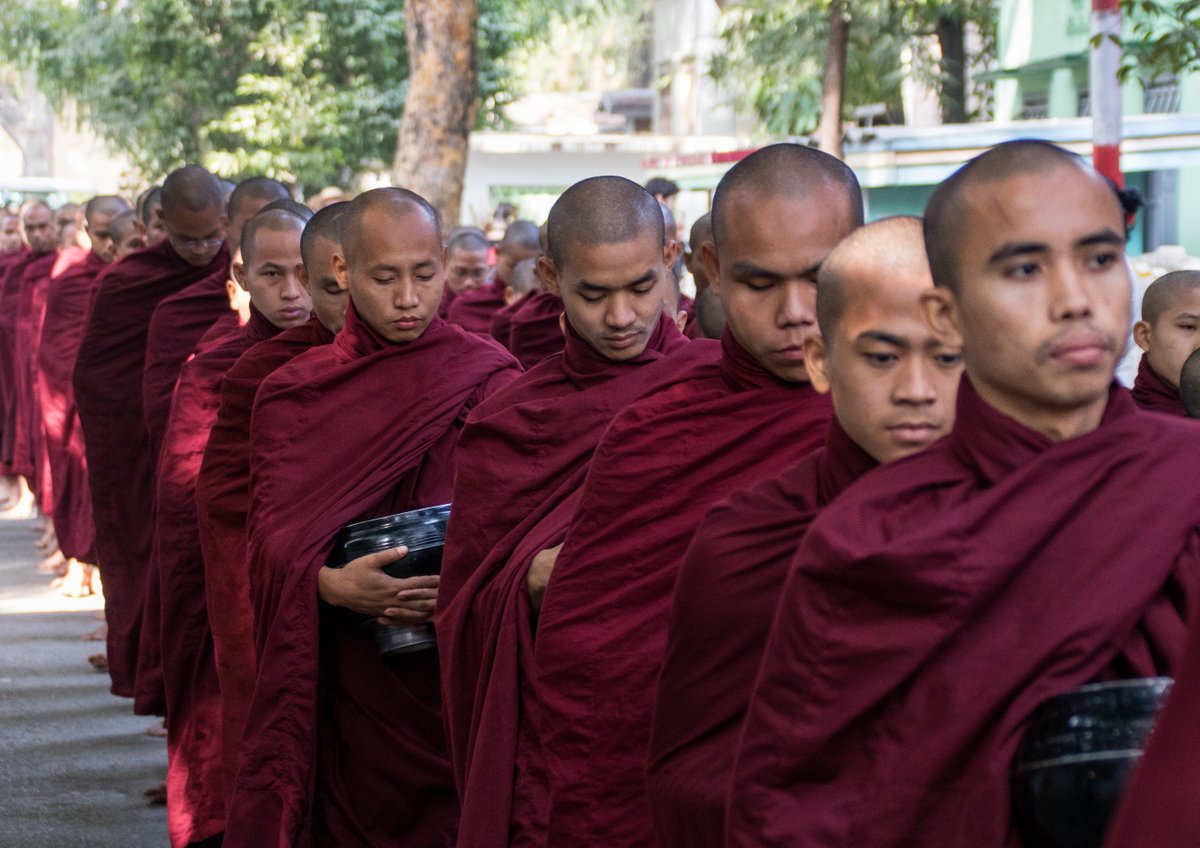
Moe Moe and Win picked us up at nine o’clock and whisked us off to a monastery in Amarapura called Maha Ganayon Kyaung. This monastery is home to 1,500 monks, half of whom get fed every morning in dining rooms where the public is allowed to watch. The monks form two lines at 10:15 precisely and then slowly walk along a road and into the dining area.
The poor monks have to walk past hundreds of tourists with huge cameras, who are all trying to get the best photo of a Buddhist Monk. I found it very intrusive and felt sorry for the monks, but it did give me some marvellous opportunities in my Monk-stalking. The trick was to try to get a picture without any other tourists in the frame and I managed to get a few good ones.

We were driven to a small ferry across a tributary of the Irrawaddy and climbed on board a horse and cart to be taken around the sights of the old city of Inwa, which was the capital of the Bamar people from 1364 to 1841.
A little history is needed here. Myanmar is a collection of ethnic groups and tribes that have been in both harmony and conflict with each other for thousands of years (in some regions the local indigenous people are still fighting the government army). The main ethnic groups are the Bamar, Shen , Chin, Kachin, Kayin, Kayh and Mon, these are further split into hundreds of tribes, many with their own customs and language.
The most powerful group is the Bamar, who live on the flat lands from Yangon to Mandalay and the current military government is mostly Bamar. The other groups tend to live in the outlying mountainous areas of the country and are fiercely proud of their heritage. When the British invaded and colonised the country, they focused on the Bamar controlled regions (hence “Burma”) and left the other groups manage themselves because they were too difficult to control.
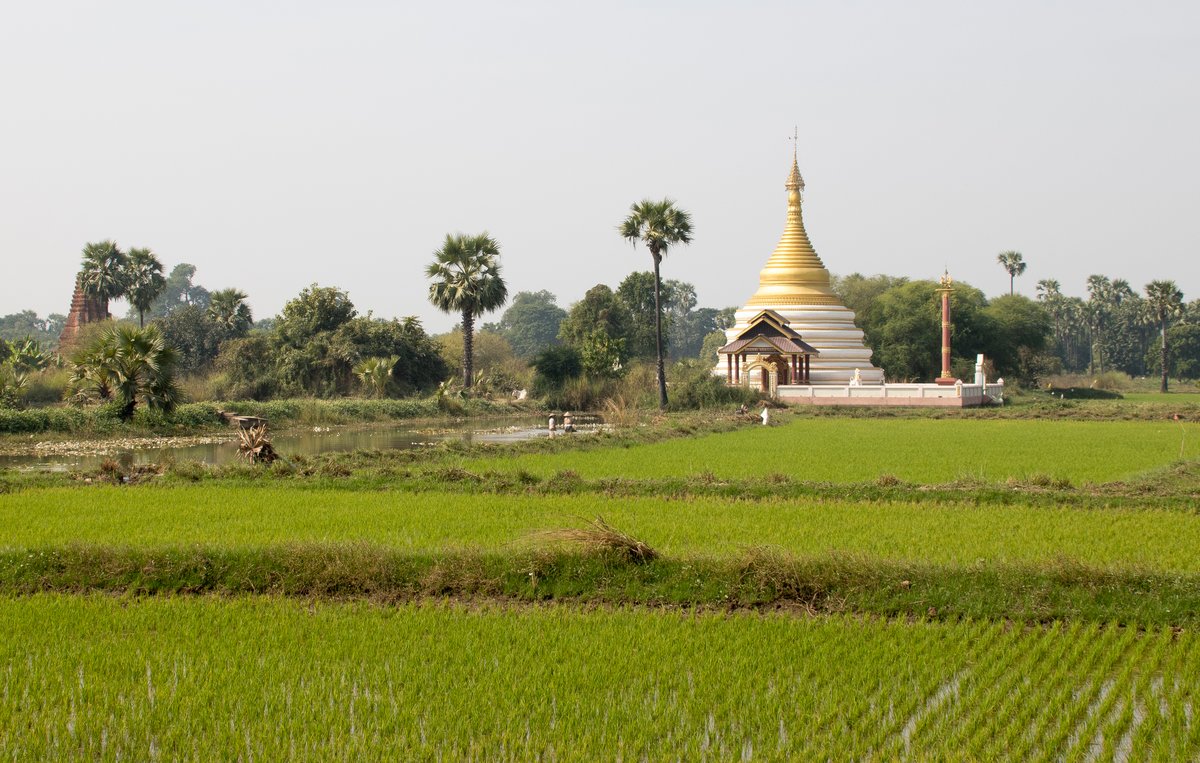
Our horse and cart trundled around various temples, stupas and pagodas. Bagaya Kyaung is a lovely monestary made from teak; and Maha Aungmye Bonzan is an impressive brick and stucco monastery built by a queen in 1822. There’s no sign that this was a major city, it’s lovely country side with rice fields and small villages in between the old monuments. Water buffalo and oxen are used to plough the land and oxen pull carts to transport the produce.

After a very nice lunch by the side of the river, we were taken back to the car and onto a pottery making area, where they (errr…) make pots out of clay. We had a stop at a lovely Nunnery, which was very peaceful and unlike the monasteries that we’ve visited, the nuns seemed to be learning something rather than aimlessly wandering about like the monks.

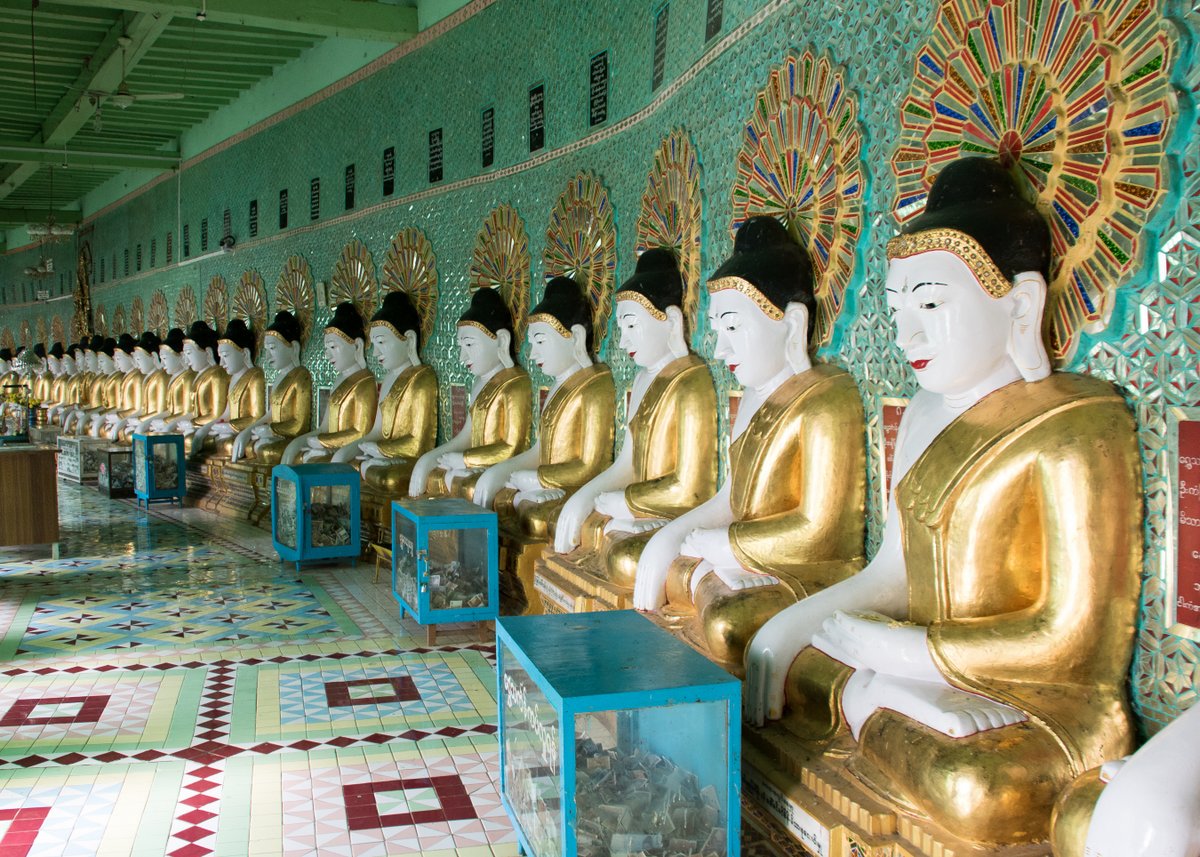
After a quick look at Sagaing Hill Monastery, with scores of Buddhas lined up on a curved terrace, we lost the will to do any more. My Man-Flu is getting worse and I was feeling very drained, so we were back at the hotel by 17:00. I couldn’t face going out for a meal, so we had room service again – chicken sandwiches. I must have been feeling bad because I couldn’t face even one beer.
15 January 2016 Mandalay to Hsipaw, Myanmar
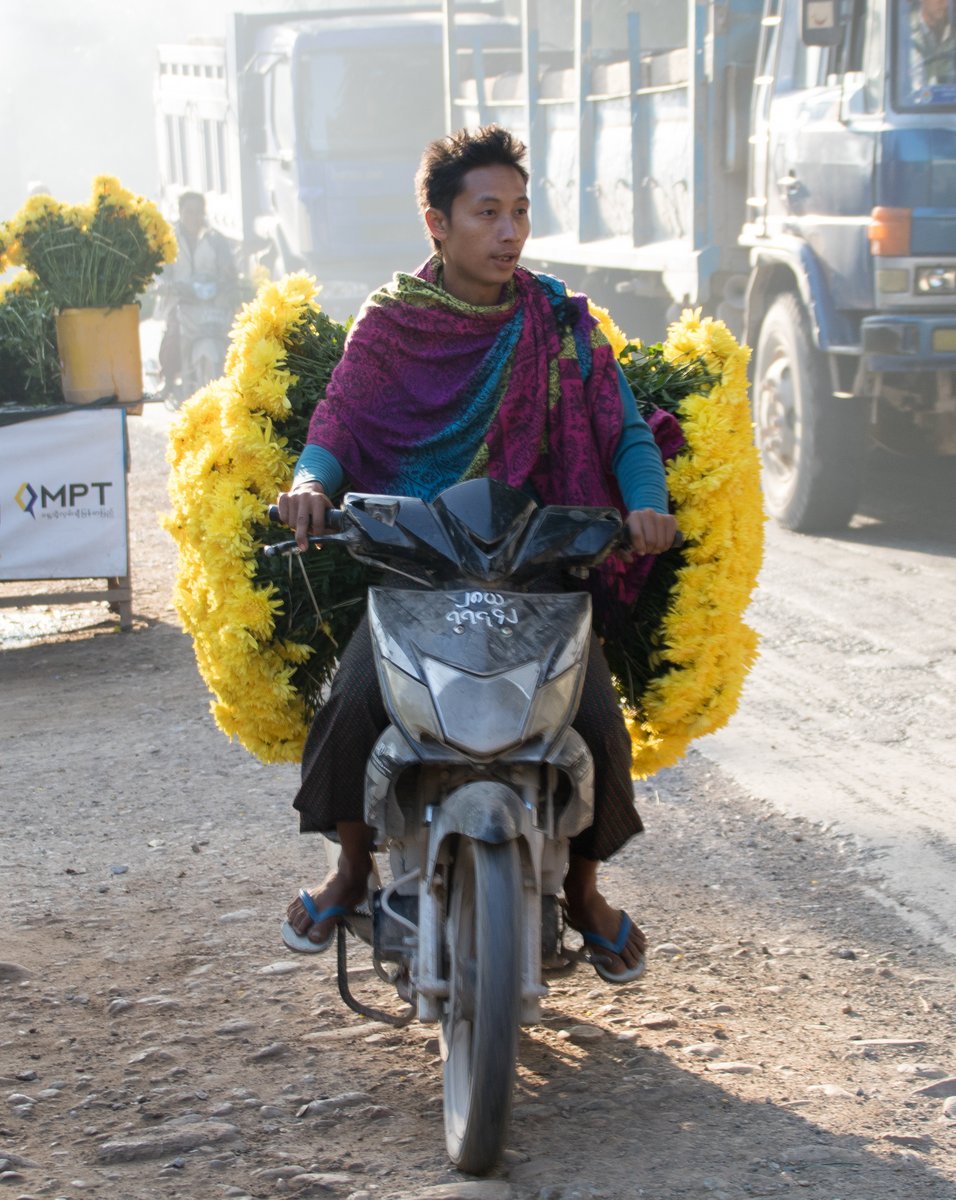
We had an early start with our driver, Win, picking us up at half past seven. After a restless night, I was feeling a little better, but was still suffering from Man-Flu. We had a one hour drive to Pyin Oo Lwin, stopping briefly to look at a place where the locals gather to sell flowers, mostly Chrysanthemums. The vendors carry huge bundles of the flowers on their motorbikes from the farms in Pyin Oo Lwin and buyers drive up from Mandalay to purchase the blooms mostly for temples.
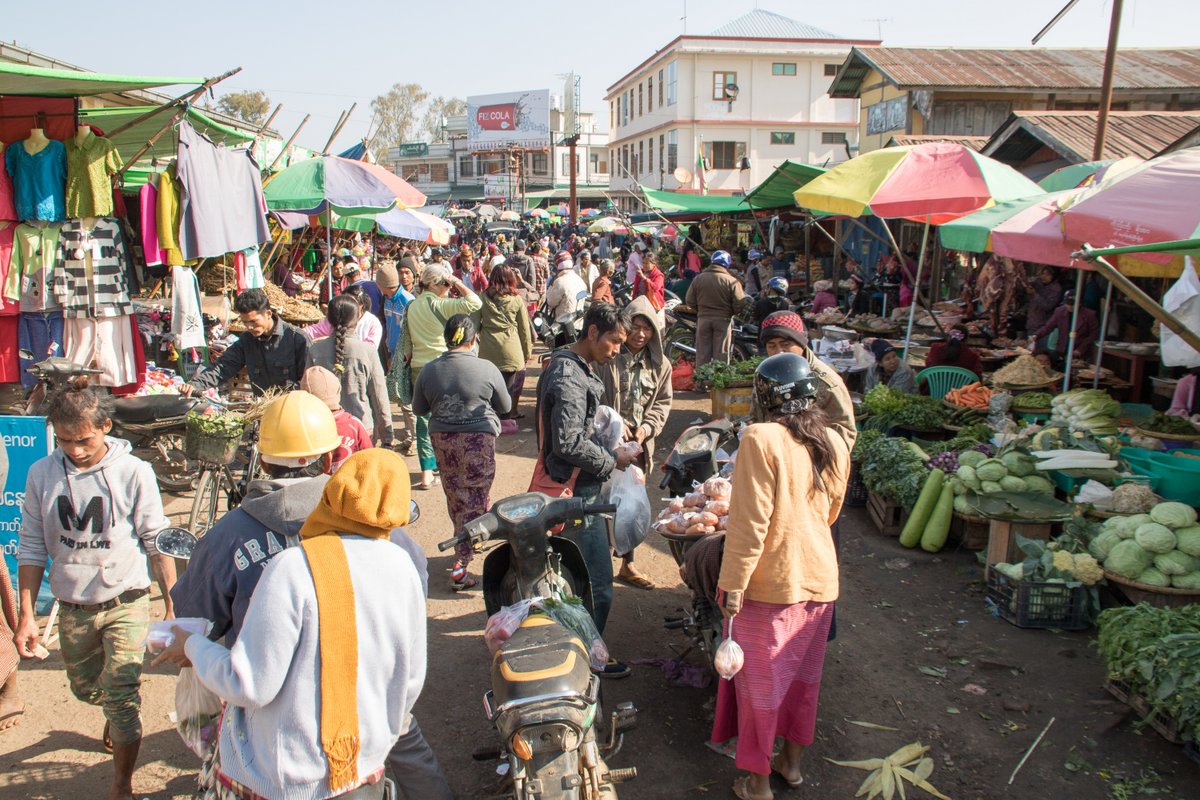
Win dropped us off at the Pyin Oo Lwin market, which is huge. We wandered the crowded, narrow aisles admiring the colourful displays of clothing, fruit, vegetables, steamed noodles and dried fish. Now that we have arrived in the Northern Shan region, Glenys bought herself a nice Shan longhi. Groups of young nuns weaved their way through the crowd chanting a song and stopping to accept donations from stall holders and the people shopping. The town is a popular place for tourists to visit from Mandalay, and the enterprising locals operate horse drawn carriages that look like stage coaches.
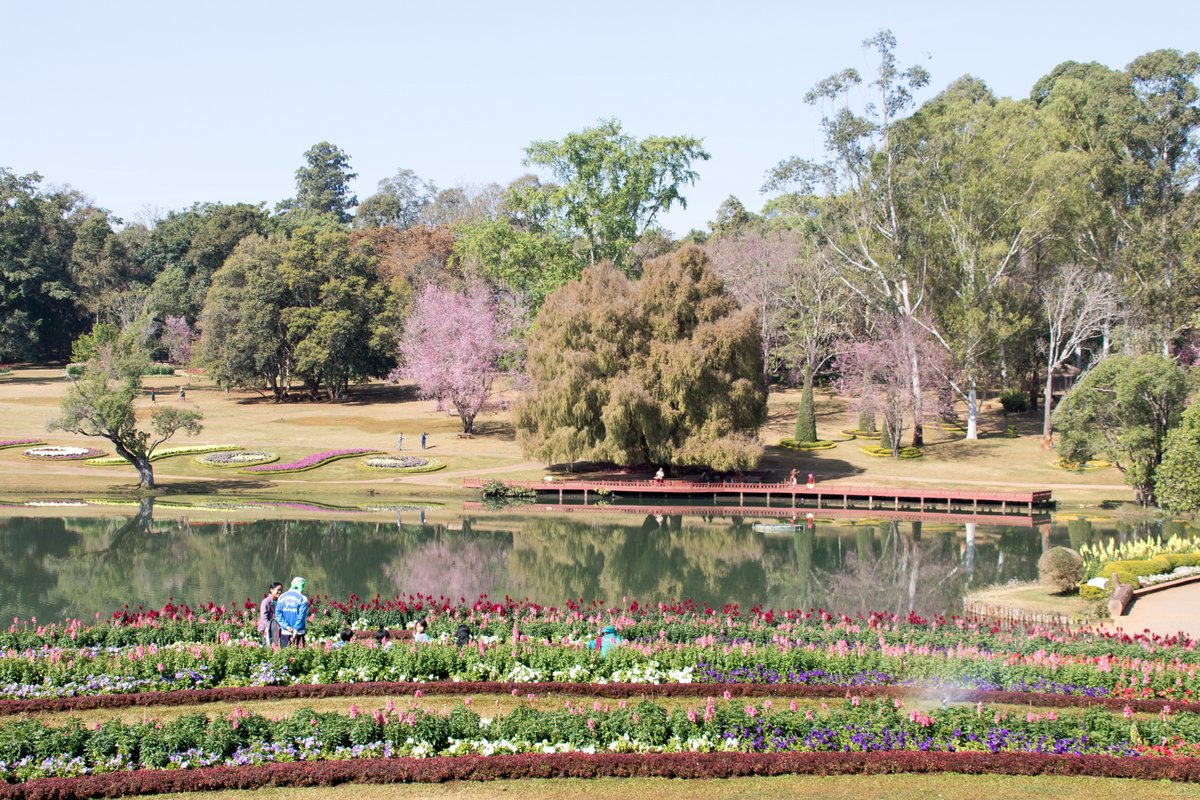
We went to the Kandawgyi Botanical Gardens which were created by a couple of British people in 1915 and look like the grounds of a stately home in England. Paths meander through wooded areas, past ornamental gardens and the central piece is a large lake complete with swans. There’s a very good orchid house and an aviary. It was a very pleasant way to spend a couple of hours away from the hustle and bustle of Mandalay.
After lunch at a very nice restaurant, we had a four hour drive along a very winding road to Hsipaw. This region of Myanmar is very dry and the dust is oppressive in some places. There are teak trees being grown everywhere and their large leaves are all covered in a thick layer of the fine dust.
As in most east-Asian countries, the locals drive very erratically, with motor bikes weaving in and out of the traffic. The road is a major highway to China, so there are many big trucks driving along the narrow road, making it difficult to go at a reasonable speed without facing a premature death.
They drive on the right hand side of the road and have some bizarre habits. If a driver thinks that it’s safe for someone to overtake him, then he puts on his left hand indicator (which also means that you want to turn left across the oncoming traffic). If he thinks that it’s impossible for someone to overtake, then he puts on his right indicator. This is totally opposite to any other country where you would put on your right indicator to signal to someone to overtake, meaning “I am pulling over to the nearside of the road”.
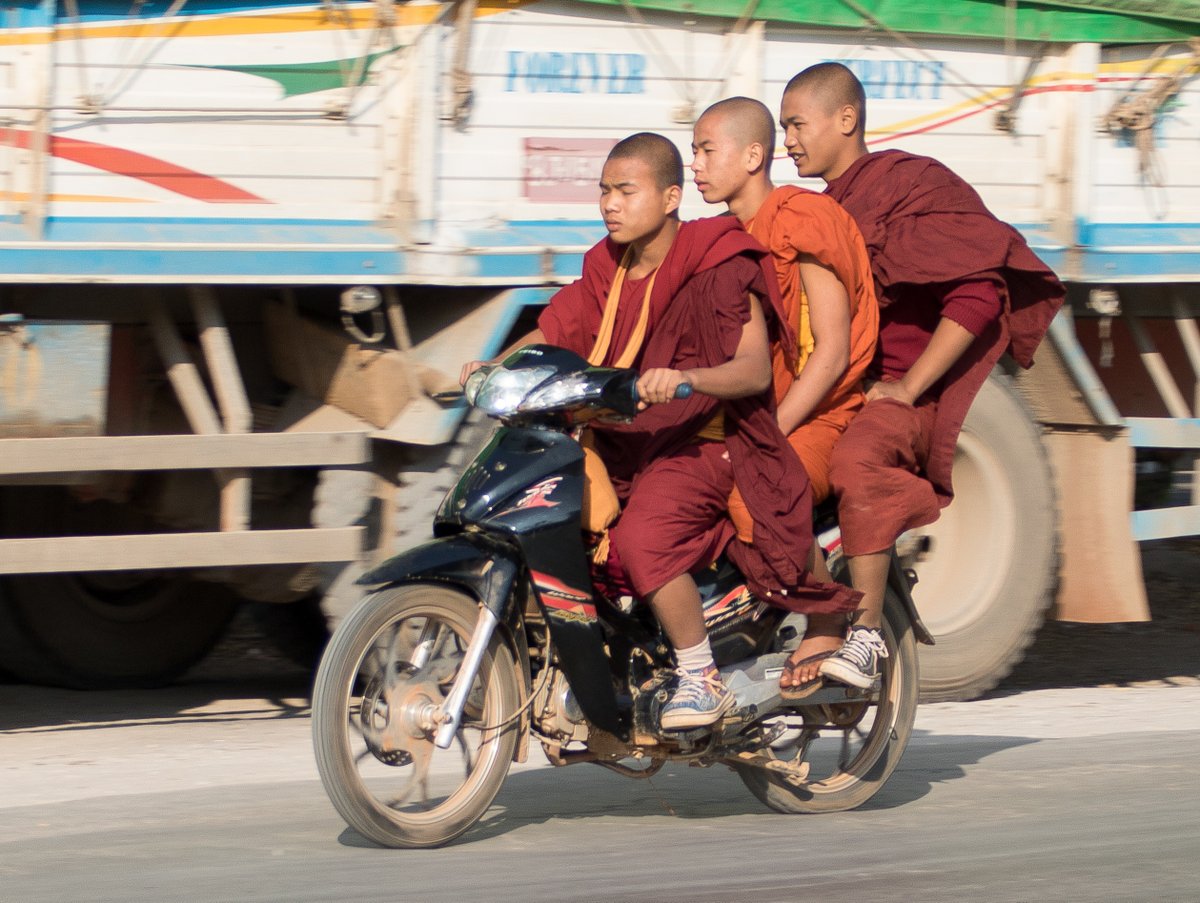
We called in at a village temple for a quick look. It was very impressive with all the walls covered with small mirrors making it shine in the sun. While we were there I noticed that the monks around here drive motor bikes, (which seems contrary to their humble life with no possessions), so I went into Monk-stalking mode, and managed to get a nice photograph of Three-Monks-On-A-Bike.
The Nai House Resort hotel is very nice with reasonable rooms, but it’s definitely colder up here. We went for a walk around Hsipaw, which is a dusty little town with a surprising amount of shops - I guess that it must be the main town for the area. We stopped off at the Café Terrace restaurant for a couple of beers overlooking the river which was very nice, but a little tourist enclave.
We had dinner at the hotel restaurant, which was good food, but expensive compared to other places. It’s all relative of course – the sweet and sour chicken cost 5,000 Kyat ($4.50 US), but didn’t include rice, so I threatened to walk out and they quickly included the rice. I suppose I’d been happier if the restaurant had been inside and warm. Instead, we were outside and it was bloody freezing - I had to go back to our room and get my waterproof hiking jacket to put on top of the two thin fleeces that I was already wearing.
16 January 2016 Hsipaw to Palaung Village, Myanmar
It was very cold last night forcing us to have three thick blankets on the bed. When we got up at seven o’clock, there was no electricity and it was so cold that we couldn’t face having a shower. Breakfast was in the freezing cold restaurant, but I had a really tasty traditional Shan soup - Glenys opted for the more traditional scrambled egg on toast.

Our guide Winco picked us up at 08:30 and after a short ride in a Toe-toe, we set off walking up to the hill village of Palaung. The morning was very misty and cold, but we soon warmed up with the exercise, hiking along a pleasant path. The sun quickly started to peek through the mist and by half past nine, we had blue skies.
The nice path soon degenerated into a dusty road, which we ground up for four hours. Fortunately, we had a few breaks and chatted to a guy riding a Water Buffalo. We made it to the village just after one o’clock and dropped our bags off at the homestay where we would be spending the night. They had prepared a big lunch of noodles, rice and two vegetarian dishes. The Shan people in this village are vegetarian.

After an hours rest, Winco took us for a two hour walk along a lovely path above the village, where we walked past tea plants, which are harvested for green tea drinks and also made into the fermented tea salad that the Myanmar people love. Back at the village, we stopped by at another traditional house where a couple of ladies served us green tea while we sat around their open wood fire, which is in their main living room. They couldn’t speak any English, but seemed to be delighted with us just being there.

We’re now in the Northern Shan province of Myanmar. The Shan people number seven million are and the second largest and we’ve been told that they are still fighting in the mountains against the Barma Government. The area to the north of here, on the border with Thailand is known as the Golden Triangle and used to be the main Heroin smuggling region. We were told that the governments have eradicated the heroin trade in the region.

In the evening we had very filling and tasty dinner – rice noodles, tofu, stir fried vegetables. There are five other tourists staying in the same house which apparently belongs to the chief of the village. He seems to have a monopoly and gets first choice of tourist staying. The other house that we visited has nobody staying tonight, which seems a shame – I’d like to ask to move, but no doubt someone would be offended, so I kept my mouth shut.
It was very cold. We were both forced to wear a fleece and a hiking jacket and we sloped off to bed at half past eight. It was very much like sleeping in a mountain hut. Everyone was allocated a thin mattress and blankets with mosquito nets overhead. There were seven tourists and guides on the first floor and the family were relegated to the ground floor – I have no idea how many they were... Glenys and I were given a bed in a partitioned off area, but after we’d gone to bed, one of the family came in and laid a mattress on the floor at the foot of our mattress – it was very cozy.
17 January 2016 Palaung Village to Hsipaw, Myanmar
What a cold night – I hadn’t arranged my blankets very well, so I kept getting arctic gales coming in under the side of my blanket. Some Russian guy was snoring for most of the night and a Dutch lady kept telling him (ineffectively) to shut up every so often, so it wasn’t the most restful of nights. I think that the village cocks started to crow at four o’clock in the morning and continued until the sun rose.
At around half past six, the small village monastery next door sounded off eight loud dongs on their gong, telling the villagers (and us) to get out of bed. There are 400 people living in Palaung village and their monastery has two adult monks and 10 or so young monks. Every morning the villagers prepare rice and other food to donate to the monastery. In big towns, the monks have to walk around and beg for their food, but here the villagers deliver food to the monks.
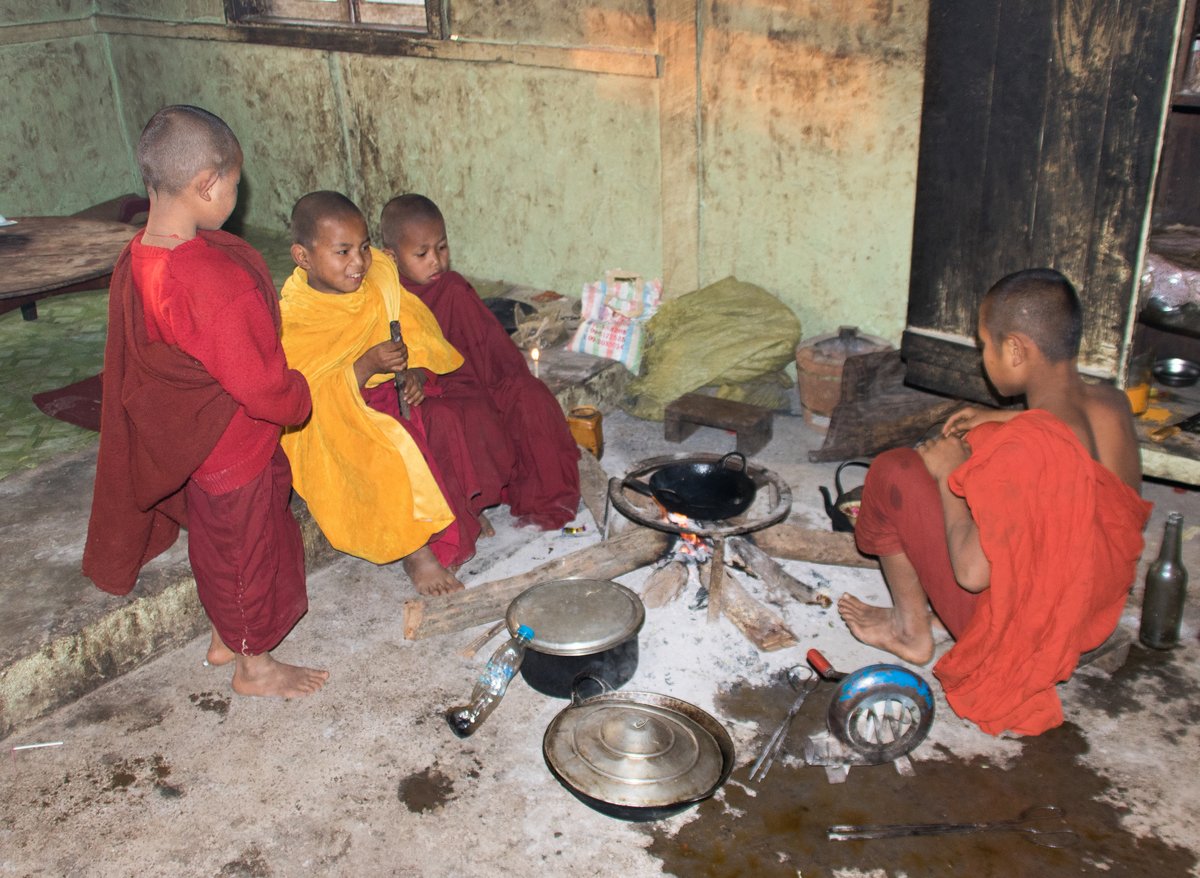
When someone says monastery, my first impression is of a towering granite fortress at the top of a snowy peak. This village monastery is more like a village hall – a single story, wooden building with a corrugated iron roof. It has a central area with a statue of Buddha, a couple of shrines around the place, a kitchen, a study and a large meeting/praying area in front of the Buddha. The place is a practical combination of a living area for the monks, a religious school and a village meeting hall.
Before breakfast, we wandered over to the monastery, saying “Com Sa” (Good Morning) to the villagers who were bringing food into the main hall. They all say a short prayer, kneeling before Buddha and then place cooked rice into big pot and take the other food into a kitchen where the bigger boys warm it up on a gas stove.
The young monks range in ages from five to sixteen years old and all come from the village, so they have known each other for all of their lives. There’s no silent devotion here – the young boys are pushing and punching each other to establish the kind of playground pecking order that one can see all over the world. However, they were a nice bunch of kids and happy to have their photographs taken. Winco tells me that many of them are orphans or children of single parents who can no longer afford look after them, so the monastery also acts as a welfare centre.
Breakfast was good and filling – rice, green beans, soup and a fried egg. As we walked out of the village, we met an old lady dressed in traditional Shan clothing, who let us take her picture and lamented that the traditions are being lost because the younger people don’t want to adhere to the traditional ways and clothing. It’s the same all over the world.


The walk back down to Hispaw was very pleasant and this time we avoided the monotonous road. We were back at the hotel just after lunch and chilled out for the rest of the afternoon. In the evening we went out to the Café Terrace restaurant for a couple of beers and ended up staying for dinner. I had poached fish in lemon sauce which is a local speciality and very good.
18 January 2016 Hsipaw to Mandalay, Myanmar
Our driver, Win, picked us up at the hotel at half past eight and took us to the railway station to catch a train to Nyaung Cho which is a third of the way towards Mandalay. There’s only one train a day that goes in that direction and it leaves at 09:40, so I thought that we were getting there way too early. But, after watching Win stand in a short queue of tourists for half an hour, I’d changed my mind. Goodness knows what the ticket guy was doing, but he wanted passports and wrote in several ledgers before he issued the tickets.
The train arrived roughly on time and all of the twenty tourists were piled into one Upper Class carriage. It cost us 1,700 Kyats ($1.40) each for the five hour journey and I believe that ordinary class was steerage was 700 Kyats. First class had comfy padded seats whereas ordinary class was wooden seats.

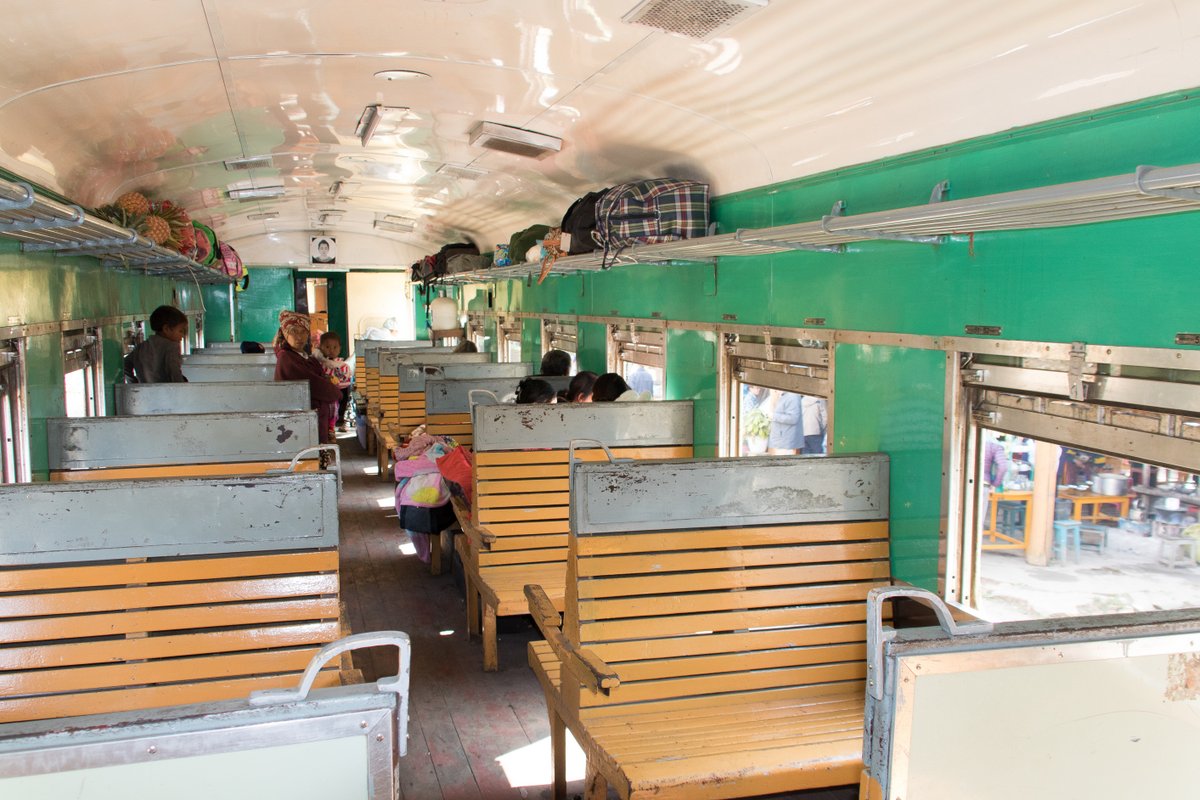

We’d been allocated seat numbers and I was very annoyed to find that our seats were facing the rear of the train, so that we would be going backwards. I had a complete sense of humour failure. Mr Win noticed that I was unhappy and called a guard over. To my amazement, the guard pressed a foot pedal and the whole double seat swivelled 180 degrees, so that we were facing forward – even the Swiss don’t have that technology on their trains!
As usual in Hsipaw, the morning was very cold (fleeces and a jacket), but that didn’t deter any of us from opening the windows on the carriage – it’s great to be sat by an open window on a train.
The diesel engine pulled us away from the station and the first thing I noticed was the strange rocking motion. Five degrees to the right and then five degrees to the left - it doesn’t sound a lot until you see the other carriage doing the opposite and feel yourself being tossed side to side every two seconds.
Fortunately, the top speed of the train was about thirty miles an hour, with an average more like fifteen, so the motion wasn’t too bad. We “sped” through rocky gullies with the walls very, very close – you could reach out and break your arm. The branches of shrubs occasionally swept in through the open windows as we wandered past, and through, the thick undergrowth lining the track.
When going up slight inclines, an oscillatory, up and down motion started which was so intense that the aged suspension on the train carriages couldn’t cope and there was an ominous, teeth rattling thumping coming from underneath the floor - it was all jolly good fun.
We stopped off at a couple of stations, where vendors flocked to the side of the train, carrying trays of snacks on their heads. By this time, the sun had started to break through the mist and we eagerly jumped off the train to bask in the sun, watching the colourful locals touting for business. The stops were quite lengthy at 30 minutes, so we had time to buy a few snacks – rice cakes, fermented tea salad and fresh pineapple with chili powder – interesting flavours.
Finally after four hours, the main objective came into view - a steel bridge over the Goeik Hteik Gorge, which is an impressive piece of engineering spanning a very deep gorge. We took the obligatory photos hanging out of the windows and waved at the locals walking about on the railway track - this is a popular destination for locals as well as tourists.

Win was waiting at Nyaung Cho station and we started heading back to Mandalay, stopping off at a waterfall. It’s a popular place for locals to visit, but wasn’t terribly interesting apart from doing some more Monk-stalking, taking pictures of monks having pictures taken with their visiting families. At one of the many small shops dotted around the waterfall, we bought some strawberry wine which is a local speciality - very sweet and strange.
We also called into a large impressive Buddhist Temple before a long drive back to Mandalay, arriving back at the Yuan Sheng Hotel in the afternoon. In the evening, we went out for a meal at the Aye Myitta restaurant on 81st street between 36th & 37th streets. It was a fabulous atmosphere, with very efficient and friendly waiters. The food was fabulous and inexpensive, they even had Myanmar beer.
19 January 2016 Mandalay to Bagan, Myanmar
The alarm went off at the ungodly hour of half past five. We picked up our two breakfasts-in-a-box and Win drove us to the Irrawaddy River where he loaded us onto a 100 foot river boat that was to take us on the eight hour trip to Bagan. The boat was nicely set-up for the long journey with sections of very high-tech red seats more suited to fast Hydrofoils than a slow chugging river boat.
There was a section with dining tables and a upper deck with outside seating, but it was far too cold to be exposed out there. We cowered down below and quietly read our books, ignoring the hundreds of golden topped pagodas sliding by on the distant river banks.
The ferry service included a pleasant breakfast in a box consisting of a hard-boiled egg, a croissant and a small Danish pastry, which supplemented our hotel’s breakfast in a box, giving us the opportunity to have a second breakfast mid-morning. They served us a choice of the ubiquitous Fried Rice or Fried Noodles for lunch.
The river is ¼ mile wide and there’s not much to do, so I camped down at one of the dining tables and caught up on my blog and editing photographs – I’ve taken and kept over 250 photographs in nine days, so I need to be more ruthless.

It was funny when we arrived at the riverside at Bagan. As soon as the boat had stopped moving, a dozen young men swarmed aboard, leaping from the boats next door. They came climbing through the windows like pirates and scrambling over the luggage that was piled up - and asking everyone if they needed a porter.
We politely declined, rescued our two cargo bags from the pile of luggage and ran the gauntlet of dozens of taxi drivers and would-be porters trying to take our bags as we struggled up the river bank. Fortunately, Pee Sue, our new driver, was waiting for us and whisked us off to the Hotel Zfreeti.
The hotel is very, very posh with a swimming pool and nice rooms. We couldn’t be bothered to go out for a meal and had our dinner in the bar next to the swimming pool – pizza and grilled pork chops for a change.
20 January 2016 Bagan, Myanmar
Breakfast was very good – too good in fact. There was a special egg chef, so I just had to have two fried eggs, with ham and baked beans, a croissant and a slice of toast. My waist line is expanding rapidly.
Aung, our guide for the day, met us at nine o’clock and we went to find a laundry as we were rapidly running out of clothes. The hotel charge $1US per item, which is outrageous, but we found a back-street place that did two bags for $12US.
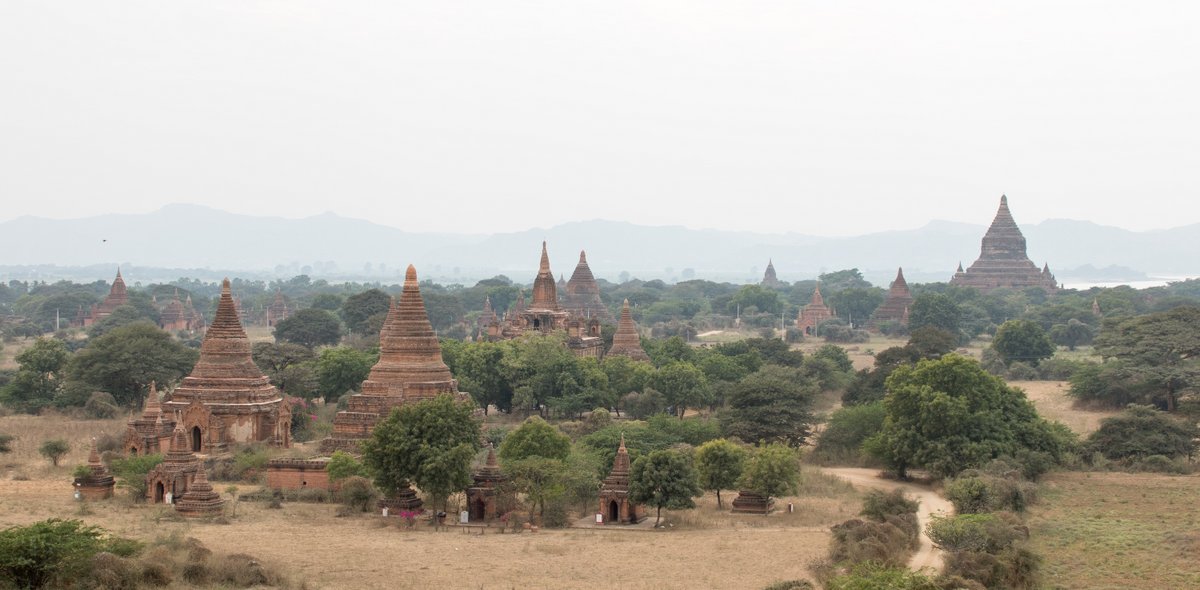
The morning was a blur of looking at Pagodas and Stupas (you can go inside a Pagoda, but Stupas are solid). Bagan was in its glory between the 11th and 13th Century.
In 1044, the Bamar King Anawrahta came to the throne and at the time Myanmar was in a period of transition between Hindu to Theravada Buddhist beliefs. Anawratha became a Buddhist and after being told that he couldn’t have any sacred texts, marched his army and seized some for himself including 32 sets of the Tripitaka. He then started a great programme of building, which continued for 200 years. In 1287, Bagan was overrun by the Mongol horders of Kublai Khan
As a small diversion, we were taken to a village, where the locals have set up a guided tour to show their way of life. It’s all a bit contrived, but is pleasantly done and the young lady that showed us around was very keen. They grow their own cotton then spin and dye it before weaving it into material. They also grow peanuts and turn it into oil. All very industrious.

Lunch was at a traditional Myanmar restaurant called “New Moon” in New Bagan and was very good, with the usual plethora of small dishes accompanying the main curry. It was far too much for lunch, but what the hell, we’re on holiday.
The afternoon was a bigger blur of temples, Pagodas and Stupas and we were told endless facts about Buddhism. I found it interesting that Buddha was born over 2,500 years ago, as Prince Siddhartha Gautama , becoming enlightened at 35 and passing away when, at 80, he achieved Nirvana. He taught that only by reaching a state of complete wisdom and non-desire can one attain true happiness. According to Buddha there are four noble truths:
- Life is Dukkha (Unsatisfactory)
- Dukkha comes from Tanha (Selfish desire)
- When one forsakes selfish desire, suffering will be extinguished.
- The Eightfold Path (Morality, Concentration, Wisdom and Insight) is the way to eliminate selfish desire.
So basically, life is horrible, so you need to meditate and have no desires (which will probably make you miserable) and then you die, but at least as a Buddhist you will be re-incarnated.
One of the “Highlights” of a trip to Bagan is to watch the sunset from a temple. The most popular place is a temple called Dhammayangyl, but it gets very crowded, so we asked Aung to take us somewhere quieter. We arrived at a temple an hour before sunset and to our delight found that there was only one other person there. Then people started to roll up and by sunset there were about thirty people perched on top of our temple.
The sunset was very bland, but the temples looked ethereal in the soft light of dusk.

21 January 2016 Bagan, Myanmar
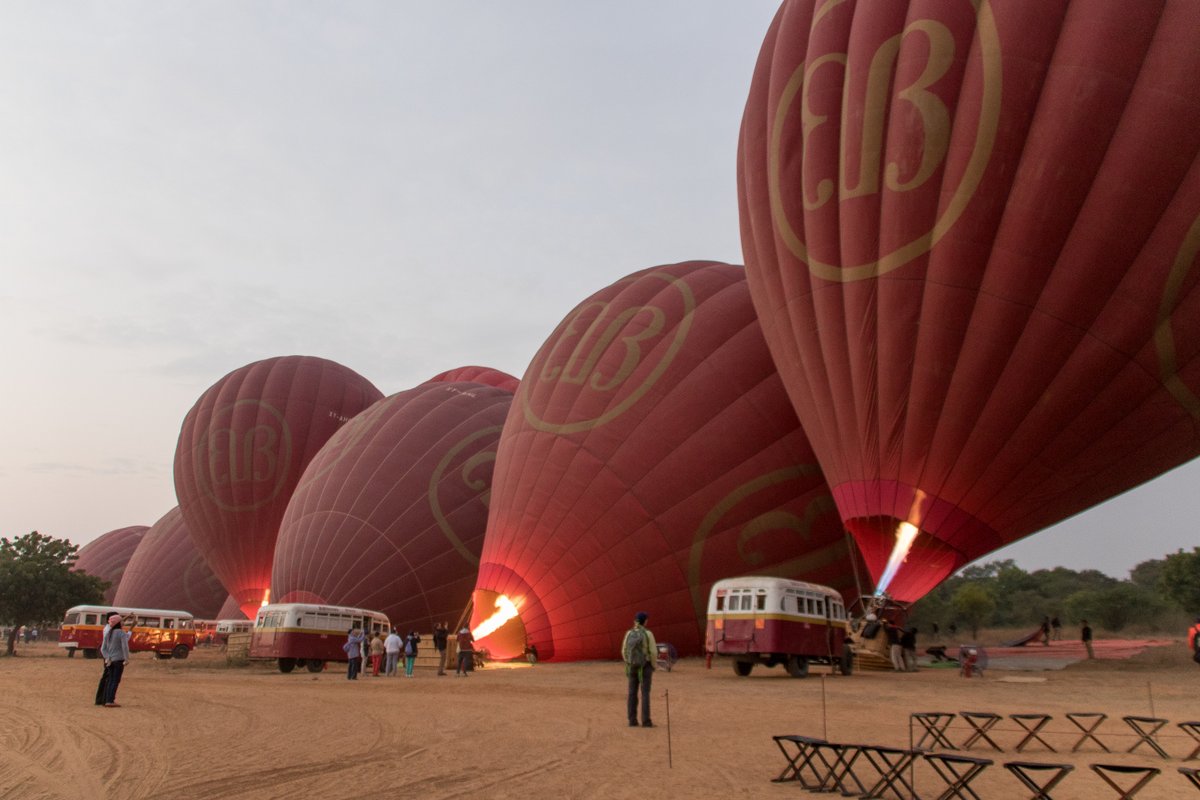
We were up an hour before dawn and a rickety old wooden bus picked us up at the hotel, transporting us to the “Balloons Over Bagan” launch site. It’s an impressive operation with a dozen burgundy coloured hot air ballons being prepared to take 175 tourists on a flight over the Bagan temples. Most of the balloons carry 16 people, but we’d gone for the slightly more expensive option of only 8 people in the basket.
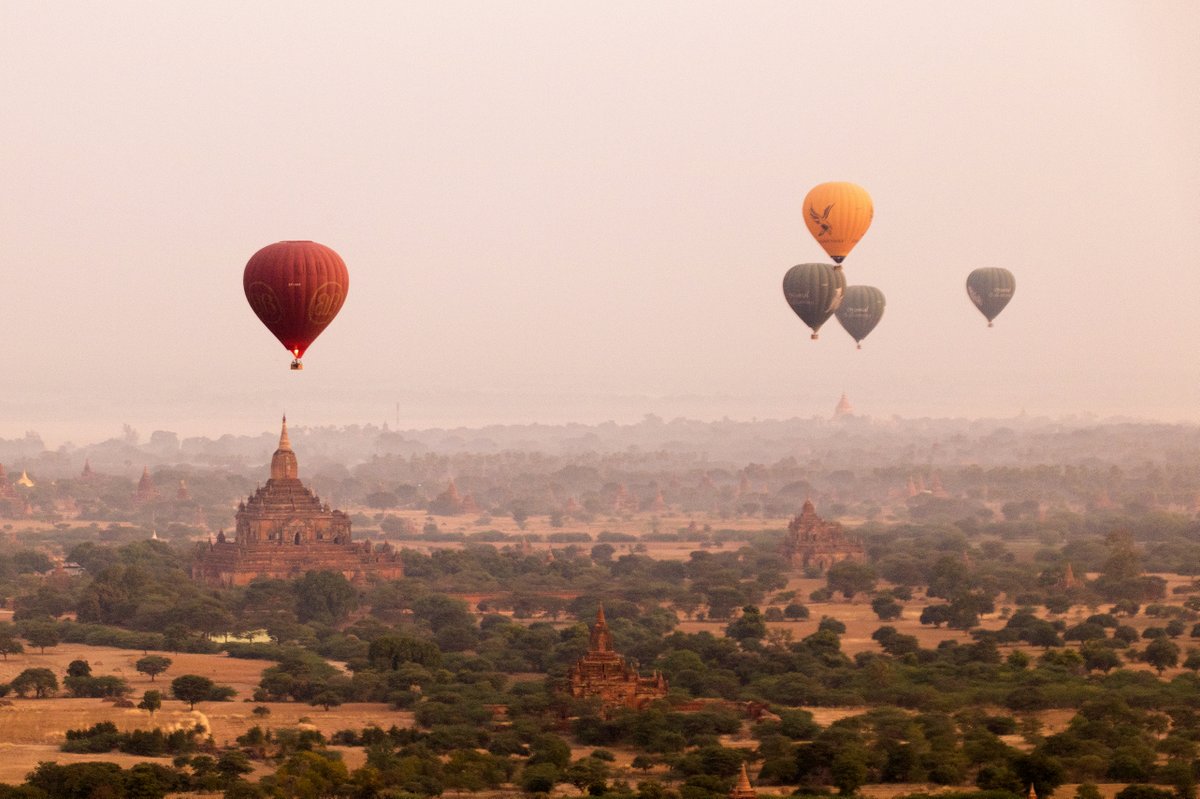
We took off just after dawn and it was a marvellous sight to have so many balloons in the air at the same time. The view of the hundreds of temples from the air is stunning. There was quite a strong wind, so our flight was a little shorter than normal and forty minutes later, our pilot was expertly manoeuvring us into a gentle landing in a field, where we were treated to a few glasses of champagne and some cake for breakfast. It was an expensive trip at $300USD each, but worth every penny.
After a proper breakfast back at the hotel, we hired a pair of e-bikes (motor scooters with electric motors) and went off on our own to explore more temples including the very large Ananda Temple. There’s a religious festival being staged at Ananda, so many local people are traveling into Bagan from outlying villages. They arrive on ox-carts and have set up camp, near to Ananda. Their makeshift tents are set up between the ancient stupas making an interesting sight.

There are lots of tourist restaurants in the area around the hotel, so we ventured out and had an Indian Curry for a change from Myanmar food, but it was very mediocre.
22 January 2016 Bagan to Kalaw, Myanmar
Our driver picked us up after a substantial breakfast and drove us to the town of Kalaw - five hours away. After a couple of hours, we stopped at Mount Popa where there’s a monastery perched on top of a small, steep-sided, rocky mountain. It looks incredible from a distance - just what you’d expect a Buddhist Monastery to look like.
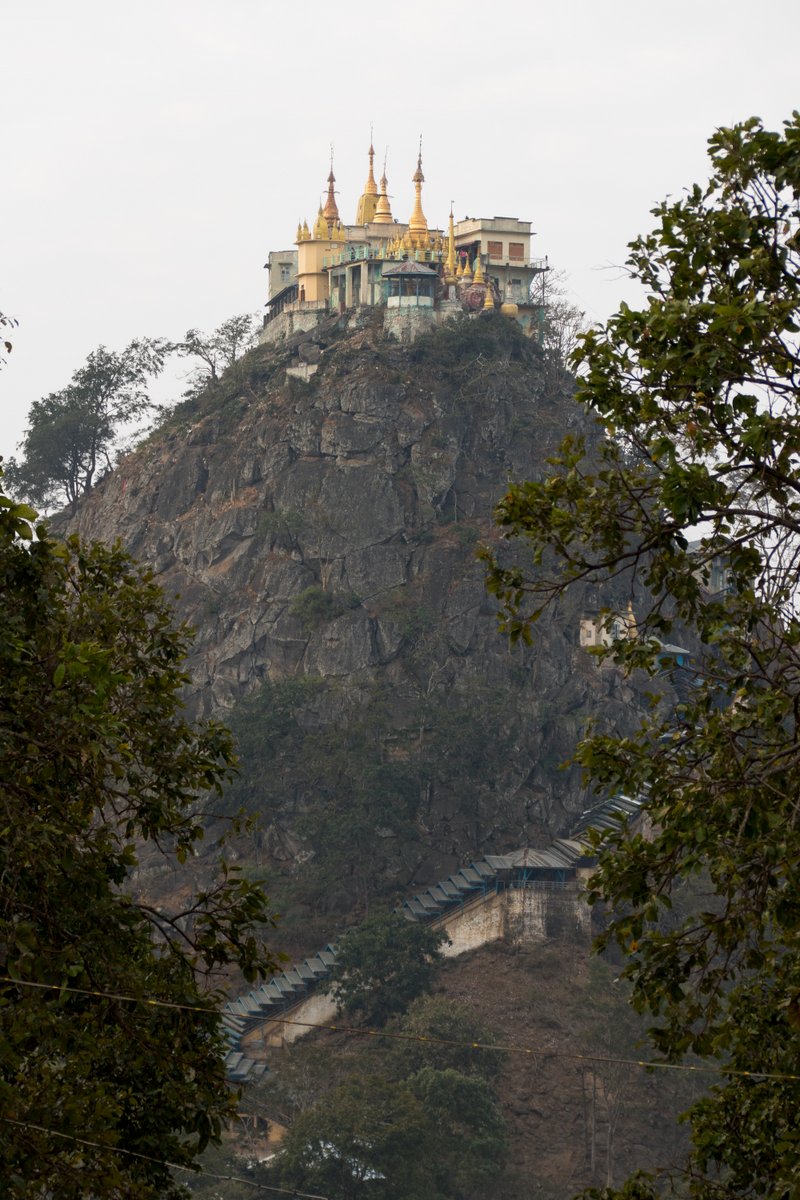
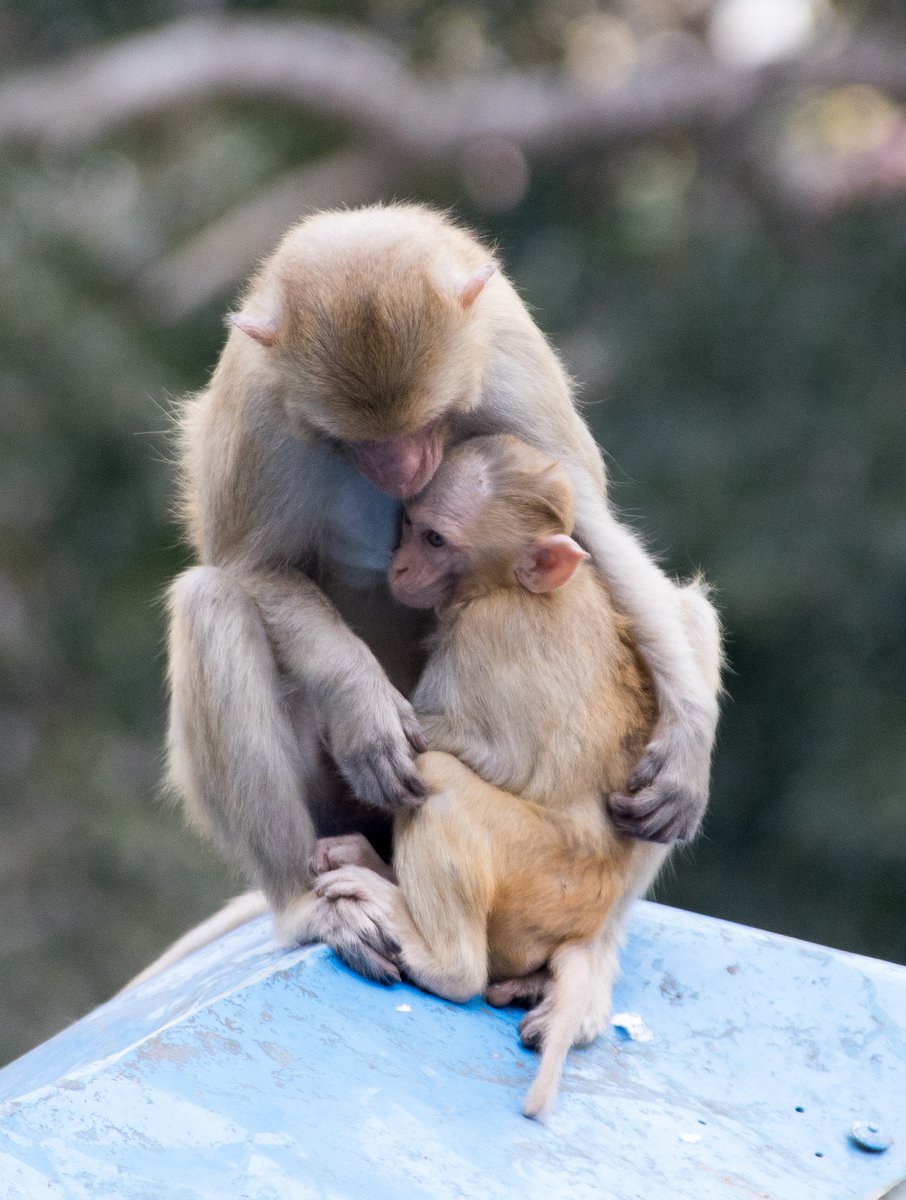
The driver dropped us off at the village underneath the monastery and we started the long climb up hundreds of concrete steps. Being a sacred place, it is forbidden to wear shoes, so we trudged up in bare feet, which was fine apart from the poo left by the hundreds of Long Tailed Macaques, who live on the mountain and beg for food. Fortunately, there are scores of enterprising men, who continually sweep the steps and then beg for money.
As usual, all the way up the steps, there are hundreds of small shops selling souvenirs to the pilgrims who flock to this holy place. The monastery itself is non-descript and rather scruffy, but the view from the top of the mountain is worth the climb.
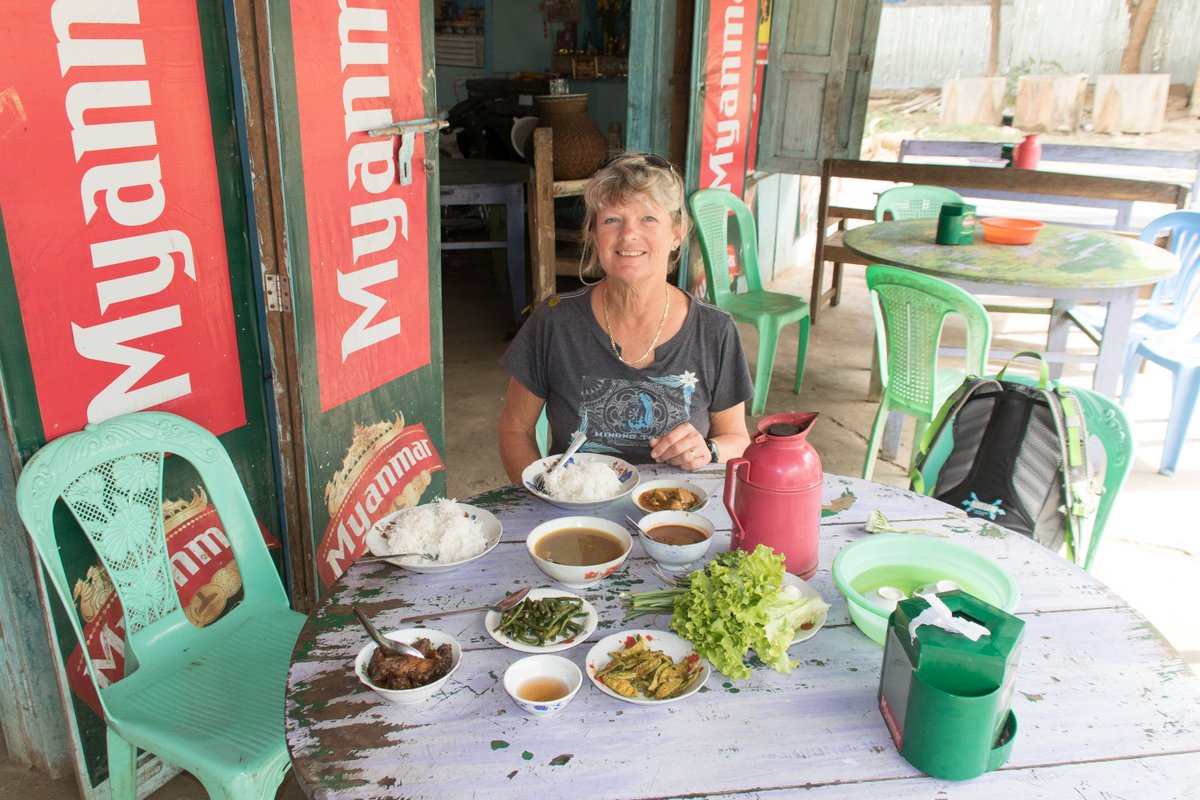
Back in the car, we stopped at a small road side eatery, which was very run-down. Our driver ordered the food for us and it was interesting that we had a main meal accompanied by lots of small side dishes even in this very down market restaurant.
The Dream Villa Hotel in Kalaw is basic, but clean and they told us that a guide is coming at 08:30 tomorrow to take us on a three day trek. In evening, we went out and walked around the bustling little town. We had a beer at one restaurant and then a dahl curry at a place called Everest which strangely is run by people from Nepal. Apparently, at the end of the Second World War, many Gurkhas from the British Army were based in Burma and settled here.
23 January 2016 Kalaw to La Mine Village, Myanmar
We polished off a huge American style breakfast – fruit, pancake, eggs on toast. Our guide Zho Zho arrived at 08:30. He was only 18 years old and this was one of his first trips as a guide, so he was very nervous. To make matters worse, he doesn’t speak much English and was very worried despite us trying to ease his mind.
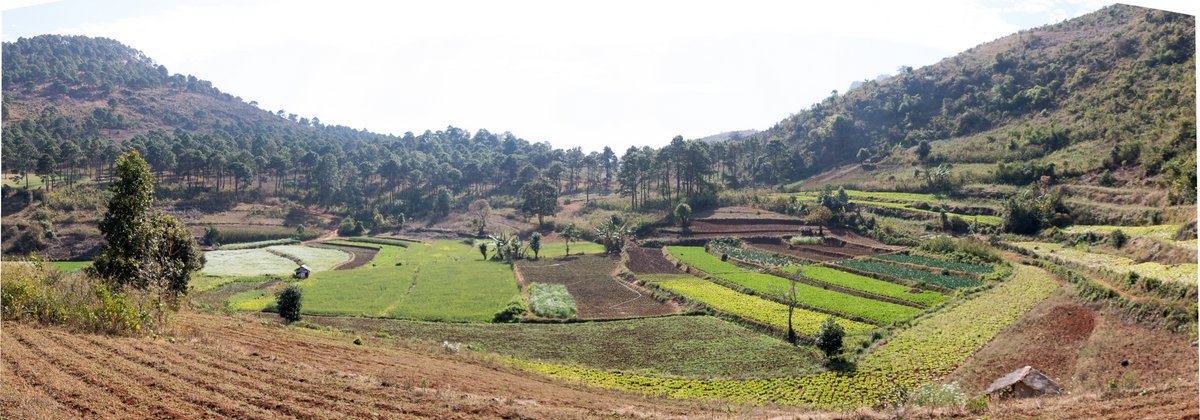
After walking through the local market where villagers bring in their produce, we headed off into the hills surrounding the small town. The paths wandered through a pleasant pine forest, very reminiscent of the lower slopes in the European Alps.
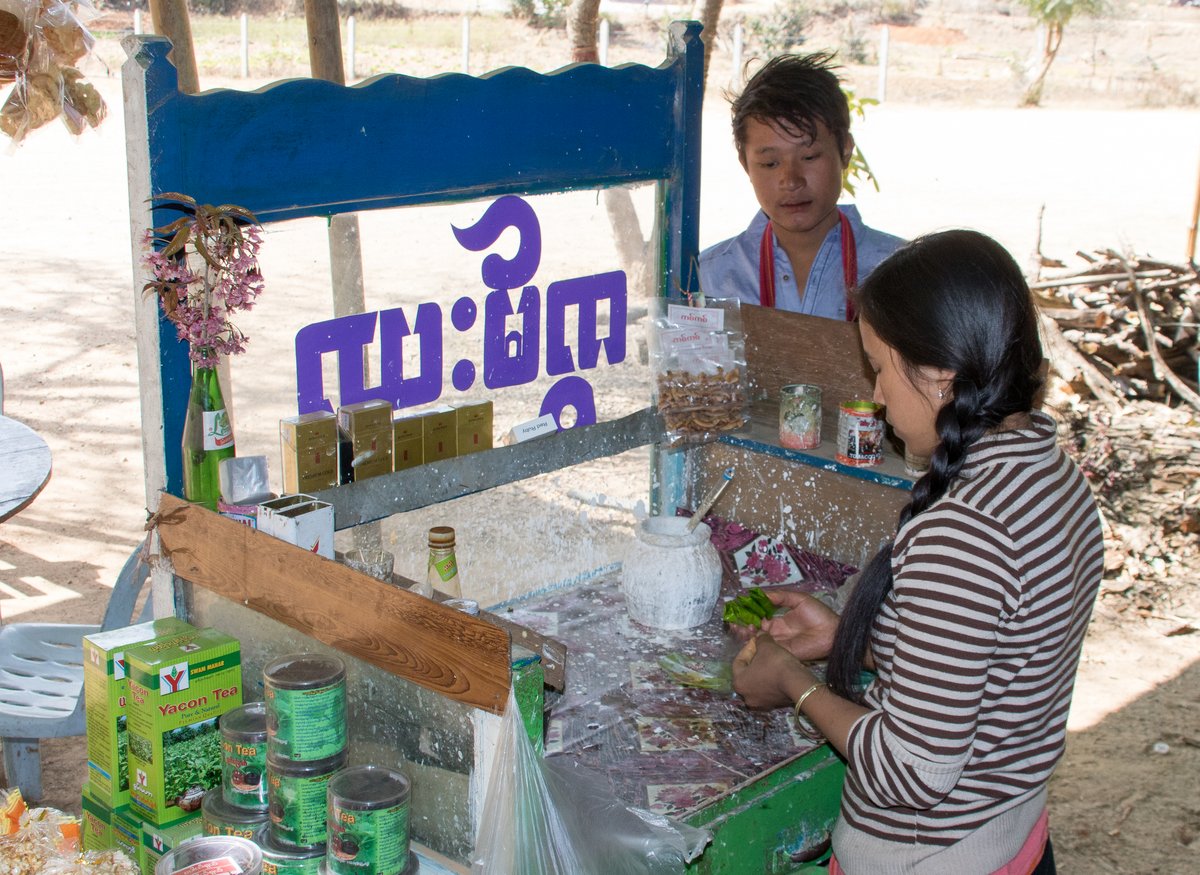
We stopped for lunch at the Myin Ma Hit caves, where we were served with another huge multi-dish lunch. At the front of the restaurant, there was a small table with a sign, which I’ve seen at several places over the last couple of weeks. It turns out that it’s a stand to sell Betel Nut. In Papua New Guinea, they carry the three raw ingredients; Betel-nut, Mustard Leaf and Lime Powder around in a small bag. Here in Myanmar, they purchase convenient little packages of chopped Betel Nut, mixed with lime power and spices, all wrapped up in a mustard leaf - ready to pop into your mouth.
After lunch, we popped into the Myin Ma Hit caves, where we spent and interesting half an hour walking around the caves looking at the hundreds of Buddahs perched on shelves and alcoves carved out of the rock.
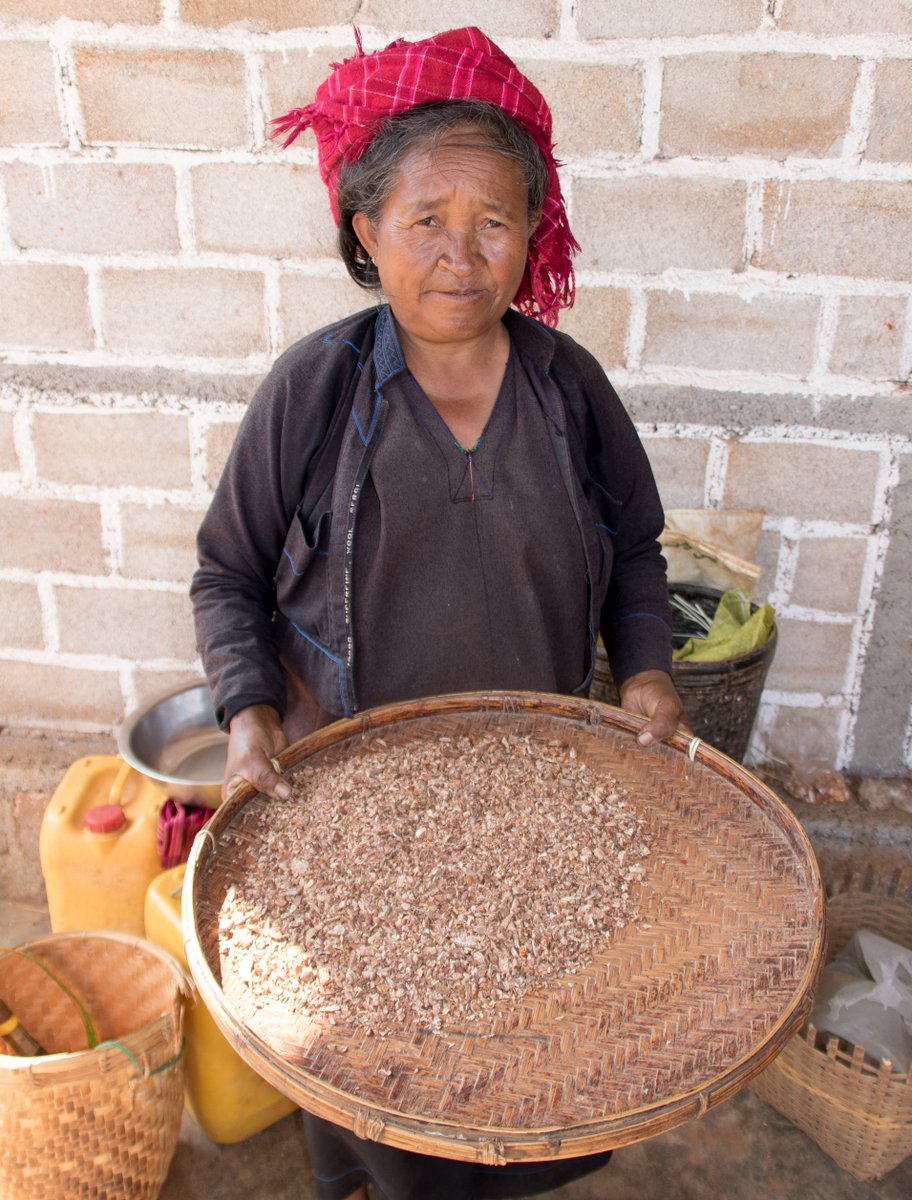
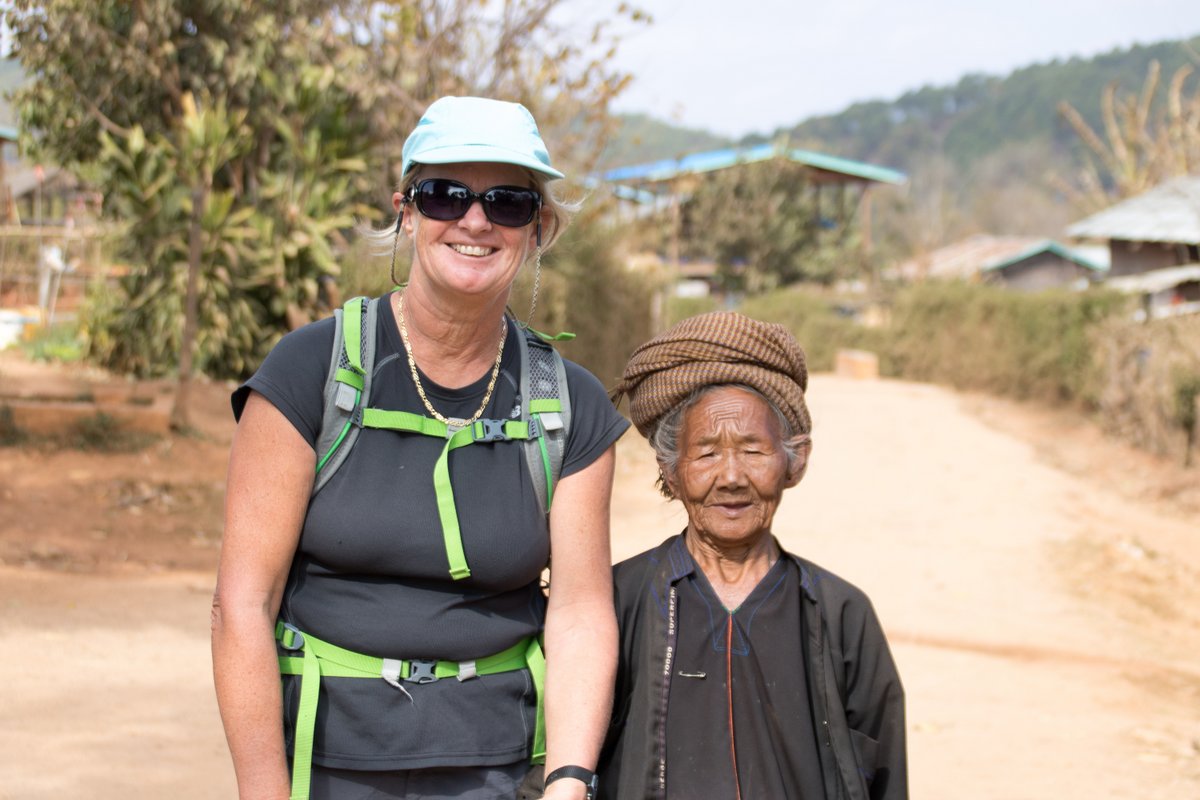
We walked for an hour or so and then stopped off in a small village called Inwan. An old lady invited us into her house for a chat, but it was a little strained because Zaw Zaw wasn’t too good at translating. The lady was very nice though and showed us her stash of Betel Nut, which she was in the process of sieving after chopping it up. As we were leaving the village, we met an 81 year old lady, who was tiny compared to Glenys. She was dressed in the traditional clothes of the Baho tribe.
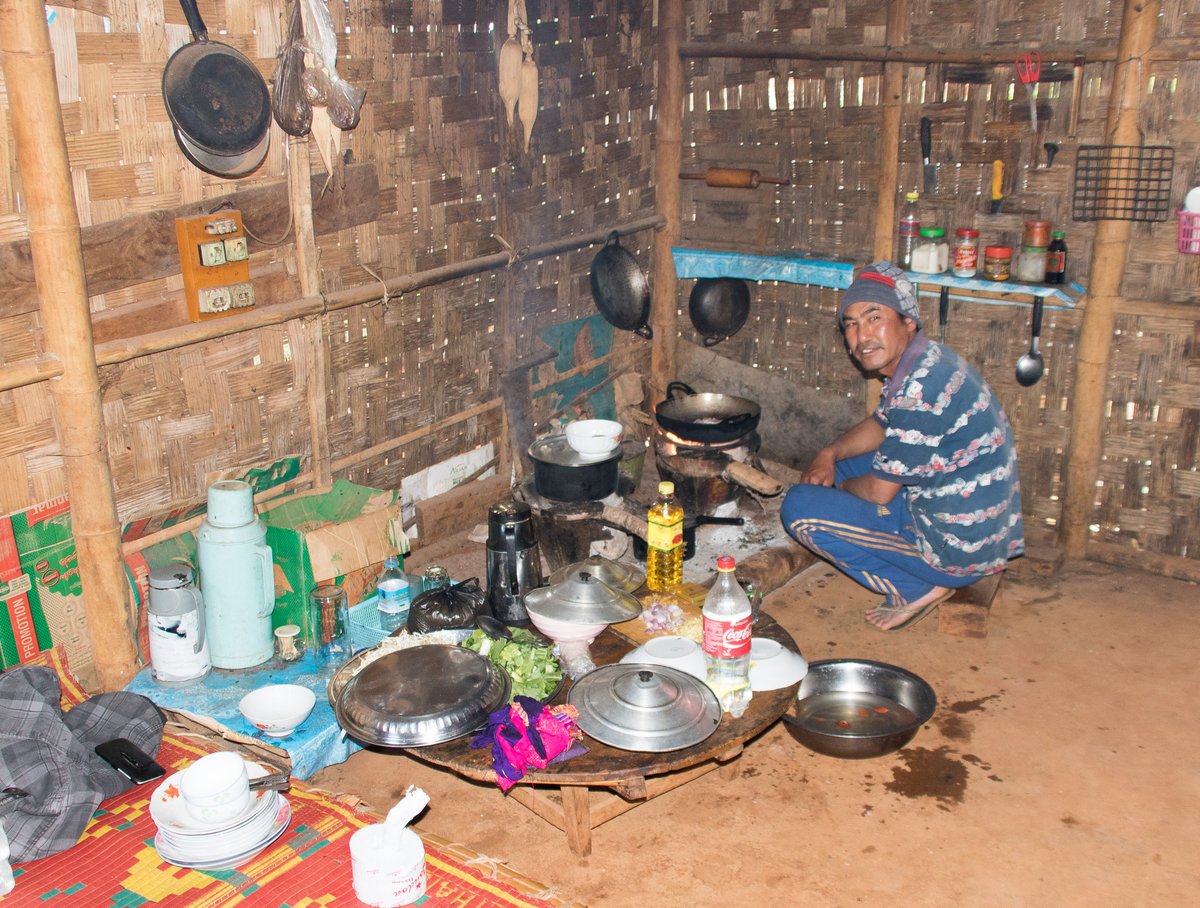
Zho Zho got a bit lost, but eventually found his way to La Mine Village where we stayed for the night. The guiding organisation sends out a cook to prepare the evening meals for the tourists who are staying in a home stay. I guess that they’ve had tourist complain about bad meals. The cook was brilliant and prepared us (another) huge meal of curried fish, rice and four vegetable dishes and even a dish full of French Fries.
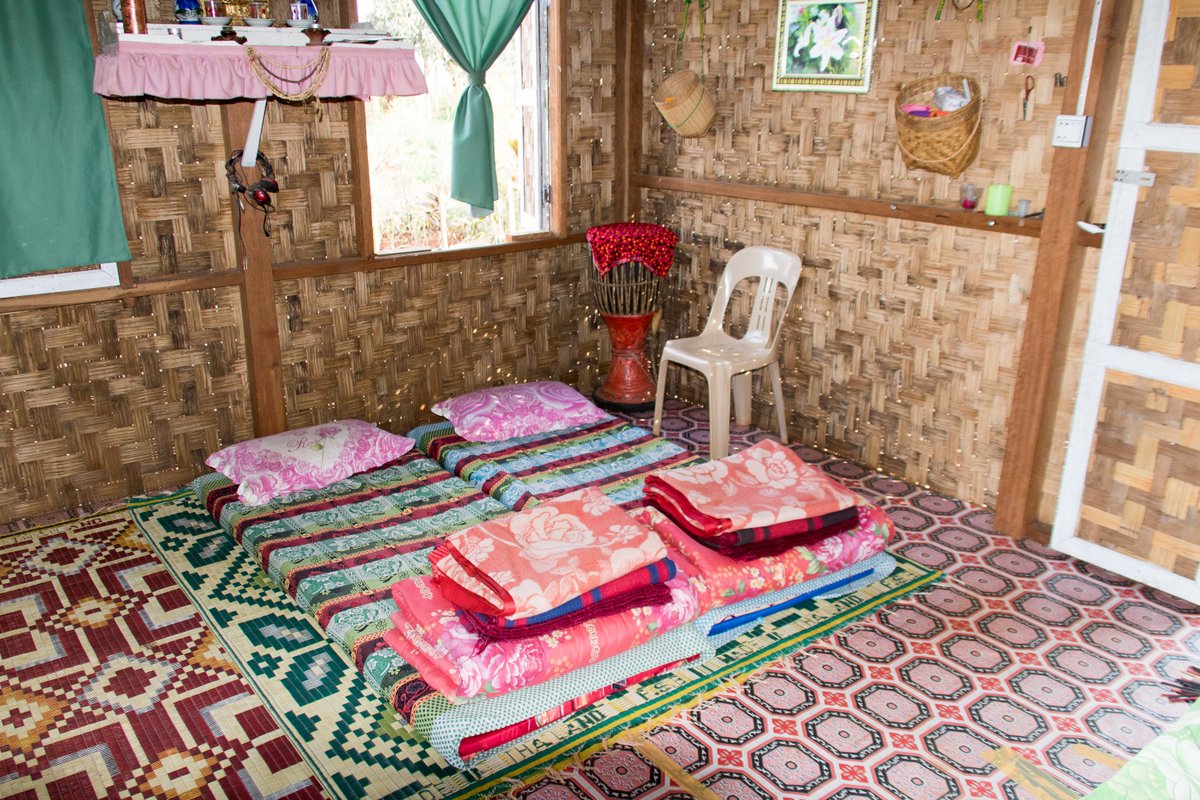
We slept in the family's living room while they and their young girl slept in a bedroom. Zho Zho and the cook slept in the kitchen, which was a separate building.
24 January 2016 Kalaw to Htee Thein Monastery, Myanmar
It wasn’t the best night’s sleep that I’ve had – the thick blankets on top of me were threatening to crush my chest. Our personal cook produced fruit, pancakes and a fried egg for breakfast – I’m starting to miss Mohinga with noodles and stir fried vegetables.
We had a very pleasant three hour hike, through farm land with various crops including corn, wheat, bitter mustard (whatever that is) and chilies. It seems to be the season for chili because there are fields and fields of the two foot high plants, brimming with bright red chilies. The farm workers are out in force laboriously hand-picking the chilies and placing then in woven baskets on their backs – it looks damn hard work. In the fields and villages, there are bright red patches where chilies are spread out to dry in the sun, with ladies picking through them or turning them over.

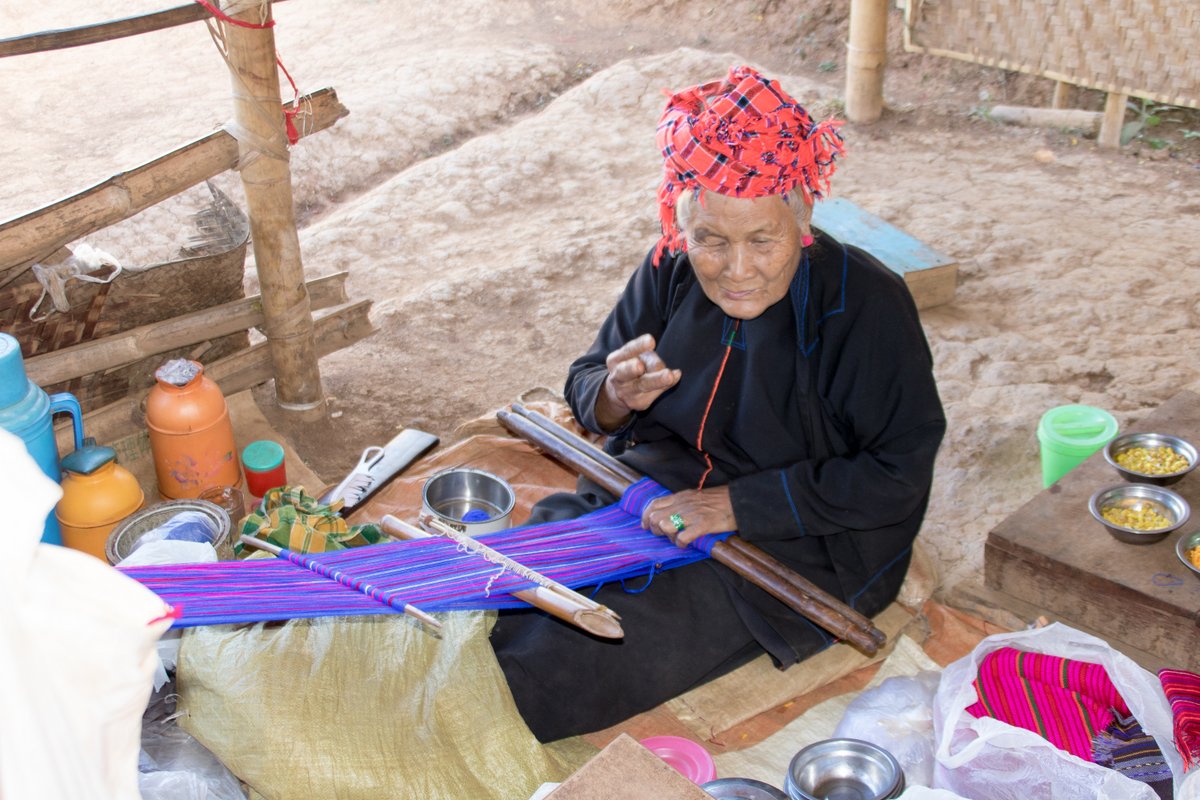
The area that we were passing through was Southern Shan and is inhabited the Baho tribe, who seemed a bit more reserved that the other people that we’ve met. Zho Zho told us that they don’t mix well with other Myanmar people, have their own language and don’t often marry outside their tribe. We stopped off at one village where an old lady showed us how they traditionally weave on a hand loom. Glenys bought a hand-woven Shan bag from her.
We had lunch at Kone La village in someone’s living room compete with a young boy watching an Anime cartoon. They prepared us a fried noodle dish, which wasn’t very spicy, so I asked for some chopped chili, which we normally get with every meal. However, they didn’t have any, which seemed very odd considering the millions of chillies drying in the village. Eventually, they managed to rustle up a plate of pan-fried chilies.
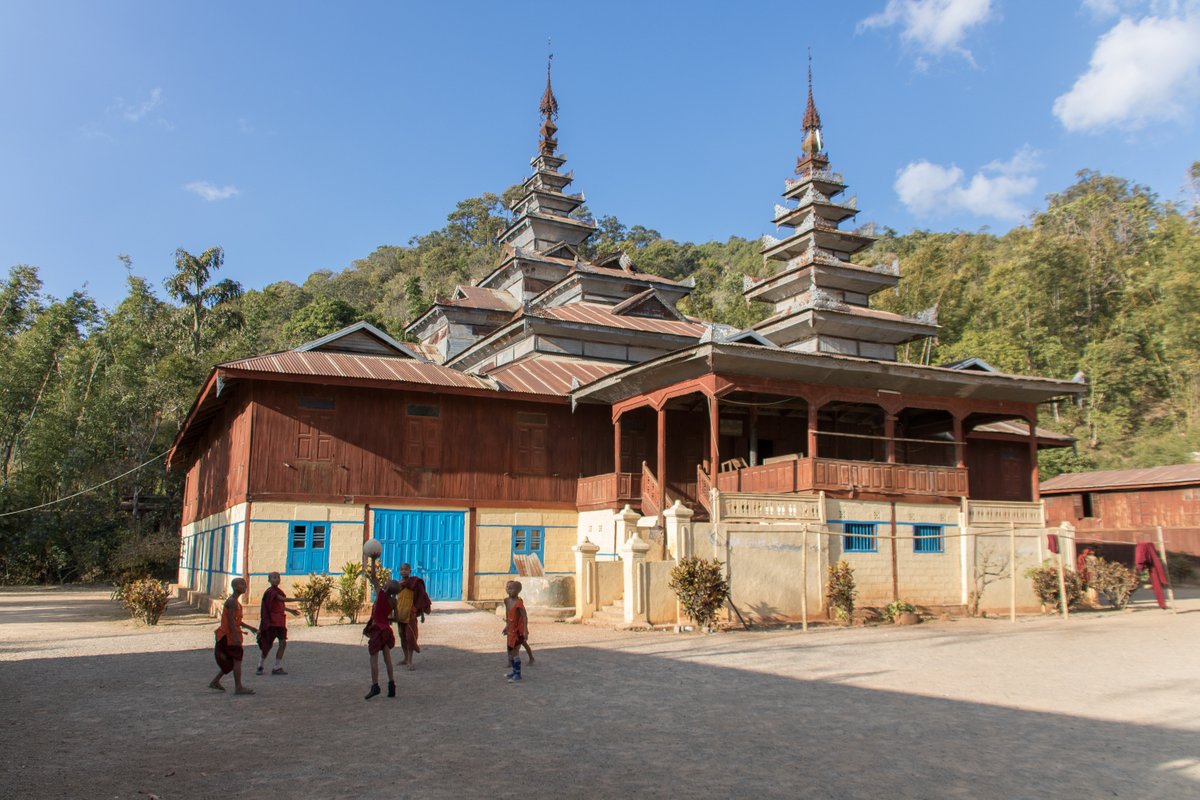
The afternoon was a pleasant three hour walk, ending up at the Htee Thein monastery where we booked in to spend the night. It’s a small run-down monastery with a dozen or so young novices and a hand full of adult monks. We were allocated a first floor room in a separate building all to ourselves, where we found the usual two sleeping pads and several blankets. Tourism is obviously big business for the monks because in the main hall of the monastery, there were sleeping mats set up for about twenty other tourists, all side by side, so I think that we’ve been given the first class accommodation.
We had a strip-down wash in the monks’ washing area, which was basically a water filled trough behind a five foot high wall - it was cold, but very refreshing. The rest of the afternoon was spent watching the novices play football in the main yard - I added a photo of a Soccer-Monk to my collection.

Dinner was prepared by our personal cook and was another huge meal consisting of soup, a main dish of chicken curry, four plates of vegetables, rice and flambéed bananas for desert. It all sounds very glamourous, but we ate it on a very low table sat on the floor. We had a candle as well, but not for romantic purposes it supplemented the single, weak bulb in the room.
25 January 2016 Htee Thein Monastery to Inle Lake, Myanmar
The damn cockerels started at five o’clock, well before the sun peeked its head over the horizon (not that we were looking). It wasn’t the most comfortable of nights because the sleeping pads that they gave us were so thin that our bony old hips were digging into the floor. We were up at half past six just as the sun shone through the gaps in the wooden walls.
Our breakfast was eggs with toast and avocado, whereas the young novices tucked into curry and rice on the ground floor of our building - I was gutted... By half past seven, we were off on our travels again. Today’s route took us up over a ridge, then gradually down to Lake Inle, passing through some lovely countryside.

After a few hours, a thunderstorm passed close giving us the first rain that we’d seen since we arrived in Myanmar. Unfortunately, the path turned into a layer of sticky mud that stuck tenaciously to our boots, building up to one inch thick causing us to stop frequently to scrape off. Goodness knows what it would be like in the rainy season.
After five hours of walking, we arrived at Inn Dein where we had lunch at a restaurant. Bizarrely, the meal was cooked by our very own chef, who had driven here on his motorbike to use the restaurant’s kitchen. It was very tasty food, but again, there was far too much to eat.
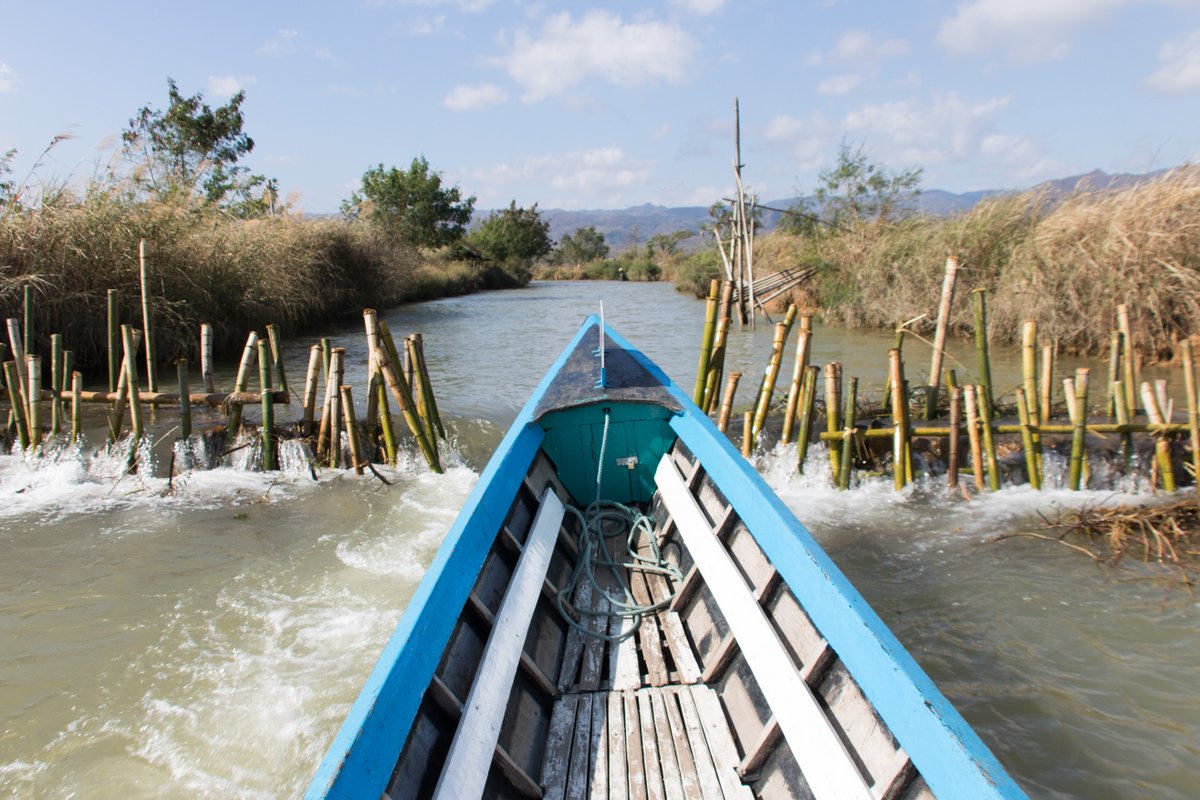
A long-tail boat driver met us at the restaurant and took us on a 30 minute ride through the canals of Lake Inle, which was interesting. The narrow canals have small weirs to slow down the flow of water out to the lake. There is about a foot of water difference at each weir and a narrow gaps in the middle allowing the long-tail drivers to zoom over the weirs with their flat bottomed, shallow draft boats - it’s exciting stuff.
We were dropped off at the Paramount Inle Resort. The hotel is built on stilts (over a swamp) and our room was pleasant, but the floor sloped disconcertingly towards the central corridor because the building is slowly sinking.
Our luggage was supposed to have been brought from Kalaw to the Paramount hotel, but hadn’t arrived. A few frantic phone calls revealed that our two bags had left in the morning on the back of a motorcycle, but it had broken down. The guiding company assured us that it would be delivered to the hotel sometime today. It rained heavily all afternoon, so we had visions of our luggage arriving soaking wet through and covered in mud, but thankfully, it arrived by five o’clock in perfect condition.
Being stuck in the middle of nowhere, we had no option but to dine in the hotel restaurant and it was expensive and mediocre.
When I had a shower this afternoon, I discovered that I’ve acquired a nasty rash on the right side of my chest that extends up to my neck. I rubbed Sudocreme (good for baby’s bottoms) into the rash and went to bed worrying that I’ve been bitten by bedbugs or some more horrible creatures while we were in the monastery.
26 January 2016 Inle Lake, Myanmar
It was very cold last night and I didn’t sleep well, mostly dreaming of spiders and cockroaches crawling out of my rash. To add to the restless night, there was a terrific thunderstorm in the early hours followed by driving rain.
In the morning, we dressed in long trousers, socks and every fleece that we had and went for breakfast. We had a very tasty Mohinga as a starter and followed it with egg on toast – I could get used to this. Nan, our guide, arrived at nine o’clock and, dressed in full waterproof clothing, we stepped into the river boat.

The local boats are very elegant craft - narrow and very long. They are made from teak wood and have a single cylinder Chinese engine on the back. The long-tail propeller shaft is more sophisticated than the ones that we’ve seen in other parts of South-east Asia, with a levered mechanism to lift the propeller out of the water. This in turn means that they have to have a universal joint where the propeller shaft comes out of the stern – and probably a kind of stuffing box (but I won’t get any more technical.)

The area at the south end of Lake Inle (near Inn Dein) is a set of canals with villages built on stilts. Being on a lake, the predominant industry is catching fish and the locals can be seen paddling about in slender wooden dugouts.
We spent the morning travelling around the lake visiting a temple, a silk weaving factory, a fishing village and a blacksmith’s shop. All of these businesses are based in stilt buildings far from the shore. At the weaving factory, we discovered that they make fabric from Lotus fibres. They can only get the fibre from the pink flowered Lotus and the extraction process is very manual involving breaking the lotus stems, pulling the fibres out of the plant and spinning them into thread.

I was interested to see that the weaving looms are designed around a “flying shuttle”, which holds the weft thread and is “fired” through the warp. This is a much more sophisticated method than the traditional hand weaving that we’ve seen before. Not to bore you too much, but I originate from Lancashire in the UK which was a major cotton weaving area in the 1900s. The Flying Shuttle was invented by a man called John Kay who lived only 6 miles from where I was brought up.

Before lunch, we were taken to a hotel which is famous for breeding Burmese cats. These are not just cats that live in Burma, but a breed of cat that are worth up to $500US each. They live on a small island in a small pond in a hotel and have their own little house. They only let tourists in to see the cats for one hour a day. It’s very weird, but about fifty tourists were there, to see (errr…) a load of cats sitting in their little house…
After lunch, we were shown some of the famous Floating Gardens. The native people, called In-Thars, grow vegetables on floating islands, which are a collection of floating weed and water hyacinth. These floating islands can be cut, dragged by boats and even be sold like a piece of land. Floating gardens are found mostly in Kaylar, Inchan and Zayatgyi villages.
We were taken to a lovely monastery called Nga Hpe Chaung, which is interesting because it is built in a traditional style where the Buddhas are all in a raised platform in the middle of the building allowing people to walk around all four sides. This monastery used to be famous for its performing cats. Allegedly, the monks were so bored, that they trained their cats to jump through hoops. It became a huge tourist attraction, so big that the abbot banned the activity because tourists were not coming to look at his monastery for the right reasons.

After picking up our bags from the hotel, we had a long boat ride to the small town of Nyaungschwe. On the way, our boat driver stopped briefly to watch some traditional fishermen. Well, actually, it was a very contrived little show put on for tourists in return for “donations”. They were very good and it was fun to watch them paddling their oars with their feet and larking about with their traditional fish traps posing for us.
We checked into the Inle Apex Hotel which is basic, but clean. We went out for a meal in the evening at a small restaurant, which was supposed to do traditional Myanmar cooking, but the service was very poor and the food was disappointing - tourist fare…
My rash hasn’t spread anymore, but has turned more pronounced (bumpy) and is starting to itch. I’m now thinking that it’s caused by too much dodgy soap powder when they washed my clothes in Bagan (or they draped one of my shirts over a Poison Ivy bush to dry).
27 January 2016 Inle Lake, Myanmar
It wasn’t too bad a night and my rash seems to be calming down, which is a relief. We had another huge breakfast and met Nan in the hotel reception. The day started off much brighter than yesterday, but we still put on full waterproof gear and we were glad of it as we zoomed into a cold wind at 15 knots. The boat drivers provide umbrellas that act as excellent wind guards, although I was a little distressed that mine was Barbie Pink.
On the 1½ hour journey up the lake, we saw the local fishermen. It was reassuring to see that they do actually use their feet to paddle and that it isn’t just a tourist circus show. It all makes sense when you see them stood on the very end of their canoes, using their feet to paddle, while using both of their hands to pull in their nets. We also saw guys out pulling weed out of the lake, which they put on their gardens as fertiliser and to retain moisture.


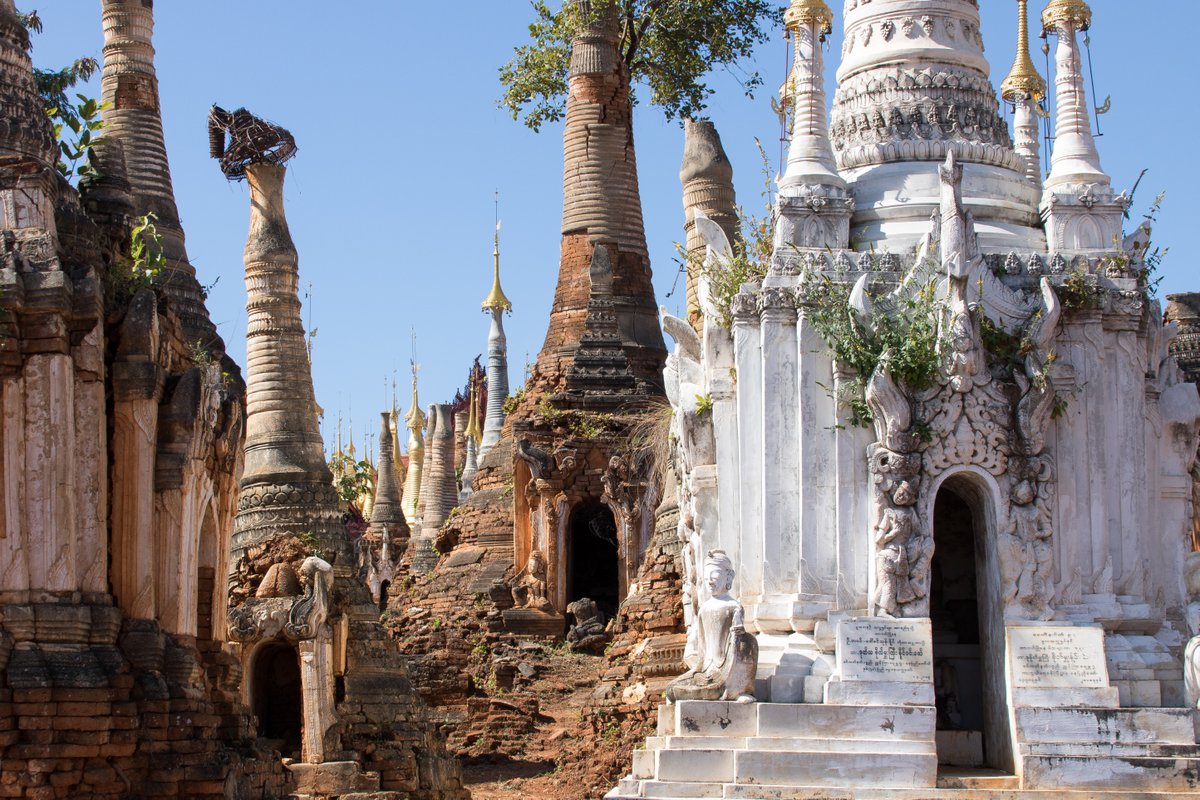
Nan took us to the Inn Dein temple area, where we saw many old stupas that date from the 17th century. Most of them are in a poor state of repair and, as late as 1950, they were completely covered by trees and vegetation. There are stupas with trees growing out of the top, and temples with 300 year old Buddha statues, half covered by rubble – it’s an amazing place, very Indiana Jones.
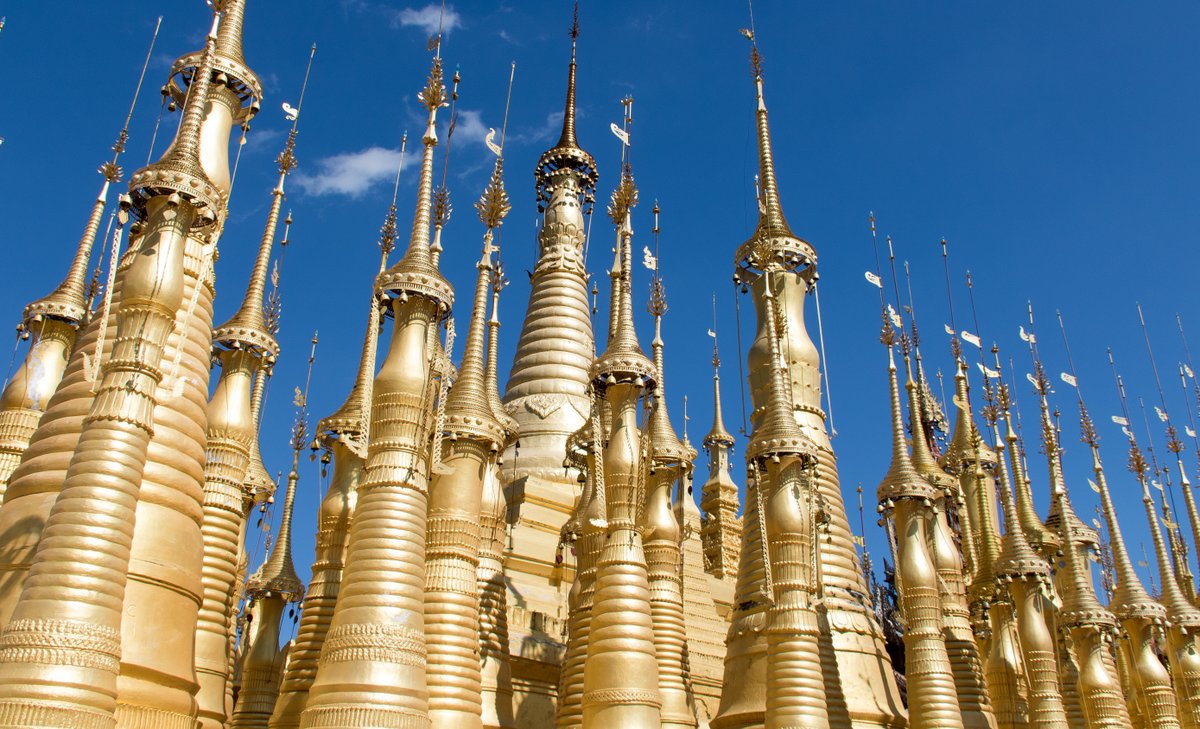
We carried on up to a well maintained temple, which had many reconstructed stupas. The locals pay $300-500US to have a stupa rebuilt, which I guess gives them lots of Buddhist Merit. Most of the reconstructed stupas have plaques that make it very clear who donated the money and exactly how much money that they gave. This seems strange to me – you donate money to offset any bad that you’ve done on your path to enlightenment, aiming to cast off any worldly desires, yet you tell everyone how rich you are.
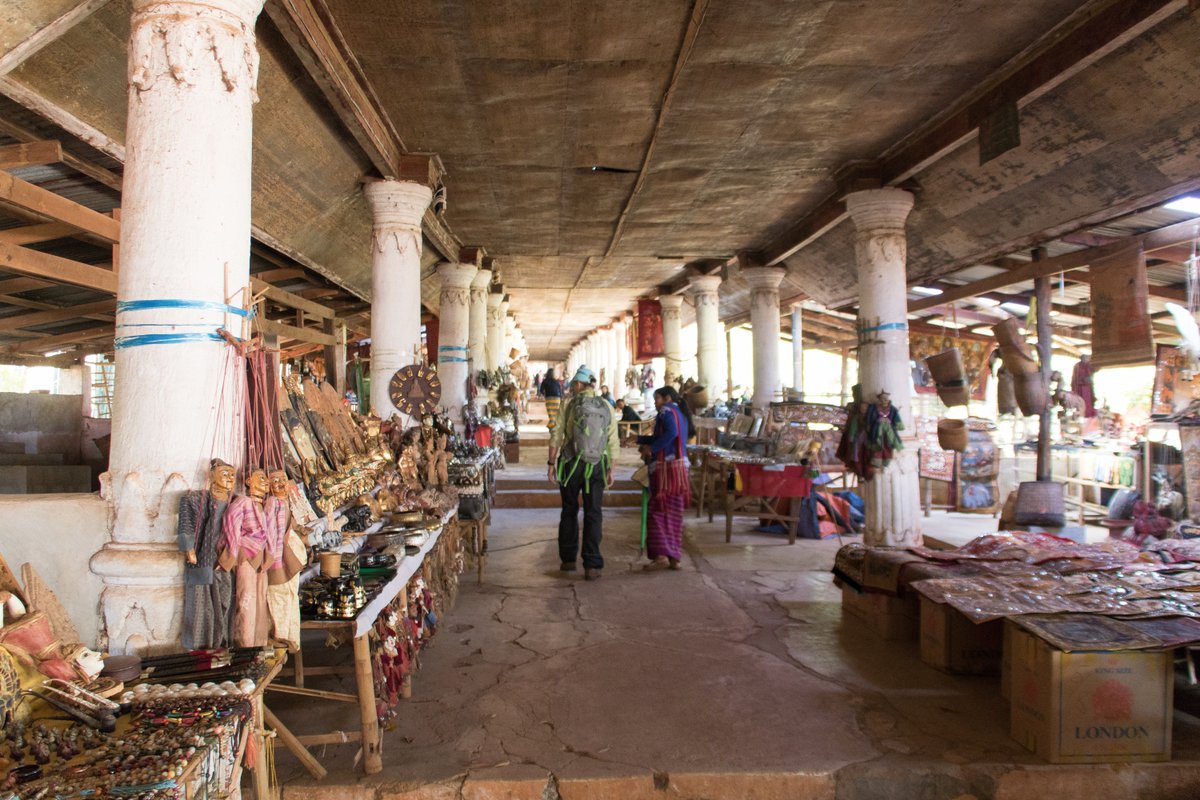
The covered walk way up to the temple is packed with stalls selling carvings, weaving, bags, t-shirts and a myriad of souvenirs – there are literally hundreds of stalls and thousands of tourists wandering around. It’s not quite what we want to see, but it was amusing to hear a British guy loudly berating his wife for spending too much money on tourist rubbish – he’d obviously seen too many markets.
We were taken to a silver smith and given a guided tour, watching the process from silver ingots to the finished product. They buy 99.99% pure silver bars and add 7.5% copper to make it harder and more resilient – apparently 92.5% silver is the standard. Everything is done by hand - producing the 92.55 alloy in a charcoal fire; producing silver foil and wire; weaving chain from the wire; filing, cutting and drilling the silver pieces all using manual tools.
It’s very interesting, but we were soon led into the salesroom, where I was ignored while the staff concentrated on Glenys, showing her beautiful, traditional, solid silver Myanmar necklaces and jewel encrusted earrings. Fortunately, Glenys didn’t succumb and we escaped without any expensive souvenirs.
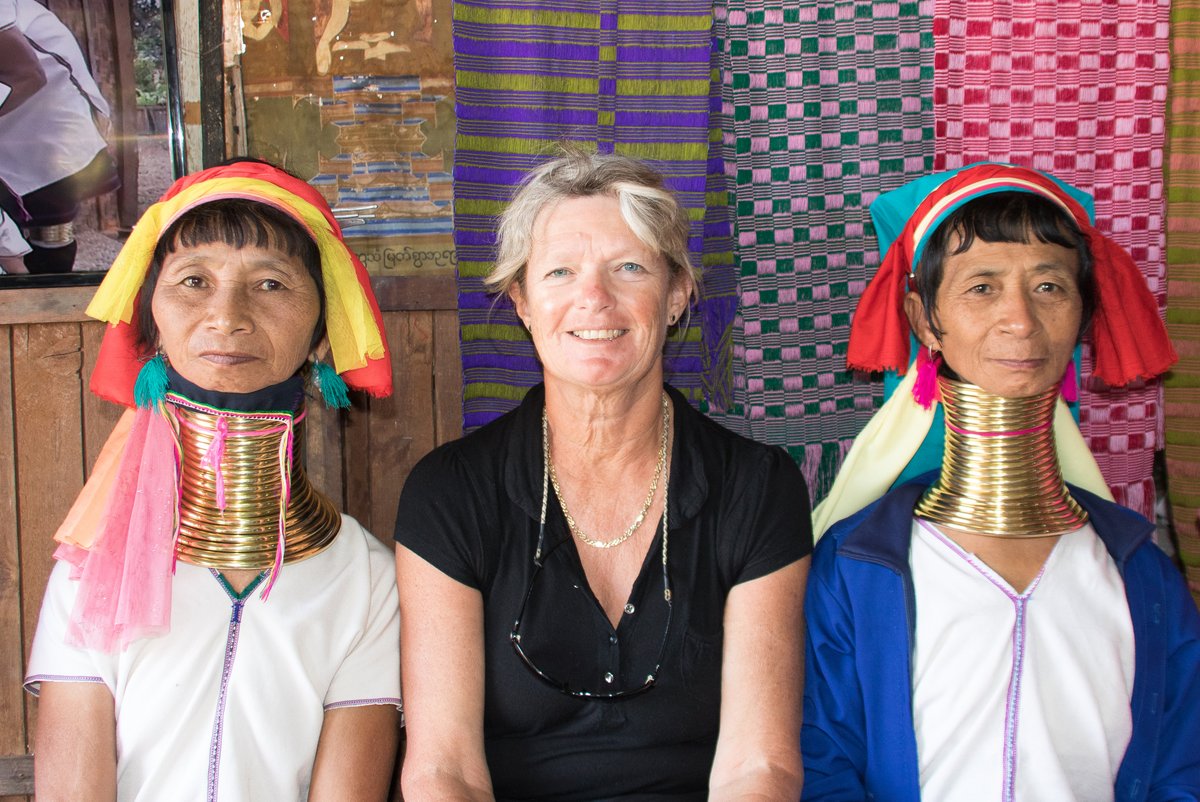
Nan then told us that we were going to see the “long neck ladies”, which seemed too intriguing to ignore. The women of the Padaung Tribe from the north east of Myanmar have a tradition of placing solid ½” thick brass rings around their necks, which extend the length of their necks. More rings are added as the woman grows and the older ladies have more than 20 of these heavy rings with their necks stretched to over 12” long. There’s a group of these Padaung people who have set up a shop in the lake where tourists can see the ladies and buy souvenirs.
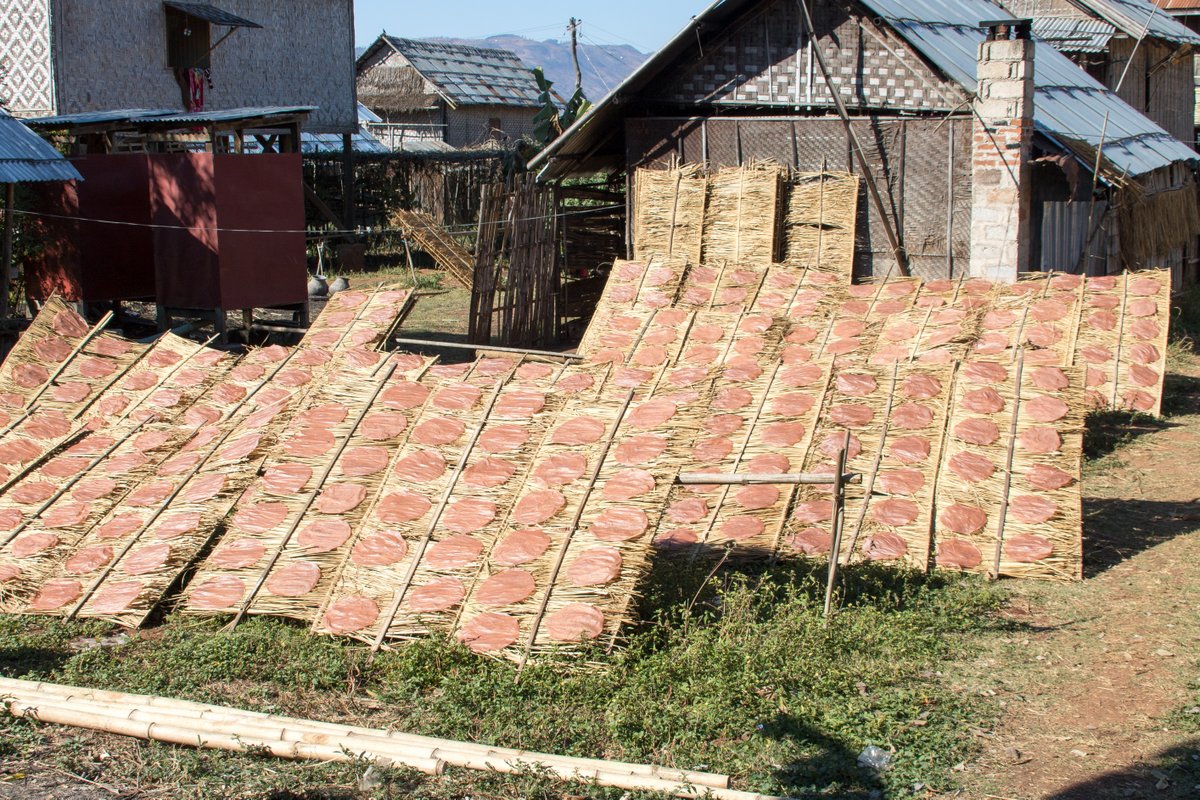
After a very pleasant and substantial lunch, we walked around a small village where they farm tomatoes on their floating gardens and also specialise in making 1 foot diameter rice crackers which are seen drying on mesh frames all over the village. Once dried, the crackers are pan-fried on a hot fire and sold around the lake. They’re very tasty and moreish.
In the evening we ate out again, but found a better establishment this time.
28 January 2016 Inle Lake to Yangon, Myanmar
After another huge breakfast, we squeezed ourselves into a car and Nan took us to a monastery on the edge of town, which was a very attractive wooden building. We watched a lesson being given to some novices, who were obviously finding it difficult to concentrate with a handful of tourists wandering about taking photographs. The monastery has some very photogenic oval windows and it’s a prime place for Monk-stalking, but no monks walked past an oval window while I was there.

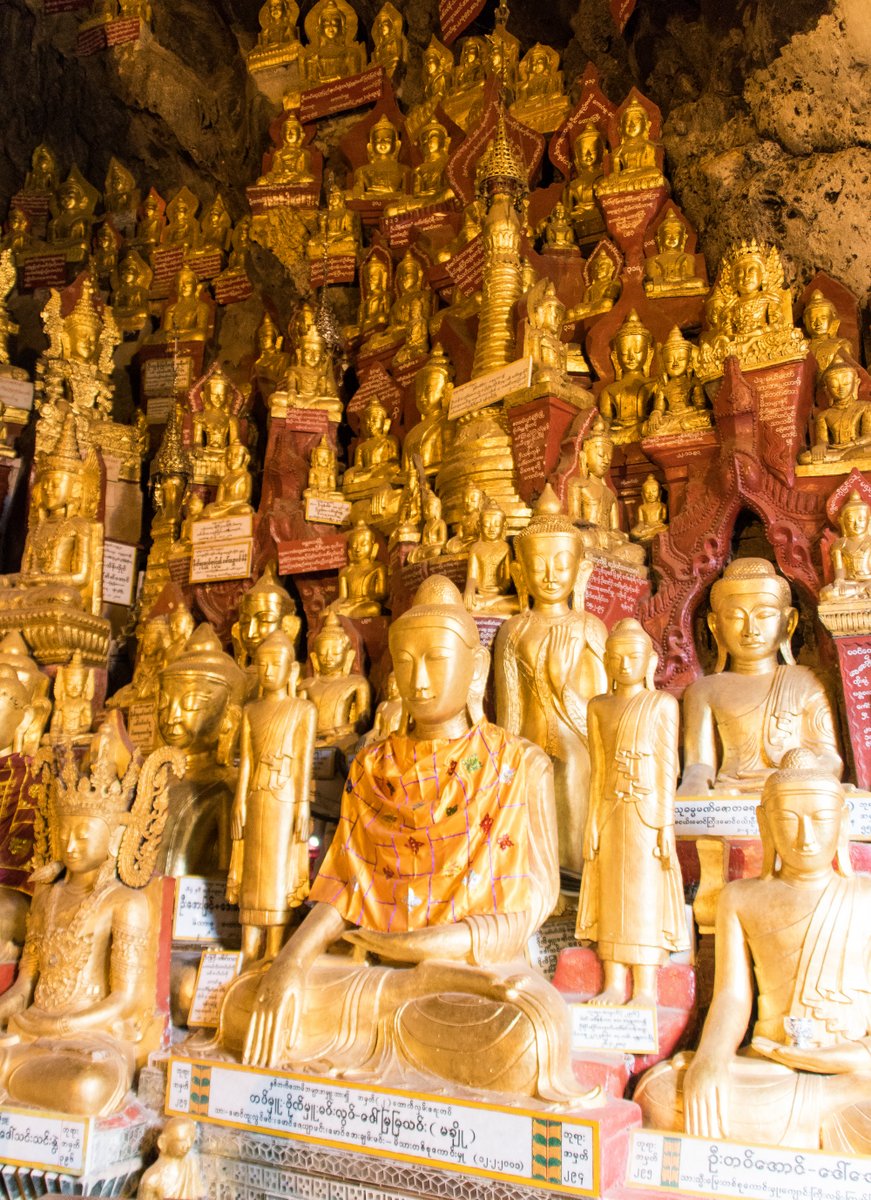
We drove for two hours to Pindea, where there are some caves that the locals have packed full of 10,000 Buddha statues. It’s quite impressive, but the most interesting part was a small cave where a famous monk stayed and meditated for ten years! There’s a small shrine inside the 3m diameter cave.

Our flight to Yangon didn’t leave until half past five, so Nan was trying to occupy us for the day. She took us to a place that makes paper by hand from mulberry bark, which interestingly is the same bark that they use to make tapa cloth in Samoa, but the process is very different. Here they soak the bark for a few hours and then bash it with a mallet to break the bark down into fibres.
A tennis ball sized lump is placed in a litre of water and agitated to break the fibres apart. A one metre square panel made of gauze is suspended in a bath of water and the fibre mixture is spread evenly on the gauze. When the panel is lifted out of the water the fibres are left as a thin mat on the gauze. This is dried in the sun for four hours resulting in a thick but remarkably tough piece of paper. As well as producing the paper, they manufacture a range of products from bamboo including parasols and fans – Glenys bought a nice fan for a couple of dollars.
We had lunch at a very flashy tourist restaurant, but only had two bowls of soup and a tomato salad – three big meals a day is starting to get a little wearing now. With three and a half hours to go until the flight, Nan was getting a little desperate for things to do with us, so we went for a walk around the town market and visited a small monastery. We drew the line at a further trip to see chick pea rice crackers being made and told her to take us to the airport.
Heho Airport is a small domestic airport and is mildly chaotic. Nan insisted on checking us in and while she was over at an immigration desk, some guy came over, tied a label on our bags and without saying anything took them away - disturbing... After half an hour of wandering around outside, we braved the security check and went through to the departure lounge. There are no nice information screens, just a lot of confused travellers milling about.
The flight to Yangon was only 90 minutes on a comfortable twin turbo prop plane. After a bit of a “slammer” landing, we were put onto buses and taken to the Yangon International Airport terminal, which was chaos. Luggage was brought on trolleys pulled by a tractor and the bags dumped on the ground outside the building. Confusion reigned as tourists and locals jostled to get to the front of the crowd, with most finding that their bags weren’t there.
Slowly more trailers appeared and the bun-fight continued. We kept out of the way realising that having checked in early our bags were bound to be at the back of the pile. Sure enough, (with some relief) we spotted our bright red cargo bags on the last trolley.
A driver met us at the exit and took us into the central area of the city, which took ages. Apparently, some Buddha relics (some of his vertebrae we think) have been brought from India to the Shwe Dagon pagoda and they go back to India tomorrow, so lots of people are clamouring to get to the pagoda to see the relics. We got caught in a Buddha crowd – kind of like a football crowd, but with more aggressive driving.
It took 90 minutes to drive 14 kilometres and we arrived at the Central Hotel at half past eight. The hotel is a bland, multi-story hotel of the kind you find in the centre of most cities. Glenys had been feeling ill all day with nausea and having to run to the toilet, so she went to bed while I sloped off to the hotel restaurant for a quick Thai curry, which was mediocre.
29 January 2016 Yangon, Myanmar
Glenys was still feeling ill, so after a couple of slices of toast at breakfast, she sloped off to bed and I went out for a walk. Yangon is a bustling city full of Burmese, Indians, Chinese and tourists. The city is laid out in a very rectangular grid, with two or three narrow streets between wider major roads. All of the buildings seem to be at least six stories high and, in the narrow streets, there are balconies jutting out from the apartments. There’s a colonial feel about the buildings, which reminds me a little of Cuba.
I wasn’t wandering aimlessly - I had my sights on the British Embassy. When I was eighteen, I shared a flat with a Burmese guy called Myo Aung. He’d come from Burma to go to a UK university and we met at a training centre where we were working for six months. At the time, I found Aung fascinating, telling stories of being a monk and showing me some martial art katas, which he’d learned in the army. He came to visit my parent’s house a few times and my Mum and Dad had some correspondence with his parents.
I thought that it might be fun to try to locate Aung. Unfortunately over the last 35 years, my parents and I have lost his address in Burma, so it’s a vain hope. The Burmese don’t have a surname like us, so one has to know their name and the name of their father to identify a person uniquely . To make matters worse Myo Aung is a very common name.

Aung must have had special documentation and visas to enter the UK as a student because, in 1973, the military had taken over the country and were implementing radical socialist policies restricting contact with the west. I would think that his parents were either very wealthy; in the military; in the government; or were political exiles.
I had thought of approaching the Myanmar authorities directly to try to locate him, but with Myanmar’s record of human right’s violations, what would happen if Aung’s family turned out to be anti-government activists? I imagined being seized in a government department then being taken to the notorious Insein prison and being tortured to find out my connections with Aung.
Hence my visit to the British Embassy in Yangon - I hoped to have a 5 minute chat with a consular officer about the political situation, see if they had any suggestions and maybe they could look for Aung’s visa records from 1973? When I arrived at the Embassy, a Burmese guard at the front door thrust a piece of paper at me containing telephone numbers and said that I had to ring a help line to make an appointment. My protests that I was already at the Embassy fell on deaf ears and I was pointed at the nearby post office to use the telephone.
In the post office, a nice lady started to help me, but using a telephone didn’t seem to be something that she could arrange. Eventually, a young passer-by offered to let me use his personal mobile. I rang the number and had a difficult conversation with a Burmese national, who finally said that I should go to the front door of the embassy. I said okay, I’d be there in two minutes.
Back at the front door of the embassy, the guard contacted reception on an intercom and I think talked to the same person that I’d talked to on the phone. Apparently, he’d told me to go to the front door to get the piece of paper containing the telephone numbers and I now had to send an email. Exasperated, I demanded to see a Consular Officer “right now” and pointed to a paragraph on the piece of paper that said in an emergency situation, I should be able to see a Consular Officer immediately.
There was much babbling on the intercom and finally, they said that someone would see me. I must admit I felt a bit guilty about scamming my way in, but I felt it was my right. What ever happened to the old days where one could pop into the Embassy for a cup of tea and a chat about the political situation in the colonies?
A very nice chap met me in reception and took me into a small interview room. He listened very politely to my little story, but they only keep visa records for two years and he didn’t think that the Myanmar authorities would be of much help after 35 years. His best suggestion was to try to find Aung through Facebook, which the Burmese people have really taken to. I’ll give it a go, but I don’t hold up much hope.
Glenys was asleep when I got back, but said that she felt a little better. We stepped out and had a naughty KFC Zinger on the basis that Glenys needed stodge to help her recuperate. We had a walk around the local area, so that Glenys could experience the chaos, but it soon exhausted her and we retired back to the hotel room to have a quiet afternoon.
In the evening, we had a stroll through the packed streets of the Indian and Chinese quarters, down to the Sule Paya temple, which is in the middle of a roundabout – it looked pretty scruffy, so we didn’t bother to go in (I found out later that it’s over 2000 years old…) We walked to the nearby Mahabandoola park, which was packed with locals taking a stroll and is surrounded by many fine colonial buildings.
There are thousands of small food stalls set up in any available space, where the locals were eating curry, kebabs and cakes. In due deference to Glenys’ dodgy stomach, we passed by them all and called in at a nice little Indian restaurant called Titu's Indian Banana Leaf Restaurant just around the corner from our hotel. I tucked into a superb mutton curry, dal, rice and a nan, while Glenys picked at a very small portion.
30 January 2016 Yangon, Myanmar
Glenys was still feeling ill, so we abandoned our planned trip to Shwedagon – it’s just another Buddhist pagoda after all - here’s a description of what we missed…
No visit to the Union of Myanmar is complete without a visit to the 2,500 years old Shwedagon Pagoda, which enshrines strands of Buddha's hair and other holy relics. Located west of the Royal Lake on 114 -acre Singuttara Hill in Yangon, Shwedagon Pagoda is the most sacred and impressive Buddhist site for the people of the Union of Myanmar. From a humble beginning of 8.2 meters, the Shwedagon Pagoda today stands close to 110 meters.

Shwedagon Pagoda is covered with hundreds of gold plates and the top of the stupa is encrusted with 4531 diamonds; the largest of which is a 72 carat diamond. It is clearly one of the wonders of the religious world. Shwedagon Pagoda is a repository of the best in Myanmar heritage – architecture, sculpture and arts. The Shwedagon Pagoda consists hundreds colorful temples, stupas, and statues that reflects the architectural era spanning almost a 2,500 years.
Ah well! Fortunately, the hotel let us keep our room until the middle of the afternoon and we had a quiet morning with Glenys reading and sleeping, while I caught up on editing photographs. I nipped out to the famous Bogyoke Aung San market, which is basically a very large market selling clothing and jewellery to both locals and tourists. I managed to buy a couple of T-shirts including one with the Myanmar beer logo.
For lunch, we had a couple of bland, non-spicy sandwiches on white bread that I picked up from a nearby supermarket, which Glenys was able to eat. Our driver picked us up at 14:30 and we endured a 90 minute battle against the Yangon traffic to the airport - an average of 5 miles per hour.
The flight to Bangkok was just over an hour and we were sent through a fast channel to the domestic departures lounge. At Bangkok, I was thrilled to find the three gods of western food (McDonalds, KFC and Burger King) all in a line. Well, it had to be a Whopper. Glenys was still feeling very delicate, so I had to eat alone, while she despairingly picked at a few fries.
The flight to Phuket was just over an hour, but Glenys didn’t enjoy it much. She had a nap, but when she woke up, she had to retired to the toilet with a sick bag - perhaps she shouldn’t have had the fries after all. We caught a taxi back to Boat Lagoon and arrived around midnight, looking forward to a lie-in tomorrow.
It was a fabulous holiday in a diversely interesting country, we hope to return to Myanmar.