1 August 2011 Chagaramus, Trinidad
Most of the weather forecasters are predicting that the low pressure area will be classified as a Tropical Storm today. It has moved a further 60 miles north and is expected to pass between Martinique and Dominica. It shouldn’t affect us now.
Glenys made the infill for our bed. I now need to cut the wood surrounding the mattress, so that the infill will fit in place. It’s going to be a very messy job and we’ll have to move into the front cabin for a few nights while we varnish the wood again. I’ll have to install a fan in the front cabin first; otherwise we’ll die in the heat.
I spent the day working on wiring for the Arch. It never ceases to amaze me how long each job takes on a boat. I’m installing the solar panel regulator into a cupboard and the installation instructions say that it shouldn’t be installed in an enclosed space. So my grand plan is to install a cooling fan like the ones in a computer case and extract the hot air into a space at the back of the boat. I bought some 2” ducting and a couple of fittings and it took me four hours to make two 3 inch holes in the bulkheads to fit the ducting.
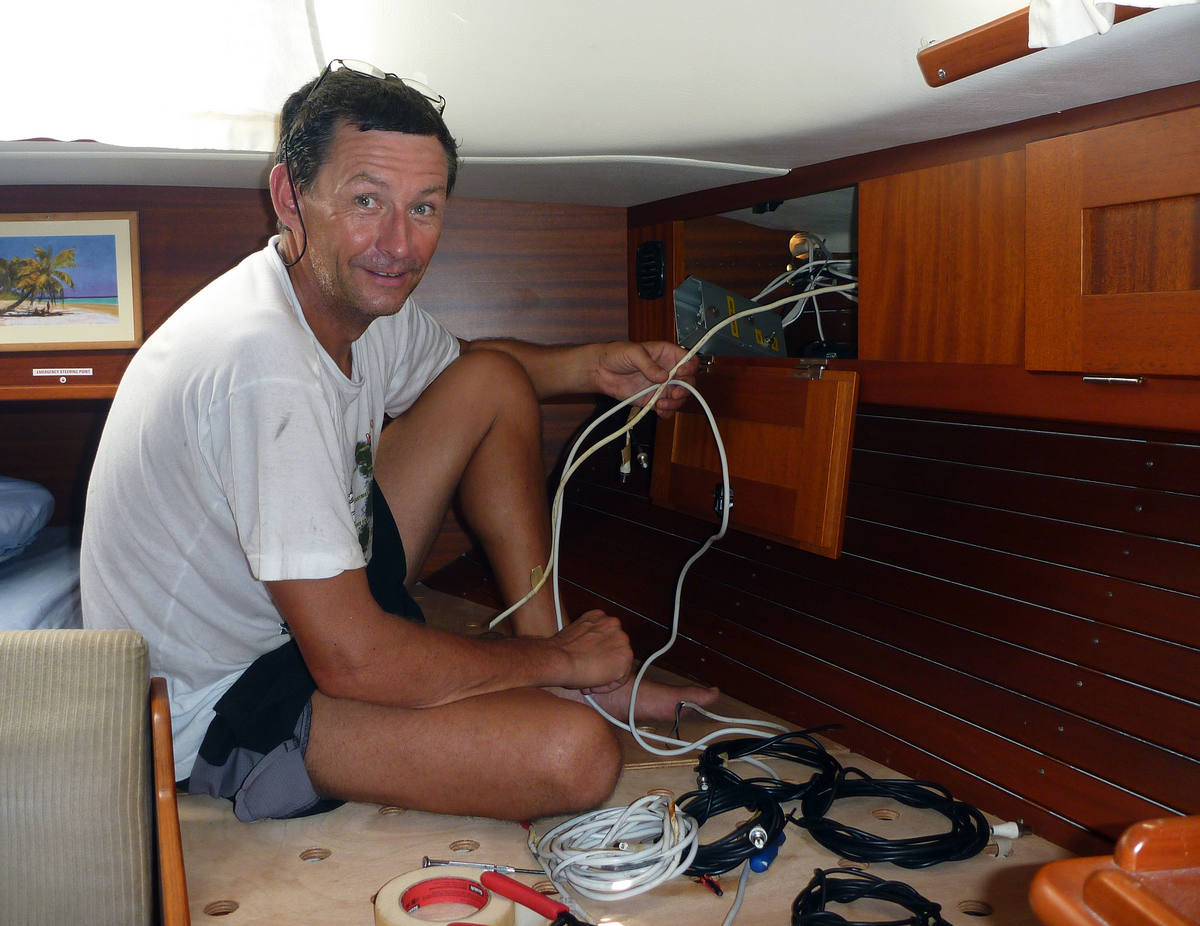
The rest of the day was spent tracing some more redundant wiring and working out how much cable I will need to buy.
In the evening, we went to a pot luck barbeque at the Trinidad and Tobago Sailing Association (TTSA) which was good fun and we met a few more cruisers. On the way back, we passed a local sport fishing boat who were unloading their catch and I managed to buy two big 3lb snapper for £5.
2 August 2011 Chagaramus, Trinidad
Tropical Storm Emily has already passed Martinique and is on its way to Puerto Rico. It is well out of our way.
We haven’t run the engine for five days, so I started it. Unfortunately it died after 30 seconds and wouldn’t start again. The generator started and ran OK. Falco came and had a look at it but couldn’t see any fuel leaks. He simply turned on the auxiliary fuel pump for 30 seconds and the engine started and ran OK. He thinks that there is a small air leak somewhere allowing fuel to drain back into the tank. His only suggestion is that I run the auxiliary fuel pump to prime the fuel system if the engine has been standing for a few days. This is driving me crazy.
I spent most of the morning running around buying cable and other bits while Glenys did a few jobs on the boat. Mitch is progressing with the Arch and hopefully we’ll have the first fitting tomorrow.
After lunch, the heat was so intense that Glenys cracked up and went shopping in the air conditioned West Mall. I tried to continue to do work in the lazarette, but it’s a tight space that I have to crawl into and after an hour my t-shirt was wringing wet with sweat. I gave up, changed my t-shirt and went for a walk to buy a few more bits.
I called in at a woodworking shop and they’ve quoted me £30 to replace a small section of the teak deck where the wind generator pole used to be. The temperature dropped at four o’clock and I spent two hours chiselling out the existing teak planks ready to be replaced.
We had snapper for dinner which was fantastic.
3 August 2011 Chagaramus, Trinidad
It was a hot sticky night and, for some reason, we had mosquitos in our cabin - I didn’t sleep very well and was bitten quite a few times. I zapped three of the little devils this morning, but not before one of them had bitten me twice more on the ankles. The heat and mosquitos are getting me down - we’ve been in Trinidad for two and a half weeks now and I want to go.
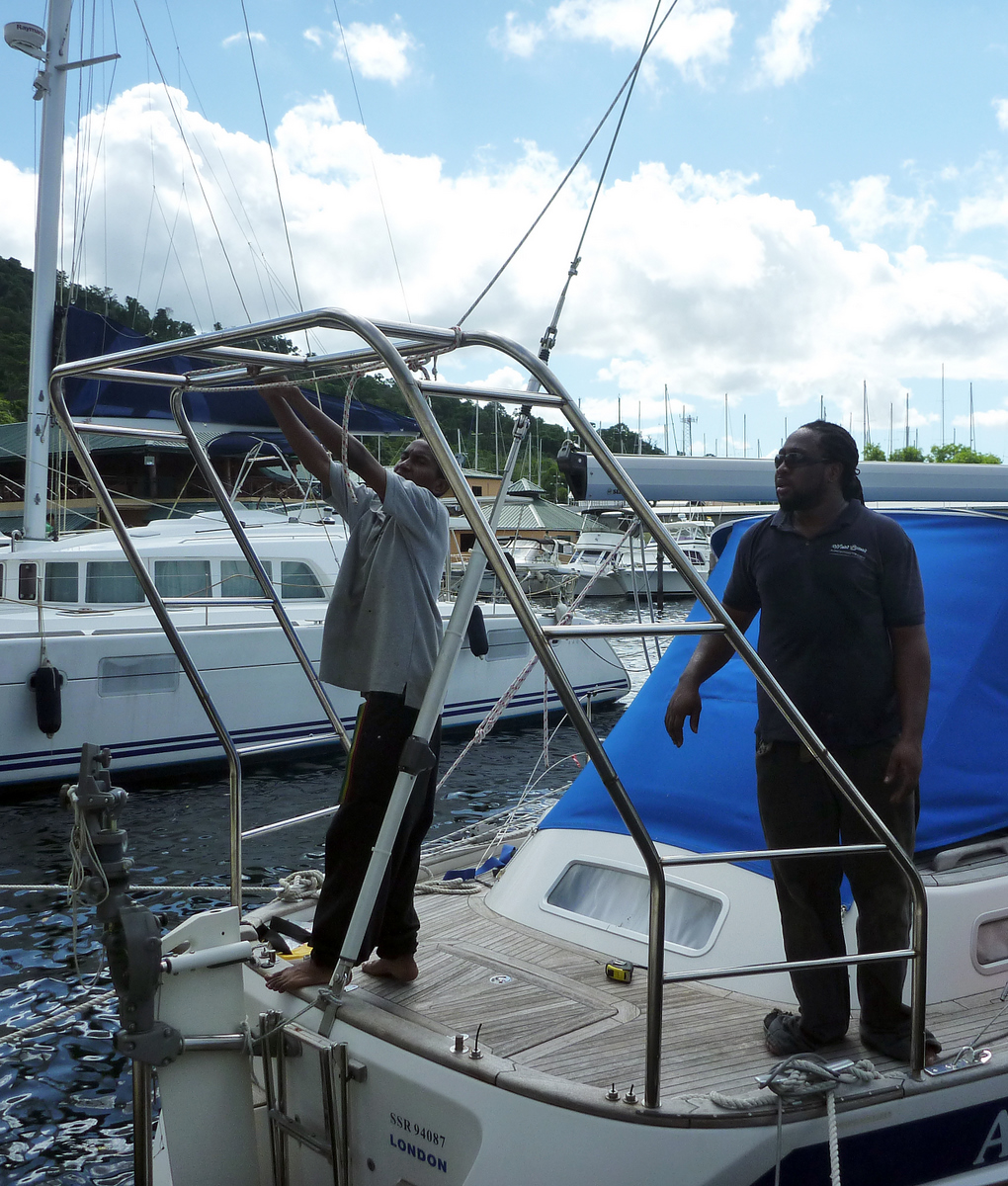
Mitch came and did first fitting of the Arch which cheered me up – the end is in sight. The Arch fitted in the correct place - with a little bit of pushing and twisting. Mitch said that the boat is out of square. To which I replied, “Of course it is – nothing on a boat is ever square”. The Arch looks to be the correct dimensions and looks good.
I fitted the ducting in the lazarette for the cooling fan for the aft cupboard. It was a mission crawling into the lazarette, applying silicone sealant and tightening bolts, while Glenys was in contorted positions below holding the other end of the bolts.
The damaged deck was my next job. The deck is made from two layers of fibreglass with a 1 inch thick core. The core in the corner of the deck is made from plywood and unfortunately it was very wet and rotten because the deck fittings for the wind generator hadn’t been sealed properly. I dug out the rotten wood, slowly making the hole bigger, looking for dry wood. I eventually ended up with a one foot wide hole with damp, but solid wood at the edges. I decided that this was a bigger job than I wanted to take on, so I talked to a guy based in the boatyard called “Cow”, who is going to give me a quote and could start work tomorrow.
Now that we’ve done the first fitting of the Arch, I removed the four stainless steel rods that supported the pushpit. I’d been dreading the job, but in the end, it wasn’t as bad as I thought it would be. The extended hole drill worked very well and it only took me an hour to drill them all out.
I’ve decided that the mosquitos are coming in through our aft bathroom, so we’re going to stop using the shower in there, keep the window shut and I fumigated the whole room with insect spray. Hopefully that will give us a good night’s sleep.
4 August 2011 Chagaramus, Trinidad
It was a better night - it was still damn hot, but at least we managed to keep the mosquitos out of the bedroom.
Glenys worked on the cockpit cushions today, but only managed to finish one of the four. I worked on running some new cables for the solar panels and a rear floodlight that will be on the Arch.
Cow arrived and we agree £300 for him to repair the damaged hole in the aft deck. It seemed to be a bit expensive, but the materials come to £150. He came back in the afternoon and started to chop everything away, but rain stopped play.
I did a bit of running about in the afternoon, trying to figure out what type of cable I need for our satellite phone aerial. We’ve never bothered to pay for a SIM card for the phone because we can just use normal mobile phones while we’re in the Caribbean. Satellite phones are expensive beasts - it costs £25/month and £1/minute. I don’t think that we’ll use the satellite phone for two years, so I’m a bit reticent to spend a lot of money on a new cable at the moment.
5 August 2011 Chagaramus, Trinidad
It was another mosquito free night in our cabin, so I think that we’ve found the crack in our defences. Unfortunately, I still have to spray myself with insect repellent as soon as I come out of our cabin, otherwise the little morning ankle-biters get me.
It was a day of doing bits of jobs. Glenys made another cockpit cushion and I put a new fan in the front cabin ready to move into there when I cut the wood surrounding our bed in the next few days. I did a bit more work on the wiring for the Arch and cut a three inch hole in the cupboard wall to allow air in for the cooling fan.
Cow came and tried to do the repair to the deck, but it kept raining hard and everything managed to get wet again even though he tried to cover it up.
We’re just waiting for the Arch to be finished.
6 August 2011 Chagaramus, Trinidad
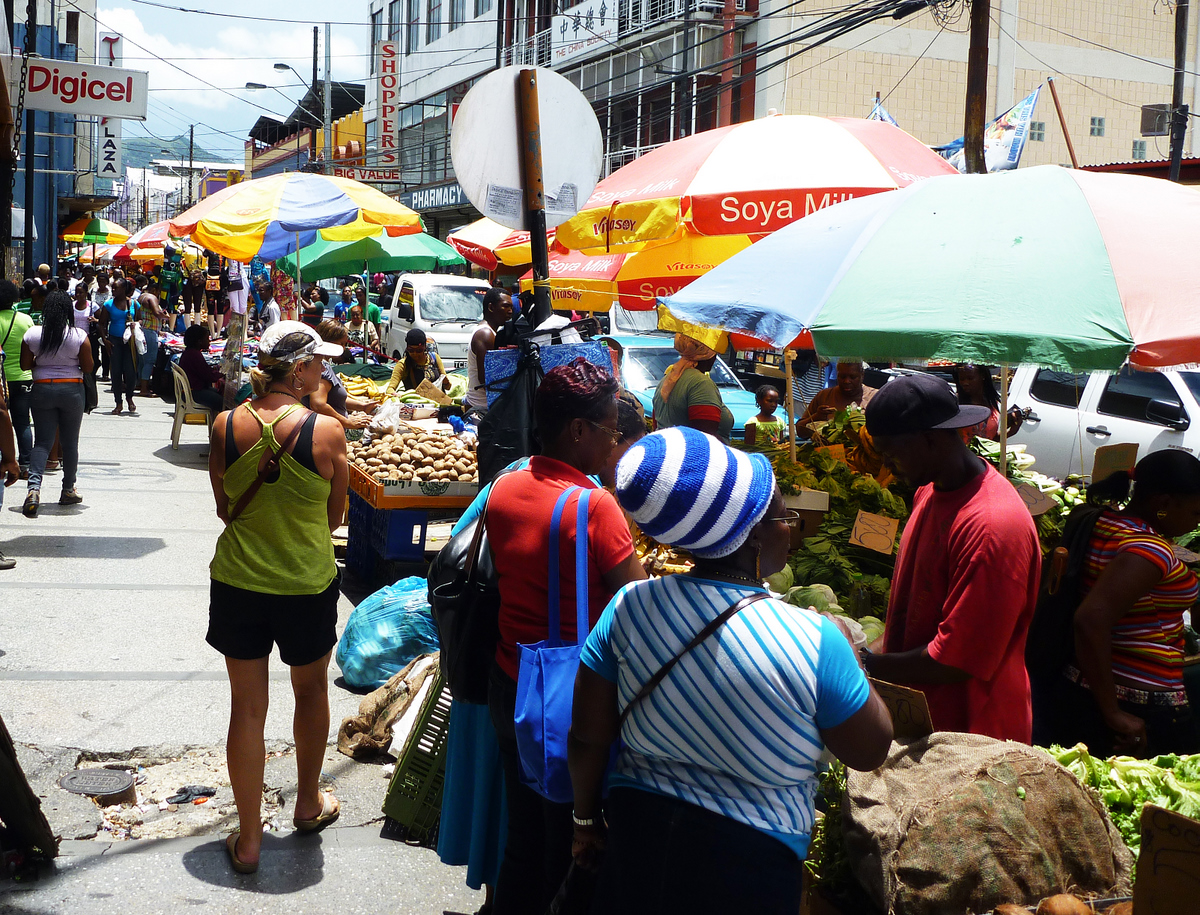
We had a day off today and went into Port of Spain to do a bit of shopping - it’s a really bustling place on a Saturday morning.
After eating a Roti for lunch, we went to the cinema and watched Captain America. We had dinner and went to bed.
7 August 2011 Chagaramus, Trinidad
It’s Sunday today, so nobody is working. I spent the day doing a few small jobs - treading water waiting for the Arch to be fitted. Glenys continued with the cockpit cushions, but gave up after lunch because the heat and humidity was so oppressive.
I took the wind generator apart with the intention of rewiring the cable, but it was so difficult to get apart that I panicked and gave up. The wind generator is nine years old and the bearings and seals look like they need changing. I have some spares, but I think that I’ll take it back to the manufacturer to get it serviced tomorrow.
Cow came back today and finished off fibre-glassing the deck – I’ll be able to get the carpenter to put the teak decking in place now. It will be nice to tick off another completed job. I’m still hoping to be out of here in a week’s time.
We went out for a meal because Glenys couldn't face cooking in this heat – spare ribs and chips with a pitcher of beer. We’ve been here so long that we’re getting into a routine.
8 August 2011 Chagaramus, Trinidad
We haven’t run the engine or generator for six days, so I started both of them. The engine ran fine after I primed the fuel with the auxiliary fuel pump. The generator started okay, ran for 5 minutes, but then cut out because of air in the fuel line again. This is very annoying. Falco the mechanic said that it may be dirty fuel causing the problem, so I turned on the auxiliary fuel pump to re-circulate the diesel through the primary fuel filter to clean it.
I spent most of the day of running about organising things. I dropped the wind generator into Kiss Energy to get the bearings replaced and went to see Mitch - we’re still on target to fit the Arch on Thursday.
The local dealer for Iridium satellite phones quoted me £150 for a 12 foot extension cable with two TNC connectors – the connectors are £35 each plus £45 labour to fit them. I’m not going to bother and will sort it out when (and if) we get a SIM card.
9 August 2011 Chagaramus, Trinidad
Glenys decided to go to a shopping mall in the morning – there’s a taxi company that organise a weekly trip.
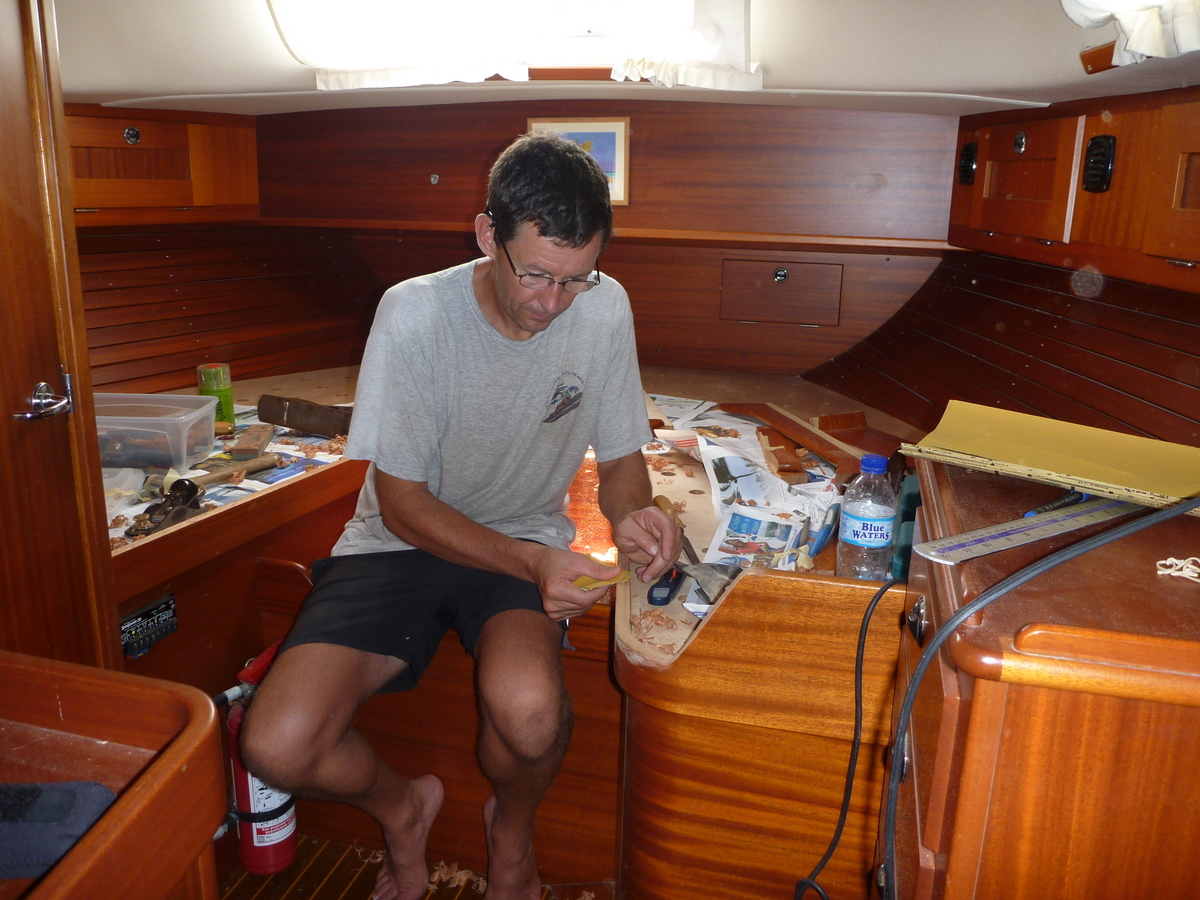
While she was off the boat, I cut the wood surrounding our bed to fit the in-fill. It was a hot messy job – I didn’t want the fans on because they would have blown the saw dust around, so it was like a sauna in the back cabin. It took me five hours to cut, shape, sand and varnish the wood.
In an attempt to get the boat cooler, Glenys bought a big piece of white Sunbrella and rigged it up over the top of main boom above the bimini. The idea is that the white fabric will reflect the heat away from the bimini, which is getting very hot during the day and is radiating heat down into the cockpit.
Ian and Jackie from “Blackthorn Lady” came for a beer in the evening to discuss going up the Manamo River which is part of the Orinoco Delta. This Venezuelan river is very isolated with Indians in dug-out canoes and piranha fish, so it will be a mini-adventure. It’s only about 60 miles from here and will only take a day to get there. We agreed that we’ll go with them towards the end of next week.
With some trepidation we slept in the front cabin.
10 August 2011 Chagaramus, Trinidad
It was a hot night - even with the fan blowing we sweated all night. I had a go at trying to get the generator started, but gave up after ten minutes – I rang Falco and told him to come out.
I picked up the wind generator from Kiss Energy – it only cost £45 to service the bearings. I did small jobs during the day including removing our old solar panel from the guard rails - Ian from “Blackthorn Lady” is buying it from us. The carpenter fitted the teak decking over the repair on the aft deck.
Falco came and started the generator – he just had to bleed more air out of the system. I hadn’t been aggressive enough. We ran the generator for 15 minutes and it seems fine. Falco checked the primary fuel filter through which I’ve been re-circulating the fuel and it was very dirty. He reckons that we have dirty fuel tanks, so he’s going to arrange for a specialist company to come in and test the diesel. I’m not convinced that dirty fuel is causing the air in the fuel lines.
The white Sunbrella shade above the bimini seems to be keeping the cockpit cooler, so Glenys bought another big piece of white Sunbrella. The intention is to have a big white shade the full length of the boom and another piece over the front deck.
We moved back into the aft cabin, which was a relief.
11 August 2011 Chagaramus, Trinidad
I walked around to see Mitch about the timetable for fitting the Arch. He wasn’t there but his assistant was still polishing the stainless steel and I could see that it wasn’t finished. I rang him and confirmed that it will be installed tomorrow – bummer.
I went back to the boat and read up the cruising notes for the Manamo River, while Glenys went into Port of Spain to buy mosquito netting and small items to trade with the native Warao Indians. There are an estimated 15,000 of these indigenous people living in the Orinoco delta. They have few possessions and everything has to be transported in their dugout canoes, so they love to trade with any passing boats. Glenys is looking forward to a bit of bartering.
Mitch picked me up in the afternoon and we went through the final touches for the Arch, working out exactly where to put the lights and fishing rod holders, etc. He’s certain that it will be fitted tomorrow.

Mitch is also making a pair of “storm drogue” chain plates for me. These will fit under the aft mooring cleats and provide a strong attachment point for a “Series drogue”. This is a long rope with lots of small cones sewn on to it, which, if we are caught in a bad storm, we can deploy off of the back of the boat. The theory is that the boat should then point downwind and be slowed down to 1 knot. We can then go and hide down below without having to worry about being capsized. I bought some 160mm long stainless steel bolts to fit the chain plates - I’m in shock because it cost me £55 for six bolts with washers and nuts.
Glenys came back with her trading goodies – small packets of crisps, party blowers, balloons, colouring books and pencils for the kids and pieces of brightly coloured material for the ladies.
12 August 2011 Chagaramus, Trinidad
Mitch came at nine o’clock and delivered the storm drogue chain plates. He still had a little bit of welding to do on the Arch and was having a problem getting bolts that were 7 inches long. I spent the morning removing deck fittings from the aft deck and drilling the holes for the chain plates. By lunch time, Mitch still hadn’t been able to find any bolts, but could get some by Monday. I told him that he could use the ones that I bought yesterday to fit the Arch and I’ll do the chain plates on Monday.
Glenys went to another shopping mall on a taxi with other cruisers and came back with heavy stuff, like milk, coke, orange juice, etc. She’s building up her stocks for going to the Manamo River where we will have to be self-sufficient for two weeks.
Mitch arrived up after lunch and we fitted the Arch in position. It was a laborious process but was all done by five o’clock. It looks good and I spent the evening, checking that everything was in the correct place.
13 August 2011 Chagaramus, Trinidad
I was up at six o’clock this morning worrying about not being able to get the wiring through the inside of the Arch tubing - the last thing that I want to have to do is take the Arch off again. It took me two hours to pull four “mouse” lines through so that I can pull the wires through later.

Mitch turned up at eight o’clock and spent all morning attaching the back part of the pushpit to complete the job. I pottered about buying bolts and drill bits to fit the various pieces of equipment.
After lunch, I made some brackets for the solar panels and started to fit the wind generator. I had a panic attack when I dropped the mouse line for the wind generator cable. The path through the tubing is quite convoluted and I was in despair at how to get it back through. Jimmy from “3/4 Time” suggested using a small fishing weight on a bit of fishing line. Five minutes later, I had the mouse line through again – I owe Jimmy a six pack of beer for that tip. I didn’t quite manage to get the wind generator installed before I gave up at six o’clock.
I hardly ever wear a watch now, but I know when it is six o’clock because pairs of green parrots fly directly over us going to roost in some trees over by Crews Inn marina. They are very noisy, squawking continually as they fly on an arrow-straight line to go to bed.
14 August 2011 Chagaramus, Trinidad
I was up at half past six and spent all day fitting the various pieces of equipment to the Arch and running the wiring. There are five aerials, two flood lights, a navigation light, two 185 Watt solar panels and a wind generator. By six o’clock, I’d got everything fitted and wired up at the Arch. All I have to do now is to run the wiring through the lazarette to the cupboard in the back cabin and connect it together.
Glenys spent most of the day helping me and doing a bit of alterations to the bimini.
We had our regular Sunday night out - spare ribs and chips with a pitcher of beer. We’ve definitely been here too long.
15 August 2011 Chagaramus, Trinidad
I woke up at four o’clock in the morning with the subconscious part my brain telling me that the Arch wasn’t square to the boat. I climbed out of bed and stared at the vertical and horizontal sections of the structure and, sure enough, it looked to be about five degrees out. In particular, the wind generator pole was definitely not vertical and the solar panels weren’t horizontal. I spent an hour working out that we need to take just over an inch off the rear main support because the deck slopes up towards the stern.
At nine o’clock, I went to see Mitch and he agreed that he would sort it out. My dilemma was whether it was worth the effort of removing all of the equipment, removing the Arch, re-doing the welding work that we did two days ago and then re-running the cables – all for a small five degree slope. Back at the boat, I discussed it with Glenys and we stared at the slight “lean” for about ten minutes before I decided that if we didn’t do it, I would spend the next ten years looking at the Leaning Arch of Alba.

I rang Mitch. He came over straight away and agreed that we should remove 1 1/8” from the rear support. Glenys and I removed the solar panels, pulled the wiring up inside the tubing, leaving some iron wire that won’t melt when Mitch has to weld. By lunchtime, we’d finished our bit and the arch was ready to lift off the boat.
Mitch arrived at one o’clock and worked all afternoon to cut out the small section of tubing, re-weld, re-polish and install the Arch back on the boat. We finished at six o’clock and had a celebratory beer.
I have a regular anti-mosquito routine in the evening. Shower, apply insect repellent to exposed skin and then sort out the back cabin - close window in heads, make sure that mosquito screen is in place on hatch, turn on fans, spray room with insect killer spray and shut the door behind me. It seems to be effective – we are having mosquito free nights now.
16 August 2011 Chagaramus, Trinidad
I was up at half past six, sorting out the wiring. The mouse wire for the wind generator snapped as I was pulling it down, so I had to remove the wires for the navigation light, the aft flood light and the wind generator and then use the fishing weight (again) to feed a mouse line down the tubing for the wind generator. The rest of the wiring pulled though okay.
I fitted the various pieces of equipment to the arch and re-wired everything – 5 Aerials, wind generator, three lights. Reluctantly, I crawled into the hot lazarette locker and spent an hour running the wiring through pipes into the cupboard in the back cabin. I was then able to connect most of the wiring in the cupboard.
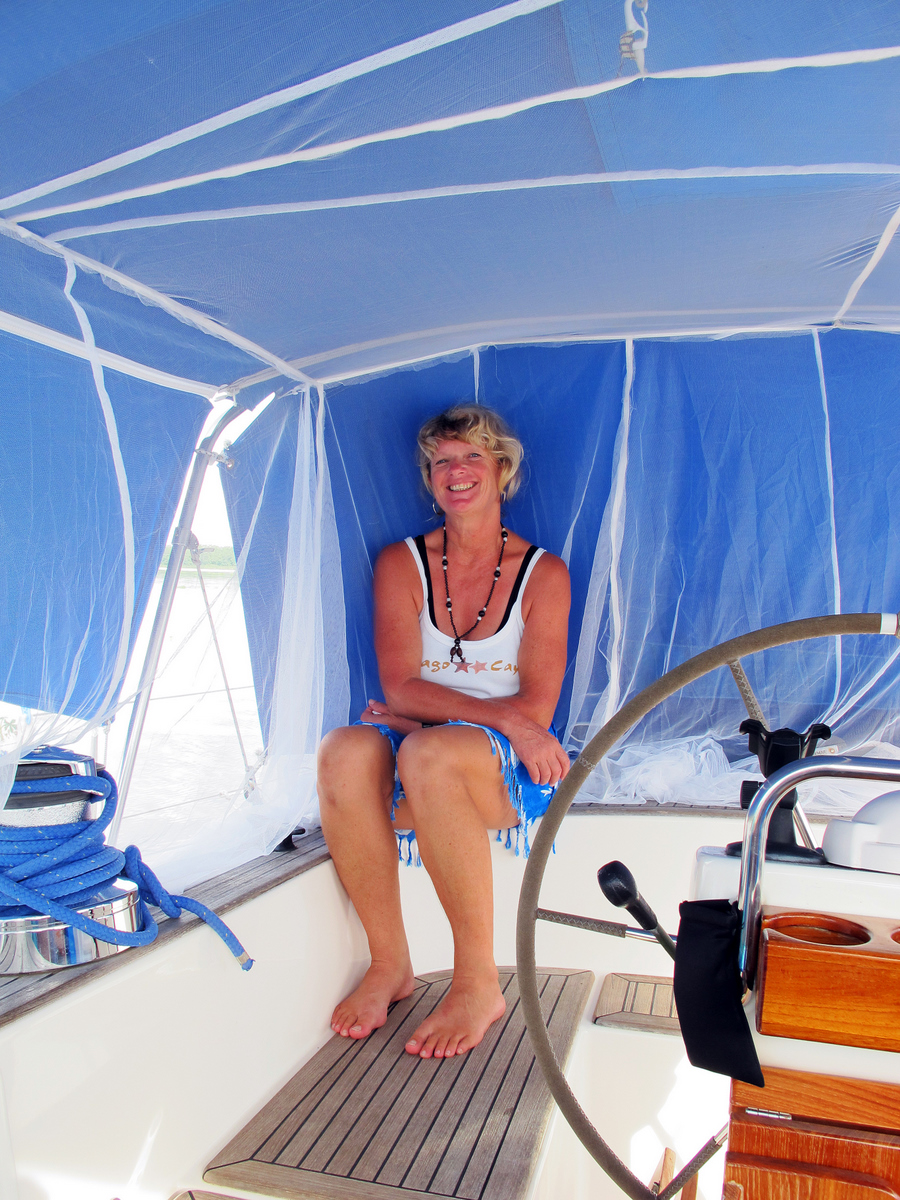
We’ve read that the mosquitos and horse flies are murder in the mornings and evenings in the Manamo River, so Glenys is on a mission to make a mosquito net that will hang under the bimini and cover the entire cockpit. She went into town to buy binding tape and more mosquito netting – we can’t buy mosquito netting by the yard, so she’s had to buy ready-made nets for queen sized beds.
It was absolutely boiling today. We always wear t-shirts because they soak up the sweat – it’s much better than having the sweat run off the end of your elbows or nipples. Glenys is constantly running to the launderette because most days we go through two changes of clothes.
I was absolutely exhausted by seven o’clock and fell down the companion way steps while trying to carry two tool boxes down. I landed in a heap after a six foot fall, bouncing off the steps with my backside and doubling up over the tool boxes. I was lucky not to have broken something – I got away with a bad bruise on my left rib cage. I’ve reached a low point.
17 August 2011 Chagaramus, Trinidad
I had a lie-in this morning and didn’t get started until seven o’clock. My day was taken up with lots of small finishing jobs today – I fitted the storm drogue chain plates, fitted the solar panels and completed the wiring.
I fitted the vane for our Hydrovane self-steering and, sure enough, it hit the Arch at many points of sail. I chopped 16 inches off the frame and it clears most of the Arch. I took the bits to Mitch and he is going to weld it back together to that it is 16 inches shorter and 6 inches wider. Hopefully that will give us enough vane area for the Hydrovane to vane to work correctly.
Glenys spent the day making the cockpit mosquito net and helping me. Mike from “El Lobo” spotted her trying the netting out and shouted in a Geordie accent, “Net Curtains? Where d’you think you are, Pet?”
We’re getting close to being shipshape now – another day of jobs and we should be ready to go.
18 August 2011 Chagaramus, Trinidad
I connected the solar panels and they were pumping 10 Amps into the batteries at eight o’clock in the morning. At midday, they were putting in 23 Amps which should be more than enough to keep us going without running the generator every day.
It’s Thursday today, so we contacted Ian from “Blackthorn Lady” and barring any major problems, we’ll clear out tomorrow, fill up with fuel and leave for the Manamo River on Saturday. There are two other boats going at the same time – “Blackthorn Lady” &” Pogeyan” (Steve and Rikzene). The area in the Orinoco Delta that we’re going to is very isolated and there will be nowhere to get assistance if we have problems with engines, etc. We’ll be in contact with the other boats via VHF radio and be able to help each other out. Ian and Jackie called around at lunch time and gave us some malaria tablets that they had bought.
I spent the day doing more finishing off jobs – mounted the barbeque, outboard and Danbuoy brackets on the Arch, fitted the guard rails, cleaned up the sealant around the deck fittings, dived down to check the propeller and generally tidied up. Glenys went into Port of Spain to pick up a few things and then continued making the mosquito net for the cockpit.
We went out for a meal because our cockpit light has stopped working – another job to sort out tomorrow.
19 August 2011 Chagaramus to Five Islands, Trinidad
I woke up excited that we’re finally going to leave the Power Boats marina and go off on a mini adventure.
I spent the morning running about buying last minute things and finishing off a few essential jobs. In preparation for the River Manamo, I bought a Fortress anchor which is supposed to hold well in soft mud. I bought and fitted some blocks and rope for the davits. I picked up the modified vane for the Hydrovane and the aerial bracket from Mitch. My credit card was red hot by lunchtime.
Glenys went to West Mall to pick up some more malaria tablets, but got stuck in a traffic jam for 1½ hours which was caused by a land slide – she wasn’t happy when she finally arrived back at the boat.
After lunch, we tidied up and went to check out. It took over two hours because “Blackthorn Lady” & ”Pogeyan” were both clearing out at the same time and the customs guy was a complete idiot. We arrived back at the boat at quarter past four loaded with the last minute food shopping and enough duty free booze to kill a small elephant. The next stop was to fill up with fuel and we only just had time to motor around to Five Islands to join up with the others for a couple of beers before the sun went down. We decided to leave at three o’clock in the morning.
Back on Alba, I managed to get the dinghy up on the davits – it’s not quite right, but hopefully it will be calm on the passage to the Manamo River tomorrow.
20 August 2011 Five Islands to Rio Manamo, Venezuela
I must admit to groaning when the alarm went off at half past two. There wasn’t a breath of wind, so we hoisted the main sail and motored south west. We both had a one hour kip before breakfast.
The wind didn’t pick up at all, so we motored for nearly ten hours. It was so calm (and boring) that Glenys retired below to finish sewing the mosquito net for the cockpit. I sat and read a set of cruising notes about the River Manamo that have been prepared by other cruisers who have visited the area. An extract from the Cruising Notes:
The Manamo River is one small finger in the vast delta that empties the Orinoco River into the Atlantic Ocean and the Gulf of Pariah. The Orinoco River, the eighth largest in the world, is 2,140 km long and its watershed encompasses seventy percent of the national territory of Venezuela. Two thousand rivers are tributaries and feed more than one quadrillion cubic meters of water annually into the Atlantic Ocean.
The Orinoco has formed one of the largest deltas in the world. The 40,000 sq km delta is known as the Delta Amacuro and is a region of wild forests, damp jungles and mangrove swamps which are woven with the rivers and channels that empty the waters of the Orinoco through more than 70 major mouths. In this labyrinth, the waters are constantly forming channels (canos) and islands where the moriche palms thrive.
The approach to the river mouth starts about seven miles out and is along a wide channel which is around 4 metres deep, going around very shallow patches. We used the GPS coordinates provided by the cruising notes and they are bang on - thank goodness for GPS because it would have been very tricky using transits and other older navigation methods.

We anchored off the small town of Pedernales at one o’clock and went to see the Guardia National to clear in. We speak very little Spanish and they spoke no English, but we managed to let them know that we want to be here for a couple of weeks. They wrote our details down in a ledger and that was it. We haven’t officially entered the country, but they don’t seem to care.
Pedernales is a very sleepy little town and there wasn’t much going on. We were unable to get anyone to change our US dollars into Bolivars, so we couldn’t buy anything. The only interesting thing was seeing Scarlet Ibis wandering about the edge of the river – they are a brilliant red colour and unconcerned with the locals (who also ignore these beautiful birds.)
In the evening, “Pogeyan” and we had to move because we were both anchored where there are cables running across the river bed to a small village – we were told to anchor to the north of the Guardia National dock. We invited “Pogeyan” and “Blackthorn Lady” for drinks. They were suitably impressed by our cockpit mosquito net, although it wasn’t necessary because there was a stiff breeze.
21 August 2011 Rio Manamo, Venezuela
The others had gone by time we surfaced. We had breakfast and then headed off around the point from Pedernales into the Manamo River. The delta mouth is about a mile wide at this point and there is a shallow bar that sticks out half way across the river. We nearly went aground a couple of times. The charts show a shoal area when coming into the start of the river and we went too far towards the shore - I had to slam into reverse when the depth gauge dropped down to 2.2 metres – we draw 2.0 metres (we think!) It was a pretty tense hour of watching the depth gauge, trying to get into the river and working out which way to turn when it was getting shallow. Fortunately, once we were in the river, the depth varied between 6 and 10 metres deep.
The main river is about a quarter of a mile across - much wider than I expected. The jungle is very thick on both sides and the water stays deep to within 20 metres of the tree line. There are plenty of Scarlet Ibis which fly overhead, so we soon gave up pointing them out to each other. We took it nice and slow and enjoyed a gentle two hour trip up the river to Ibis Island.
Once we had anchored near to “Pogeyan” and “Blackthorn Lady”, we had several groups of Warao Indians visit us. The cruising notes say the following about these indigenous natives:
The Warao (15,000 est. in 1987) rely on dugout canoes to fish for morocotos in the canos and to access fields cleared in the island forests. The dugouts range in size from a few meters for small children, to craft ten meters or more holding 40 to 50 people. Giant sassafras and ceiba trees are preferred for construction of the larger craft as the durability of the wood gives a useful life of up to 10 years.
Palafitos, rectangular pile dwellings supported on the trunks of the moriche palm are the typical dwellings in the bajo delta. Walkways, also supported on piles often connect various dwellings. The platform of the dwelling is made of two layers of split palm trunks, covered with a layer of clay. Two central forked posts support the ridgepole. The roof is thatched with fronds of the termiche palm. The ends and sides are open although the roof slopes nearly to the level of the floor. Most of the villages are concentrated near the Atlantic and the Warao often travel to Tucupita or Barrancas to trade.
The moriche palm is the Warao’s tree of life. From it they extract flour, called yuruma for bread, fat grubs, which they eat fried, boiled or raw, a wine called guarapo de moriche and a drink called mojobo. The moriche seeds are also eaten. The top of the palm sprout is beaten, split and twisted into strands used to make sails and twisted into heavier cords and ropes. The Warao also make wax candles for lighting, extract oil from the castor bean and sassafras for medicinal uses and sejo, palm tree oil which is used for medicinal purposes and for frying food. The Warao also weave moriche baskets, which they dye with extracts from the moriche and other nuts and seeds and the barks of various trees. Baskets are also made from small cane (itirite). Also woodcarvings are made from the soft wood of the buttress roots of the sangrito (Dragon’s Blood Tree).
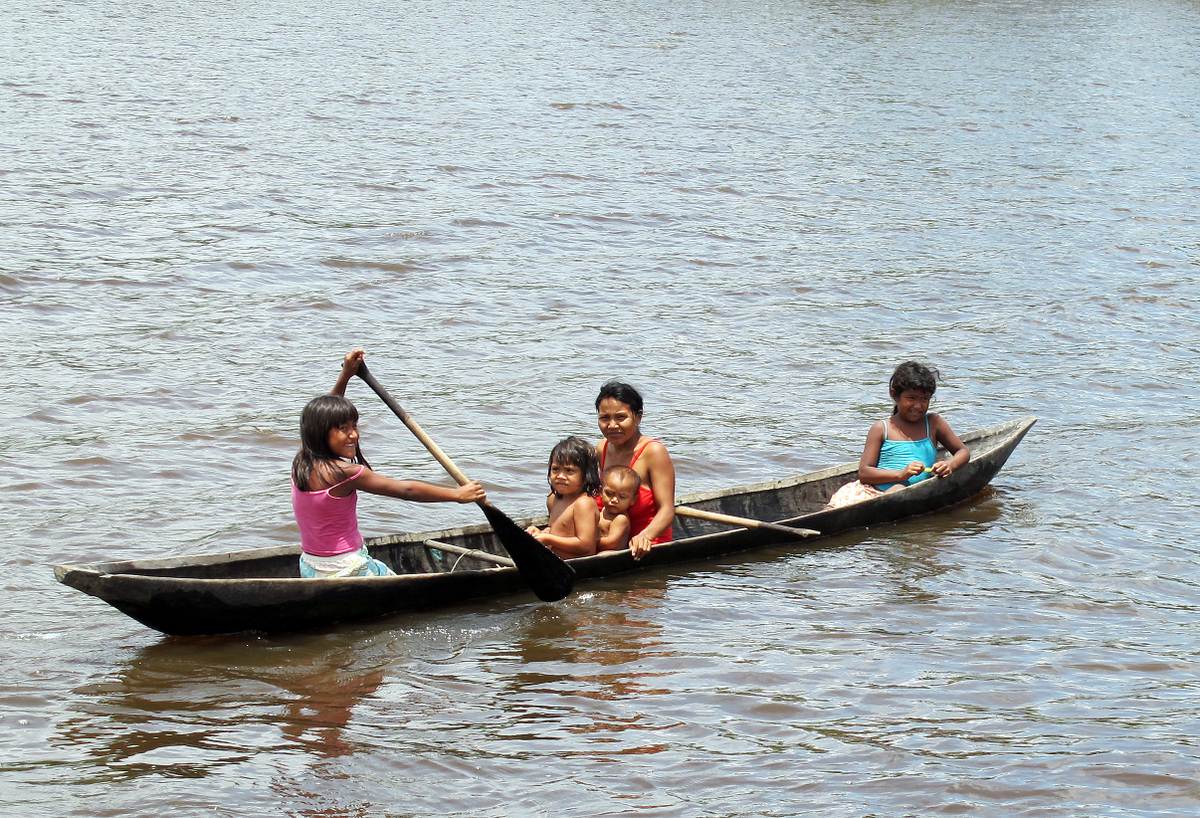
The first Warao to arrive were children from the nearby village. The boys came in a pirogue with a powerful 40hp engine, while three girls arrived in a dugout canoe. They didn’t have anything to trade and have obviously come to expect hand-outs. We gave them sweets and the odd little trinket.
We had another family that came for hand outs. It’s very odd. They come alongside, speak no Spanish or English and just stand there patiently waiting. Glenys gave the children a couple of sweets and eventually they left. They came back later with some small items to trade. Glenys traded a towel, some soap and a t-shirt for some beads and a small woven basket.
After lunch, we did a few little jobs and went for a quick explore down a small cano in the dinghy. There wasn’t much to see, so we spent the rest of the afternoon mooching about.
We all congregated on “Pogeyan” for a pot luck barbeque dinner to watch the Ibis arrive to roost for the night. In past years, there have been thousands of them, but there didn’t seem to be very many this evening. There was a spectacular thunderstorm and heavy rain as night fell.
22 August 2011 Rio Manamo, Venezuela
The alarm clock went off just before six o’clock and we climbed into the dinghy to watch the Scarlet Ibis leaving their roost. We have been told that they leave slowly at first and then lift off in a spectacular flock with a great rush of noise. Unfortunately most of them seemed to have found somewhere else to roost. Even so, it was nice and peaceful drifting slowly in the dinghy and we heard a troop of Howler Monkeys in the distance – a very strange and eerie sound.
We pottered about in the morning doing a few jobs and then left about two hours after the others. The river is a maze of waterways and it’s a bit scary being alone because the channels all look the same and it would be easy to become disorientated. The Navionics electronic charts that we have on our portable chart plotter are surprisingly accurate. The general shape of the canos and islands is correct but the GPS position is a quarter of a mile out at times. The hand drawn map with the cruising notes is very useful and is our main guide to getting south.

We passed three Warao villages on the way. The first village had already visited us for hand outs yesterday, but repeated the process as we passed their village. The second settlement was much larger and we were literally mobbed by about 10 large pirogues full of children. Again they had nothing to trade – just expecting hand-outs. We didn’t see anyone from the third village and found out later that there is a huge swath of water hyacinths at the water’s edge and they can’t get through.
“Pogeyan” and “Blackthorn Lady” were anchored ½ mile from another large Warao village. As soon as we dropped anchor, we spotted a small group of River Dolphins swimming around the anchorage. They are strange, mottled pink creatures with long snouts. I went up the spreaders to try to get a good photograph of them, but the best I could get was a blob in the water. We also heard a group of Howler Monkeys to the east of us.
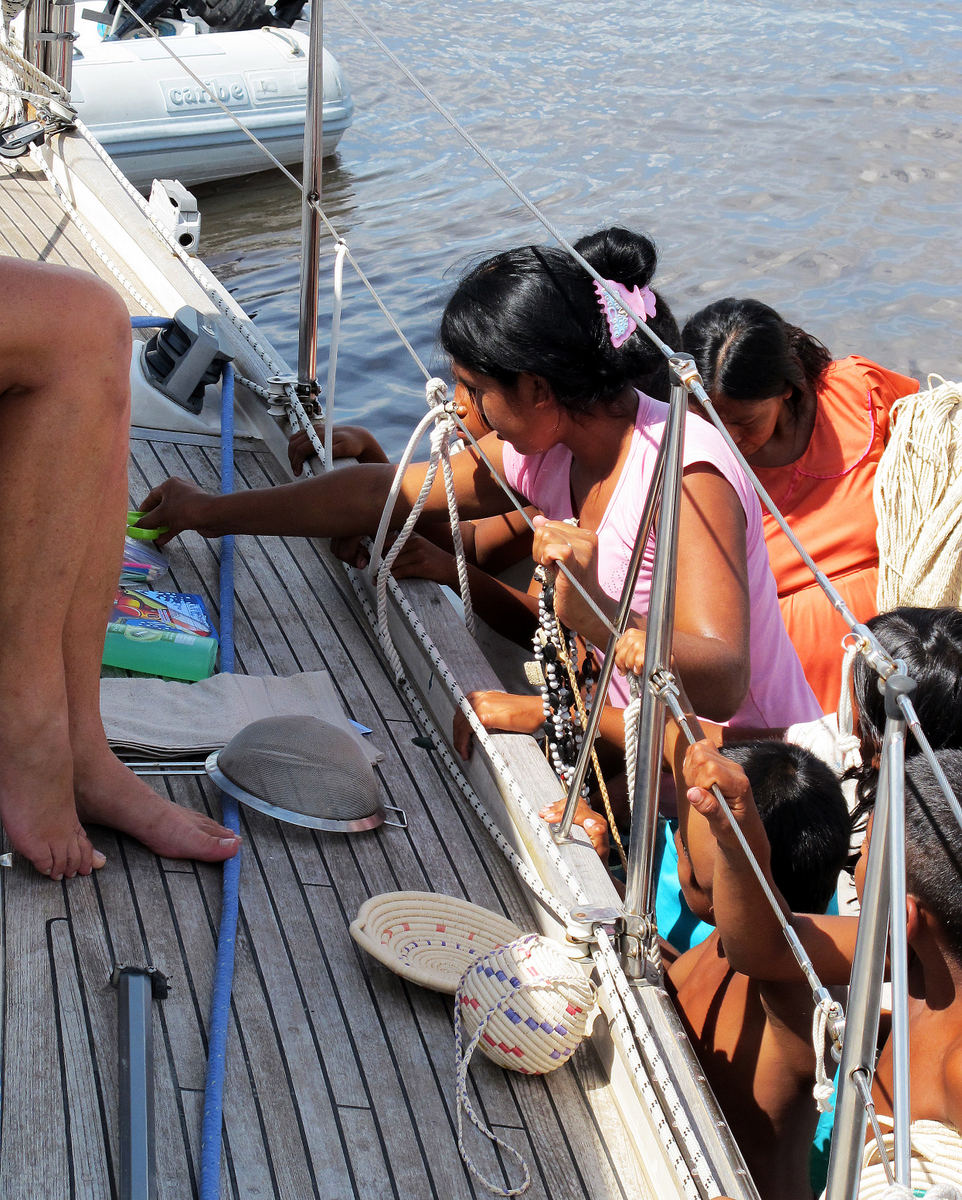
The Warao Indians arrived in droves, but at least they all came with something to trade. I was starting to get despondent about the previous villagers begging. Glenys had a fun time bartering for baskets and bracelets. She now has an established process where she first choses one or two items from the many being offered. Glenys will then get a small selection of items that she is willing to trade and lays them out on the deck, indicating how many items she is willing to trade. It’s all small items like toothpaste, pencils, colouring books, small towels, clothing, soap, dress material, etc. Interestingly, it seems to be only the ladies and older girls who make the final selection. The fun part is watching the ladies touch the various objects trying to decide which one they want. They are torn between the practical items like soap and the more frivolous items like pencils for the children. Most times they end up with a choice between two items and go for the practical object, at which point, Glenys cracks up and hands them both items. We’re worried that we’re going to run out of things to trade.
After trading with about ten boats, there was a short lull, so we jumped into the dinghy and went for a ride up a small cano – more jungle and mangroves, but there was one little stream through beds of water hyacinth which was a welcome relief from jungle. We didn’t see any wild-life, so we went over to have a look at the Warao village.
The dwellings are more traditional here than downstream – the roofs are made from palm leaves rather than corrugated iron sheeting and there are intricate wooden walkways between the buildings. They also seem to be a lot more organised than the previous villages, with some evidence of traditional activities, I saw one guy handling big branches of palm leaves – I assume that it was Moriche Palm. There is however, evidence of modernisation with electricity cables strung on poles, some more solid looking buildings (with government notices) and 75hp Yamaha outboards everywhere you look.
We had drinks and nibbles on “Blackthorn Lady”. The mosquitos and horse flies haven’t been a problem – we were expecting to be continually fighting the little beasts. I didn’t put on any mosquito repellent this evening and wasn’t bitten at all. This is the first time after battling the little blighters in Power Boats for a month. I think that we can go to MOSCON 2.
23 August 2011 Rio Manamo, Venezuela
We were actually cold last night, even when covered by a sheet. It was a cool, over cast morning and the current was against us, so we waited for an hour until the tide turned and headed south.
There was a big bora (raft) of Water Hyacinths lodged against our anchor chain, so I lashed a machete to a mooring hook and cut it away – the plants are surprisingly tough and I had to cut down for two feet before breaking it apart. Rikzene told me later that the best way to get the hyacinths off is to motor forwards then to reverse back leaving the bora separated from the chain. Whilst in the dinghy, I noticed that the boat is sitting 2 inches lower in the water because we are now floating in fresh water. I hope that the barnacles that we picked up in Chagaramus are dying and falling off our hull.
I’m pleased with the solar panels that we have installed - having 380 Watts of solar energy has transformed the way that we live – we can effectively use as much electricity as we want during the day. This means that we have many of our seven fans running continuously and, when we get up in the morning, the batteries are still above 80% charged.
Once on our way, we had to dodge bora of water hyacinths which are floating by on the current. These apparently have small eco systems of their own with frogs and even snakes living on the larger ones. We were stopped by a few Warao Indians whilst motoring past their dwellings and traded for some more small things.
We stopped at a side cano and went for a short tour in Pogeyan’s dinghy with Steve and Rikzene. We saw a couple of locals fishing with a line – possibly for piranha? I was quite excited to see a couple of Toucans fly overhead. We heard howler monkeys, but didn’t see any.
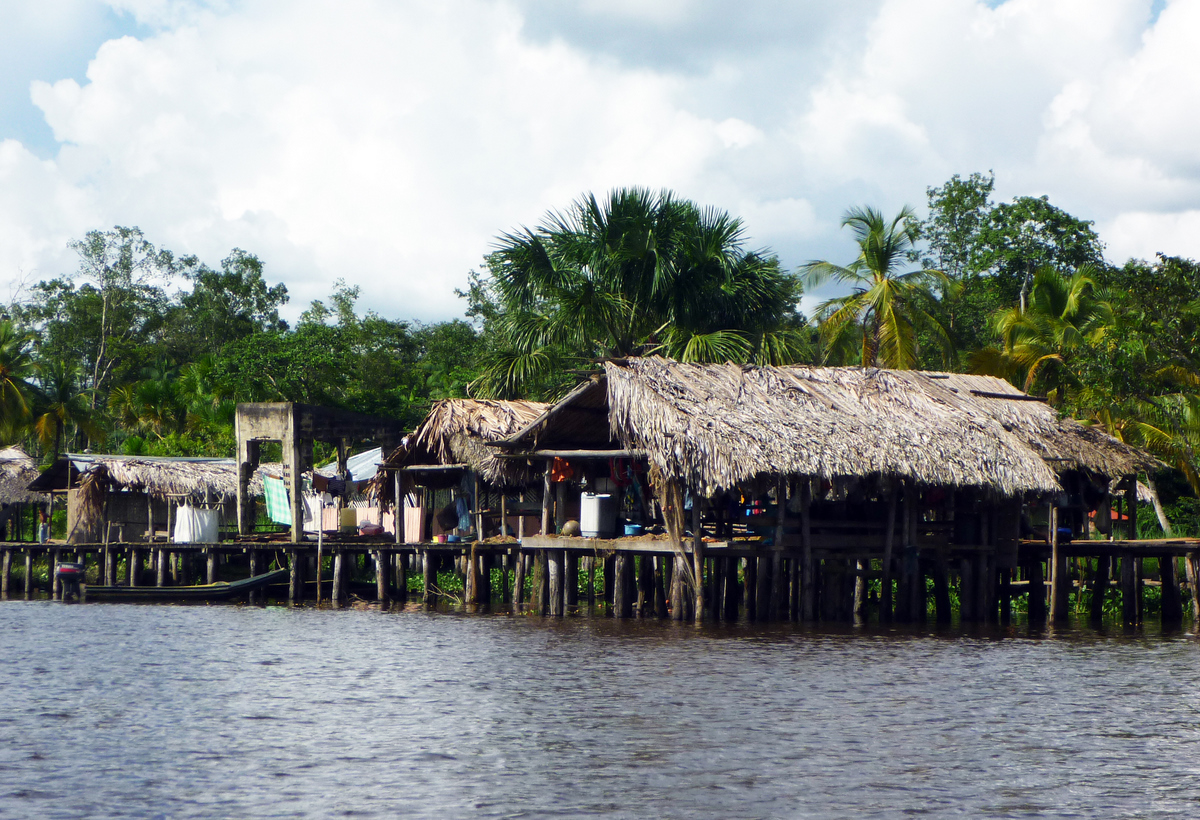
Our anchorage for the evening was at the south end of Isla Monos (Monkey Island) just off an small “Eco-resort” called Boca Tigre Lodge. They can take 30 guests who come out to see the jungle and the Warao Indians. We all went to the bar to see if we could organise a trip into the jungle or something, but no one could tell us if it was possible or how much it would be.
We invited the others for dinner and we didn’t bother to put the mosquito netting up in the cockpit – a BIG mistake. Just as the sun went down, I felt a mosquito bite my leg. About 30 seconds later, we were invaded by hundreds and hundreds of big, black mosquitos. I got out the cockpit mosquito net, but with six people trying to help, we got into a tangle with it and it took five minutes to sort it out. By this time, the inside of the mosquito netting and the boat were swarming with the little black buggers.
I produced the tennis racquet zapper and we started to kill them, but there were too many. We retreated down below while I sprayed the cockpit area with insect killer (called BOP). I then started to BOP the inside of the boat and we all fled back into the cockpit. Ten minutes later, all of the surfaces of the inside of the boat (carpet, upholstery, table, etc) were speckled with hundreds of dead black bodies. Glenys had to stop making dinner and hoover the carpet while the rest of us were still trying to kill the insects that had survived in the cockpit. It was an hour and a half of chaos, before we settled down to eating dinner. I found 25 dead mosquitoes on my chart table in a small 2 square foot area.
24 August 2011 Rio Manamo, Venezuela
I didn’t sleep very well, worrying about mosquitos and things that bite in the night. We also didn’t bother to put up the Uber-windscoop so, when it rained, Glenys had to shut the hatch. It then became very hot in the cabin, so I had to get up at four o’clock and put up the Uber-windscoop.
Rikzene organised a tour guide in the morning. Our first stop was up a small cano where we donned wellies and walked through the muddy jungle while the guide pointed out various trees which the Warao Indians use. It was hard to understand the fine detail because it was all in Spanish, but he pointed out a moriche palm and extracted a big fat grub which he offered around to be eaten. When there were no takers he ate it himself – nice.

We then went fishing for Piranha for an hour or so. The Piranha live in small canos and not in the main river. We used simple fishing poles with a small ½” long hook and small chunks of uncooked chicken for bait. The secret is to attract the Piranha by splashing the water with the end of the fishing pole to simulate an animal that has fallen in the water. Glenys and I caught one each, which we cooked later and shared with everyone else as a starter for dinner.
The guide then took us to a Warao Indian habitat. I was very uncomfortable at the way that we walked into their home and stared at their meagre possessions. The building is very, very basic consisting of a rough wooden floor suspended about six feet above the muddy shore on poles with a roof thatched with palm leaves. There appeared to be about 30 people including children living in the one that we visited and I guess that they all sleep in hammocks or on the floor. Clothes are either hanging from the roof on string or in small piles. They were weaving a traditional hammock on a simple loom. It’s incredibly basic living, but they have electricity, a TV and there was a 40hp Yamaha engine being serviced on the floor.
We went back to our luxury yachts and spent the afternoon lounging about in the heat – not a breath of wind. I’ve started an audio Spanish course – a bit late, but I need to learn the language. I find it very frustrating not being able to communicate with people. The guide came back after five o’clock and took us down the river where we saw three troops of howler monkeys in trees right on the edge of the river.
“Pogeyan” is a large 46 foot catamaran with a large lounge, glass doors and air conditioning. Following the “Night of the Mosquitos” yesterday, we were concerned about being attacked again by insects, so Rikzene and Steve invited us to their boat where Jackie cooked a meal.
25 August 2011 Rio Manamo, Venezuela
I felt a bit dull this morning- too much duty free red wine last night. The current was against us first thing in the morning, so we did some small jobs until eleven o’clock.
The river is 30 metres deep here. We decided to hug the outside of each bend in the river and were able to motor along about 25 metres from the shore and look at the jungle – we managed to get a reasonable photo of a wild curassow, which are like wild chickens that roost in the riverside bushes.
There were a few small dwellings at first and we were met by the inevitable children in their canoes. Some came to trade and others for hand-outs. We then hit a stretch where there were several villages and we were inundated by happy smiling faces – it gets a bit wearing having to slow down all the time. Glenys did quite a bit of trading and handed out some cookies that she made yesterday.

One of the tips that we picked up from the cruising notes was to put all traded items into a plastic bag and BOP them with insect killer. This is definitely a good idea - Glenys had a weevil thing squirm out of one basket onto her hand as it was passed to her. She flicked it over the side.
The Orinoco Delta Lodge is ½ mile up a small cano which branches right off the main river. The entrance is very shallow in the northern part of the river, so we favoured the southern side. We were too far south and nearly went aground just off the small settlement on the shore. We eventually made it to the Orinoco Delta Lodge at four o’clock. As soon as we had anchored, we had a small pod of River Dolphins swimming around the boat – I still didn’t manage to get a decent photograph of them.
We had a quiet night alone. It’s great cruising in company, but the constant partying is getting too much for my liver. We put up the cockpit mosquito netting and watched hundreds of big black mosquitos trying to get in as darkness fell. At the height of it, there were 20 mosquitos per square foot on the netting. Hundreds of tiny flies were still getting through the mesh of the netting, but they didn’t seem to bite and were just attracted by the cockpit light. I rigged up a holder for the insect zapper next to the light, stuck the button to “on” and watched one insect per second get zapped for the next three hours.
26 August 2011 Rio Manamo, Venezuela
It was a hot night and I woke up at three o’clock having been bitten. I switched on the light and used the zapper to clear the room.
The first job in the morning was to remove the mosquito netting and hang it up on the front deck to shake out the insect bodies. Then I swept up the hundreds of small fly bodies from the cockpit.
I’m very pleased that we put davits on the Arch as the system works well both at anchor and when under way in calm waters. I hoist the dinghy with two ropes and then use another two ropes to pull the dinghy in tight against the Hydrovane to stop it swinging from side to side. There are a couple of little niggles - the ropes that I bought are too thin and too short, so I’ll have to buy thicker rope when we get back to Trinidad. The more serious problem is that the dinghy being worn by rubbing against protruding parts of the Hydrovane. So I spent most of the day making a shaped teak pad, which I’ve screwed to the Hydrovane. Hopefully, this will give a bigger and smoother surface to hold the dinghy in place without chafing.
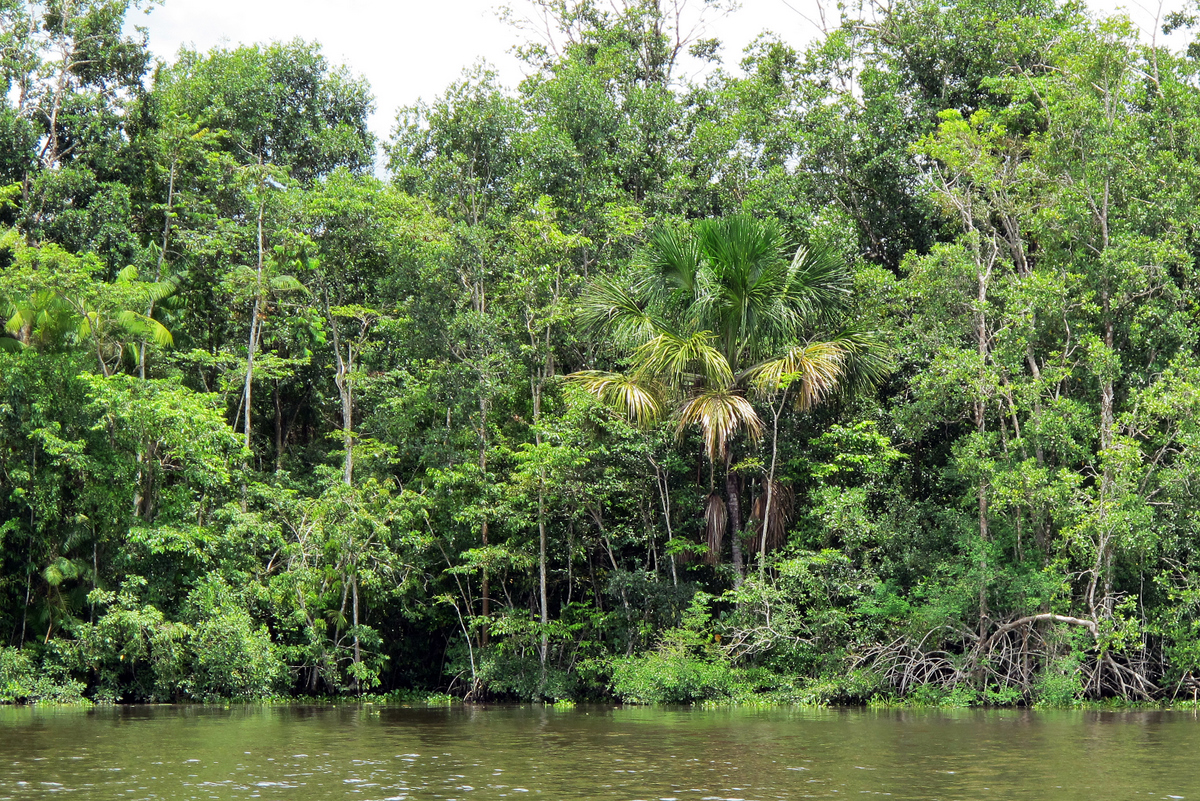
Rikzene, Jackie and Glenys went for a dinghy ride back to the main river to visit a small settlement, where some small boys had given some of us necklaces as gifts. Rikzene wanted to go and give them some more things in return. As they went alongside a dugout canoe by the shore, the children came down and gifts were exchanged. One little girl had a Toucan on her hand and one of the ladies was holding a small monkey.
Glenys and I went for dinghy ride for a mile up the river and down a small cano. I tried fishing for Piranha using my spinning rod and some dried salted fish for bait. I had a few nibbles but caught nothing. We saw little else apart from a Toucan high up in a tree.
Back at the boat, there was a little bit of excitement when a blue and gold macaw flew onto Pogeyan and then onto our boat. It was obviously a parrot from the Lodge (saying “Ola” all of the time), but was a fun photo opportunity.
We all went for dinner at the Lodge. They only have a few guests staying and we had to give them advanced notice that we wanted to eat there. There was only a set menu with no choice, but for $20US per person, the food was good. We gleaned some more information from the staff about the electric cable strung across the river at Boca de Uracoa and the fact that we can buy diesel there. A guide from a small group of Germans was able to exchange some US dollars for bolivars at an exchange rate of 7 bolivars to a dollar. We all had $20 worth which will be enough to buy a few things in Boca de Uracoa tomorrow.
27 August 2011 Rio Manamo, Venezuela
It was a hot still evening, so Glenys slept in cockpit last night. She said that it was very pleasant listening to the jungle noises rather than the whirr of a fan in the cabin, but the cockpit seats are a bit narrow to sleep comfortably. I had a mosquito free night, if a little hot. It’s Saturday, so we took our weekly malaria pill today.
It was a beautiful, misty morning. We all left at seven o’clock because we wanted to get over the shallow entrance at high water. The lowest depth of water that we recorded was 2.8 metres about 50 metres from the north shore right next to the village. Again, I think that we should have been further off the shore.
There were lots of Water Hyacinth boras to negotiate in the main river and the mist soon lifted to give us another nice sunny day. The scenery has now changed quite dramatically. The thick jungle is giving way to farmed land and plantations, while the housing is much sturdier, with walls, roofs, doors and windows. These seem to be villages that have been set up by the government, as the houses are very similar in construction. I even spotted a basketball court and children on bicycles. The locals still have dugout canoes, but not many came out to see us. Those that did, just came to stare and not to trade.
We had the current with us for most of the trip and, after a couple of hours, we took the right hand branch in the river towards Boca de Uracoa. It took us 4½ hours to reach the electrical cable strung across the river, where we anchored on the west side in seven metres of water. The holding was once again surprisingly good - I expected more soft mud in the river, but our 60lb CQR seems to dig in well. Perhaps the bottom is hard sand due to the fast flowing current.
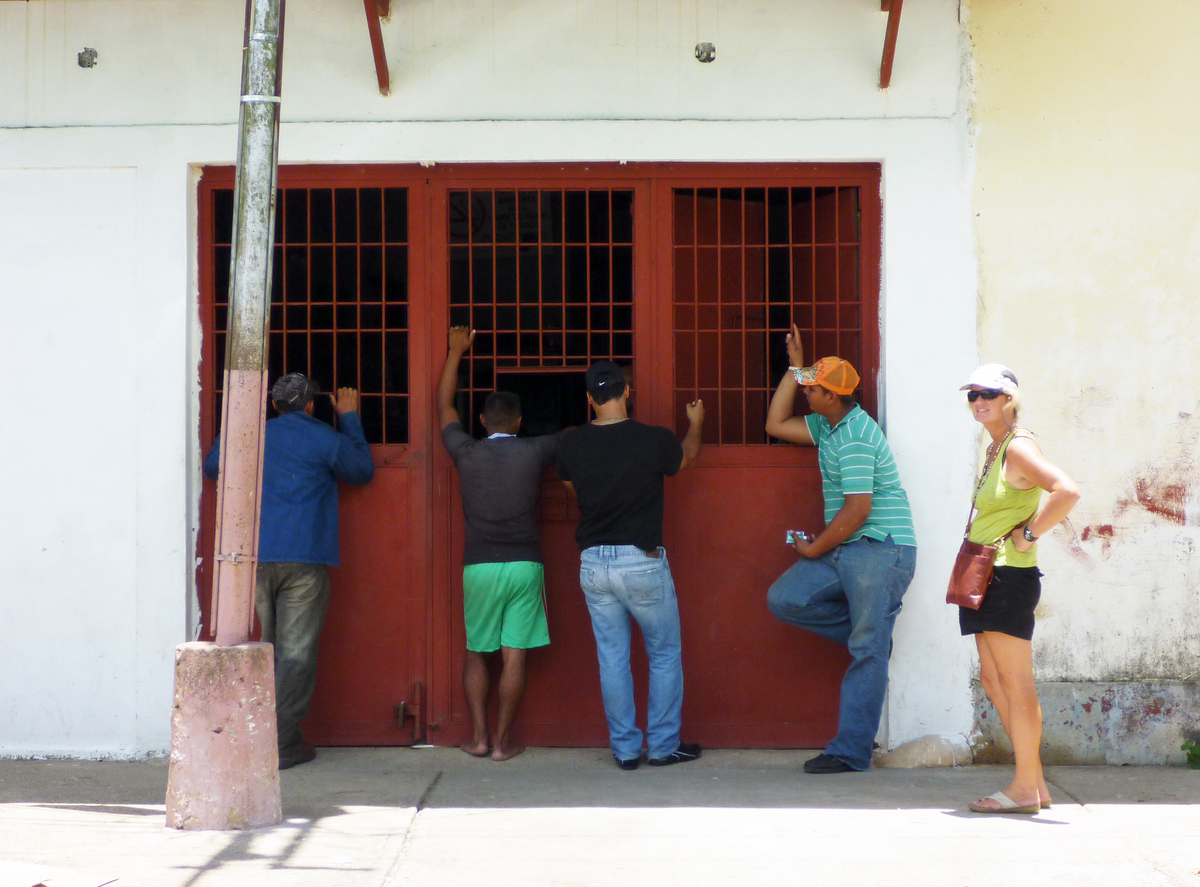
Glenys and I went into town to have a look around and hopefully buy lunch. Boca de Uracoa is a real one horse town. There are very impressive, gaily painted concrete water taxi stands on the river front, but beyond that there is one main street with only a couple of shops and food stalls. The main grocery shop doesn’t have any sign, but can be found by the crowd of people hanging about outside the small frontage. There are red iron gratings stopping anyone going into the shop and you have to ask the shop keeper for the items that you require - shop lifting is obviously a problem around here. Glenys bought a bag of twenty four bread rolls for 18 bolivars which she shared with the other boats.
We bought a couple of pasties from one of the food stalls, which contained a shredded beef concoction - tasty if a little greasy. Having exhausted the possibilities of the town, we climbed back into the dinghy and motored around the corner into a small cano where we found “Pogeyan” and “Blackthorn Lady” at the fuel station filling up jerry cans with diesel. They bought 150 litres of diesel for 7.5 bolivars which is approximately $1 US – that makes diesel only three US cents per gallon.
There is a small bar next to the fuel dock, where we managed to get US dollars changed at a rate of 8 bolivars to one US dollar. We bought a case of beer for $15 US which makes beer $2.15 US per litre which is 71 times more expensive than diesel.
I’d estimated that we’d used over 100 litres of fuel with all the motoring that we have done in the past week, so we borrowed some of Pogeyan’s jerry cans to fill up our tanks as well. I had a bit of a minor disaster when our tank overflowed after putting in only 75 litres of fuel. We had nasty, smelly diesel running down our beautiful teak decks. However, a bit of washing up liquid soon sorted that out. I just hope that the diesel tank vent pipe is higher than the filler pipe, otherwise we’ll have smelly diesel in the bilges.
We invited the others over for dinner and the mosquitos weren’t as overwhelming as previous nights – perhaps it is a little bit windier here? A few of the devils managed to get past our defences though and the zapper was deployed at various times. The Polar Lite beer that we bought today is tasteless. What’s with Lite Beer anyway – surely that’s an oxymoron?

28 August 2011 Rio Manamo, Venezuela
We had a chilled out morning waiting for the current to turn, to start taking us back downstream. Glenys worked on the big sun shade to cover the main boom while I mooched about, editing photographs and writing this diary.
We ran the water maker and the output is amazing. It normally produces 45 gallons per hour but because we’re in fresh water, I reckon that it’s outputting at least twice as much – about 100 gallons per hour. We only had to run it for 15 minutes, so we filled two big jerry cans with water for “Blackthorn Lady”.
We decided to go back to the Orinoco Lodge and try to arrange a fast pirogue to take us on a day trip to Tucupita tomorrow. We had a little bit of wind as we left Boca de Uracoa and put up our sails, but soon ground to a halt in the fluky winds. The trip back to the Lodge was uneventful, but we had to pick our way through areas of quite dense water hyacinth once we were back on the main river.
It was around low water when we entered the cano for the Orinoco Lodge and we recorded a depth of 2.3 metres at a few points. Our nervousness was made worse by the approach of a huge thunderstorm which was giving us gusts of 20 knots as we edged our way over the shallows. We had lashing rain and 30 knot gusts as we approached the anchorage, so I just dumped the anchor using the windlass control in the cockpit and we sat and waited for the storm to pass.
We tried to get a trip down to Tucupita, but they wanted $180US and we would have to get leave at five o’clock in the morning because they are taking some other guests to Boca de Uracoa first. We decided that they were trying to overcharge us so we declined. We had dinner on “Pogeyan” – no problems with the mosquitos behind the patio doors in their air-conditioned saloon.
29 August 2011 Rio Manamo, Venezuela
I was woken by the sound of parrots squawking as they flew overhead. We had another morning of waiting for the tide to turn. Glenys finished off the white sun shade for the main boom. It’s massive and will probably be a major hazard when it gets windy, but it will keep the boat considerably cooler while we are sitting in a calm anchorage.
I decided that I’d draw a map of the Manamo River with notes about the various things that we have discovered. It can then be added to the cruising notes that are being shared by cruisers. I had to use screen shots from MaxSea program that came with the boat, but the CMaps that it uses aren’t as detailed as the Navionics charts that we have on our little chart plotter. The Navionics charts are on an encrypted Compact Flash card and needs a proprietary Navionics reader to load them on a PC. Very frustrating – I think that I’ll have to buy the special reader for the PC.
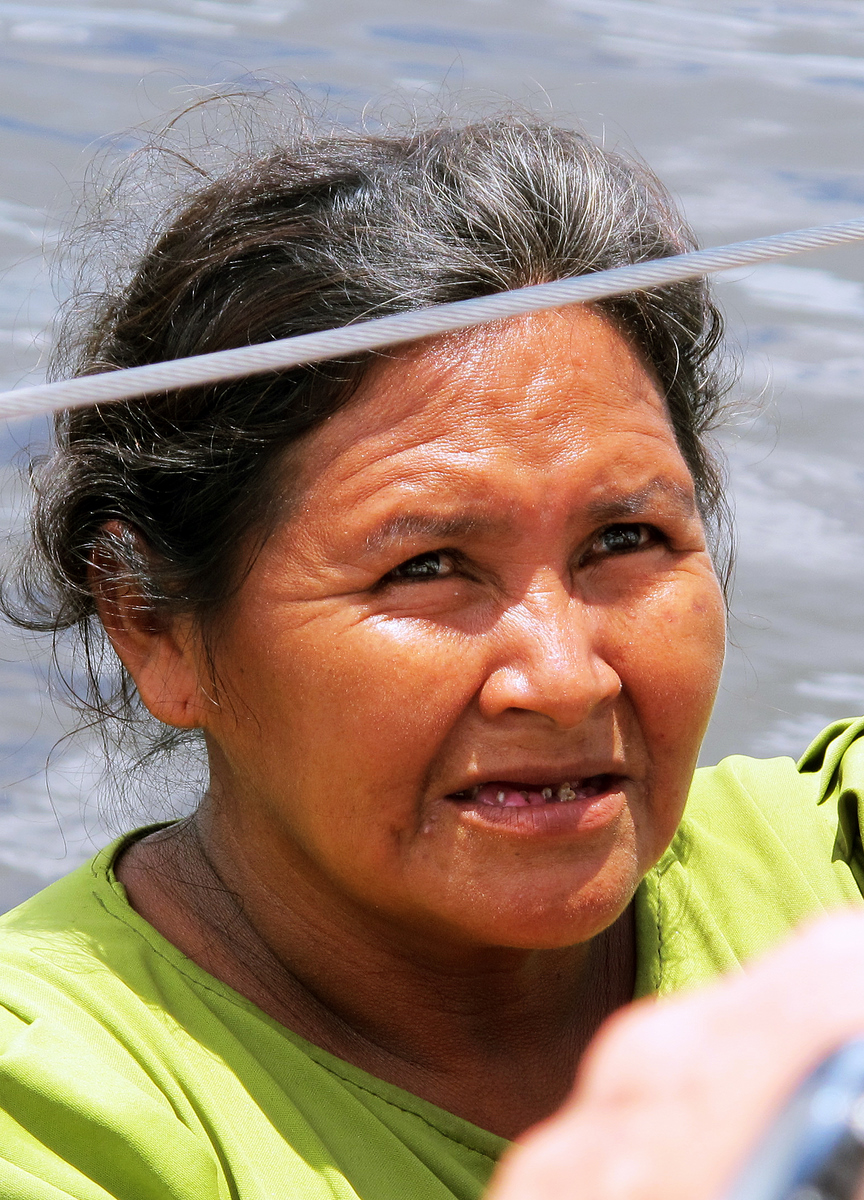
We set off at eleven o’clock and negotiated the shallows at the entrance to the cano. The trip down the river was quiet with only two lots of Warao Indians coming out to see us. The first group were in two boats – a small dugout with three small boys and a larger boat being rowed by eight children. We started to slow down, but we were still going at two knots when a small boy at the front of the dugout grabbed a fender. Glenys told him to let go, but before he could, he tipped the whole canoe over. The dugout turned upside down and immediately filled with water. The children in the other boat thought that this was hilarious and, as we drifted off, they were helping the boys on board their boat and bailing out the canoe.
We stopped to trade with another boat from a village and Glenys finally managed to get four plate mats. Hopefully that is all that we need now. The elderly lady who was in charge of the boat was good at negotiating and fleeced us for a lady’s blouse, a belt, a baseball cap AND a bar of soap. Her serious face was a joy to watch as Glenys communicated in sign language and poor Spanish.
Just after noon, the clouds started to build as a big thunderstorm approached. We were hammered by very heavy rain and 20 knot winds. I had to change into swimming shorts to continue to steer down river. Glenys retreated below and cooked a roti for lunch.
We anchored next to the Boca Tigre Lodge. Ian and I went into see if we could get a trip to Maturin which is a big town further to the west. The only guy that we could find wasn’t very helpful - this lodge always seems to be shut down. Looking at a map, we would have to go to another small town and get a bus, so we decided that it wasn’t worth the effort.
We had a boat come over to us when we had anchored. It was driven by a teenage Warao Indian, but had a load of small children in it. They simply said hello and then hung onto the fenders waiting for a hand out. I have mixed feelings about this. On the one hand it’s great to give the kids a treat in their otherwise hard lives, but should we encourage this begging. It is much better when they come to trade and we give the children a present at the end of the bartering.
Glenys and I had a quiet night by ourselves in an attempt to rejuvenate our livers. After dinner, I spotted a movement outside the mosquito netting and said “We’ve got a rat”. Glenys leapt up but couldn’t see anything. After a few minutes exploring the deck, I spotted it on top of the mosquito net. It was a small marsupial-looking creature and was fascinated by the light. We assumed that it arrived on a bora of hyacinth, so I took a photograph of it and tossed it overboard from whence it came.

30 August 2011 Rio Manamo, Venezuela
I woke up this morning with a burning desire to go exploring up the river to the west of the anchorage. The charts all stop about half a mile west, so I thought that it would be interesting to map it out and see if it leads to San Hose de Buja which has a road going to Maturin. I jumped in the dinghy and went to talk to “Pogeyan and “Blackthorn Lady”, but they weren’t interested in doing battle with the large number of water hyacinth bora that have passed us going up this river.
Glenys and I set off at eight o’clock by ourselves. We had to do a considerable amount of manoeuvring to avoid the water hyacinths, but it slackened off after a mile. We passed a fairly large Warao Indian village and continued up the wide, deep river. We had a few stops to look and listen to the wildlife – howler monkeys, parrot, toucans, etc.
After an hour, we came across a junction in the river, where there is a floating barrier across the branch which heads south west. This consists of 56 gallon oil drums, strung together with chain and logs. The purpose appears to be stopping the Water Hyacinth going up this part of the river – and it looks to be effective. We watched a local pirogue slide across by pulling up the outboard, but there didn’t seem to be any way that we would be able to cross it with our 2 metre deep keel.
We continued up the other branch, continually doing battle with the ever thickening bora of hyacinths. When we were eight miles from the anchorage, we can across another junction in the river. By this time, the sky was darkening with ominous thunder clouds and both river branches seemed to be getting thicker with hyacinths, so we decided to call it a day. As we turned around, a group of ten scarlet macaws took off from a nearby tree and flew away squawking their protests at being disturbed.
We managed to get into the clearer water before the first heavy rain hit us. Once the rain had stopped, we anchored for lunch and chilled out until Glenys spotted a huge raft of hyacinth heading straight for us. We leapt into action and just got the anchor clear of the water and out of the way before the raft arrived.
Back at the anchorage, we chilled out for the rest of the afternoon – I finished off my map of the Manamo River including the new bits that we had explored. We had a lamb curry on “Pogeyan” cooked by Jackie.
31 August 2011 Rio Manamo, Venezuela
Another late start today, waiting for the tide. Glenys is making dinner for everyone tonight, so she went and scrounged some onions and potatoes from the other boats. We’re starting to run out of things now.

We left before the others and motored down the river. Meanwhile “Pogeyan” were having a few problems. They had a huge raft of water hyacinths lodged in the front and between the two hulls of their catamaran. Using one of their engines, they tried to motor forwards and then back off, which has been working pretty well up to now. Unfortunately they weren’t able to move the hyacinths and, in the process, their starboard engine overheated and they had to shut it down. “Blackthorn Lady” and some of the local pirogues came to their assistance and the locals used grappling hook type anchors to pull chunks of the raft away. Fortunately, “Pogeyan” have two engines and were able to start the port one and motor down the river. Glenys and I heard the saga on the VHF radio and anchored a few miles away to have lunch and wait for them to catch up.
We carried on down the river until we came to a smaller cano which heads east. The Cruising Notes say that this cano links the Manamo River to the Pedernales River, but that the river becomes very narrow and the trees overhang the river. Some cruisers have made it through and I would like to try it. Glenys and I went down the cano to have a look, while the others carried on and anchored a mile further down river.
We motored for 40 minutes and the river didn’t narrow at all. The depth varies between 6 to 15 metres and it seems pleasant enough. We turned around and headed back to anchor next to the others. We had dinner on Alba – salt fish stew.