1 July 2011 Hog Island, Grenada
First thing in the morning, Glenys told me that the fridge had switched itself off overnight. I checked the batteries and the voltage was down to 11.5 Volts. There’s obviously something wrong with the batteries or the charging system, so I spent the morning reading up on the various bits of equipment that we have on the boat.
We’ve been relying on a clever battery monitor, which has been showing us the % of charge left in the batteries. By running the generator for an hour or so every day, we thought that we were keeping the % Charge between 50% and 100%, which should keep the batteries in their working range. If batteries are discharged too much, they rapidly degrade by a process called “sulphation” which loses the lead from the plates inside the battery.
My investigations indicate that our “clever” battery monitor has been fooled by the charge from our solar panel and wind generator and has been showing us a % charge figure that is much higher than it actually is. I should have been looking at the voltage of the batteries and making sure that it was between 12.2 Volts and 12.7 Volts. My big worry is that we now have six batteries which have been kept in a heavily discharged state for the last couple of months and may be damaged beyond repair. If I’m correct, it will be an expensive mistake because the batteries are only four months old and to replace them will cost £900. I’m not a happy bear. I ran the generator for four hours which should have charged the batteries enough – we’ll see what happens overnight.
In the afternoon, we went for a walk around Hog Island and got soaked when a squall caught us out. The island now has a dirt road which loops around the shore line and goes across a new bridge linking the island with the mainland. We’re told that the owners of the island were intending to build a holiday resort and sell land to build houses, but it has fallen through because of the global recession.
2 July 2011 Hog Island, Grenada
Bad news this morning. The voltage on the batteries was down to 11.6 Volts again, so I’m more nervous that the batteries are destroyed. I ran the generator for a few hours in the morning and decided to be a bit more scientific in my approach by monitoring the voltage and the current going into the battery while it is charging. Meanwhile, I read more about how the battery charger and other charging equipment should work.
Unfortunately, after running the generator for four hours, it suddenly cut out on me. After a few minutes of panic, I deduced that it was a fuel problem and I managed to get it working again by bleeding the diesel system. Is this related to the air that I’m getting in the diesel for the engine? The engine started OK and I ran it for 30 minutes to make sure that it was okay.
Glenys waterproofed the bimini and kept out of my way – I’m a little bit “preoccupied” and not good company at the moment.

In the afternoon, we went on a “Hash”, which was great fun. It involves a “hare” who sets a trail along paths, up hills and down valleys, dropping handfuls of shredded paper as he goes. The “Hashers” follow the trail aiming to arrive back at the starting point between one and two hours later. There were about 200 people on this one and it is a real fun atmosphere with people who do it every week – mostly locals with a few yachties.
There is a certain amount of ritual in the event and anyone who hasn’t been before is called a “Virgin”. One of the team is called the “Cobbler” and walks around before the start looking for anyone with new running shoes. When the “Hash Master” is giving the briefing, all the people with new shoes are dragged to the front of the crowd and have their new shoes displayed to the baying crowd. Beer is poured into the new shoes and the owner forced to drink it from their shoe.
The “Hash” was fairly hard, steep and muddy – just imagine the chaos of 200 people trying to get up a slippy, muddy path in single file. There were all ages from 8 to 70. The trail took us up very steep slopes through areas with banana trees, cocoa trees, rain forest, bamboo, open grassland and even down a river. Some of the locals were up a tree throwing down ripe “Local Apples” (Malay Apple), which were very welcome.
Back at the start, they had a bar selling food and beer – some Hashers describe them selves as "Walkers with a Drinking problem", but others insist that they are "Drinkers with a Walking problem". We had the foresight to bring a change of clothes and it was great to change into a clean dry t-shirt. There was a closing speech by the “Hash Master” during which the “Virgins” were all asked to come up and claim their certificates. Once gathered, all Virgins were (of course) sprayed with beer – I wish that I had waited to change my t-shirt…
When we got back to the boat, I started the generator with the intention of running it for an hour, but after five minutes it conked out on me. I went to bed in despair - the batteries are not charging and the generator is not working…
3 July 2011 Hog Island, Grenada
I woke up with a mission – I had to try to get the generator running and sort out these diesel problems. The generator is an essential piece of equipment – it charges the batteries, powers the water maker and runs the dive compressor. We can survive for a week with the water that we have in our tanks, but I needed to get it sorted.
I spent all morning tracing the fuel systems and tightening every connection that I could see. I changed the fuel filter on the generator circuit, bled the system and managed to get the generator running again, but it was erratic – it kept slowing down and occasionally cutting out. I checked various things and bled the system three times, but couldn’t get it to run smoothly. The engine (which has a separate diesel circuit) starts okay, so I decided that I’ve done as much as I can and need to get someone to look at the generator.
After lunch, we went snorkelling on the reef just outside Hog Island. It was very murky and not a lot of fish about – I think that the reef is fished out by the locals.
We went to the Hog Island barbeque in the evening. Most of the Americans had gone to an Independence Day party in Port Louis, so it was a non-American event which was pleasant for a change. We ended up chatting to Mike & Pat from “El Lobo” (UK) who were hit by a jet ski in Tobago which put a big hole in their hull just above the water line. Another British guy had been boarded and robbed in Venezuela. Both he and his wife were beaten up and his wife is now back in the UK – sounds like we should definitely avoid Venezuela.
4 July 2011 Hog Island, Grenada
I was up early with another mission, this time to sort out our charging system. I rang an engineer to get him to look at generator – he will come tomorrow.
I analysed my voltage/current graphs and spent all day tracing electrical systems. In order to charge effectively, the voltage of the batteries has to be raised to between 14.0 and 14.4 volts. We have a battery charger which is run from the generator and two alternators on the main engine. Both of these systems are installed in a way that only raises the voltage to 13.5 volts, so it was impossible to fully charge the batteries without going into a marina and plugging into the mains supply.
The alternators are quite small and installed to charge through splitting diodes which is a common way of wiring boat systems up, but it isn't very efficient. There’s nothing I can do about this in the short term – it will be a major project to fit a bigger alternator and re-wire it all.
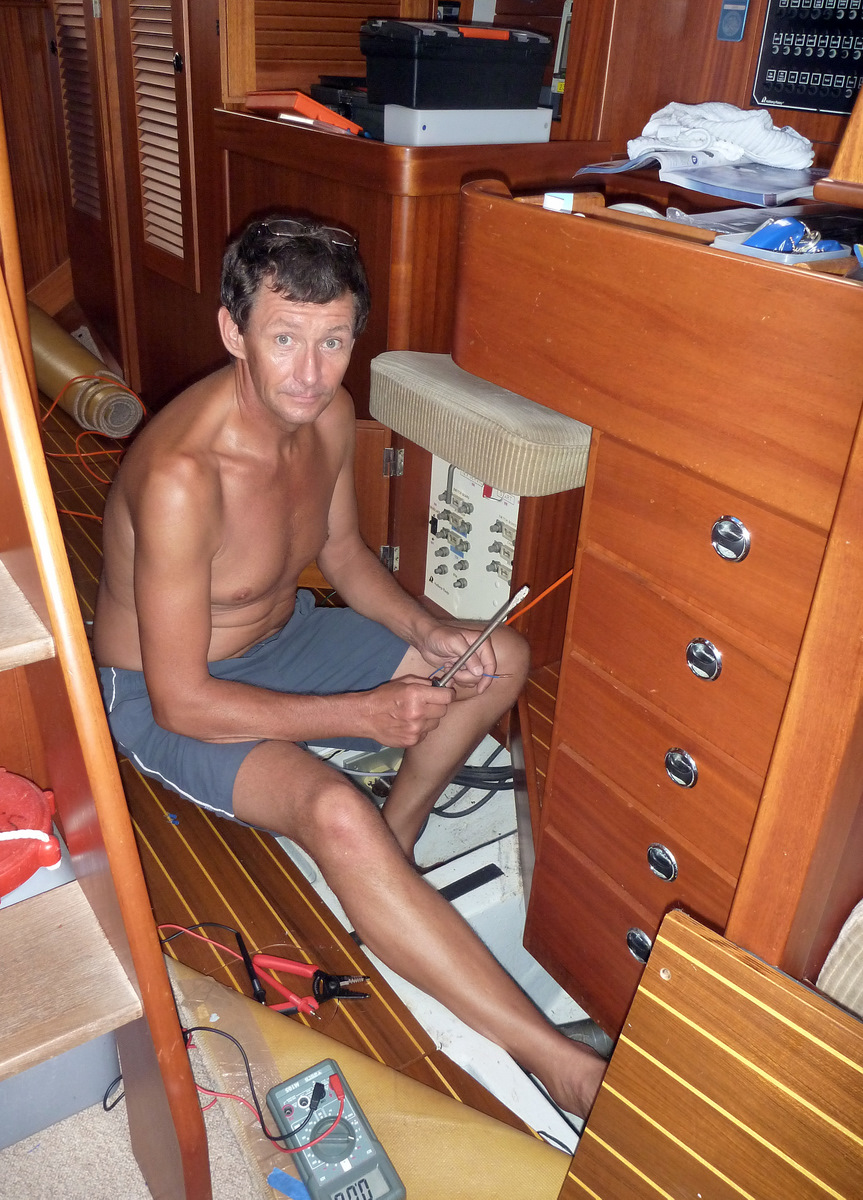
The battery charger is a very sophisticated device (a new one costs over £1000.) It should charge at 14.25 Volts, but it obviously thinks that the voltage on the batteries is higher than it actually is. After tracing the wiring, I decided that the basic installation is correct. I did a few experiments and found that if I installed a sensor wire from the charger to the batteries, the charging voltage increased to above 14.0 volts. (It was hard to be certain because the generator keeps varying its speed and cutting out.) This is good news; I left the temporary sensor wire in place ready to be used when the generator is fixed tomorrow.
We have a wind generator and one solar panel that provide additional charging capacity and they seem to be installed correctly, but with a very simple regulator. I'll have to improve this when I fit more solar panels onto our arch.
Glenys spent day cleaning and polishing stainless steel fittings and generally keeping out of my way as I ripped the boat to pieces tracing wiring.
5 July 2011 Hog Island, Grenada
Mike from Palm Tree Marine came in the morning and I was very impressed with him. He found and fixed the generator problem in ten minutes flat. He deduced that it was being starved of fuel, looked at the electric fuel pump and found that it wasn’t switching on properly hence the lack of fuel. He found the relay for the fuel pump, swapped it with another one and the generator ran perfectly. I was on the right track, but wouldn’t have thought of the relay.
While he was on-board, he gave me a few more clues on how to track down my “air in the fuel” problem for the engine. He had a look at the alternator circuit diagram and agreed with me that I’d be better off getting a bigger alternator and a ”smart” charger. I also got him to test my batteries and his clever device said that all six batteries were good, but undercharged, which is a relief. The cost for fixing the generator, testing the batteries and his advice was only £40 – a bargain.
Now that the generator was working, I did some more experimenting with the battery charger and managed to get it to charge at 14.15 volts which is great. We decided that we’ll go into a marina tomorrow to get access to mains electricity and fully charge the batteries.
We went to Roger’s Beach Bar at five o’clock because it was “Zero to Cruising’s” wedding anniversary and there was a small celebration going on. We had a few too many beers and then foolishly cracked open a bottle of wine to go with our dinner.
6 July 2011 Hog Island to Port Louis, Grenada
I had a hangover this morning, but no time to feel sorry for myself - we needed to get around to Port Louis marina in St Georges lagoon. We had a good sail around the coast and went alongside a huge pontoon. I immediately plugged into the mains and started charging the batteries.
After lunch, we went to the chandlers and spent loads of money- mostly on two life jackets and another fan for the saloon. Back on the boat, I ran a permanent sensor cable through the boat from the battery to the battery charger – that took three hours of sweating and cursing. Glenys wisely retired to the swimming pool to cool down and stay out of my way.
It’s very airless in the marina and the lagoon has a reputation for being “buggy”. I was bitten four times while fitting the cable so we went onto MOSCON 1 - full out war. This meant that all hatches are closed unless covered with mosquito netting and I’m covered from head to toe in mosquito repellent while outside.
7 July 2011 Port Louis, Grenada
It was a pretty good night. We left the fans on, so it was fairly cool and thankfully no mosquitos managed to get past our defences.
I decided that it was time that we switched the anchor chain end-for-end. We normally use only about 40 metres of our 60 metres of chain, so it’s a good idea to flip it over every so often and attach the other end of the chain to the anchor. As with all “simple” jobs on a boat, this took about two hours because we had to lay it all out on the deck and then re-mark it, so that we know how much chain has been let out when we are anchoring. We used special little pieces of flexible plastic which are much more effective than painting marks on the chain or using cable ties. Unfortunately, they are a complete rip off at £4 for eight little pieces, but with no other alternative, I’m biting my lip and buying them.
We went into St Georges to the Nutmeg Restaurant for lunch, where they serve very good rotis. These are like a curried meat and potato pasty, but with a “skin” that is similar to a tortilla but thinner. We shared a Lambi roti and a chicken one. Lambi is the local name for the flesh of the Queen Conch. It’s a bit chewy – I think that I prefer chicken. We wandered around the town in the afternoon, then went to the pool when we got back to the marina and chilled out with other yachties until it went dark.
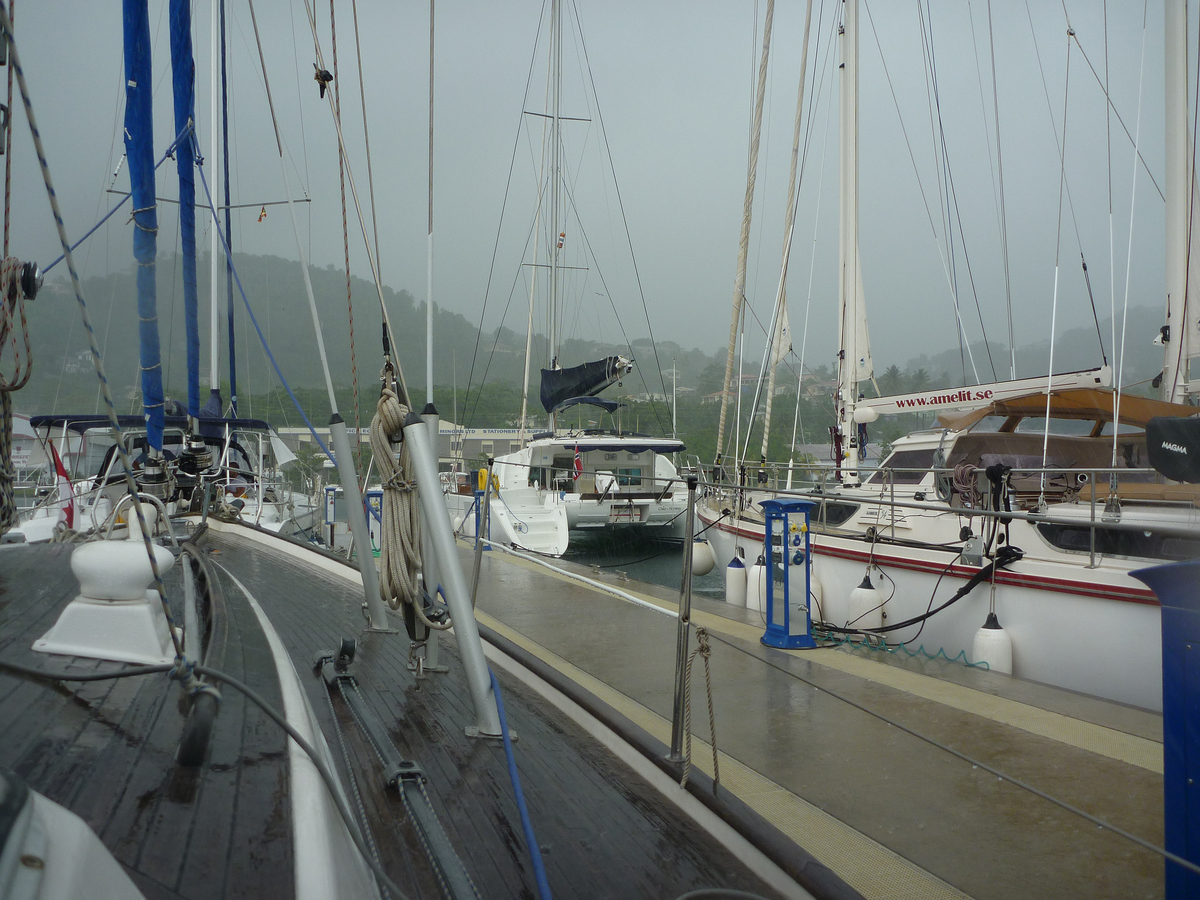
After dinner, there was a huge thunderstorm which passed to the north of us. The flashes of lightning were spectacular and I fell into counting the number of seconds from the lightning flash to the rumble of thunder. When the count got down to 10 seconds, indicating that the storm was about 2 miles away, I disconnected my laptop from the power supply and put it out of harm’s way in case we were struck by lightning – this had me thinking that I must back up my hard disk drive.
We weren't struck by lightning, but we did have very heavy rain, which proved that our various zip-on flaps on the bimini are effective. We now have the Uber-windscoop at the back and two side panels that stop the rain coming in from the sides, so we remained pretty dry in this down pour. It’s actually very pleasant to be sitting in the cockpit, dry as a bone, listening to the rain pounding around us.
8 July 2011 Port Louis, Grenada
When we got up, it was throwing it down and the sky looked very black. The weather forecast says that the Tropical Wave will be past us by tomorrow, so we decided to stay put in the marina for another day. I feel like a coward, hiding in a marina.
I spent all day keeping out of the rain and playing with our web site. Brett has suggested that I make the web site more interactive, so I'm thinking of adding new functionality, allowing users to register and log in and giving them the ability to add comments to the articles and send us messages. I also played around with adding a forum and allowing users to make and chat to “friends” (like FaceBook), but that’s a lot more complicated.
Glenys caught a bus to Spice Mall in the afternoon and did some shopping therapy. It continued raining after we went to bed.
9 July 2011 Port Louis to Hog Island, Grenada
The sky looked fairly clear first thing in the morning, so we sailed around to Prickly Bay. The anchorage was incredibly rolly, so we went to the chandlers bought Glenys’s new cooker, had lunch and went around to Hog Island which is very calm and peaceful.
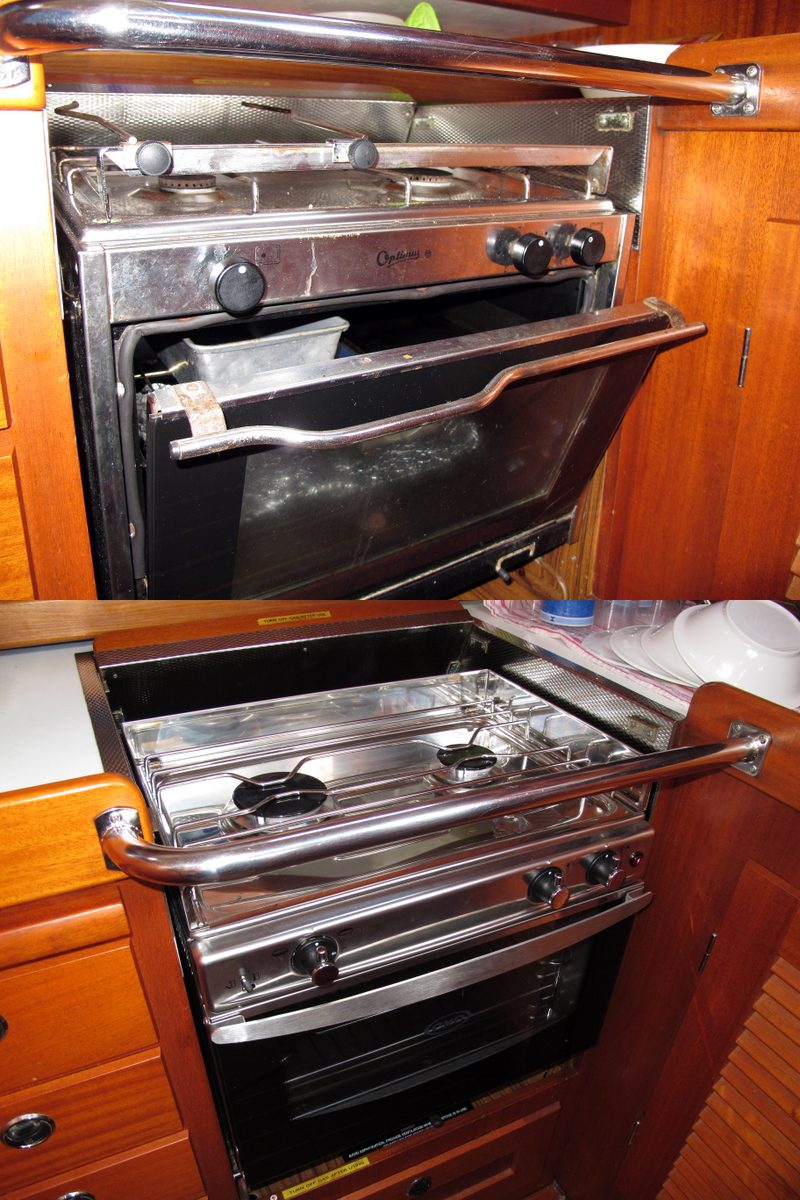
I spent the afternoon installing the new cooker. It fits perfectly into the space in the galley which is a relief. However, I didn’t have the correct fittings for the gas pipe, so I had to do a bit of a bodge job and attach the gas pipe with some jubilee clips. It’s safe enough, but I need to get a gas fitter to sort it out. Some of the other gas fittings are looking a bit old, so I might get them replaced at the same time. Boats tend to explode if there is a gas leak. Any escaping gas can collect in the bilges, one spark and Boom!
Glenys tested her cooker and is very pleased with it. We had chicken enchiladas baked in the oven for dinner.
10 July 2011 Hog Island, Grenada
It was a lovely sunny morning. I ran the generator and water maker for half an hour, but the generator started slowing down again and stalled the electric pump on the water maker, so I shut them both down. I was not happy.
I decided to replace the two relays that the engineer had swapped a few days ago. I’d had the foresight to buy a couple of 12V relays at the chandler yesterday, but unfortunately, when I looked at them closely, they were 30 Amp relays and the originals are 40 Amp relays – bugger! Ah well, there was nothing much that I could do about it – I’ll just have to get a couple more tomorrow.
I decided that I need some adrenaline, so I went up the mast to check the rigging. We have two “Bosun’s Chairs” on board, but both of them looked decidedly dodgy to my mountaineering eye, so I used my rock climbing harness instead. We have folding steps all the way up the mast so it was fairly effortless to climb up. I attached the spinnaker halliard to my harness and Glenys locked it off on a cleat when I wanted to hang around a while. It was a fun two hours and the standing rigging looks okay as far as I can see. We're going to get a rigging survey done in Trinidad which will be a more thorough inspection.
After lunch, we went for a dive on the east side of Mount Hartman reef. It was rubbish. The visibility was only about 5 metres and the reef is covered with sediment. The only highlight was finding six lobster which "will be mine" when lobster season starts.
We went to the Sunday Barbeque on Hog Island and imbibed a few beers.
11 July 2011 Hog Island, Grenada
My mission today was to get some 40 Amp relays for the generator, but it’s not easy out here.
First I had to dinghy ½ mile around to Mount Hartman Bay and then walk two miles to Ace Hardware - no 40 Amp relays. My next stop was an auto part shop about ½ mile away, but they didn’t have any relays at all. They suggested Knights Auto about four miles away, so I caught a bus and asked them to put me off at Knights. After about ½ mile, they told me to get off and pointed to an auto parts shop. The place was definitely not Knights Auto, but they did have some 40A relays – I bought three. I then had to walk two miles back to Mount Hartman Bay in the blistering sun. Fortunately, I spotted a “Subway” and just HAD to stop for lunch in their air conditioned shop. The round trip to buy three relays was four hours (mostly walking).
I fitted the new relays and the generator ran for three hours without a hiccup – queue “Hamlet Music” (Bach’s Air on a G String) because “Happiness is a Working Generator”. I ran the watermaker for an hour and topped up our tanks.
Glenys did some jobs while I was out. She put a second coat of waterproofing on the bimini and painted some anti-slip varnish onto the steps into the saloon, which had become very slippery after ten years of use.
12 July 2011 Hog Island, Grenada
It was another nice sunny morning. I fitted two safety pad eyes in the cockpit – one just by the gangway and one by the wheel. We’ll be clipping our harnesses into these when we sail over night to Trinidad.
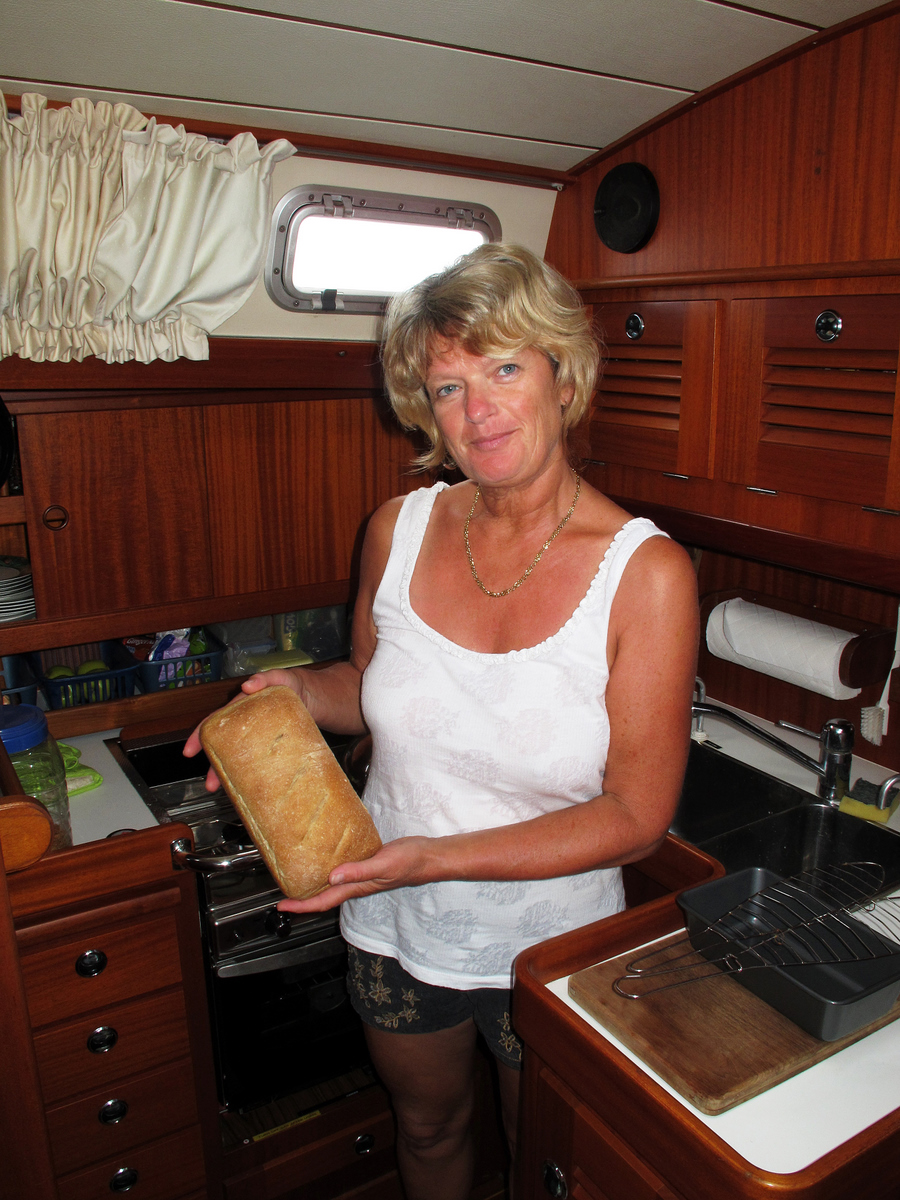
Glenys made some bread today in her new oven, which was excellent. The downside to having freshly baked bread is that we can’t stop eating it – this will counteract my morning exercises if I’m not careful.
By mid-afternoon, we’d done all of our jobs and the weather looks very settled for the next few days, so we decided that we’ll sail to Trinidad tomorrow night.
13 July 2011 Hog Island to Prickly Bay, Grenada
We motored around to Prickly Bay after breakfast and bought 25 gallons of diesel to allow us to motor overnight if the wind is light - I didn’t fill the tank because I’ve been told that fuel is significantly cheaper in Trinidad.
We had a short list of things to do before we left for Trinidad. We picked up some safety lines from the sail maker, which I fit along the deck so that we have something to clip our harness to whenever we go out of the cockpit. I also bought and fitted a radar reflector to the rigging.
One of the worries about sailing to Trinidad is there have been a few attacks by Venezuelan “pirates” on yachts sailing in the area. The pirates approach in fast speedboats and board the vessel, typically beating up the people on board at knife or gun point and taking electronics, money, etc. (However, there has not been any problem for about a year.) We discussed our strategy, which is basically to sail overnight and go as fast as possible for the last quarter of the route, which is where there is the highest risk.
We don’t have any weapons on board. I’d like a pump action shotgun, but I’ve compromised with a flare gun which fires 12 gauge rocket flares. I may be able to scare away an attack by firing flares at the blighters.
If we do get boarded, then the thieves will probably use violence to get us to tell them the location of our money and valuables. They’ll probably expect some of it to be hidden away, so we split our money into three different locations and hid our credit cards, leaving expired cards in our wallets. We also hid our two good laptops and left an old one on the chart table to be stolen. I backed up all my data onto a hard drive, just in case.
The plan was to leave at six o’clock and we were ready to go by two o’clock, so we pottered about until half past three when I went to clear out. Customs is supposed to close at four o’clock, but the immigration officer had already left. The customs officer was getting ready to leave and refused to clear me out. There was nothing I could do about it – I’ll have to clear out tomorrow and leave tomorrow night. I was really angry with myself for not going over earlier – I’d been messing about for two hours…
There was nothing else for it – we went to “happy hour” at the bar and got drunk with Rod and Mary from “Sheer Tenacity” and Steve from “Celebration.”
14 July 2011 Prickly Bay to Chagaramus, Trinidad (Day 1)
I felt a little “dull” this morning, so I caught up on the Alba Chronicles and published a couple of weeks of my ramblings on our web site.
At ten o’clock, I went to clear out of the country. It took half an hour to do it. I had to wait ten minutes while the customs guy faffed about filling in forms for someone else. Everything is so sequential - I tried to ask him to give me some forms to fill in to save a bit of time, but he just showed me the dismissive “hand” and I had to wait. He then leisurely put away the paperwork from the previous guy, re-filled his stapler, slowly turned off his calculator, put it into his drawer and then shuffled some more paper. He then carefully separated four copies of the clearance form, slowly inserted three sheets of carbon paper and handed the forms to me to fill in. I bit my lip – bloody petty bureaucrats.
Back on the boat, Glenys and I did more tidying up, hid a few more of our things from the pirates and waited.

We left Prickly Bay just before six o’clock and sailed out into a reasonably calm sea with 3 to 5 foot waves and a nice 15 knot wind from the east. Glenys had prepared a stew for dinner and we ate in silence as the sun slowly set - we were both pretty nervous because this was our first overnight sail for over 15 years.
Glenys did the first watch from eight o’clock for two hours while I went to bed. When I got up at ten o’clock, the full moon was out and we were sailing along nicely at 5½ knots. My watch was fantastic; I played about with the sails a little and just stared at the silvery sea and the moon.
15 July 2011 Prickly Bay to Chagaramus, Trinidad (Day 2)
At midnight, I reluctantly woke Glenys for her watch. The wind picked up during her watch and we were bounding along at 6½ knots for a while. There was a yacht sailing about ½ mile behind us for most of the night and Glenys managed to increase the distance between us during her three hour watch – it only takes two yachts to make a race. For my part, it was pretty hot below and the lee cloth that we set up on the port-side berth was not very sturdy making it difficult to sleep – another job to sort out.
Glenys woke me up at three o’clock and it was still beautiful sailing conditions. I didn’t have time to sit and stare this time because there were two oil rigs coming up and a fleet of fishing boats trawling in the area – at one point I saw lights for ten boats randomly motoring about. I had an encounter with one of the fishing boats who approached on a collision course from starboard. I was expecting him to turn at some point, but he kept remorselessly coming on. Eventually, I had to make a radical turn to starboard and sail down-wind for five minutes to clear him and his nets.
Dawn came and the winds dropped. Glenys’s watch from six to eight o’clock was a slow affair – our shadow yacht (“Indigo”) passed us. She spotted dolphins and dragged me out of bed at half past seven, but they were very lethargic and not interested in playing in our bow wave – I couldn’t blame them we were only doing 3½ knots. I pulled out our stay sail for the first time ever, which gave us an extra knot or so of boat speed.
We arrived at Chagaramus at eleven o’clock. The regulations say that all incoming yachts have to go to the customs dock, which is a nightmare of a dock. It’s made of concrete with no protection for a yacht’s topsides and there’s not a lot of room to manoeuvre. We came in a low tide and our depth gauge was showing 2.3 metres which gave us 20 cm of space between our keel and going aground. We coped with a lot of cursing. The clearing in process was quick and we managed to pick up a spare mooring just before a massive downpour which lasted half an hour – welcome to Trinidad.
In the afternoon, we wandered about in a daze trying to find where everything is and trying to organise all of the jobs that we want to do. It’s very frustrating arriving on a Friday – we didn’t manage to achieve anything, apart from getting very hot and irritable.
We spotted “El Lobo” on the way back to the boat and Mike gave us some recommendations of various companies that we could use. We had an early dinner and crashed out – exhausted.

16 July 2011 Chagaramus, Trinidad
Life seemed a bit better this morning after a good night’s sleep. We caught a “Maxi Taxi” (a small local bus) into Port of Spain and wandered around the bustling town centre. Our main aim was to find materials to make cockpit cushions and the in-fill for our bed. There is a large selection of shops selling material and we found a great shop for general upholstery items including foam.
For lunch we decided to try a “Double”. These are sold by street vendors and consist of two pieces of Barra bread (like small chapattis) which are covered with chick pea curry. The whole thing comes in a piece of grease proof paper. It tastes nice, but is incredibly messy to eat. One is not quite enough for lunch.
We took a maxi taxi back towards Chagaramus and called at West Mall, where we wandered aimlessly (after having a Chinese meal as our second lunch.)
We bought two pirated DVDs in town for £0.50 each and decided to watch one. This involved getting out the 21 inch monitor and the digital media player that has been stored in the front cabin since April. It took me an hour to rig it all up and I was quite excited about watching the first TV for nearly five months. Unfortunately both DVDs were rubbish quality. We persevered with “Thor” which was the better of the two, but by the end of it we wish we hadn’t bothered.
17 July 2011 Chagaramus, Trinidad
After our disappointing movie last night, I packed away the monitor and media player – I wonder when that will see the light of day again. We moved into the Power Boats Marina – I was a little bit worried about backing in between two piles, so I asked Peter and Kate from “Ravens Eye” to give us an extra pair of hands. It all went pretty well and, by judicious use of the bow-thruster, I managed to back in without any dramas.
We spent the afternoon planning what jobs need to be done. It’s so hot and humid here that we want to leave as soon as possible – our plan is to leave in a week’s time.
I spent some time investigating solar panels and their sizes. I’ve eventually decided on two 185W panels that I can get from Island Water World in Grenada - they are over 50% more expensive than the on-line prices quoted in the States. However, there’s not a lot I can do about it – the shipping costs would be huge.
We went for a meal at the bar with Alan and Ann from “Freya”. Ann is one of the controllers for the local radio net and we gleaned some useful local knowledge from them.
18 July 2011 Chagaramus, Trinidad
We did a serious amount of running around. I arranged for Gittins to service our main engine and generator – the estimate is £700 including parts. We have a clacking noise coming from the front of the engine which is a bit worrying and they will be trying to sort out my air leak on the fuel.
I obtained a quote for the Arch from Mitch at West Coast Fabrications, which was $3,980 US dollars. He is working on one in his workshop which looks very good. It will take two weeks to make it and fit it. He wants to make it from 1½” stainless steel tubing and put extra strengthening on the uprights which is going to be a lot heavier than my design. I’m not sure how much strength is needed.
We had the life raft picked up to be serviced, they say that it will be back to us by Friday. It hasn’t been serviced since it was bought five years ago – they are supposed to be done every three years, so it is well overdue. We’ve been quoted £600 to service it – gulp!

I talked to Caribbean Marine Electrical about my plans for enhancing the charging systems on the boat. He was mostly in agreement with my plans. The first stage is to buy a “smart” regulator and possibly a new alternator which will set me back over $1,000 US.
Glenys wandered about, bought some Sunbrella for the cockpit cushions and obtained a quote for a man to do the upholstery for the infill for our bed.
We sweated through the afternoon - there is no breeze in the marina and the heat was intense. At six o’clock, we went to an informal gathering of cruisers and met a few of the others in the area.
19 July 2011 Chagaramus, Trinidad
I was up at half past six this morning. There was a lot of noise from locals going out fishing and I was restless anyway. I walked around to Jeff’s Outboard and arranged for him to service our 15hp outboard engine in the next couple of days.
Jonas the Rigger turned up and did a survey of the standing rigging. There is nothing wrong with it, but he recommends that we replace the standing rigging in two years’ time. It was interesting to pick his brains and I learned a lot about the rig on our boat. He told me that the running backstays were very important part of the rigging and I should be using them a lot more. He suggested that we need two more winches and should replace the current running back stays with rope which will make it much easier to handle. He’s going to get us a quote – I’m guessing $3,000 US.
Falco the diesel mechanic turned up and serviced the engine. The water pump was leaking and he gave the primary fuel filter a good clean because it was gummed up with thick diesel residue. Other than that, the engine is in good working order. The clacking noise mysteriously went away when he’d finished his service which is slightly worrying.
We finally received an emailed quotation for the Arch from TechNick in Grenada, but he is quoting $5,000US and has a few caveats in his quote. I obtained another estimate from a fabricator in Power Boats - he said that the cost is normally about $4,000 but it may vary depending on what they have to do. He wouldn’t give me a fixed price and I get the feeling that he will ramp up the price when the job is finished. It looks like West Coast Fabrications is the best bet, so I went back to him and told him that his price was higher than I expected. I asked him to re-quote me with davits which will allow us to lift our dinghy out of the water. We’ll see what he comes back with.
We sweated through the afternoon - even though it kept raining, the humidity and heat was oppressive. We felt like we were trapped because we had the rigger and the mechanic on board and one of us had to be around all of the time.
In the evening, the temperature became more bearable and I re-did some of the drawings for the Arch ready to run through a few design points with West Coat fabrications.
20 July 2011 Chagaramus, Trinidad
I finished of the modifications to the Arch design drawings and went to see Mitch. We agreed a price of $4,200 including the dinghy davits. I really like the guy; he has a good sense of humour and listens to what I’m saying. I’ve got to go back tomorrow by which time he’ll have drawn up a contract and he can get started.
This means that our plans have changed slightly and we’ll miss the Grenada Carnival, which is a pity. Mitch will come and measure up this week and can get started next week. In the meantime, we’ll nip up to Tobago for a couple of week’s holiday and when we get back, he should be ready to do the first fitting of the arch. I’ll then have a week of frenzied activity while I sort out the rear deck and alter the wiring for the solar panel, the wind generator, five aerials, the stern navigation light, etc, etc. I’m hoping that we’ll be able to return to Grenada in the middle of August and still head over to Curacao in the last week of August.
The rigger turned up and finished off the small jobs that were stopped by the heavy rain yesterday. Falco the diesel mechanic turned up and spent all day servicing the generator. He didn’t find too much wrong apart from the seal and bearing had gone in the salt water pump and the valve clearances were out of specification. He’s taken the injectors away to be checked – hopefully they will back the day after tomorrow and we can escape to Tobago on Monday.
Glenys foolishly decided to wash all of the curtains – it took her two hours to get them down, two hours to wash them and two hours to put them back up. They still have mildew marks, so she’s planning to get some new material in Port of Spain and make some new ones at some point in the future.
We had rotis for lunch at the roti shop in the boat yard which is about 20 metres from our boat. They were delicious and the temptation to have one every day will be hard to resist. This is not good news for my waist line.
In the afternoon, I dropped off the outboard to be serviced and walked a mile to another boat yard to see Echo Marine who manufactured our water maker. They sent an engineer out immediately to give the system a quick inspection – the best bit was that he gave me a lift back to the boat. Once on board, he sorted out the o-ring on the high pressure hose which gave me problems a few months ago and explained a bit more about the system, which was very helpful. He couldn’t find anything wrong, so he said goodbye and no charge. This is the first time that I’ve had some one on board that hasn’t cost me $50/hour.
The afternoon was blisteringly hot again and when it cools down at six o’clock, the mosquitos come out. I had four bites in rapid succession before I went for a shower – I’ll be glad to be away from here.
21 July 2011 Chagaramus, Trinidad
The life raft people came over and gave us a lift to look at our inflated life raft. It looks to be in good condition and inflated correctly. The technician showed us the various features, how to right it when it turns over, etc. A few things need to be replaced like flares and the torch. I asked if it would be ready by tomorrow as promised, but unfortunately the air cylinder needs to be pressure tested and filled - this apparently will take at least three days. I was not happy at all. So it will be ready on Tuesday next week? Err, No; the only technician qualified to repack it is on a course all next week and the following Monday is a bank holiday – the earliest that they could have it done will be in ten days. Unbelievable! After a lot of discussion, they finally agreed to lend us a life raft so that we can go sailing and we’ll pick up ours when we get back. What a shower.
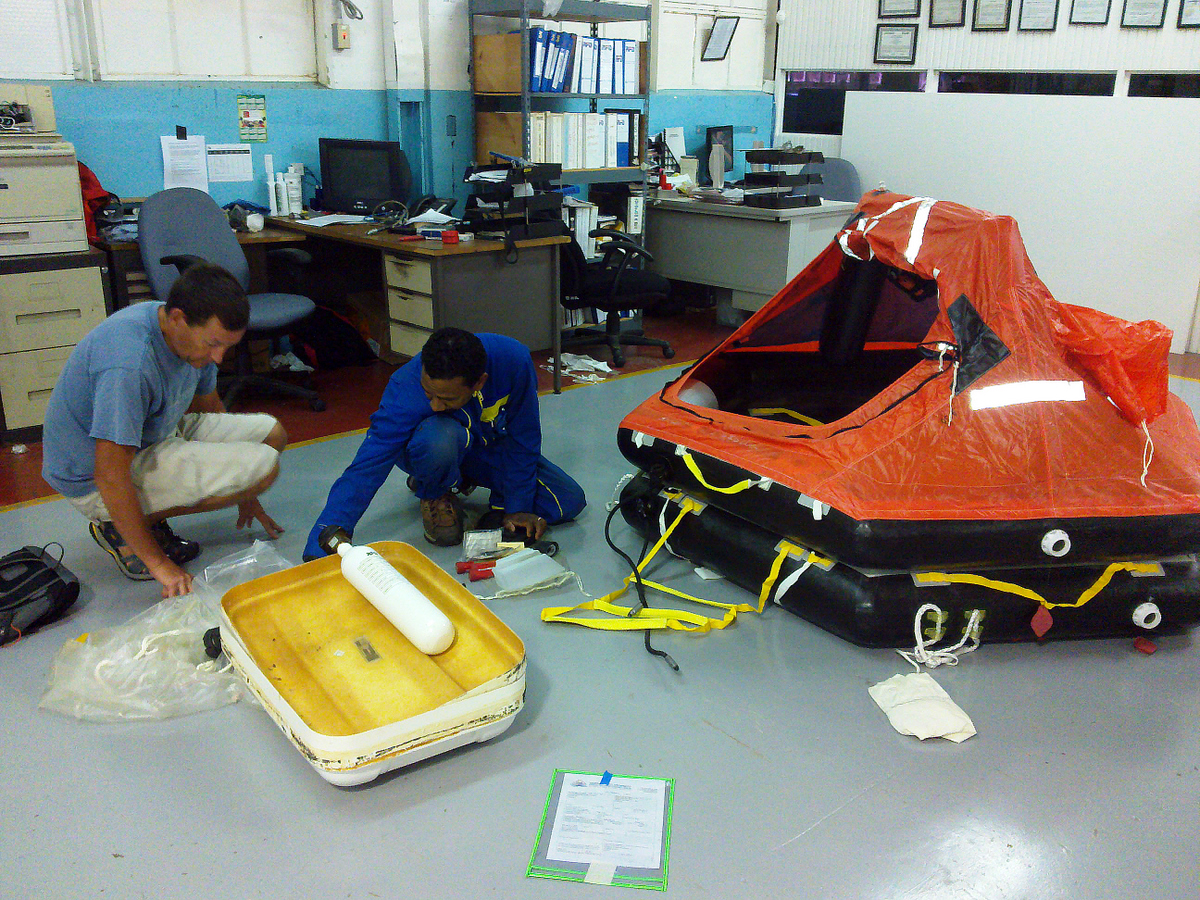
Glenys went into Port of Spain to buy material and foam while I sorted out the final details for the Arch. Mitch and I signed the contract and he will start the work next week. It will be ready for the “first fitting” on the 10th August and be completed by the 12th August. This will give us time to get up to Tobago and back - if we get the injector for the generator sorted out…
It poured it down in the afternoon, so I just lurked about and ran a few errands. Glenys arrived back at five o’clock with two huge rolls of foam wrapped up in black plastic. She took a taxi back from Port of Spain, but she had to carry the huge rolls along a busy shopping street in Port of Spain to get to the taxi rank – she must have looked a sight.
We had a pitcher of beer at the bar and Glenys made a pizza for dinner. We’re really tired because of the heat during the day. I now remember why the Mediterranean and Arab countries shut down from midday to four o’clock.
22 July 2011 Chagaramus, Trinidad
We spent the day hanging around the boat. Mitch came and measured up for the arch, the rigger came with his invoice, the outboard was returned and the loan life raft was delivered. Glenys cut the foam for the cockpit and did a little bit of sewing.
I spent the morning deciding how I am going to mount the solar panels on the arch and how I will wire everything up. My biggest problem is where to put the regulator for the solar panels. It’s quite a big metal box, with heat sinks and the installation instructions say not to put it in an enclosed space. It can’t be outside because it’s not waterproof, so it has to go in the back cabin somewhere. I could bolt it on the outside of our beautiful mahogany cupboards, but it would spoil the “ambiance” of the master cabin (especially because it has a red display which will glow balefully all night.) I’m thinking of putting it into a cupboard and installing cooling fans like they put into computers.
The afternoon was slow - it was blisteringly hot – 37 degrees Celsius in our saloon at one point. We managed to talk to Brett and Tash by Skype which was great. They have already booked their holidays at work for coming over at Christmas, so we need to book the flights for them.
We were looking forward to going up to Tobago early next week, but our plans were shattered by the news that the injectors need replacement tips and there are none on the island. The injector company can import them, but it will cost £200 for the two tips and it will take 5 days to get here. We told them to get on with it and be as quick as they can.
All we can do now is to wait. The engine is finished, but the generator is out of action, so we decided to get out of Chagaramus on Monday for a few days. We decided that we’ll go around to Scotland Bay or Chacachacare - hopefully we’ll be able to swim and get a breeze.
The mosquitos were murder this evening.
23 July 2011 Chagaramus, Trinidad
We had a day off today and went hiking with a group of eight other yachties to Guanapo Gorge. We were picked up at six o’clock by a taxi driver called Jessie James, who organises a lot of trips for yachts. The first stop was at a roadside stall to get breakfast. The choice was a Double, Aloo Pie (potato wrapped in a chapatti) or a deep fried ball of crushed chick pea. It didn’t matter what you had, it was all covered with chick pea curry – a bit of a shock to the stomach at seven in the morning.
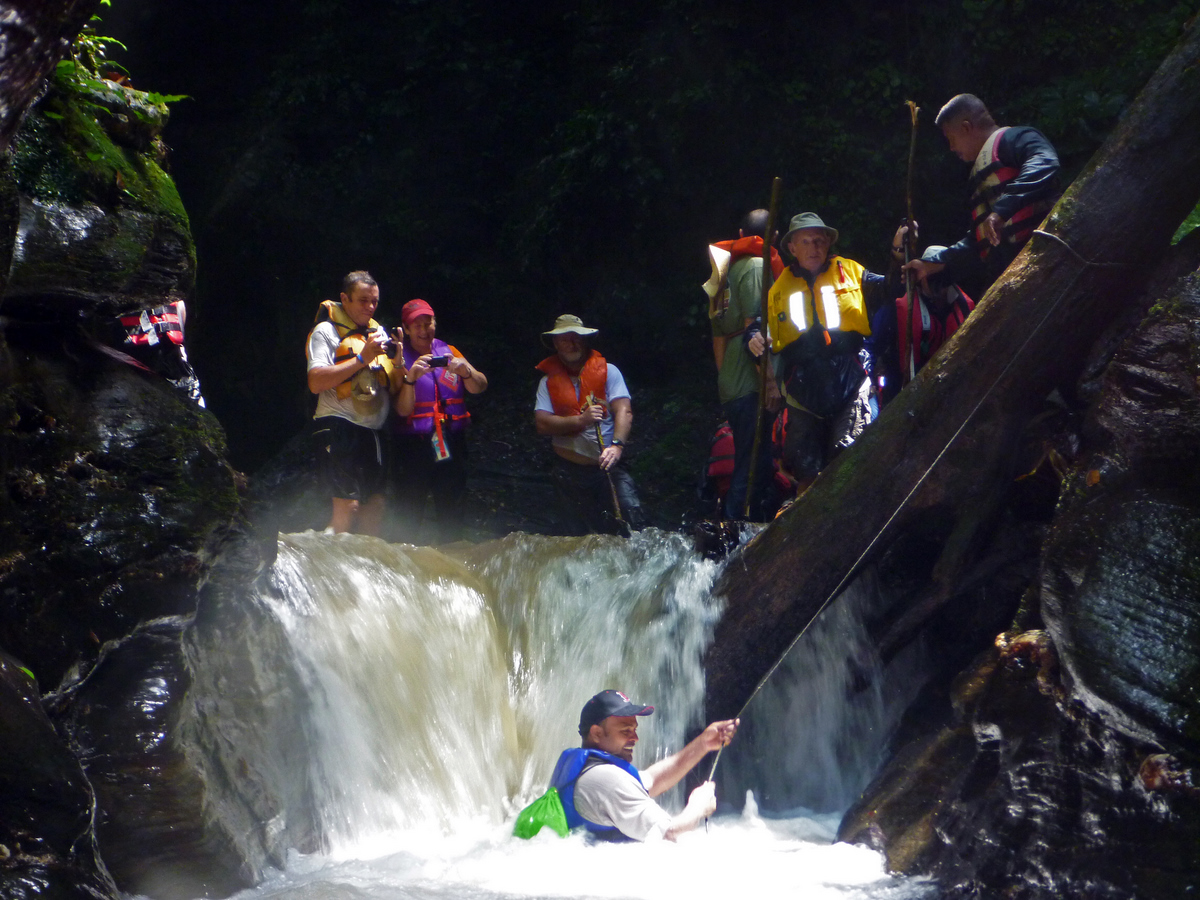
We drove up into the mountains and were introduced to our guide, “Snake”. The plan was to walk down to a gorge and then go along the river, so we were issued with a motley collection of floatation vests, which Mike from “El Lobo” had borrowed. Snake pulled on a set of workman’s overalls and wellington boots and proceeded to tell us that we should all have long trousers and shirts because of the risk of snakes (3 deadly varieties in Trinidad) and various nasty jungle plants like razor grass. It was a bit late for most people who were in shorts and sandals, but I was feeling smug stood in my long trousers, long sleeved shirt and sturdy approach shoes.
We walked down a very steep road and, after a stop to pick mangos and oranges, set off into the rain forest. It took about ten minutes before a torrential downpour drenched us. It didn’t really matter because ten minutes later we were jumping down a five foot water fall into the river. We had a great time wading and swimming down the river for about two hours. In places the current was extremely strong and we had to use a rope to stop us being swept away and slammed into rocks by the water.
After a brief stop for lunch, we headed up a muddy path through the jungle. I have never seen so many mosquitos in my life. Glenys was in front of me and had a swarm of about twenty five of the little buggers constantly circling her head. I used a lot of mosquito repellent and didn’t get bitten once, which I found incredible. Apart from the insects, the jungle is beautiful with a huge variety of plant life and sounds. It was great walking up the path, but the walk back up the steep road was a mission.
Back at the taxi, we changed into dry clothes and had a quick meal of chicken pilau cooked by Jessie. The drive back to the boatyard was interrupted by a welcome stop at a shop to buy cold beers. It was a great day out and only cost us £20 each.
24 July 2011 Chagaramus, Trinidad
I spent most of the day on the computer getting our finances in order. Glenys made use of the hosepipe and cleaned the cockpit and deck. We also filled up with water because our generator is still not working and we can’t use our watermaker. We’re planning to go sailing tomorrow for a few days.
“Hurah” are buying a cruising chute from “Freya”, so I went to look at how they rig it all up. They have a stainless steel bowsprit which fits into a bracket on deck and then over the bow roller. This keeps the tack of the cruising chute away from the pulpit and the roller furling gear. The cruising chute that they are buying has a snuffer sleeve and it looks like the ideal light wind solution when sailing shorthanded. I want one…
We went to a “pot-luck” barbeque at Coral Cove Marina and met a few more cruisers. There are quite a few people that have been in Trinidad for several years, supposedly doing work on their boats, but they've gone "Tropo" and seem to be partying all the time. I don't think they’ll ever leave here.
25 July 2011 Chagaramus to Chacachacare Island, Trinidad
We tidied up the boat, did a few little errands, told customs that we were leaving and motored five miles to Chacachacare Island. We anchored in Sanders Bay and had a problem with the anchor dragging. The sea bed is sand and broken coral and I had to manually push the anchor in to get it to hold. Once settled, we sat and stared at the place. What a difference compared to Chagaramus. There are no other yachts and there’s a breeze – this is what we’re supposed to be doing.
Chacachacare was a leper colony until 1975 when they found a cure for the disease. It was a large community and most of their houses are still standing, although the jungle is remorselessly reclaiming the land – we plan to go exploring tomorrow. It’s incredibly peaceful.

We chilled out in the afternoon reading. There are some Trinidadians camped out in one of the houses ashore. I noticed that one of them caught a catfish using a spear gun from the shore, so I went and had a quick chat – they’re here for a few days fishing. I tried fishing with my spinning rod, but didn’t have any luck, so I dug out our fishing trap and put it down by the anchor. This is the first time that we’ve used it, so it will be interesting to see if we catch anything.
26 July 2011 Chacachacare Island to Scotland Bay, Trinidad
It was pretty bouncy this morning because the wind was coming from the south-east bringing waves into the bay. We were only anchored in 3 metres of water, so we decided that we had to move. I snorkelled down to get the fish trap, but disappointingly, there were only four tiny fish in the trap – I’ll use them as hook bait.
We motored over to the south side of the bay, but the wind and waves were still getting into those bays - we decided to go to Scotland Bay. It took an hour to motor there and it’s a very sheltered bay, only exposed to winds from the south west. There are no roads into Scotland Bay, so it is totally isolated and surrounded by jungle. Corbeau (vultures) circle overhead and parrots fly across the narrow bay screeching loudly. It’s a lovely place to chill out. We spent the afternoon reading and dozing, because there is nothing else to do here – I chatted to some other yachties and they said that there are no paths to go walking on.
Later in the afternoon, I got bored sitting about and snorkelled down to clean out propeller – it was covered in big barnacles after only one week in Chagaramus (which is notorious for accumulating vegetation on the bottom of boats.) We even have a resident 2” diameter crab living just above our rudder.
27 July 2011 Scotland Bay to Chacachacare Island, Trinidad
Glenys had a restless night because she kept worrying about vampire bats. It’s my fault for telling her last night that there are vampire bats are in this area. I gave her a graphic description of the bat tearing its way through mosquito netting, then silently crawling across the bed, using its razor sharp teeth to scrape a layer of skin away from a big toe and then lapping up the blood of its victim - I guess that I did exaggerated a little…
It was so quiet in the morning that we decided that Scotland Bay is too peaceful and motored back to Chacachacare. We anchored in Coco Bay and the holding was much better although the sea bed is still sand and broken coral.
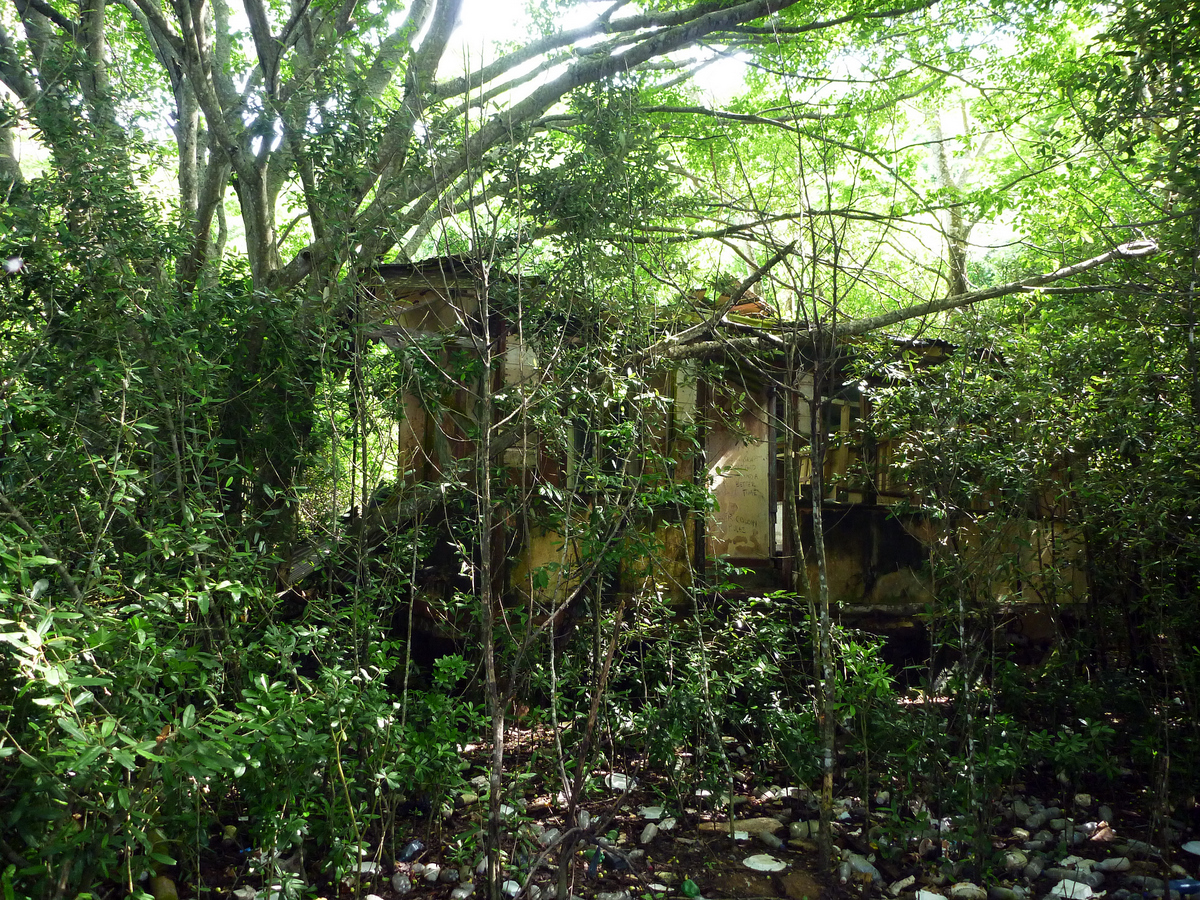
We went for a walk up the only road to the lighthouse on the top of the hill. The island looks idyllic from the water, but there is a phenomenal amount of litter ashore. The island is so close to Trinidad that I guess it is a favourite weekend destination for the speedboats based in Chagaramus. The lighthouse is non-descript but there is a good view of the Peninsula of Paria in Venezuela which is only eight miles away. It is a real shame that the risk of armed robbery is keeping cruising yachts away from Venezuela.
We had our lunch sitting under a mango tree watching a huge thunderstorm building to the east of us. By the time we had walked down the hill the skies were very dark and it was obvious that the storm was going to hit us. We just made it back to the boat and put down the side flaps on the bimini before the torrential rain hit us. The wind picked up to 25 knots, but soon backed off. It thundered and rained for 2½ hours, so we just read our books all afternoon.
The storm disappeared at five o’clock and it was a very peaceful evening.
28 July 2011 Chacachacare to Chagaramus, Trinidad
After breakfast, we went ashore to look at the buildings that the lepers used to live in. Unfortunately, the jungle has really taken over and it’s impenetrable without a cutlass in many places. There’s a chapel in Sanders Bay, but most buildings are complete wrecks. The litter is shocking.
We headed back to Chagaramus to start working again and moored stern-to in the same berth in the marina next to El Lobo.
After lunch, I went to see Gittens and they have ordered whole new injectors rather than replacement tips – which is why they were £200 for the two. I told them to put the new injectors into the generator tomorrow. I’ll get the old injectors back as spares and get them serviced in Curacao.
I managed to get hold of Mitch at West Coast Fabrications, but the money that I transferred to him hadn’t arrived. After a few phone calls it turned out that the money had arrived at the bank, but didn’t get into his account until late afternoon. All is not lost because Mitch says that he’ll be ready to do the first fitting of the Arch next week as planned.
I went Peakes Hardware store near West Mall to try to get some electrical junction boxes, but no joy. I’ll have to re-think the Arch wiring panel. I went to Budget Marine who gave me a quote for two solar panels and a smart regulator – it adds up to £1,600. I went back to the boat and did some more research on the Internet. I can get a better specification of equipment for £1,000 – that’s nearly 60% of the Budget Marine price. I sent off some emails to see if some of the US companies will ship the panels to be here in Trinidad and how much it will cost for freight – it can’t cost any more than £500.
29 July 2011 Chagaramus, Trinidad
We have the first threat of a hurricane in our area. There’s a strong Tropical Wave about 1200 miles to the east of us which has a low pressure area with a 30% chance of developing into a Tropical Storm. The wave will be passing our longitude in three days. The big question is whether it will start moving north and miss us.
I did a little bit of running around in the morning, while Falco put the new injectors into the generator and got it going again which is a relief. I ran the water maker for 30 minutes to make sure that it was still working. We had a roti for lunch, so I’m feeling guilty. Glenys went into Port of Spain for a few things while I worked on the boat.

I removed the aerials, outboard and other equipment from the pushpit. Taking a deep breath, I took down the wind generator and its support pole, which turned out to be easy enough. With all this out of the way, I removed the pushpit away from the port side – the back deck looks very bare now.
The pushpit is held in place by six 7/8” stainless steel rods which are bonded into the toe rail. My plan is to remove four of these, so that the wiring coming down the Arch frame will be able to go straight through the toe rail. I’ve been worrying about this job for a few weeks. My plan is to use a hole saw which has an inside diameter slightly larger 7/8” and hopefully I’ll be able to drill a hole around the rods. It will either go well or turn into a complete nightmare.
It was a hot sticky evening. I bought an insect zapper today which looks like a small, square tennis racquet. It has metal bars instead of strings and has over 1000 volts between the bars. I love the way that the mosquitos are destroyed with a very satisfying “crack” and a flash of light.
30 July 2011 Chagaramus, Trinidad
The low pressure area now has a 60% chance of developing into a Tropical Storm and is directly east of us heading west north west. Hopefully it will keep going in that direction.
I received a few quotes for solar panels and a regulator from companies in the USA. They are about 60-70% of the cost of the local chandlers, but none of them are willing to ship abroad. I would have to organise a shipping agent to get the goods from the US – it would be complicated, so I went to Budget Marine and bought the solar panels and regulator from them. They gave me 10% discount which appeased me a little.
I decided that I need to extend the hole drill to allow me to drill out the stainless steel rods in the toe rail, so I dropped it around to Mitch who is going to cut it in half and weld a 4” extension tube so that I have 6” clearance. He’s started manufacturing our Arch, which was good to see.
In the afternoon, we went to pictures and watched Harry Potter. By the end of the film we were both freezing in the air conditioned theatre - fantastic.
31 July 2011 Chagaramus, Trinidad
The low pressure area now has a 100% chance of developing into a Tropical Storm and is about 650 miles directly east north east of us heading west north west. Our current latitude is 11°N and the centre of the low is at 13°N, which puts it about 120 miles north of us. As long as it keeps going in its current direction, we should be OK.
I spent all day working on the wiring for the Arch. I pulled all the wires out of the pushpit and lazarette ready to wire them into a wiring panel in the aft cabin cupboard - I found a few redundant wires running through to the main switch panel and removed them.
Glenys did a few jobs down below in the morning, but by lunch time she found the heat unbearable (36°C in the main saloon), so she sat outside under a tree and read a book.
We treated ourselves to a meal out – spare ribs and chips with a pitcher of beer.