1 April 2012 Isla Culebra, Puerto Rico
We motored down to the entrance of the bay and anchored inside the reef at Ensenada Dakity. It’s a very calm anchorage and the weather looked good, so I spent all day changing the chain plates for the Series Drogue. My brother, Andy, brought out a new, thicker pair that he calculates will be able to take the potential 6½ ton snatch loads.
It should have been an easy job, but nothing on a boat is ever easy. It took me an hour to remove the first chain plate and clean everything up ready to fit the new one. Unfortunately, four of the holes were not in the same position as the old chain plate. It was only out by two millimetres, but that was enough to stop me dead. I decided to drill out the holes to make them 1.5mm larger – this is easier said than done in 10mm thick stainless steel.

My 230V power drill is knackered, so all I had was a Bosch battery drill. I drilled out the holes slowly, just increasing the diameter by 0.5mm at a time, using plenty of WD40 oil to lubricate it and running at a slow speed. I managed to do the first one without a major problem and fitted it in place just after lunch.
The second one was more of a problem because the drill bits were now blunt and the drill didn’t have enough power. I had to keep charging the drill battery and eventually the charger overheated and gave up. In a mild panic, I dinghied around the anchorage trying to find someone with a variable speed 230V drill. There are a lot of Americans here who only have 110V power, but I eventually found a British guy who lent me his drill. I managed to finish the job at half past four – a long day.
Glenys meanwhile used some very caustic cleaner to get rid of the rust stains in the inside of the dinghy. It's horrible stuff containing hydrochloric, phosphoric and oxalic acid, so she wore protective gloves and even had rubber wet suit bootees on to protect her feet. It worked well and the dinghy now looks great.
Peter and Robyn came over from “PR2” for sun-downers. They first met Sergio in 2001, when he had just sailed Alba from the Hallberg Rassey boat yard in Sweden to the Canaries.
2 April 2012 Isla Culebra, Puerto Rico
We had a reasonable Internet connection, so I spent all day catching up on maintenance of our web site and trying to help our son, Craig get a job. He graduated from Leicester University last year with a good 2:1 honours degree in Physics, but the job market in the UK is very depressed. The recruitment process is very impersonal, mostly being done on-line. Craig has been filling in on-line application forms and psychometric tests. Each application takes around two hours and the companies never bother to reply, never mind give some feedback. He’s been getting disheartened about it all.
I sent out emails to various business contacts that I had in my past life and they started to come up with some good ideas and contacts. I’m hoping that this will give Craig something to work with.
Glenys had a working day and cleaned the teak deck and the hull. Our anchor chain has now lost all of its galvanising and is starting to rust. I’m planning to get the chain re-galvanised when we haul out in October, but for now the damn rust is staining the deck. I’m not sure what to do about it.

Glenys started to make Picadillo for dinner, which is a Cuban dish made from salted beef, but even after being in the pressure cooker for an hour, the piece of beef that she had bought in St Maarten was incredibly stringy and chewy, so it went overboard and we had Huevos Rancheros instead.
3 April 2012 Isla Culebra to Sun Bay, Vieques, Puerto Rico
It was a lovely sunny day again. The weather forecast is for very light variable winds for the next week, so we upped anchor and headed off to the island of Vieques. There was hardly any wind, so we motored for five hours to get to Sun Bay, where we picked up one of the three free moorings.
We jumped into the dinghy and zipped a mile around to Esperanza, which is a very small town. It is very tourist orientated with at least ten restaurants, bike hire, snorkelling gear hire, kayak hire, etc. We stopped off at the small museum, which doubles as an information centre. They lent us a phone and Glenys arranged for us to go horse riding in a couple of days.
A big tourist attraction here is to visit a bioluminescent bay at night. The bay has lots of phosphorescent plankton and on a dark night, it is supposed to be spectacular especially if you can jump in and swim about. They arrange trips on electric powered boats and also kayaks. Unfortunately, it will be a full moon in three days’ time meaning that the evenings won’t be very dark, so we’re going to give it a miss.
We walked to a small grocery store and then along the Sun Bay beach, which is very pretty with palm trees planted all along the one mile stretch of sand. There are lots of people camping on the edge of the beach; perhaps they’re here for Easter which is this weekend.
Back on the boat, there was a swell hooking around the corner and making us roll, so I put out a stern anchor to keep us bow into the swell. We chilled out for the rest of the afternoon reading. At sundown, we had a minor attack from mosquitos, which were taking advantage of the still air. I received six bites in two minutes, so we went to MOSCON 1, closed all the hatches, put up the mosquito net in the cockpit and “Bopped” our bedroom with fly spray. This is the first time that the mosquito net has been out since our trip up the Manamo River last September.
4 April 2012 Sun Bay, Vieques, Puerto Rico
Our mosquito tactics worked last night and we had a good night’s sleep. The wind seemed to be picking up from the east and having a stern anchor out puts more strain on the mooring, so I lifted the stern anchor.

We took the dinghy over to the beach and spent an hour doing a couple of jobs. I de-rusted the steel bar for the outboard lock while Glenys started making templates for a dinghy cover. We bought the Sunbrella for this in Trinidad over five months ago and have never managed to get around to making it. The tropical sun is quickly degrading the rubberised Hyperlon tubes and we’re getting an increased amount of damage when the inflated tubes rub against dinghy docks. We’re hoping that this cover will help to cut down these problems.
It’s quite a complicated three dimensional problem, but after an hour of messing about, we think that we have some templates made out of old newspaper.
Back on Alba, the wind had dropped and we were rolling a lot, so I reset the stern anchor. It didn’t work quite as well as last night because the wind veered through 180 degrees during the afternoon, but it was better than nothing.
I dug out the Series Drogue from under the front berth and connected it up to the new chain plates to ensure that it all fitted together. This is a piece of safety equipment like the EPIRB which hopefully will never be used. If we are caught out in a major storm, then the biggest danger to our small sailing yacht is surfing down a large breaking wave which can capsize the boat and roll it over. The Series Drogue consists of 200 feet of heavy nylon rope to which there are attached 132 small, 5inch diameter nylon cones. When the weather gets too rough, we'll deploy the rope out of the back of the boat and the small drogues will slow the boat down to around one knot. This will prevent us surfing down big waves.
I assembled all of the parts and carefully packed it into a holdall bag. It will be stowed away until we are making long passages and then be placed on the aft deck ready for instant deployment should we get caught out in a storm.
Glenys made some neater templates for the dinghy cover – we’ll have a second fitting tomorrow. We’re running out of beer and fresh food now – we need to get to a supermarket and stock up again. We had Baccalau made from salt cod for dinner.
5 April 2012 Sun Bay to Esperanza, Vieques, Puerto Rico
It was another fine, light wind day. I cut my hair with the electric trimmers. I’m becoming quite an expert at doing a number 12, which is ½” all over. I look a bit like a convict, but it’s much cooler than having long hair.
We went to the beach for the second fitting of the dinghy cover, but half way through, a police woman came along and told us that we weren’t allowed to land our dinghy here because it’s a national park. She threatened us with a fine, so we left quickly.

We motored a mile around to the anchorage off Esperanza, so that we will be closer to the dinghy dock while we went horse riding in the afternoon. The sea bed consists of very thick weed and our CQR anchor wouldn’t dig in on the first attempt, so we dropped the anchor a second time and I snorkelled down and physically pushed the point of the anchor in. Once it was started, it ploughed into the weed when Glenys backed the boat up.
At three o’clock, we went into Esperanza to walk to the Horse Riding centre. It’s the day before Easter Friday which is a big national holiday in Puerto Rico. All of the available space along the beach is taken by tents. These aren’t small tents, but huge dwellings with everything including the kitchen sink. The small town was buzzing with people partying and dancing to Spanish music at the various restaurants.
We walked a mile out of town to the horse riding centre and met Elizabeth and her sister. There were eight people in the group with one being a total beginner, so the ride was a little tame, but pleasant. The horse are a paso-fino cross breed. The paso-fino horses are trained to do a running gait (called the “Paso”), which is a very smooth when you get it right. The route was varied – along some beaches and narrow paths through woodland. My horse was terrified of waves, so it was difficult to control along the beaches.
We managed to get back on board Alba before sunset.
6 April 2012 Esperanza to Cayo Obispo, Puerto Rico
It’s Easter Friday today. We still have very light winds, but we’ve decided to move onto Fajardo, where we can restock with food and fuel, ready for going to the Bahamas when the wind returns.
We had a lovely sail down the south coast of Vieques and then north up to Fajardo. The 12 knot winds were from the east and the seas were very calm. We anchored behind Cayo Obispo, which is a small island with a marina and apartments. It lies ½ mile offshore from the town of Fajardo.
We went into the marina, but the office was closed up. However, we managed to get a ticket for the small ferry that runs across to the town of Fajardo – we plan to go shopping tomorrow. We’re able to pick up a wireless Internet connection from Sunbay Marina across on the mainland, but for some reason, I can’t pick up or send email, which is a bit frustrating. Perhaps it will work tomorrow.
We were invited on to “July Indian” for an evening beer or two with Linda and Garry. They’re heading up to the USA like us and are also waiting for the winds to pick up. There’s a big cold front across the northern Bahamas which is producing gale force winds and seems to be sucking all the air away from us. Garry reckons that it will be another week before the trade winds return.
7 April 2012 Cayo Obispo, Puerto Rico
First thing this morning, we spotted a manatee which surfaced very close to our boat. I knew that there are lots of them on the south coast of Puerto Rico, but didn’t expect to see one here with all the boats whizzing about.
We took the marina ferry over to Fajado and walked the mile or so into town. It's a pretty dodgy area with all of the houses having thick iron bars - obviously burglary is a problem around here. Being a holiday weekend it was a little quiet. We walked up the high street which is just lots of small shops with no real character. There’s a pretty square with a church and a fountain, but not much else.

We walked down to the public transport depot to get a “publico” which are small mini buses. Normally you tell the driver where you want to go and he then waits until the bus is full and then takes everyone to their destination. There were only a few publicos hanging about and not much business, so one guy agreed to take us to West Marine by ourselves for $7US.
West Marine is a big American boat parts chain, but I was disappointed that their prices were higher than Budget Marine who we have been using up the islands. They also didn’t have anything that we wanted – not even the correct size of pop rivets to repair our rod kicker. We met Kathy & John from “Oceana” while we were in West Marine and they kindly gave us a lift to Wal Mart.
Wal Mart was fantastic – it was like being in wonderland after all of the small stores that we’ve seen for the past year. Glenys bought a USA SIM card for her phone, so that we don’t have to pay outrageous roaming charges for local calls. We only bought a few other things, but we spent a happy hour walking around and staring at things. After lunch at Burger King (well we’re in America), we spent a couple of hours in a big supermarket, restocking for our trip through the Bahamas. The plan is to come back on Monday and Tuesday when we have a hire car and get lots more heavy stuff like orange juice, milk, beer, etc.
We rang for a taxi, which dropped us back at the ferry dock for $6US. I made a reservation for a hire car which we can pick up early Monday morning. The plan is to visit the old town of San Juan on one day and go hiking in the rain forest on the other day. We had a quiet night in and treated ourselves to King Prawns in Garlic.
8 April 2012 Cayo Obispo, Puerto Rico
It’s Easter Sunday, so we planned on a quiet day.
We’ve been living on Alba for exactly one year today, so I worked out a few statistics. In the past twelve months, we’ve sailed 3600 miles, but we’re still only 220 miles to the west of Grenada, so we need to start clocking up some miles if we are going to travel 25,000 miles around the world in the next nine years. We’ve not done very well on our motoring to sailing ratio – we’ve put 435 hours on the engine, which is indicative of the type of sailing that we’ve been doing – short hops and often in the lee of islands. Running the engine for four straight days motoring from Curacao to Trinidad last October accounted for 20% of our motoring.
Glenys rang her brother Gareth because she was worried about how her mum was getting on. Gareth said that Ceris has had a few funny turns recently and has been in to hospital a few times over the past two weeks, but the doctors have finally decided that she has an infection of some sort and put her on antibiotics, so hopefully she’ll settle down now.
We spent the day reading, playing on the computer and generally chilling out. Glenys made Moroccan Chicken Tagine for dinner with Couscous.
9 April 2012 Cayo Obispo, Puerto Rico
We picked up a hire car. I was pretty nervous because I hadn’t driven for a year. In the trips in the taxi yesterday, I’d noticed that the Puerto Ricans not only drive on the wrong side of the road, but they also drive like lunatics. However, I donned my Reacto-Fear Sunglasses and we headed off towards San Juan.
We didn’t have a road map and immediately made a navigational error, ending up in the middle of downtown Fajardo in rush hour. I decided to try to go around the High Street and finished up going down what we “think” was a one-way street - the wrong way. I say ”think” because there were no road signs to indicate a one way system, but all the parked cars were facing in the same direction (towards me) and all of the traffic was driving straight at me. In addition, the drivers that I encountered didn’t honk their horns or make dramatic gestures with their fingers, so perhaps it’s a non-official one-way street. After a couple of hundred metres, I decided that discretion is the better part of valour and turned down a side street, back to the high street.
We eventually made it to the freeway, but couldn’t buy a road map for love nor money – we gave up after trying a garage and a Super K-Mart. It wasn’t a huge problem because the road into San Juan was well signposted and we managed to find a multi-story car park right in the centre of the old town.

San Juan is a city built by the Spanish in the 1500’s and is therefore incredibly old by American standards. The Spanish built a big fort at the head of the well-sheltered bay and it became a major stopping place for the Spanish fleet taking gold and silver from the New World to Europe. Over its history, the town has been attacked by the British, the Dutch and even the USA, but no country other than Spain managed to hold it for long. Eventually, Puerto Rico was handed over to the USA at the end of the Spanish American war in 1898. The old town is interesting to walk around, reminding me of some of the great cities in Europe, with lovely cobbled streets and very Spanish architecture.
We had lunch at a small Puerto Rican restaurant where Glenys had a local dish called Mofongo Rellano. It’s made from mashed plantains and is very tasty. I’m sure that Glenys will be trying to reproduce it soon.
We left San Juan and drove back to Farjado to do some more food shopping. We went to another supermarket to get a bit of variety – our biggest problem is the rubbish beer that they sell over here. The choices are a range of insipid, gassy American beers and, what is worse, they are mostly “Lite Beer” – which to me is an oxymoron. The only real choice is Heineken which is very expensive and comes in very small cans, which only serves to create twice as much garbage.
10 April 2012 Cayo Obispo, Puerto Rico
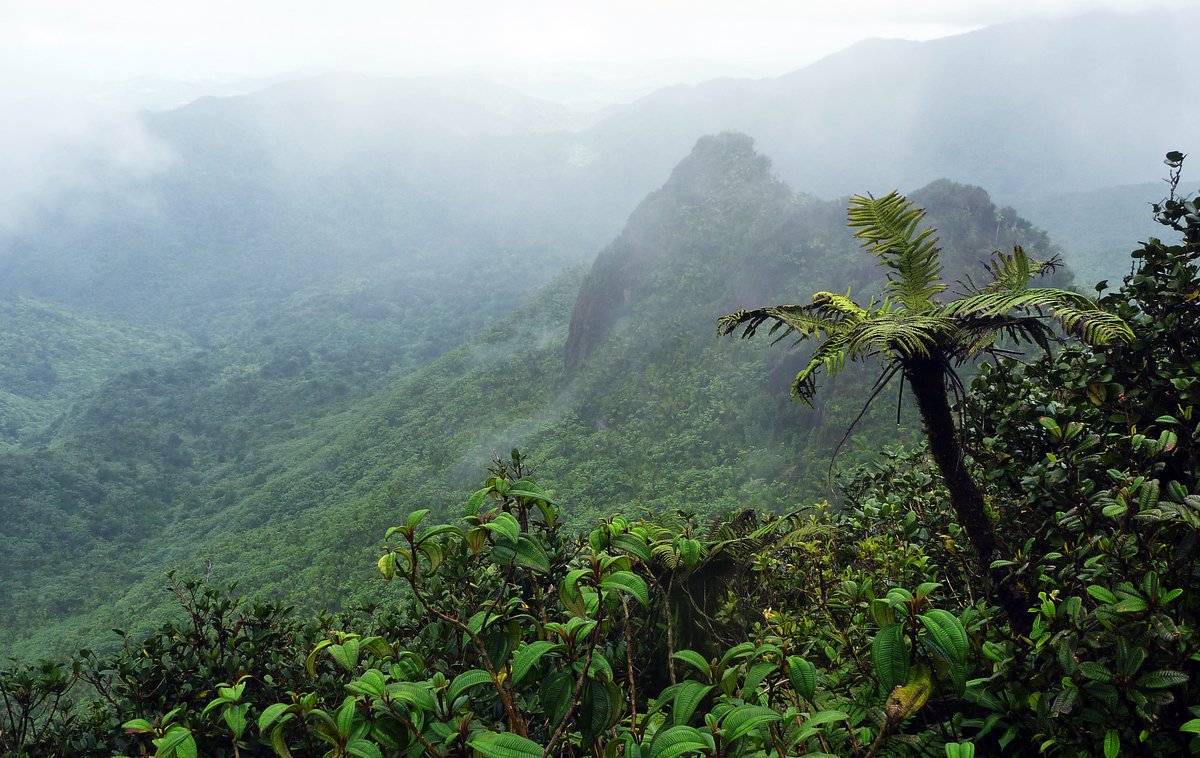
We drove to the El Yunque National Park and went walking on a trail to the top of El Yunque. It’s all in rain forest and (errr), it rained, so we were dripping wet through when we arrived at the top. It was a very nice three hour hike and good to be out walking again. The national park is a popular tourist stop and there were some very ill equipped people in plastic ponchos, struggling up the path in their flip flops.
In the afternoon, we stopped off at Luquillo, where there are lots of small kiosks selling snacks. We had an Empanadilla (Chicken Pastie) and a Piononos , which is a kind of pie made from sweet plantains and minced beef – very nice. We called into Wal Mart on the way back and did boring stuff like buying some new pillows. I’ve been unable to buy any pop rivets for our broken Rod Kicker.
11 April 2012 Cayo Obispo to Isla Culebra, Puerto Rico
I managed to talk to a guy called Dennis who runs a weather net in the morning at 0745 on 4420Khz. He couldn’t hear me, but Ian from “Blackthorn Lady” was on channel and relayed for me for a while. I asked Dennis about a weather window for our five day passage to the Bahamas and he told me that there’s a cold front coming from the north and we need to wait for that to go through so Monday (23rd) is probably the best bet for the start of our five day passage to the Bahamas. Dennis knows Sergio, the previous owner of Alba.
I made a temporary kicking strap from the block and tackle from one of our running backstays, which we hardly ever use. It looks the part and I’m guessing is a strong as the original rod kicker. We went to Sunbay Marina, refuelled and then sailed to Culebra which is 20 miles as the crow flies. The wind was a pleasant 15 knots, but dead on the nose, so we ended up sailing 42 miles as we tacked back and forth – it took us 7½ hours.
We anchored inside the reef at Ensenada Dakity.
12 April 2012 Isla Culebra, Puerto Rico
We motored to the anchorage at Dewey and went to the launderette – I've not been to a launderette for over twenty years – it wasn't as bad as I remember.
We chilled out for the afternoon and then went to the bar for happy hour and onto a pizza bar for dinner.

13 April 2012 Isla Culebra to Isla de Culebrita, Puerto Rico
I chatted with Dennis again this morning and the cold front is still coming down from the north and it will bring strong NE winds with it tomorrow evening and Sunday. It looks like we’ll have to wait until Tuesday (17th) for the large swell caused by this wind to die down.
We took another two loads of washing to the launderette in the morning and then motored around to Isla de Culebrita with “Blackthorn Lady” to have a change of surroundings while we still have pleasant weather. Bahia de Tortuga is a lovely bay with a white sandy beach and is surrounded by reefs and clear water. We went snorkelling which was good and then went to “Blackthorn Lady” for a barbeque with Tony and Rosemary from “English Rose”. It was good to catch up with Ian and Jacqui, but we drank too much red wine.
14 April 2012 Isla de Culebrita to Isla Culebra, Puerto Rico
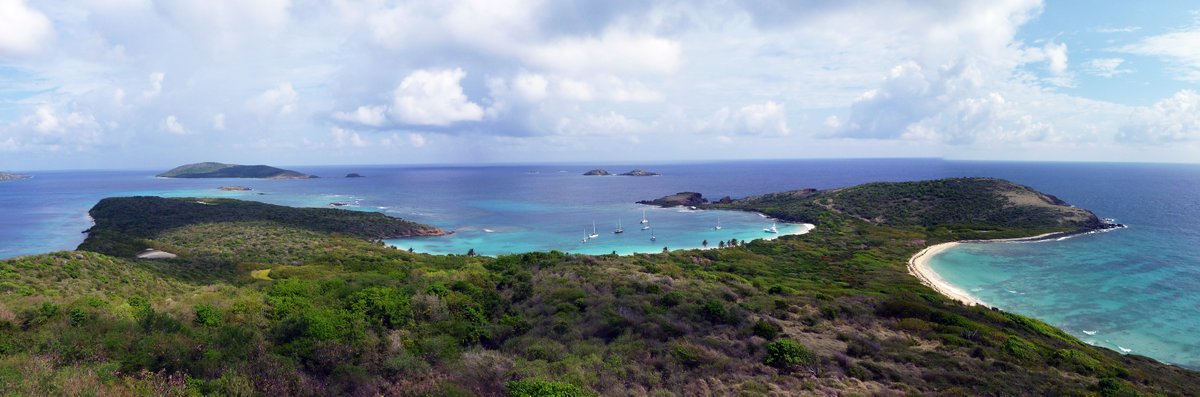
Glenys and I were feeling a little “dull” this morning. We took the dinghy to the beautiful beach and went for a short walk up to the abandoned lighthouse on the top of the hill. It’s a nice little walk. The island is a protected nature reserve and there’s a well maintained path starting from the middle of the beach. The lighthouse is derelict, but we managed to climb up to the top of the tower on the dodgy, rusty, spiral stairs. We had a great view of the Spanish Virgin Islands from up there.
Back on Alba, we went for a swim to cool down and spotted a nice big Green Turtle and watched a Remora who was lurking around underneath the boat. The cloud was starting to build up by eleven o’clock, so we motored back to Ensenada Honda and anchored off Dewey. Kath and Jim have just arrived on “Flawless D” after a five day passage from Curacao, so we went for a quick chat with them. The rain and wind from the cold front hit us at three o’clock and it poured down for the rest of the afternoon.


We donned our waterproofs and went back to “Flawless D” for a few beers in the evening, while the wind howled and the rain lashed.
15 April 2012 Isla Culebra, Puerto Rico
It was a very blustery night, with 25 knot winds from the north-east, so we had a restless night with the anchor chain snatching in the strong gusts.
It was quite sunny for most of the day but the wind was gusting to 25 knots, so we stayed down below. We sorted out our grab bag, which contains the various things that we want to take with us in the unlikely event that we sink and have to take to our life raft. It’s only a five day passage but anything can happen so we depressed ourselves with this task.
The rest of the day was spent on reading, internet and clarinet practise. Glenys painted a Bahamian courtesy flag because we've been unable to buy one in the BVI or here in Puerto Rico.
At the end of the afternoon, dark rain clouds started to head our way, so we had a quiet night in. Glenys made a brave attempt at Piononos for dinner. Unfortunately, the recipe calls for plantain strips to be held together in a kind of ring with cocktail sticks and we didn't have any, so it collapsed into a heap. It was very tasty, but looked a bit like road kill. I look forward to the next attempt.
16 April 2012 Isla Culebra, Puerto Rico
The weather forecast hasn't changed much. Today is nice 20 knot winds from the north-east, but horrible big seas. Tomorrow should be perfect, but I'm a little worried that we’re going to run out of wind after a couple of days. We had a quick debate about leaving today, but decided to stick to our original plan and leave early tomorrow.
We went ashore to get some cash and go to the supermarket to buy fresh food for the passage. As the supermarket has its own dinghy dock, it’s very convenient to get heavy stuff, so we invested in six cases of beer – people have told us that beer is $90US a case in some places in the Bahamas - that works out to about £6 per pint…
 We dropped off our garbage and then cleared out in the afternoon, which was very quick and easy. In the evening, we went on a mini pub crawl and for a meal at Zaco’s Tacos for our last night out with “Flawless D” and “Blackthorn Lady”. It was very convivial.
17 April 2012 Isla Culebra to Mayaguana, Bahamas (Day 1)
The alarm went off at quarter to seven and we leapt out of bed to do the last minute preparations for sea – outboard and dinghy on deck, check the engine, fishing lures, make sandwiches for lunch, etc.
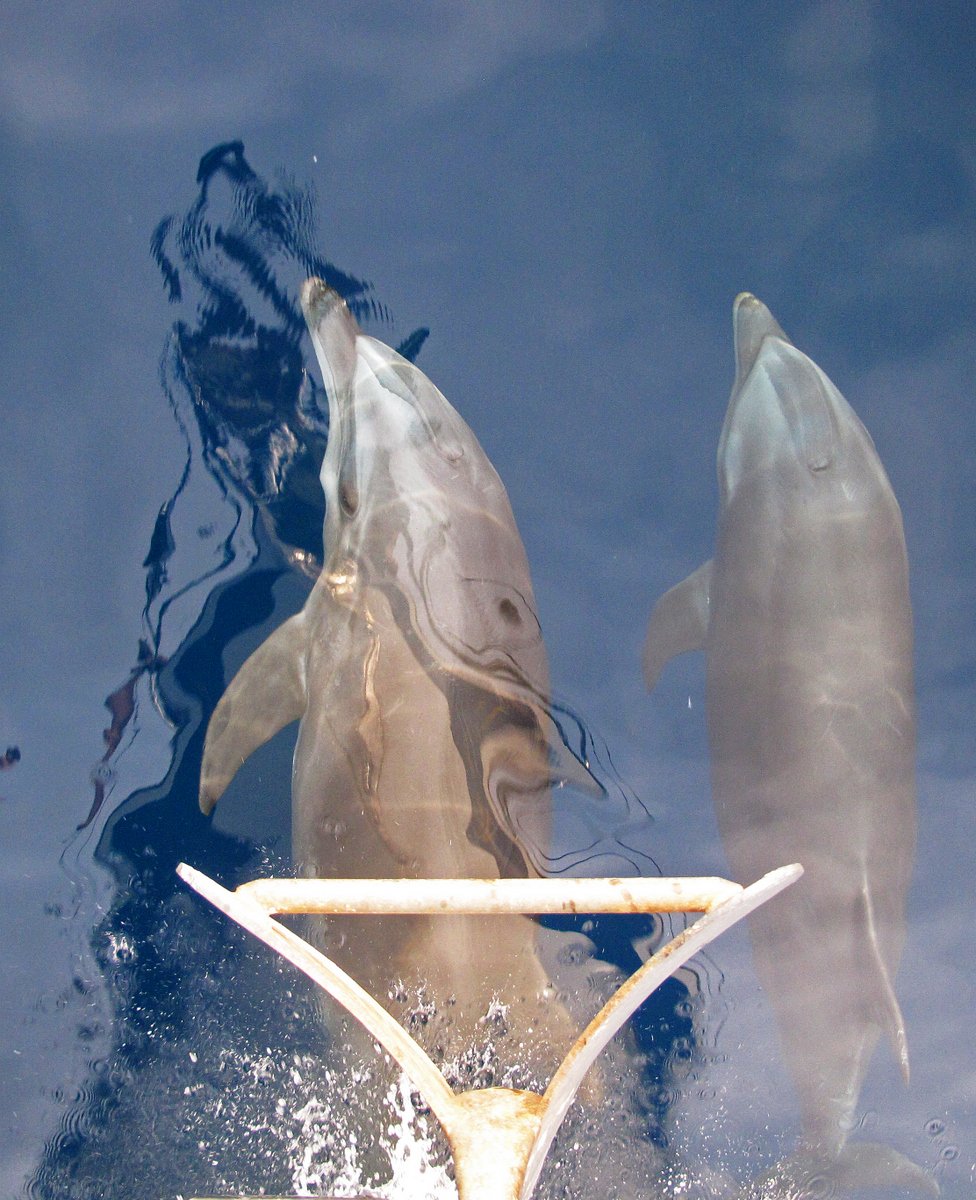
We upped anchor and left at eight o'clock. I put up the main and then realised that we hadn't fitted the rudder for our Hydrovane wind-vane steering, so I had to don swimming shorts and climb down the swimming ladder to fit it in place. Just after we passed the two entrance buoys, a Bottlenosed Dolphin came to say “hello”, which I regard as a good omen.
As we rounded the south-west tip of the island, we picked up a nice 15-20 knot wind from the east, which allowed us to sail past the outlying small islands and reefs, out into the Atlantic Ocean. Once clear of the reef, I put out two fishing lines – the fishing rod and a hand line with my “birds”.
I overheard two boats chatting on the VHF about going to the Bahamas, so I contacted them and had a chat. Jan and Karen on “Bella” and Larry and Beverley on “Chandelle” are both heading to Georgetown and are a few miles behind us. We’ll probably stay in touch with them on the way.
Once out at sea, the waves were a little large at 6-9 feet, but it was fairly comfortable because we were on a reach. The wind settled to around 15 knots, so I unfurled the stay sail and we romped along with all sails out doing 5½ - 6 knots.
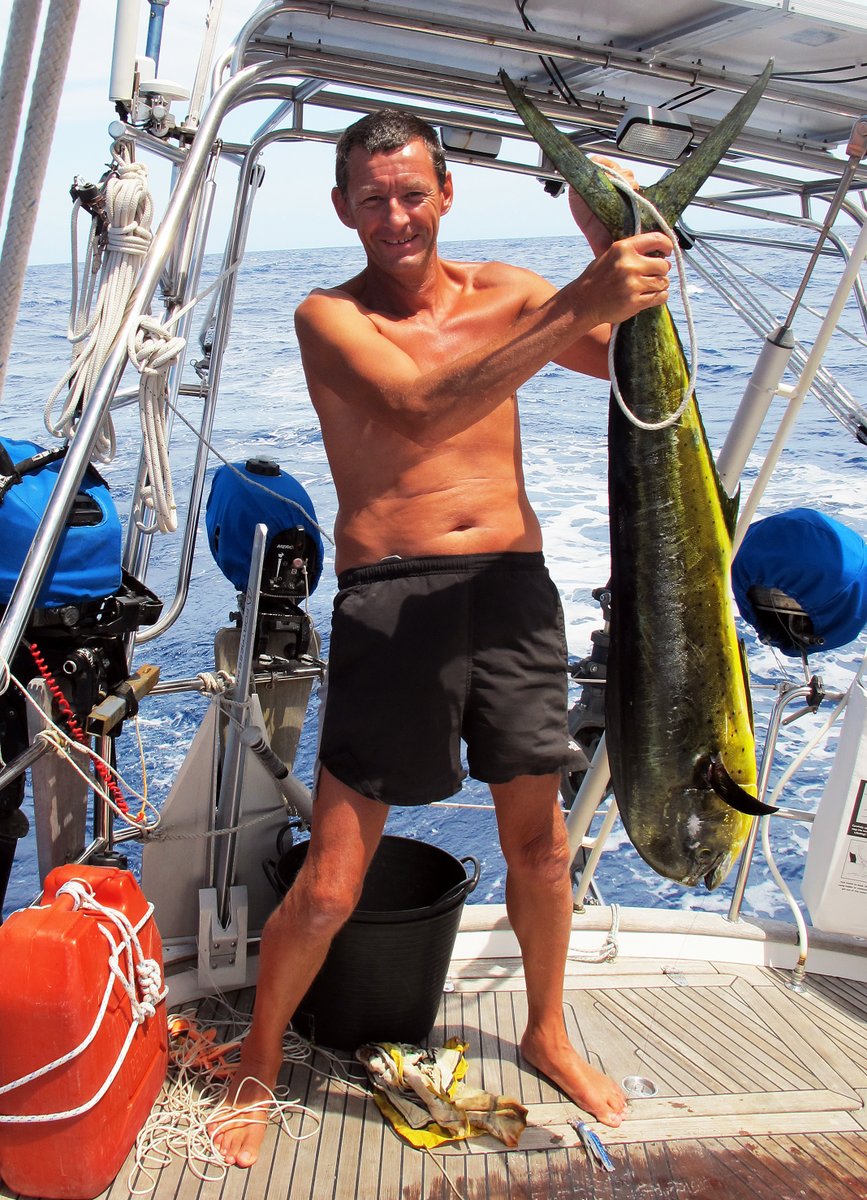
After lunch, we must have sailed through a school of Dorado, because I suddenly hooked two fish. I increased the friction of the fishing rod reel and concentrated on the hand line. I managed to get the large fish to the side of the boat when, with a sudden panic attack, it managed to throw the hook as I was about to lift it on board. I played the second fish for a while and was very pleased to land a large 18lb female Dorado.
I filleted the fish and Glenys packed it away in zip-lock bags in the bottom of our drinks fridge, covered by cold beer cans. We’re not very well geared up for catching a lot of fish because we have limited freezing capacity. The galley fridge has a small freezer compartment, but that is usually full of meat. Our other fridge is normally packed full of cold drinks. Perhaps when we do these longer passages, we should turn the drinks fridge into a freezer, so that we can stock up on fish when it is available.
We chilled out for the rest of the afternoon, going along nicely at 6-7 knots. Yesterday, Glenys made a beef stew in the pressure cooker, intending it to be our dinner for the first two evenings, but as we have nice fresh fish, she rustled up Dorado Catalan with mashed potatoes – yummy!
I went to bed at seven o’clock at the start of our three hour watches. The wind had been gusting up to 20 knots and we had been doing over 7 knots in the gusts. However, the wind was forecast to drop, so I left out all of the sails. I didn’t sleep very well – nervous about the passage and we seemed to be crashing along. Sure enough at nine o’clock, Glenys called me up because the wind was gusting 25 knots and we were over pressed. We ended up putting 1½ reefs in the main and a deep reef in the jib.
18 April 2012 Isla Culebra to Mayaguana, Bahamas (Day 2)
It was a dark night with only a sliver of a waning moon appearing an hour before dawn, but at least the clouds cleared away and we had a beautiful starry sky. At usual, it was hard to get into the three hour watches - only the thought of a Dorado sandwich got me out of bed at four o'clock in the morning.
The wind had dropped to 10-15 knots by dawn, so I shook out the reefs and we slopped along at 3½ knots in the four foot swell. It was cold last night and I had to wear long trousers for the first time in a year. However, by seven o'clock, the sun had warmed up and I was back in shorts.
At quarter to seven, I managed to report into Dennis’s weather net. He forecast 8-10 knots for today and 10-15 knots for tomorrow. He also mentioned a trough of low pressure that is forming over Florida, which he's going to investigate and give more information tomorrow. At eight o'clock, we’d done 150 miles in 24 hours which is an average of 6.25 knots, which isn't a bad start to the passage.
At nine o'clock, I listened into a conversation between “Bella” and “Chandelle”, but I had difficulty hearing them clearly and they couldn't hear me because they are a lot further west and ahead of us. They've picked up a forecast from Chris Parker’s weather net and it sounded like the low pressure area in Florida is going to turn into a cold front and bring strong south winds to Georgetown on Sunday 22nd which is when we plan to arrive there. This was not good news, so we turned on the engine hoping to catch up and be able to talk to them to confirm what we had overheard.
I spent the rest of the morning looking at charts and pilot books to work out where we can go if the weather turns nasty on Sunday. I also tried various frequencies to try to pick up weather forecasts on the SSB radio with very little luck – I'm getting a lot of background noise. There’s obviously something wrong with my setup – I need to get an expert to look at it.
I’ve become too reliant on getting weather from websites and really struggle whenever I can’t get an internet connection. Ideally, I want to be able to hear SSB radio stations and also be able to request and receive weather information by email. There are two methods of having remote email – either using a satellite phone or a “Pactor” modem on an SSB radio. Either system will involve spending $1,000 to $2,000 US to install new equipment and a monthly fee for connection and email compression, but I need to get it sorted out in the USA before we go any further afield. It’s very frustrating (and potentially dangerous) being unable to get a decent weather forecast.
We motor-sailed all day and, in the afternoon, I finally managed to contact “Bella” who confirmed the cold front arriving in Georgetown on Sunday with 25 knot squalls. Both “Bella” and “Chandelle" have made the decision to go for Georgetown - by motoring hard to maintain seven knots, they are expecting to arrive midday on Saturday 21st. In the evening, the wind picked up to 10-12 knots, which was allowing us to sail at 4 knots, but we've decided that we’ll motor-sail all night and re-appraise our position tomorrow.
Sailing in light winds is the bane of our lives. We only have three sails on board – a main, a jib and a stay sail. They're all heavy duty cruising sails which perform very well in winds over 15 knots, but very poor in light winds. We spent some time this afternoon debating whether we should bite the bullet and buy a cruising chute (which is a kind of spinnaker) which would help to resolve this problem. Unfortunately, it will cost £1,500 and will be very bulky, which will give us a storage problem.
With the weather communications and cruising chute, it looks like we may be spending a lot of money in the USA this summer.
19 April 2012 Isla Culebra to Mayaguana, Bahamas (Day 3)
It was a very quiet night with an 8-10 knot wind from the north-east. We motor-sailed all night with the wind on our starboard beam and, at eight o'clock this morning, we'd managed to do 166 miles in 24 hours, which is an average of 6.9 knots. On the negative side of things, we've clocked up 22 hours motoring since we left Culebra.

Ian on “Blackthorn Lady” gave me a relay on the SSB radio to Dennis, who confirms that we’re going to get a cold front coming down into the Bahamas on Sunday 22nd, which could have gale force winds. It was difficult to hear what was being said, but I think that the winds will go southerly and then swing around to the north-west as the front passes over.
I spent most of the morning re-looking at alternative anchorages and revising our route and waypoints. We’ve decided that it’s unlikely that we’ll be able to get to Georgetown in the Exumas before Saturday evening without thrashing the engine for 48 hours. Instead, we’re going to head for Mayaguana, which is supposed to have a good “all weather anchorage”. If we continue to average 6.5 knots then we should arrive tomorrow afternoon (Friday). We can then spend Saturday getting ready for a big blow on Sunday when the front arrives. We can clear into customs in Mayaguana and then take our time going to Georgetown when the front has gone through.
I had a nap before our lunch of Dorado sandwiches and then I cleaned the electrical connection between the antenna cable and the backstay which acts as our SSB antenna. Hopefully, it will improve our reception of the weather forecasts tomorrow. Glenys had a nap in the afternoon while I chilled out reading another book – thank goodness for our eBook readers because we get through a lot of books on passage.
We continued to motor-sail all day to ensure that we keep up our boat speed and make it to Mayaguana as soon as possible tomorrow. The anchorage is inside a very shallow reef, with lots of coral heads, so it will be important that the light is good enough for eyeball navigation.
Just before dinner, I managed to talk to Jan on “Bella” and he tells me that Chris Parker’s forecast for Georgetown is now 30-40 knot squalls from the north-west on Saturday pm and Sunday, but the effect of the cold front in the south-east Bahamas is less with 30 knot squalls on Sunday pm through to Monday. It sounds like we’re making the right decision by stopping at Mayaguana. The wind picked up a little bit, but we need to keep motoring in order to arrive midday.
We saw no sign of land, ships or yachts for the whole of today, just the endless sea with the rolling swell. Dusk came a lot later this evening – it’s 30 minutes later than in Culebra. With the dark, came the loom of lights from the towns on the Turks and Caicos off our port side – our first sign of land for three days.
20 April 2012 Isla Culebra to Mayaguana, Bahamas (Day 4)
At midnight, I went down below to write a position entry into our log book and heard a loud vibration coming from the engine. I looked in the engine compartment and found that we've got a nasty, grinding vibration coming from the stern gear. I wasn't sure whether it was the gearbox, the propeller shaft seal, the cutlass bearing or the propeller, but whatever it was, it didn't sound good. I went back into the cockpit and put the engine out of gear. To my horror the engine stalled and I couldn't get it started again.

I was in the pit of despair, we couldn't continue motoring and the wind was so light that there was no way that we would make it to Mayaguana in daylight – this meant another night at sea. I spent thirty minutes poking around in the engine compartment and finally decided that the bearing surfaces on the propeller shaft seal are breaking down and causing the horrible grinding noise. This would be very bad news because, if we try to use the engine and the bearing surfaces seize up, then it could potentially rip the rubber bellows holding the seal and water would gush into the boat. The only way to replace the shaft seal is to get hauled out and the nearest possible place is Georgetown 150 miles away. I sank deeper into despair.
Glenys took over her watch at one o'clock, by which time we were sailing at 3 knots. I had a restless three hours in bed, dreaming of boats sinking. After breakfast, I had another look at the problems. I was able to start the engine straight away, so I don’t know why it stalled last night – perhaps it was sulking because we’d been running it constantly for 40 hours.
I looked at the grinding vibration and decided that the shaft seal looks okay – it’s leaking slightly and I was intending to change it when we get hauled out in the USA, so I think that it’ll be okay for another few months. I also don’t think that it’s the gearbox, so it has to be the cutlass bearing, the propeller or maybe something wrapped around the propeller. In any case, we decided not to motor unless we really have to.
I had a very faint contact with Ian of “Blackthorn Lady” on the SSB and didn’t learn much new about the weather – the front is still coming through on Sunday.
The wind continued to drop during the day. By lunch time, it was down to 5 knots from behind us giving us a pathetic 1½ knots boat speed. We still had fifty miles to go and I was worried that we could get becalmed and wouldn't even be able to get into Mayaguana tomorrow. The wind was so light that I decided to go into the water and snorkel down to have a look if there was an obvious problem with the stern gear.
We rolled away the jib, pulled the main in tight and hove to. It’s a little bit disconcerting to jump into water that is 2½ miles deep, in the middle of nowhere. I cautiously climbed down the swimming ladder, checked that there were no pelagic sharks lurking under the boat and then dived down to have a look at the stern gear. The propeller looked OK with nothing wrapped around it and the propeller shaft was tight enough in the cutlass bearing – no problems there. On the second breath, I noticed that the rope stripper is very loose. After a few more dives down, I now think that the rope stripper is causing the vibration. I'm still very reticent to use the engine for very long, but this is a major relief because as I should be able to sort out the problem when we get to the anchorage in Mayaguana.
The wind didn't pick up, so in the middle of the afternoon, we turned the engine on and motored for an hour at low revs to test it and to get a few miles under our belt. The wind picked up gradually and, by half past six, we had 10-15 knots with only 30 miles to go, so we rolled away the main, reefed the jib and bobbed along at 3 knots.
21 April 2012 Isla Culebra to Mayaguana, Bahamas (Day 5)
At midnight, a red flashing light appeared ahead. I always feel nervous when approaching small islands in the dark – GPS is very accurate, but some of the electronic charts are still based on surveys in the 1800’s and can be out by a mile or so. I used a compass bearing from the light and a radar bearing from the southern headland to verify our position as being three miles off the southern tip of Mayaguana. I was please to get confirmation as it was pitch black and the reef-strewn coastline is very low with no other lights.

At the change of watch at one o’clock, we hove to with just a reefed jib. Without the main, Alba lay at 70°-80° to the wind. This wasn’t ideal, but we didn’t roll too much in the small four foot seas. When I came back on watch at four o’clock, we had drifted 3 miles south, away from the island. The entrance through the reef was still 13 miles away, so with daylight only two hours away, we set off sailing again at 3 knots with just the reefed jib.
We arrived at the western entrance through the reef at nine o’clock. It’s a very large area 4½ miles long by 1 mile wide and is littered with reefs and shallows. We were motoring east into the sun, so the visibility wasn’t really good enough to see the coral heads, but we managed to find a sandy anchorage in four metres depth without an mishaps. I snorkelled down to check the anchor and the water is fantastically clear. From the deck, the water colours are stunning.
We’re in the middle of nowhere - the main settlement of Abraham’s Bay is at least three miles away and we’re quarter of a mile from the outer reef and half a mile from the shore. The holding is excellent in white sand, so I think that we’ll be fine when the front comes through tomorrow night. I think that the only problem is that we may get large waves from the north-west because we're half a mile from the land in that direction – it may get a little bouncy.
We both collapsed and had a nap before lunch. We managed to get a mobile phone signal and sent out a few texts to let people at home know that we’ve arrived safely. Our son (Brett) rang me back because Tasha and he have just put an offer in for a house and he wants to borrow some money to help him with his deposit. I said that we’ll sort it out in a week when we get to Georgetown. We only chatted for a couple of minutes and, even though he rang me, we gobbled up the remaining £4 of my prepaid credit on my mobile phone.

Glenys spotted what she thought was a Southern Stingray swimming past Alba, which turned out to be three sharks. They swam around our boat for ten minutes and seemed to be attracted by the slapping of the dinghy in the water. I went into the dinghy, donned my mask and put my head underwater to confirm that they were Nurse Sharks. Two swam off, but one remained stationery on the sea bed, with three Remora on its back. I decided to go and take a photograph of it.

All my previous experience with nurse sharks is that they are very docile and normally swim away when you get too close. I’ve even pulled the tail of one before now. When I dived down to take a close up picture of this one, it quickly swam off the sea bed and shot towards me. I bolted to the surface and started to swim backwards towards the boat with the nurse shark following close behind. I kicked my fins into its face, at which point, it decided that I was too big to eat and swam off. Phew!! We decided to go snorkelling another day - at least I got a good picture of the shark.
We chilled out in the afternoon, had our first cold beer for 5 days, ate a nice big fish dinner and went to bed early.
22 April 2012 Mayaguana, Bahamas
It's not surprising, but we had a lie in. Later in the morning, I put on my scuba tank and dived down to sort out the rope stripper. I was a little cautious and had a quick look around underwater for sharks before plunging in. There were no sign of the nurse sharks, but there was a large shoal of squid lurking around next to the boat. I swam over to look at them, but when I moved within five metres of them they flashed through a kaleidoscope of colours and kept their distance.
The fixed part of the rope stripper was very loose and I found that the two plastic bearings had disintegrated. I have some spares, but decided that I would remove the whole assembly rather than trying to fix it while the boat is bouncing up and down and swirling around. It took me half an hour to clean off the barnacles and disassemble it – one has to be so careful when working underwater because it’s so easy to drop something.
As soon as I climbed back on board, we had a visit from a nurse shark which swam around the boat coming very close to the stern. I splashed the swimming ladders in the water and the shark came over to investigate – these are unusually active nurse sharks, perhaps other cruisers or the fishermen are feeding them.
After lunch, we motored over to the anchorage just off the small settlement of Abrahams Bay where there are five or six other boats. Our plan is to clear into customs tomorrow. It was an interesting experience motoring for three miles avoiding reefs in depths that slowly decreased to 2.3 metres – we go aground at 2.0 metres. The good news is that the stern gear doesn’t have any vibration now.
It’s a lot shallower over here (we’re in 2.5 metres of water), but it’s good to have some points of reference to check whether or not we’re dragging our anchor at night. I snorkelled down to measure exactly how much water we have between the bottom of our keel and the sea bed and it’s the length of my forearm with outstretched fingers - exactly 0.5 metres, which is not a lot.
The cold front is still expected to bring 25 knot winds from the west tomorrow evening and into Tuesday. We pottered about for the rest of the afternoon doing small jobs. Glenys is trying to work out which anchorages we should visit as we go up through the Exumas because we only have five or six weeks before we need to go to the east coast of the USA.
23 April 2012 Mayaguana, Bahamas
We went into the settlement to clear in. They call the small villages, “settlements”, which is very appropriate as the dwellings are randomly built and there isn’t much there. This particular settlement is a ten minute walk from the run-down concrete pier along a very badly maintained tarmac road. There’s a Batelco (telephone company) antenna under which are two small, mustard coloured buildings and a shed. This is the administration centre for the island – customs, immigration, post office, magistrate’s court, telephone company, etc.
We were in the customs office for about an hour. We filled in the plethora of forms and paid our $300US customs fee – the most expensive country that we’ve visited so far. The fee is supposed to give us a 12 month cruising permit. The actual piece of paper was a photocopy and says that it's a cruising permit for six months. When I asked the customs lady about this, she just shrugged and said that it was wrong – it was actually for 12 months. We should be able to use the cruising permit again when we come back south in six months’ time.

While we were in the customs office, we were able to get Internet access and picked up our email. It looks like the cold front has dissipated and we’re not going to get any strong winds now. The winds are going to remain from the north for a couple of days, so we’ll have to wait until Wednesday 25th before we can sail north. Our son, Craig, sent an email telling us that he’s finally got a job as a junior software developer, which was fantastic news.
We had a quick wander around the settlement. There’s one “grocery store”, which is actually someone’s dwelling with a sign outside. There was nobody in, but some other cruisers have told us that there’s no bread and no fresh food because the mail boat hasn’t been in for a while, but they have frozen chicken, burgers and fries. There’s also no gasoline left on the island and people are trying to buy it off each other now. We walked as far as a crossroads where there was some kind of shelter with ten or so guys hanging about – obviously there’s not a lot of work here.
Dismayed, we walked back to the dinghy and to the luxury of our yacht – I’m sure that we’re carrying more food and beer than there is in the whole of Mayaguana.
By lunchtime, the wind had veered to the west as forecast. We spent the afternoon reading pilot books for the Bahamas and trying to work out a rough itinerary of the places where we should stop. We’ve only got five or six weeks before we want to get to the USA, so we want to make the most of our $300 cruising permit.
We went to “Shalamar” for drinks with Sebastian and Liz – Mitch and Jessica from “Boomerang” were also there.
24 April 2012 Mayaguana, Bahamas
The wind has veered around to the north as forecast, so we’re going leave tomorrow when it should come around to the north-east. We continued to read pilot books and plan out our next two months cruising. At eleven o’clock, when the sun was higher, we motored three miles towards the west entrance and anchored close to where we were a few days ago. I’m still not comfortable sailing around in such shallow water, dodging all the small reefs. I guess that I’ll get used to it after a couple of weeks.
After lunch, we did a few jobs and then went for a snorkel. A nurse shark came and swam around the boat just before we climbed into the dinghy, but I didn’t tell Glenys in case she refused to go. We looked a few small isolated reefs, which were in very good condition with nice coral, but I guess that the locals fish these regularly because the fish are very shy.
I filled the scuba tank that I’d used the other day and we did a few small jobs, tidying up ready to do a 150 mile passage to Conception Island tomorrow. It will be another overnight trip, but hopefully this is the last one for a month or so.
25 April 2012 Mayaguana to Georgetown, Great Exuma, Bahamas (Day 1)
The wind was from the NNE at 10-15 knots as forecast, so we left at half past eight. We had a cracking reach along the south-west coast of Mayaguana and then had to steer NNW towards Plana Cays, which meant that we were hard on the wind. However, it was pretty pleasant as the winds were light and the seas were only 3-4 feet high.

We cleared the north-east tip of the Plana Cays at around two o’clock in the afternoon and were able to ease the sheets and head off north-west. As evening approached, the wind started to veer to the north-east and picked up to 20 knots, so we had a romping reach in growing, confused seas.
There was nothing to do apart from read our books and clear weed from the fishing lines. There seems to be an incredible amount of the Sargassum Weed around here and it very soon catches hold of the fishing lines or the lures. Dragging weed along is no way to catch fish – we didn’t have a single bite.

I reefed the sails before dark, which was fortunate because the wind picked up to 25 knots by midnight.
26 April 2012 Mayaguana to Georgetown, Great Exuma, Bahamas (Day 2)
We didn’t sleep well because the confused seas made the boat bounce around like it was in a washing machine. It’s hard to drift into blissful slumber when the waves are booming against the hull and you’re being thrown around in bed.
The wind abated and veered a little bit more overnight, so by dawn, we had 15 knots from the east putting us on a broad reach. We passed three miles off Rum Cay at day break and headed towards Conception Island where we were expecting to spend a couple of days.
I listened to Chris Parker’s weather net and discovered that there’s a low pressure trough coming up from the south and will bring unsettled weather to the Exumas. The winds are expected to pick up on Saturday night to 25 knots. Sunday and Monday are forecast to be horrible with squalls passing through bringing winds up to 35 knots. This weather sucks – why the hell are we going north?
We decided to go past Conception Island, which is very isolated and exposed. Instead we carried on towards Georgetown. The sail was uneventful until we arrived off the channel through the reef.
To the east of the Exumas islands is a very deep trench called the Exuma Sound. This goes down to 2000 metres in places. About a mile east of the islands, the sea bed comes up very rapidly from 1000 metres to 30 metres in a kind of underwater cliff. To get to the leeward side of the islands, one has to find a gap between the small islands (generally called a “channel” or a “cut”) and then navigate through coral reefs to the anchorage. The islands are all very low, with few distinguishing landmarks, so it is confusing and GPS is very, very helpful.
Our approach was downwind in six foot seas and it was very nerve wracking as we surfed towards the reefs. To make things a little bit more exciting, our small GPS chart plotter was playing up and kept zooming in and out by itself, making it difficult to know exactly where we were. We managed to get through the entrance and turn 90° to starboard before we hit the rocks in front of us, then we motored for 5 miles in 3-5 metres of water, through isolated reefs until we arrived at the anchorage off Stocking Island.
We were a little shell-shocked when we arrived - we just cracked open a beer and sat and stared at the hundred or so boats in the anchorage. Not surprisingly, we had an early dinner and crashed out.
27 April 2012 Georgetown, Great Exuma, Bahamas
It was a miserable, grey, overcast day with drizzle - reminiscent of April in the UK. We dinghied over to Georgetown, which is a mile across the harbour and very bouncy. The Family Islands Regatta is taking place this week, which is a fiercely contested series of races in traditional Bahamian sloops. It’s a very big event to the islands and Georgetown was buzzing.

We wandered around, looking for the necessities – supermarket, liquor store, bank, launderette, petrol station, etc. The town has everything that we need at the moment, but I wouldn't like to do any major jobs on the boat – there’s a small hardware store that has some boat parts, but not a lot.
We found where the Regatta was being run from. There were loads of food/drink stalls set up on the way to the government dock where the ferries come in. It was pretty mad with a couple of places booming out loud music. As usual, the speakers were as large as a VW camper van, so the noise of the two competing DJs was intense. While watching the people strolling by, we bought some conch fritters at a small stall which were very nice, but contained a week’s allowance of saturated fats.
We called in at the supermarket and bought a few things. As expected the prices of food and beer is almost twice the cost in St Maarten and Puerto Rico. We bounced back to the boat, had a quick sandwich and went for a look at Stockling Island which we’re anchored off. There are three very sheltered lagoons – one is too shallow for yachts and the other two are covered with moorings. It looks nice and protected in there.
Georgetown is the sort of place that cruisers arrive and never leave – it’s called “Chicken Harbour” by some people because Americans have an easy sail down from Florida aiming for the Caribbean, but never manage to get any further south because it would involve real sailing in the Atlantic Ocean. The cruisers have set up footpaths which wander around Stockling Island, we walked across to the windward beach which is lovely.
We went to the small marina and bought a couple of prepaid tickets to get Internet access – a bargain at $2US for 80 minutes. Glenys cooked Goat Curry for dinner and then, because it was raining, we watched a film.
28 April 2012 Georgetown, Great Exuma, Bahamas
The weather was even more miserable today. We received an email from Gareth and it sounds like Glenys’s mum, Ceris, is not getting any better, so we’ve decided to have the boat hauled out in June in the Chesapeake, so that we can go home to the UK and see Ceris and the rest of our families.

I spent the morning planning out all of the jobs that we want to do on the boat – it has turned into quite a list and will be a major refurbishment operation. The main job is to replace the standing rigging which will cost approximately £7,000, but it needs to be done as the rig is now over 12 years old and the insurance company are requiring us to do the work. I’ve got some more rigging work to be done to improve the running back stays and add a couple of new winches. Plus work on the generator, engine, anti-fouling the bottom, replace parts on the stern gear, new chart plotter, etc, etc. I reckon that we’ll be lucky if it’s less than £15,000.
The weather didn't improve any and it was raining on and off during the afternoon, so I continued doing admin and sorting out our finances, while Glenys chilled out reading and watching the regatta races through binoculars. We had a little bit of excitement in the evening when a twin otter sea plane came in and landed through the anchorage. It tied up to the beach, the passengers went to the beach bar for a drink and then they zoomed off again - obviously an uber pub crawl. The plane took off about 30 metres in front of our bow – crazy pilot.
29 April 2012 Georgetown, Great Exuma, Bahamas
It was yet another miserable day – very overcast and raining. The forecast is to get worse for the next two days. I continued plan the projects for our haul-out.
At lunchtime, we donned our waterproof jackets and ventured off the boat. We went to the bar at Volleyball Beach, where we had a Barbequed Roast Pork lunch and a few beers. While there we met Jim and Patricia from “Passage Maker” who are heading towards Nova Scotia.
We braved the driving rain back to Alba and spent the rest of the day drinking more beer and watching films on my laptop. So decadent, but there was sod all else to do.
Glenys made a nice pizza to go with our third film before we sloped off to bed.
30 April 2012 Georgetown, Great Exuma, Bahamas
It was an absolutely awful day – heavy rain and strong gusting wind over 30 knots at times. Now that the wind has veered a bit more south, we’re not anchored in the best place. There’s a good mile of fetch in front of us, so the waves have built up to a couple of feet. We’re pitching, but I suppose that the motion is not too bad – I’m looking forward to getting to a nice, peaceful, calm anchorage.

I spent the day on electronics jobs. I first took our small chart plotter to bits and tried to find out why it keeps crashing and doing strange things. I found a small section on the circuit board that had some salt crystals, so I cleaned them away with some alcohol. Hopefully, that will fix the problems.
The various piece of electronic equipment on board can share information using a standard protocol called NMEA. It’s a simple four wire network that sends messages out on two wires and receives messages in on the other two wires. I spent a couple of hours tracing the wiring and documenting it. The setup on Alba is not too bad – the GPS talks to the autopilot, the radar and the VHF radio. There’s also couple of leads that I can connect into the PC to pick up these signals.
I spent a couple of hours trying to configure my laptop so that we can use it as a chart plotter if our small one finally goes down. It’s not easy, because Windows 7 has a mind of its own when it comes to RS232 ports and keeps changing the port number when the wiring is unplugged. I finally routed everything through a USB hub and that seems to have worked.
We watched a film in the evening, as the wind howled and the boat pitched and rolled.