
10 July 2009 Travelling to Grindelwald
Driving to the Alps is an odd experience. You want to get there, but don’t want to do the travelling. Getting up at an ungodly hour and driving through the night is not the most pleasant experience. We got up at one o’clock and thirty minutes later, we were driving down the M42 towards London. It was a very quiet run down to the Channel Tunnel. In an unusual bit of foresight I’d made up the bed in our van so, when we arrived early at the tunnel, we were able to get a 45 minute nap before going through customs and onto the train. Once on the train, we went to bed again. With typical luck, I had developed a cold the previous day, which was okay when I was awake, but as soon as I lay down, my nose started to run and I had a tickly cough. In spite of that I managed to get another 45 minutes of sleep.
The journey through France was nothing out of the ordinary – just desperately trying to stay awake while doing 80 mph down the motorway. We decided to go down though Besancon, first stopping at Gray for a quick foray into a supermarket, before grinding our way through Besancon in heavy traffic. The plan was to head for Interlaken via Lucerne and Bern. Unfortunately, we missed a turning in Bern and ended up heading towards Biel which was a very pretty road alongside a lake, but we just didn’t want to be there.
Finally we saw a sign for Interlaken which was a relief. We started to see mountains as well which gave us hope. The drive up to Grindelwald is impressive, up a very steep-sided valley. Unfortunately there was fairly low cloud so we couldn’t see much of the major peaks.
We arrived in the Grindelwald at about seven o’clock and then went through the trauma of trying to find a campsite. It’s very confusing when you don’t have a map of a town. We spotted one campsite from the main road, but that seemed busy, so we tried to find another one by following a road sign. This led us up a very narrow lane and eventually we decided that we were so far from town that we’d give up. We turned around and went to the site that we’d seen earlier (EigerNordWand). When we got to the camp entrance, it looked okay and not too busy.
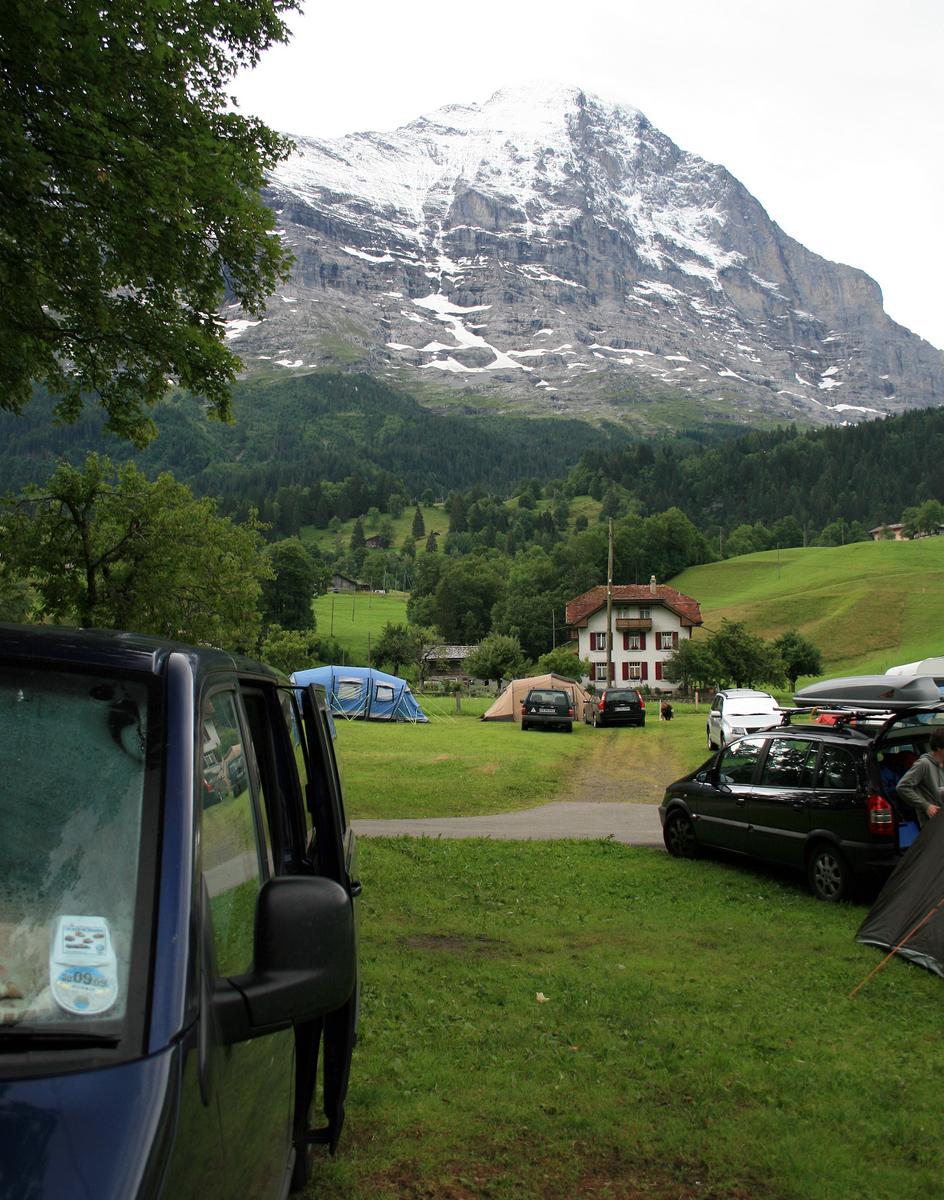
Thankfully, they had space and gave us a pitch under some trees which was fairly level and has a stunning view of the North Face of the Eiger out of our back window (unfortunately covered in cloud the first night). The campsite is in the grounds of a small hotel so we went there for dinner and then crashed out, exhausted.
11 July 2009 Exploring the Area
We didn’t bother to set the alarm clock and woke at ten o'clock – nearly 12 hours sleep, we must have needed it... The plan was to have a leisurely day looking around the town. We had Frosties for breakfast and a nice cup of tea. The Eiger was still half covered in cloud, but we could see the Wetterhorn (3600m) which looks very rugged from the valley.
We packed a small bottle of water and went exploring Grindelwald. The whole village is built on a hill-side, very much like Leysin. We managed to find the town centre after walking up a very steep hill. We bought a couple of very small ham and cheese rolls from a bakery for the grand sum of £5.
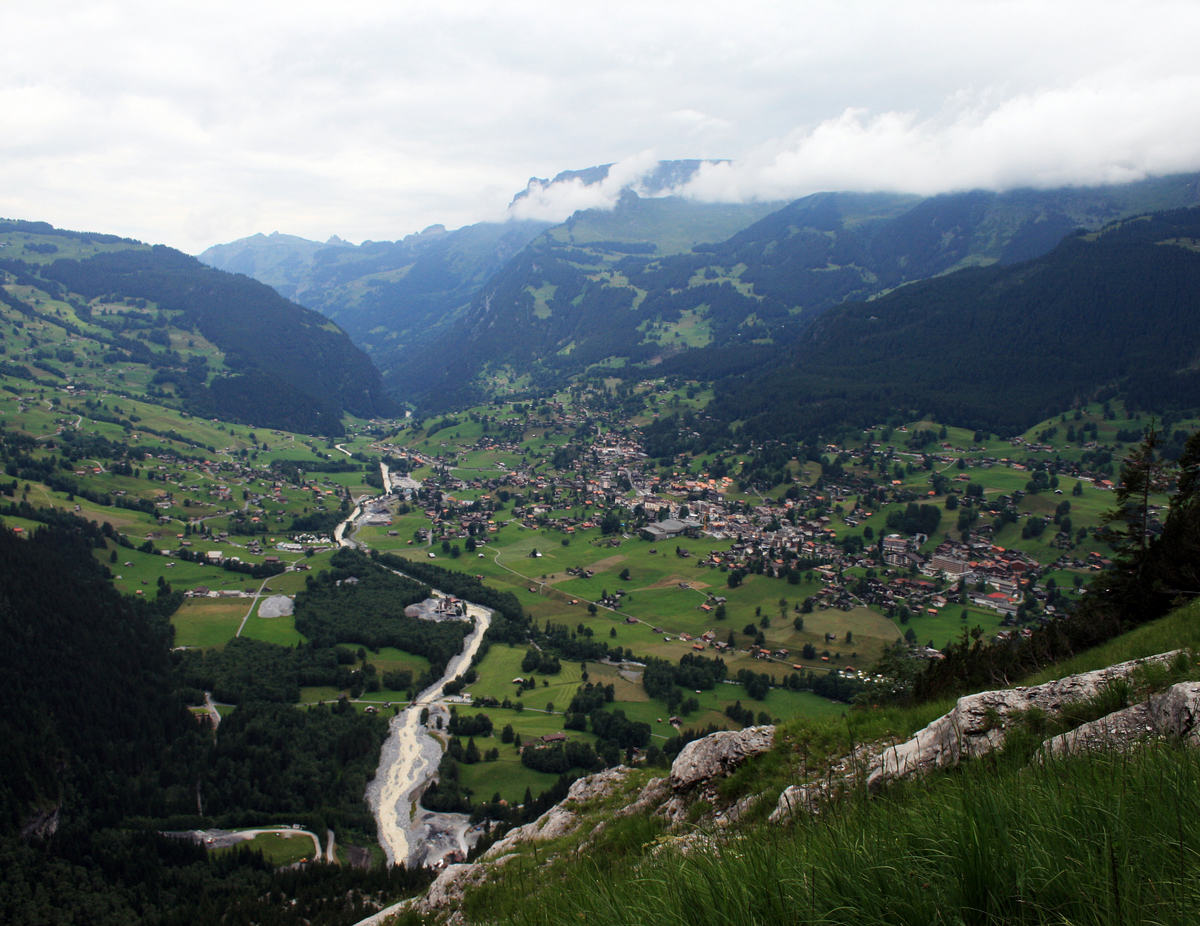
By one o’clock, we had walked the length of the main street and had exhausted the possibilities. We came across the Pfingstegg cable car, which according to the tourist information goes up to a path along the side of the Mettenberg. We decided that a walk up a mountain was in order, so we caught the cable car. We walked up to the Barreg hut, which is on the route to the Schreckhorn hut. It was a nice one hour walk with an ascent of a few hundred metres yielding a closer view of the glacier which is visible from Grindlewald village centre (Unter Grindlewaldgletcher). Unfortunately, the cloud base was too low to get a good view of the 4000 meter peaks which include the Finsteraarhorn.
We stared at the scenery for a few minutes and then set off back down, walking past the cable car station and along to the Milchbach restaurant. The path was fairly level and interestingly went through a tunnel which protects the path from a huge gulley that must turn into a waterfall when it rains. We walked past the restaurant towards the Hotel Wetterhorn pausing to stare up at the Wetterhorn and trying to see the path to the Gleckstein hut – a possible objective for later in the week. Eventually we saw tiny dots walking up a path high above but couldn’t make out where the lower part of the path went. We walked to the start of the path indicated in my guide book, but there was a sign saying that the path was closed. Confusion reigned.
We walked to the Hotel Wetterhorn and had an apple strudel and a coke – yummy. We then walked back down to town, which seemed a long way to our tired legs. I went to the tourist office to ask about the path to the Gleckstein hut. The tourist office has a set of automatic, sliding glass doors. A couple walked in and I could see people inside being served, so I stopped just outside to get my map from my rucksack. I turned and walked towards the door and nearly walked straight into the door when it didn’t open. It was 1801 and with typical Swiss efficiency the Tourist Office was now closed. The Coop supermarket also closed on the dot. Fortunately, we had seen another supermarket earlier up the main street so we rushed there to buy some bread for the next day.
We walked back to the van and sat in the sunshine on a picnic blanket, gazing at the mountains and eating olives washed down with cold beer. Glenys made ravioli for dinner which went down well with a few glasses of red wine. The clouds drifted from the Eiger as night fell and we were treated to a view of the north face in the moonlight with lights twinkling from the Mittellegi hut and the Eigerwand train station.
12 July 2009 The Eiger Trail
We got up at half seven with plans to walk up the Eiger Trail. The weather looked better today with a high layer of cloud just above the mountain tops. We caught the half past nine train from Grindelwald Grund which is only about 5 minutes walk from the campsite. The fare to Alpiglen was £8 each which was well worth it, saving us a remorseless 700 metre walk up.
The Eiger Trail starts at Alpiglen (1615m) and runs under the north face of the Eiger up to the Eigergletscher train station at 2320m. The path is very well maintained and at a very pleasant angle for most of the way. The views of the north face of the Eiger are fantastic – I took lots of photographs. We stopped just under the start of the classic route and stared at the face through binoculars. It’s easy to say when you’re just on a bumble up a path, but it doesn’t look too bad (apart from the freezing cold waterfalls, verglassed rock , the constant danger of rock fall and the prospect of bivouacking for three nights....)
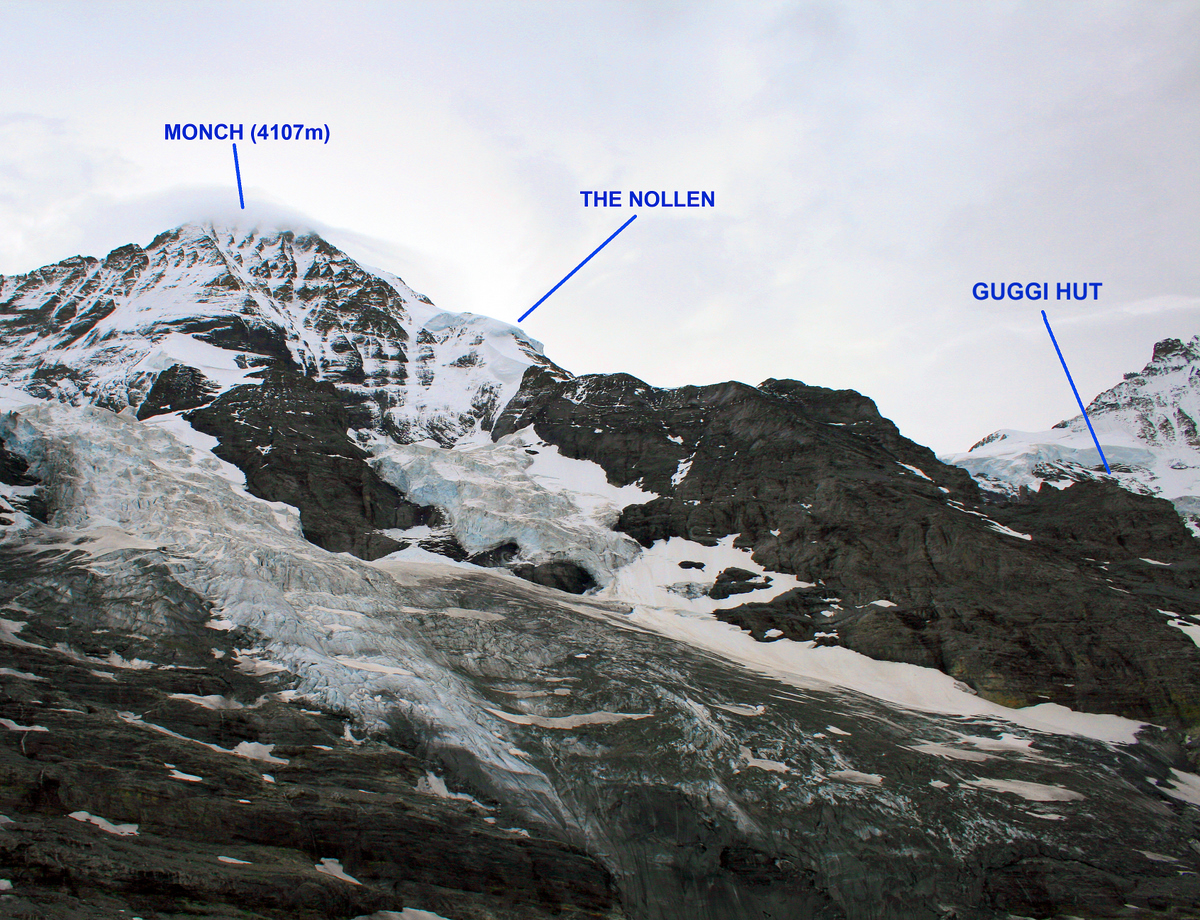
We arrived at the Eigergletscher train station having walked past a via-ferrata at the bottom of the east ridge of the Eiger. The views of the Monch and the Jungfrau are very impressive and the routes from the north side look to be very steep. The “Nollen” Route goes up the North-west buttress of the Monch and is graded as AD. There is an ice “bulge” on this route which gives the route its name, which is supposed to be tricky in some conditions – ice climbing for 2 pitches, sometimes vertical in places, but it didn’t look too bad from where I was standing. The route starts at the Guggi hut which is perched on the ridge between two glaciers. The whole route looks like it is achievable and appears to be a great route up the Monch. It’s 1300m of ascent and the guide book says that it takes 6-10 hours depending on the conditions found on the Nollen.
We had a look at the old Mittellegi hut that had been airlifted from the ridge and replaced by a newer larger hut. They have perched it on a ridge above the railway station and fitted it out with original equipment and a wax work figure – fun to look at for five minutes.
For the past hour, there had been specks of rain and the wind had picked up, so it was quite chilly at the top. We went and hid behind a workman’s hut for shelter from the wind and ate our sandwiches gazing down at Grindelwald and looking up at the Eiger. We then walked down into Kleine Scheidegg which is where the railways from Grindelwald, Lauterbrunnen and the Jungfraujoch all meet. It’s like Disneyland with cafes, hotels, a tepee and lots and lots of tourists – very surreal. It’s amazing how many people come up in the train and never walk up any of the paths which radiate out from the place. However, it’s worth visiting because you get the classic view of the North Face of the Eiger from here, where many epic adventures have been watched from telescopes from the hotel balconies. We didn’t stay long; in fact, we just went to the toilet and left.
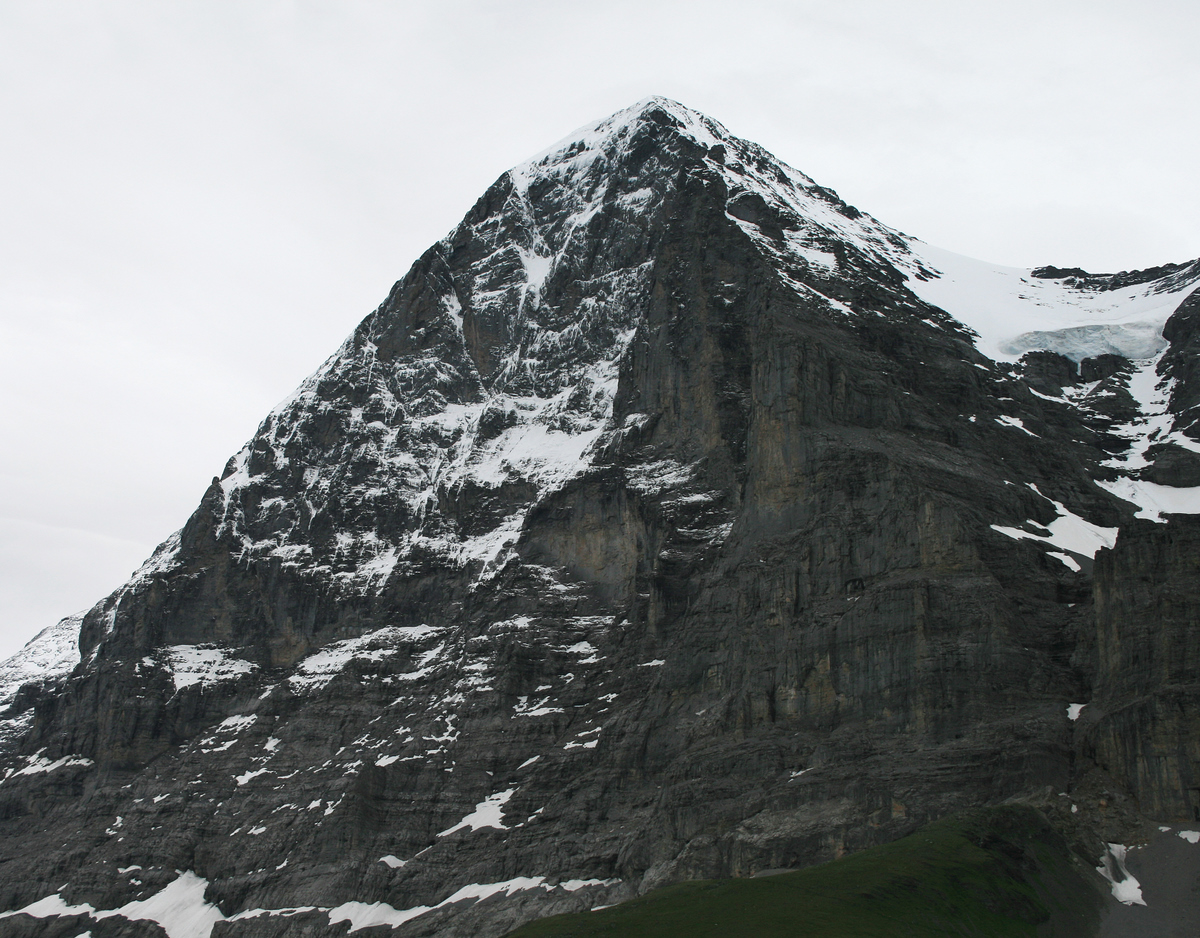
We decided to walk down, which started off nice with great views of the Eiger, but then deteriorated in to a remorselessly constant path that went down and down and down by the side of the railway. Eventually we arrived back at Grindelwald Grund and then had to walk up into town to go to the supermarket for some bread. I went to the tourist office and asked about the path to the Gleckstein hut. They said that the path has been closed by an avalanche and that we should get a bus past the Hotel Wetterhorn to a bus stop especially for the Gleckstein hut.
We staggered back to the campsite for a well earned shower. I then agonised over a timetable for the rest of the week. We eventually decided to go up to the Gleckstein hut for tomorrow night and, after a day’s rest, go up the Jungfraujoch on Thursday for an ascent of the Monch on Friday. We walked back up to town and had dinner in a nice Italian restaurant.
We dragged ourselves out of bed at eight o’clock. The plan was to do a small peak called the Chrinnenhorn (2700m) on Tuesday, which according to the walking guide book is about 1½ hours from the hut. The problem was that I didn’t know anything else about it – was there snow, what gear did we need to take? I went and asked the owner of the hotel, but he hedged his bets and said that there may be snow from the last few days and that I should ask at the guides’ office in town. That didn’t help at all because there was not much chance that I was going to go up there and back before going up to get the bus. We decided that we should take harnesses, a rope, crampons, ice axes and a small rack – in fact enough gear to climb a major 4000m peak.
13 July 2009 The Gleckstein Hut
We caught the bus in town, which cost £25 each for a return ticket. We decided that it was worth it when we got dropped off next to the path about 30 minutes later. It would have been at least 2 hours walk.
The path up to the hut is very good at first, almost a goat track through the middle of a cliff. The path then turns a corner above an old cable car station and becomes a normal mountain path going into the valley high above the bottom of the glacier. There are very impressive waterfalls on the other side of the valley and, for a bit of variety, the path goes underneath a small waterfall which is very refreshing.
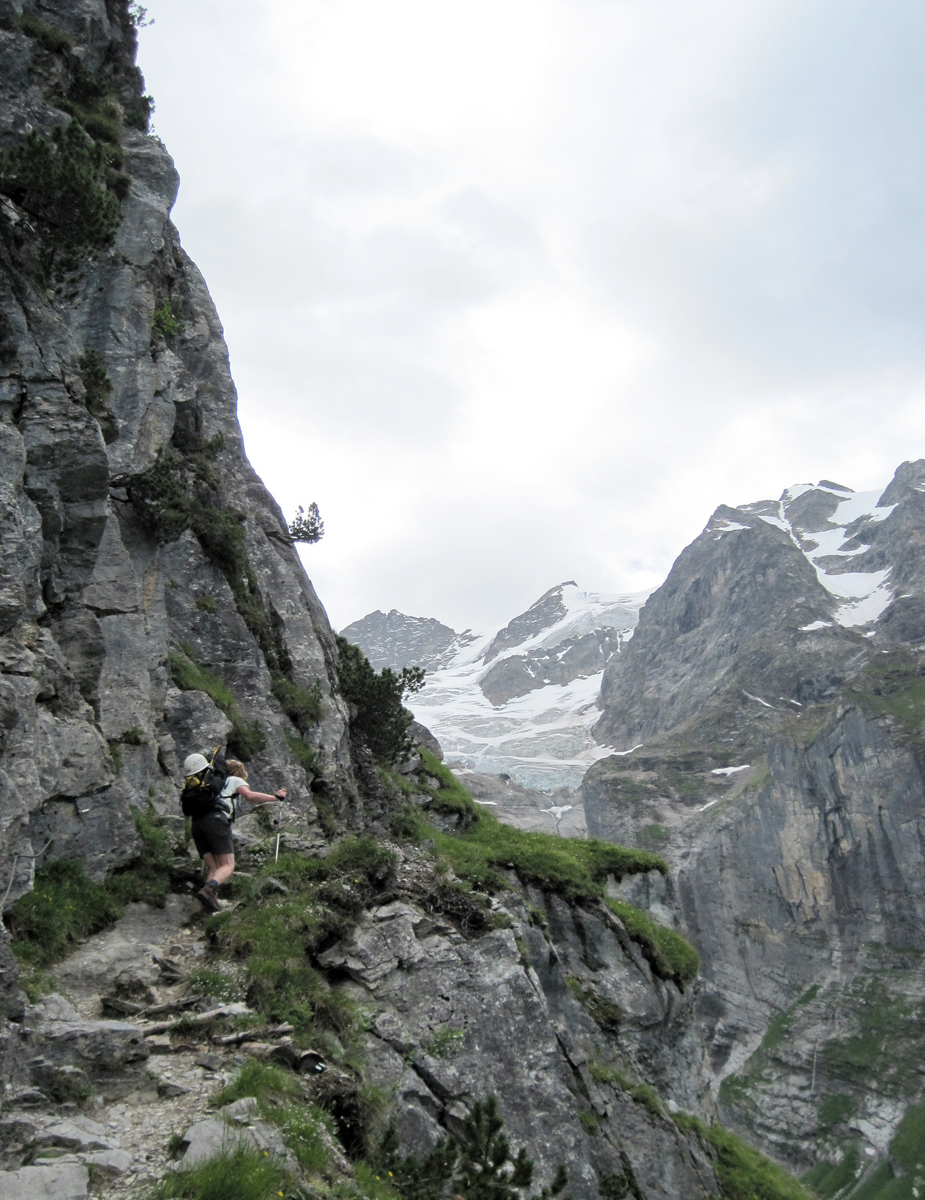
It was a very hot, humid day so we both sweated and suffered and we were glad to arrive at about half past two. The hut looks fairly new and is very tidy. The guardian is a middle aged lady, which is a nice change from the grumpy old men in some other hut. She has pots of Edelweiss dotted around on the terrace and keeps chickens.
The hut has a fantastic view down to Grindelwald and up to the Schreckhorn and the Lauteraarhorn. The seracs of the Grindelwaldgletcher can be seen below and the rumble of avalanches is heard several times an hour as huge lumps of ice cleave from the glacier. We spent the afternoon lounging around on the sunny terrace. One of the other climbers provided a bit of entertainment by falling asleep on the ground, then being pecked on the toes by the local cockerel. The guardian chased it away by pouring water on its tail, but the persistent bird was back 5 minutes later for more toe pecking. The hut even has a shower, so before dinner, we invested SFR 5 and had a lukewarm shower. I’ve never been so clean at a hut – luxury.
Dinner was served at seven o’clock. There were two groups of people staying at the hut. The walkers (like us) and the “real” mountaineers who were going to climb the Wetterhorn (3692m, AD-, mostly scrambling). We were segregated into two separate rooms; neither group spoke to the other – we were obviously beneath them.
After dinner, I popped outside and saw my first Marmot which was lurking around just outside the hut wall. When it saw me it popped up on its hind legs and then ran off. I watched it for a few minutes and then saw it jump up and disappear into a shed a short distance away from the main hut. I mentioned it to the guardian later and she said that she knew about it and that it was a lazy Marmot that couldn’t be bothered to dig a hole.
The rest of the evening’s entertainment was watching the Ibex arrive for their evening salt lick. The guardian’s little girl put salt out on a nearby rock and the wall surrounding the hut. The wild animals were unfazed by the presence of people, although they didn’t like the flashes of cameras.
The guardian told me that the Chrinnenhorn was a straightforward walk with no need for any gear. Ah well, at least we would be able to leave our gear at the hut in the morning. Breakfast was to be at seven o’clock, so we went to bed at half past nine. I lay there for ages trying not to cough – bloody cold won’t go away.
14 July 2009 The Chrinnenhorn
The alarm went off at seven o’clock and we were the first people up (apart from the “Wetterhorners” who had left at 0430.) We had a leisurely breakfast – orange juice, cornflakes, solid bread with jam and hot chocolate. In another nice touch, the guardian had provided a jug of water with some rose quartz crystals in the bottom which is supposed to provide energy.
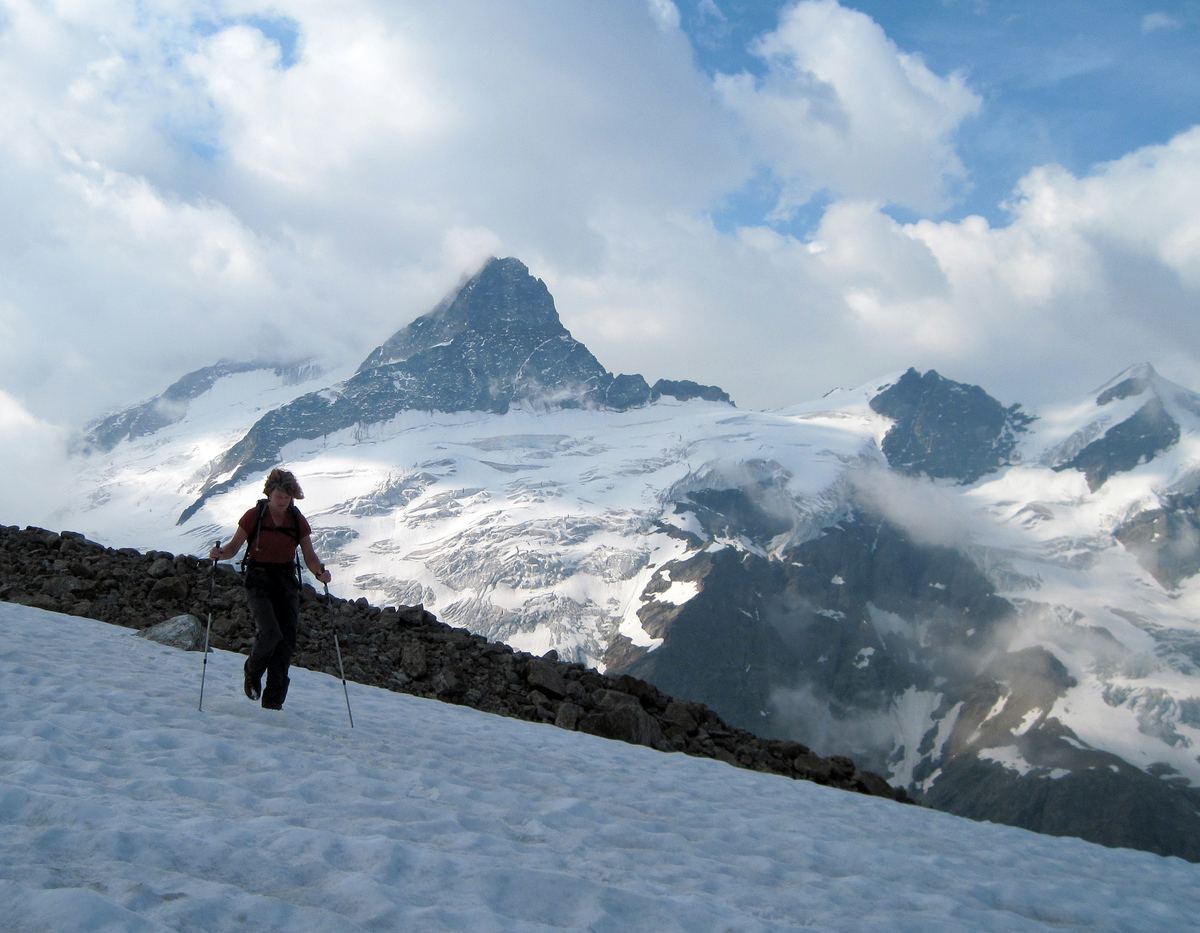
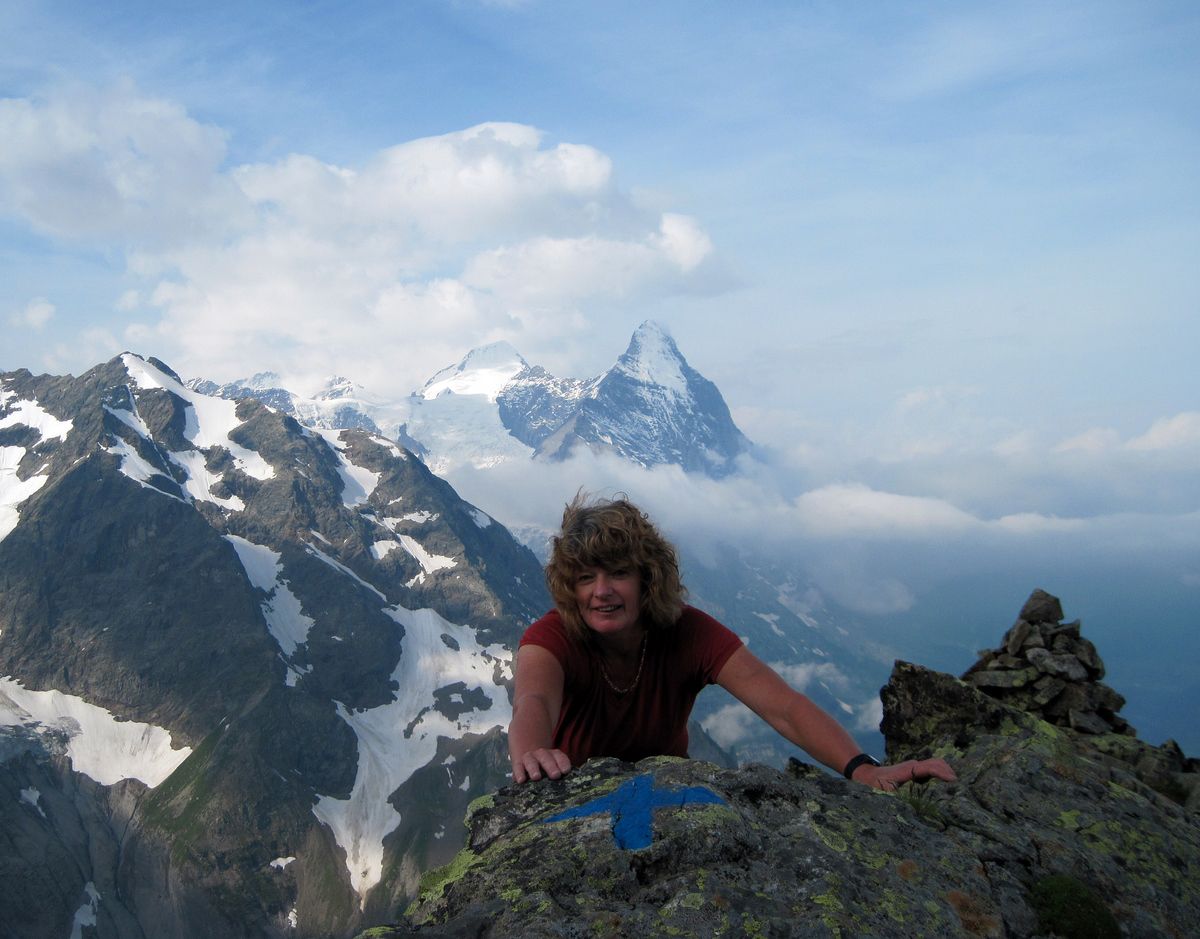
We left the hut at about eight o’clock and started the walk up to the Chrinnenhorn (2736m). It was a straight-forward walk up a path, a short walk across a snow field, a slide down the snow and up a scree slope to a small col. From there it was a short scramble to the top taking us about one and quarter hours. The view from the top was very good but the climb was disappointingly short.
We walked back down to the hut, picked up all the gear that we had left behind and started to walk back down at about eleven o’clock. The walk down was pleasant apart from the normal aching knees and the rucksack getting heavier and heavier. On the way down we met a Japanese couple walking up. This was unusual - there are a huge number of Japanese tourists in Grindelwald, but very few are seen on the mountain paths. I said “Kanichiwa” to the guy and immediately got a huge smile.
Half way down, I checked the bus times and there was one at 1220 and another at 1340. I estimated that we would have no chance of catching the 1220 bus. However, we walked a lot quicker than I thought and reached the corner of the valley above the old cable car station at about noon. We could see the bus stop below us. Glenys read my mind and said that she wasn’t going to run for the bus, so we sat on a grassy patch at the edge of the cliff and had our sandwiches.
After 15 minutes, we were bored at looking down at Grindelwald, so set off again. Half way down, I could see the path going down to the Hotel Wetterhorn which had been closed by the avalanche. It didn’t look that bad – only a short section of the path was affected. We were going to be at the bus stop about 45 minutes early, so we agreed that it would be better to walk down the path to the Hotel Wetterhorn and catch the bus there.
The path was a little overgrown but pretty good down to the avalanche. It had been a snow avalanche that had stripped the soil from a slope high above and then ripped up trees on its way down to the path. There was about 50 metres of the path covered in the debris, which consisted of frozen snow, soil, rocks and trees. I started to pick my way across, climbing over trees and rocks. It wasn’t particularly easy. I started down one steep patch that appeared to be soft soil. As I stepped on it, I discovered that it was actually about 2 inches of soil over frozen snow. My feet went straight from under me and I slid down the slope on my backside. I was covered in mud, embarrassed, but uninjured. Glenys was not impressed.
Having managed to negotiate the rest of the avalanche debris without further incident, the rest of the path down was lovely, going through woods and alpine meadows covered in flowers. We stopped at a stream so that I could wash off the mud and then emerged into civilisation at the Hotel Wetterhorn where we treated ourselves to an ice-cream and a coke.
We caught the bus back to town where I went to the Information office to check on the weather. It looked to be generally good tomorrow, good on Thursday and thunderstorms in the afternoon on Friday. On the way back to the campsite, we decided that it would be better not to have a rest day tomorrow, but to go straight up to the Monch Hut and take advantage of the good weather on Thursday. We didn’t have to go up until the afternoon, so we thought that we would spend the morning going up to the First cable car and having a short walk to the Bachsee lake, which is supposed to have a stunning view of the Wetterhorn reflected in the water.
Back at the campsite, we sorted out our gear and repacked our rucksacks ready for tomorrow. I tried to cut down on the weight, but all I could manage was to leave out my soft shell jacket (0.6 kg) and reduce my rack down to 6 nuts, 1 ice screw and four slings with screw-gates. Glenys did a washer load of clothes; we had a few snacks and went into town. The weather was very hot and humid and we sweated buckets walking up the hill. We have a very nice meal on a terrace of a hotel looking up at the Eiger.
We were now ready to Climb The Monch at 4107 metres altitude.