
8 May 2013 Kingston to Pigeon Island, Jamaica
I downloaded some weather forecasts, which showed that there's a trough passing through the area bringing rain and thunderstorms, so we decided to go to Pigeon Island to wait for a couple of days.
We filled up with diesel, paid our bill and left by ten o'clock. As we motored across the harbour, I checked the vibration on the engine and the horrible clacking noise seems to have gone away. I‘ll keep an eye on it because I may have to re-align the engine anyway. There was no wind at all in Kingston harbour, but as soon as we got a few miles outside, the wind picked up to 20-25 knots - the effect of the land on this coast is very pronounced. We had a cracking down-wind sail through the coastal reefs and we soon arrived in the anchorage in Pigeon Island.
A Marine Police boat with three guys and guns pulled up alongside as we were anchoring and wanted to know how long we were going to stay. I told them that we'd just come from the yacht club in Kingston and were probably just staying one night - I didn't bother telling them that we'd checked out already. This seemed to satisfy them and they zoomed off. I hope that we don't get any hassle from them tomorrow.
The clouds built up during the afternoon and the strong winds continued, only dropping down to 15 knots in the evening. It looks like there may be thunderstorms around as forecast, so I'm glad that we hung around.
9 May 2013 Pigeon Island, Jamaica
We had a chill-out morning. I spent most of the time figuring out how to play a couple of songs that I’ve been looking at for a few weeks. I’ve been getting information on each song from a variety of sources – sheet music, guitar tabs, lesson videos, artist videos, etc., and it’s frustrating how the quality differs, so I’ve finally come up with a way of documenting each song on a single sheet of paper that seems to work. It’s not just a matter of documenting the lyrics and chords, but I also want to keep track of the strumming pattern or finger picking pattern without pages and pages of sheet music. The idea is that I learn the song and this will act as a “Cheat Sheet” – I’ve saved the songs in a pdf file which displays nicely on our iPad
After lunch, we lifted the dinghy onto the front deck and prepared for four days at sea. It’s funny how relaxed we are now about a longish passage, we both know what to do and it’s almost automatic. Glenys prepares a one pot meal in the pressure cooker that will last for a couple of days – this time its Paprika Beef. I pad around the deck checking everything after the dinghy is lashed down, then check the engine and make sure that everything is stowed away and that’s it.
I had another look at the food fridge and it seems to be behaving itself – I topped it up a little bit. The beer fridge is not doing too well; it was very low on its pressure and has been gurgling again. I topped it up again.
We had a fairly strong 20 knot wind as the sun went down, but at least the clouds seem to be clearing as forecast. Glenys cooked Ackee Rice with Saltfish as our last meal in Jamaica.
10 May 2013 Pigeon Island to Providencia (Day 1)
We had a rude awakening at six o’clock with a Marine Police boat circling us and shouting “Mr Howarth”. I dragged on some shorts and went on deck rubbing my bleary eyes. They’d come to check up on us and seemed to be satisfied when I said that everything was okay and we’d be leaving in an hour or so. Now that we were up, I checked the weather forecast which predicted consistent 15-20 knots winds from the east for the next five days, so we had breakfast and did our last bit of tidying up.
We left at quarter past seven and motored out of the main ship's channel into some very confused seas, with a big under-lying swell from the east. Due to the effect of the land, we didn't get any wind until we were fifteen miles offshore, three hours later. Perhaps we should have waited in the anchorage until ten o'clock, but then the seas might have been rougher...
Just as we started sailing, I hooked and landed a lovely 6lb Dorado - we always seem to catch fish when our fridge is full of food. Glenys had already prepared dinner for today, so she bagged up the fillets of fish into meal sized portions - one for tomorrow and two have been frozen for later.

By midday, the wind had picked up to 20 knots from the east and, as we are sailing more or less south west, we had a cracking broad reach all day. The waves were fairly big with some at 10 footers occasionally, so we were rocking and rolling, but the skies were blue and the sun was shining - perfect trade wind sailing for a change.
We had Paprika Beef for dinner as the sun went down and settled into our three hour watches. There was no moon at all, so the stars were spectacular - the Southern Cross was clearly visible in front of us as we bowled along at 6 knots.
11 May 2013 Pigeon Island to Providencia, Colombia (Day 2)
The wind gods were kind to us last night because we had a consistent 20 knot wind, only having to tweak our Hydrovane steering a couple of times. We had blue skies and continued to gently roll downwind on a broad reach, so the morning passed quickly and pleasantly. I had a two hour kip to catch up on lost sleep - we never sleep well on the first night of a passage. Glenys made Dorado sandwiches for lunch, which have to be the best thing on sliced bread.
The wind was forecast to back more to the north east over the next 24 hours, so I started to rig up our spinnaker pole, so that we could run directly downwind with the genoa poled out to port. I wandered up to the front deck, placing the down-haul rope and a snatch block on top of the upturned dinghy. Five seconds later, while I was untying the up-haul rope from the mast, we had a large roll and everything on top of the dinghy slid gracefully into the Caribbean Sea.
I shouted an expletive starting with F, which scared Glenys to death. She was down below in the galley, thought that I'd gone overboard and came rushing up into the cockpit. We both sat in the cockpit for 5 minutes to calm down - Glenys from the adrenaline rush and me from the loss of £150 worth of gear because of a momentary loss of concentration.
Glenys had an afternoon kip and then made Sweet & Sour Fish for dinner - meals are always the highlight of the day when we're at sea.
12 May 2013 Pigeon Island to Providencia, Colombia (Day 3)
It was a pleasant night with the wind at 15-20 knots. On my 10-1 watch, we were passing to the east of Serrana Bank, so I altered course 20 degrees to starboard heading for the north end of Providencia. As we were now running downwind, I gybed the genoa and poled it out to port to run goose-winged. At quarter past seven, we had sailed 280 miles out of 380 miles in 48 hours, so the end was in sight.
We had another nice day of sailing downwind, only marred by a small shower that soon went away. There wasn’t much to be done apart from sleeping, eating and reading. By the time that we had dinner at six o’clock, we only had twenty miles to go. As we were going to arrive fairly early, we decided to sail to the entrance to the harbour and check out the channel which is supposed to be well buoyed and possible for a night entrance. If we didn’t like the look of it, we’d heave to in the shelter of the island and wait for day break.
We rounded Low Cay in the pitch black of night – there was a small sliver of a new moon, but that didn’t give off much light. There's a navigation light on the small cay that is supposed to be flashing once every 10 seconds, but the only light that we could see was flashing twice every 8 seconds which was worrying. To make matters worse, we've read quite a few articles on the internet that say that the position of the island is a ¼ mile different to that shown on the charts, so we gave the reef a really wide berth.
By nine o'clock we’d rounded Low Cay and were sailing towards the harbour in the lee of the island – it was a relief to be sheltered from the three metre waves. An hour later, we dropped our sails at the seaward buoy and motored slowly and cautiously down the channel that is marked by three red buoys and two green buoys - all flashing at the same time-period of three seconds, which is a little confusing. The Navionics chart on our little chart plotter showed that we were heading straight over a very shallow reef, but the chart on our iPad showed something different, so it was a tense fifteen minutes until we rounded the final green buoy and entered the Providencia anchorage.
There were five other yachts bobbing gently in the dark and we soon found a spot to drop our anchor, which thankfully, bit straight away. We popped open a couple of nice cold beers, tidied up and had a snack of cheese and biscuits while gazing at the lights ashore and wondering what the place is actually like.
13 May 2013 Providencia, Colombia
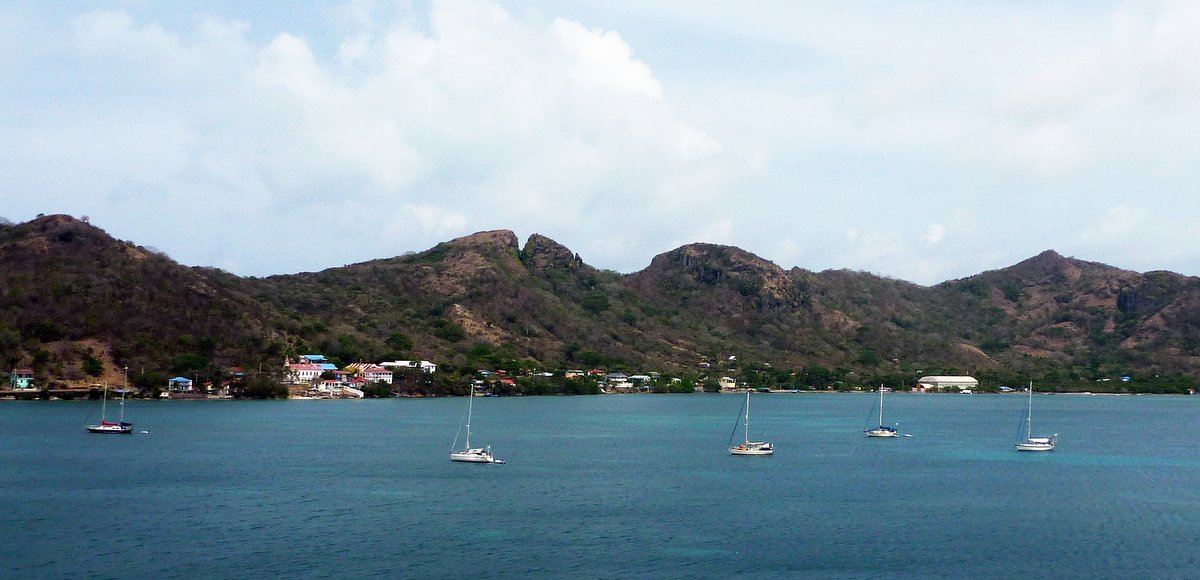
We managed to drag ourselves out of bed before nine o’clock, which was a miracle. It was exciting to see Providencia in daylight, which is surprisingly hilly. The harbour is very quiet. There are five other yachts at anchor, a naval frigate on the town dock and various pirogues dotted along the shore line. Ashore there are no large hotels or any buildings higher than two stories and it looks very laid back. It reminds me of Bequia – or rather how Bequia would have been 100 years ago without all the buildings that now sprawl around Port Elizabeth.
After breakfast, we dropped the dinghy in the water and, as I was connecting the fuel pipe, a dinghy whizzed past. I attracted their attention and Tony and Gail from “Cetacea” came over to say hello. We asked them the normal questions that need answering when we arrive in an anchorage: Where do we clear in? Where can we dock our dinghy? Where’s the Bank? Is there someone who does laundry? Where can we get Internet access?
I assembled our clearance paperwork and printed out a few more copies of our crew list, before jumping into the dinghy and heading ashore. On the way we called in at “Lonely Planet” and introduced ourselves to Wim & Matilade who are from Holland. They supplied us with some more local information.
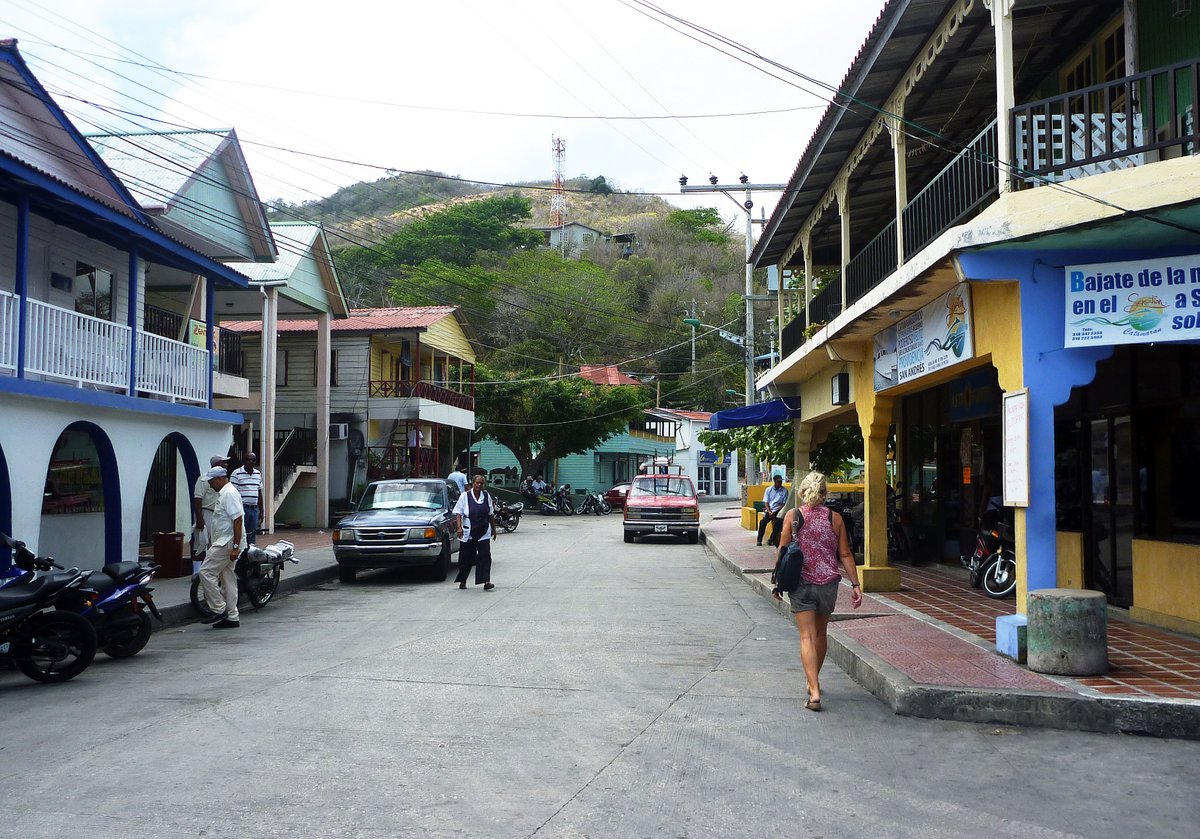
There’s a good dinghy dock next to the town dock and we’ve been told that there’s zero crime in Providencia, so we didn’t bother to lock it up as we normally would. We wandered through the sleepy little place heading for the office of Mr Bush, who is the only clearance agent on the island. As we turned the corner (at the only junction in town) a guy approached us, with a plastic carrier bag full of hot food. After the constant hassle in Jamaica, my immediate reaction was “Here we go”, but the guy turned out to be Mr Bush – we obviously stand-out and look like yachties.
Mr Bush took us to his office, which is in the living room in his house and we soon had the paperwork sorted out. He took our passports and asked me to sign a few blank forms, then told us to come back tomorrow to collect our passports. It’s going to cost us $140US to clear in, so it’ll be an expensive two week stay.
After a couple of attempts, we managed to get some cash out of an ATM – the exchange rate is roughly 2,000 pesos to $1US, so there’s going to be some serious mental arithmetic going on when we buy things. We had a quick wander around the small town and ended up in a restaurant on Santa Catalina, which is a small island connected to the "main land" by a floating pedestrian-only footbridge.
The restaurant had six tables covered with grubby, plastic table cloths and a white board showing the available five dishes. No prices in sight, but there were some locals eating in there which is always a good sign. The meal was ordinary, but filling – chicken soup to start, then meat, rice and plantains. The soup was very tasty, but had some dubious hard bits in the bottom – possibly pieces of the chicken necks and feet? It cost us 38,000 pesos for two meals including four beers, which was good value.
We had a little trouble ordering the beer in our broken Spanish. Most of the locals speak English, but not the lady who served us. She told us the names of the three beers that she had “Meeya, Omiwahkey, Enacan”. We asked her to repeat, but still didn’t get it. Glenys then spotted someone drinking a bottle of Miller MGD, so we pointed and had a couple of those. This was the “Meeya” – the Spanish pronounce the double “L” as a “Y”.
After we’d supped the Miller, I wanted to try one of the other local Colombian beers, so we asked the names of the beers again.
“Meeya, Omiwahkey, Eenacan”, she rattles off.
“Hmmm, what’s the second one again?”
“Omiwahkey”. Blank looks from us – say again?
“O – mi – wah – key”, she says slowly.
The penny drops. Glenys says, “It’s Old Milwaukee”. It’s another American beer, not some local Colombian brew.
One mystery solved, I ask for the name of the third beer.
“Ee – na - can”, she spells out.
Nope. Don’t understand. A lady on the next table come to our rescue and tells us that it’s Heineken. Disappointed, we ordered two more Meeyas.
We wandered back to the dinghy (which was still there) and pottered out to the boat. The remainder of the afternoon was spent chilling out, dozing and playing the guitar before Tony and Gail from “Cetacea” came for a couple of beers. They’re also heading down to Panama and then through the canal in October/November, so we’ll probably see them along the way.
14 May 2013 Providencia, Colombia
We tried to get someone to do our laundry. There's a lady called Barbara on Santa Catalina who does washing, but it turns out that she's gone to hospital on San Andreas and no-one else seems to want to do it because there's a water shortage the island.
We went to see Mr Bush and collected our passports. He printed out another form, asked me to sign it and told me that our tourist visas would be ready within a week. I asked him if we would get some paperwork to show that we've cleared in and after a bit of searching he gave me a scratty bit of paper that seems to be a duplicate of a form from the port captain. It’ll have to do I suppose.
We met a few more cruisers while we walked around town. The species is very obvious to spot - well suntanned, wearing scruffy, well-worn clothes. We called in at the tourist office and the very enthusiastic staff gave us all sorts of goodies including a 200 page cruising guide to Colombia which is very detailed and has charts for all of the Colombian coast.
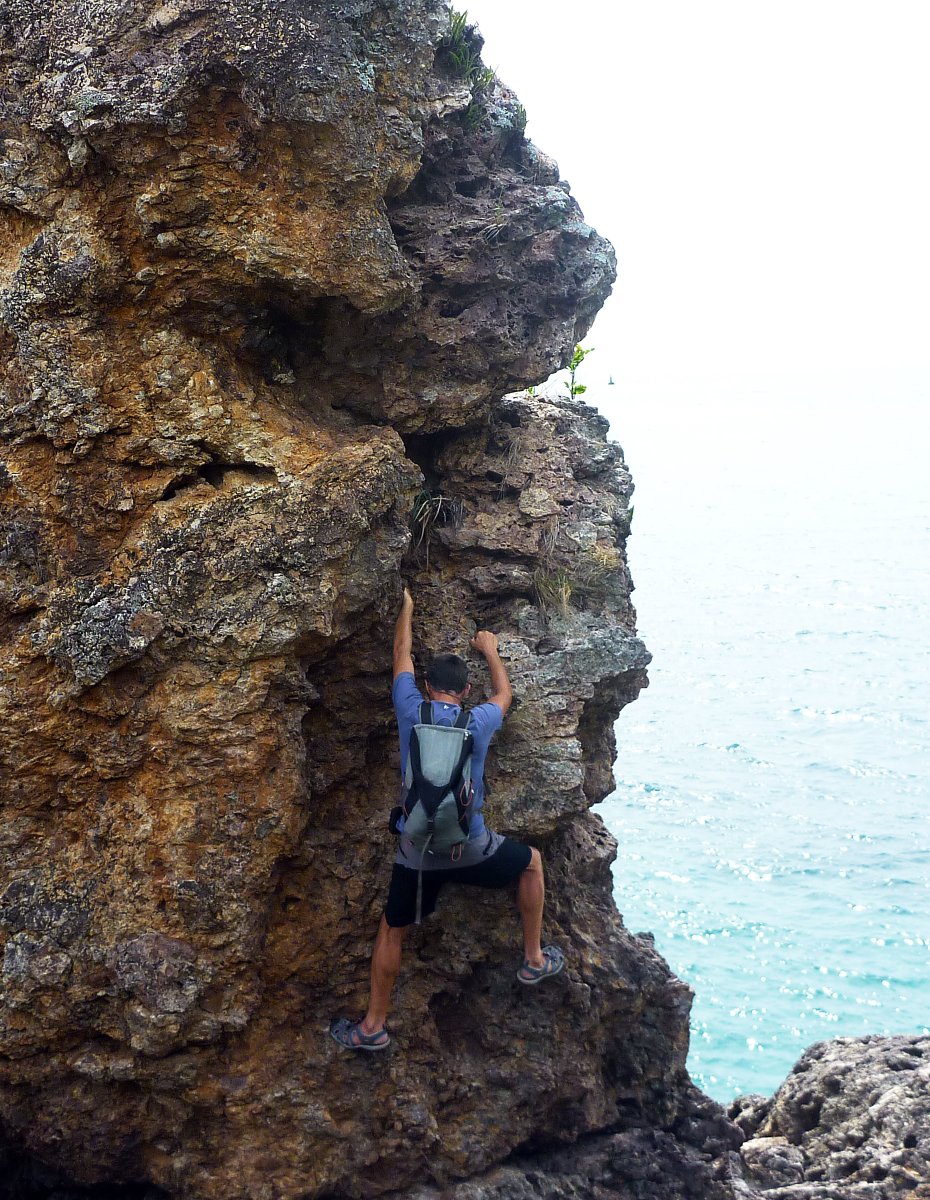
This is an interesting little island - from the tourist office we learned that:
The English colonised Providencia (and San Andreas, its larger sister island) around 1630 and brought in black slaves from Jamaica to cultivate tobacco and cotton. Because of their strategic location, the islands provided convenient shelter for pirates waiting to sack Spanish galleons bound for home laden with gold and riches. In 1670, the legendary pirate Henry Morgan established his base on Providencia and from here he raided both Panama and Santa Marta. It is said that his treasures are still hidden on the island (most Caribbean islands claim this…)
Shortly after Colombia achieved independence in 1810, it laid claim to the islands, although Nicaragua (only 150 miles away) fiercely disputed its right to do so. The issue was eventually settled by a treaty in 1928, which confirmed Colombia’s sovereignty over the islands. Nicaragua continues to press the issue of its sovereignty at the International Court of Justice in the Hague. The court reaffirmed Colombia’s sovereignty over the main islands in 2007, but has recently given some of the off lying atolls to Nicaragua. Tensions remain high and there is a military presence on the island and a naval frigate patrolling the surrounding seas.
In the early 1990s, the local government introduced restrictions on migration to the islands in order to slow the rampant influx of people and preserve the local culture and identity. The majority of the 5000 people live close to the main town of Isabella, with all the Island’s supplies come from the sister island of San Andres, 72km to the south.
All around the island there are signs that read, “Old Providence, Not Oil Providence” and “They Didn’t Ask What We Want.” They refers to the dispute between Colombia and Nicaragua and the locals want to stop any drilling for oil which has been found on one of the local cays.
After lunch, we went for a snorkel by Morgan’s head, which is a prominent round rocky outcrop on a headland. The snorkelling was pretty good, but there aren’t as many fish as I would have expected. Wim & Matilade from “Lonely Planet” came for sun-downers. They’ve been here for six weeks waiting for parts because one of their shrouds had started to unravel. They're desperate to get out of here and head north to the Rio Dulce.