
15 July 2015 Panasia, Papua New Guinea
It was a lovely day with blue skies and light winds, so we were doing pirouettes in the anchorage as the wind swirled around us. For breakfast, Glenys started to prepare fried Bush Fowl egg, but when she opened it, the egg contained a partly grown chick. Bush Fowl eggs are buried in the ground and the chicks emerge from the egg with all of their black feathers already grown, so the inside of this egg was horrible and went overboard very quickly - we had normal hen’s eggs for breakfast.
I started to get the dinghy into the water and, half way through, we were visited by three kids who had walked over the island from the village on the south shore. They brought some things to trade - papaya, coconut and a small pumpkin. We didn’t really need any of it, but Glenys took them anyway, giving them some clothes, exercise books and pens. They hung around watching me putting the outboard on the dinghy, so I took them out for a joy ride, which they loved - I’ll probably have a queue of kids around tomorrow wanting a go.
We dinghied out to Nasakoli Island, which is about 1½ miles across the lagoon. It’s a small deserted island with a beautiful white sand beach, which is good for shelling. When we arrived we found Frank sitting on the shore - he’d been out on the reef looking for lobster for us and had come to the island for a rest. We told him that John had delivered four lobster last night and we only needed two lobster from him, which he accepted with grace. He then walked around the beach with us, helping Glenys to look for shells.

Frank is a lovely bloke, but his smile is a bit scary because he’s a long term user of Betel-nut and his teeth are stained red. Everyone around here seems to chew this mild stimulant - I guess that it’s a habit like smoking. Here’s some information that I've gleened from various sources:
Betel-nut, the Areca Catechu seed, is used by virtually every adult in PNG as a pick-me-up during the day and the nuts take up half of the selling space in every market throughout PNG. Long term chewers get badly stained teeth - first red then black. The mild stimulant is brought about by the reaction of the Betel-nut, a Mustard Leaf and Lime Powder - and it tastes awful. Nuts can vary in potency and a strong one might cause you to sweat and want to lie down for a few minutes.
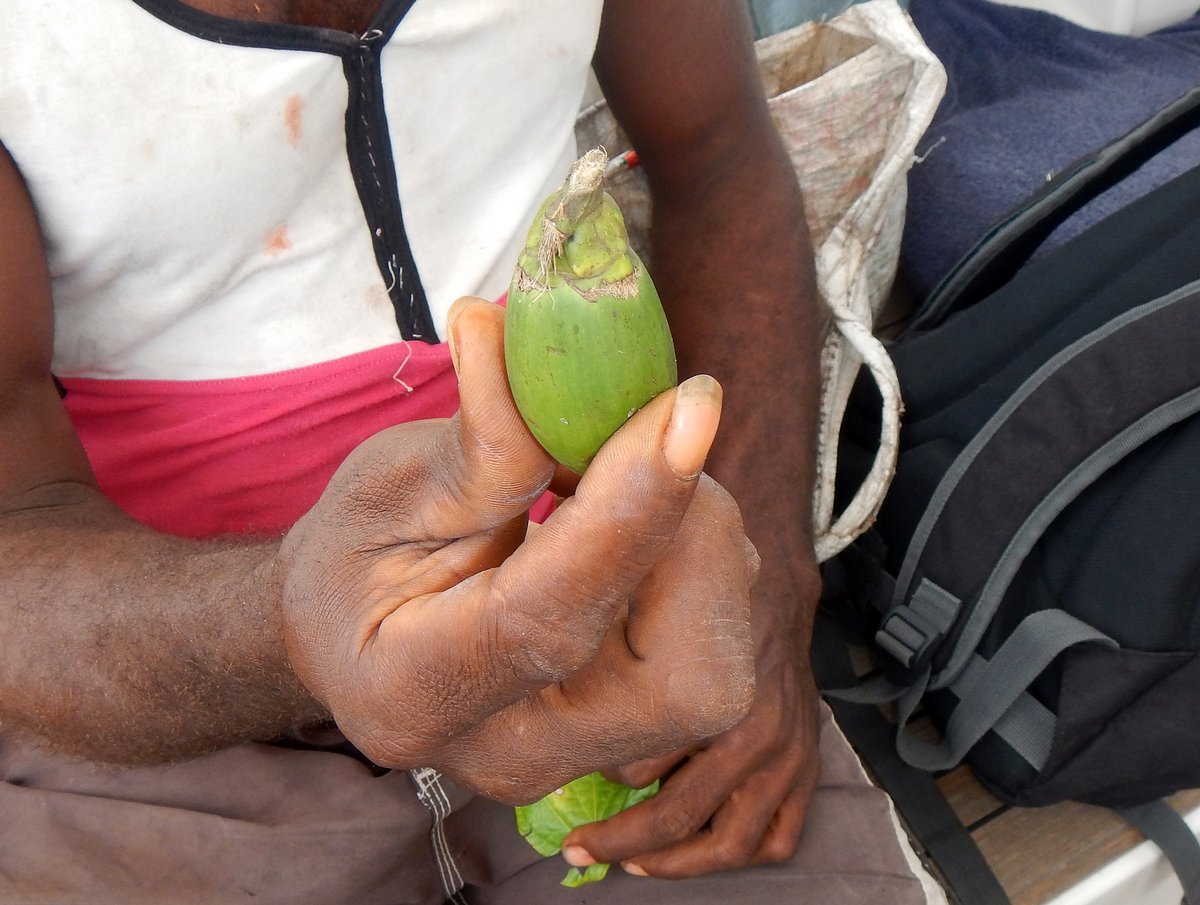
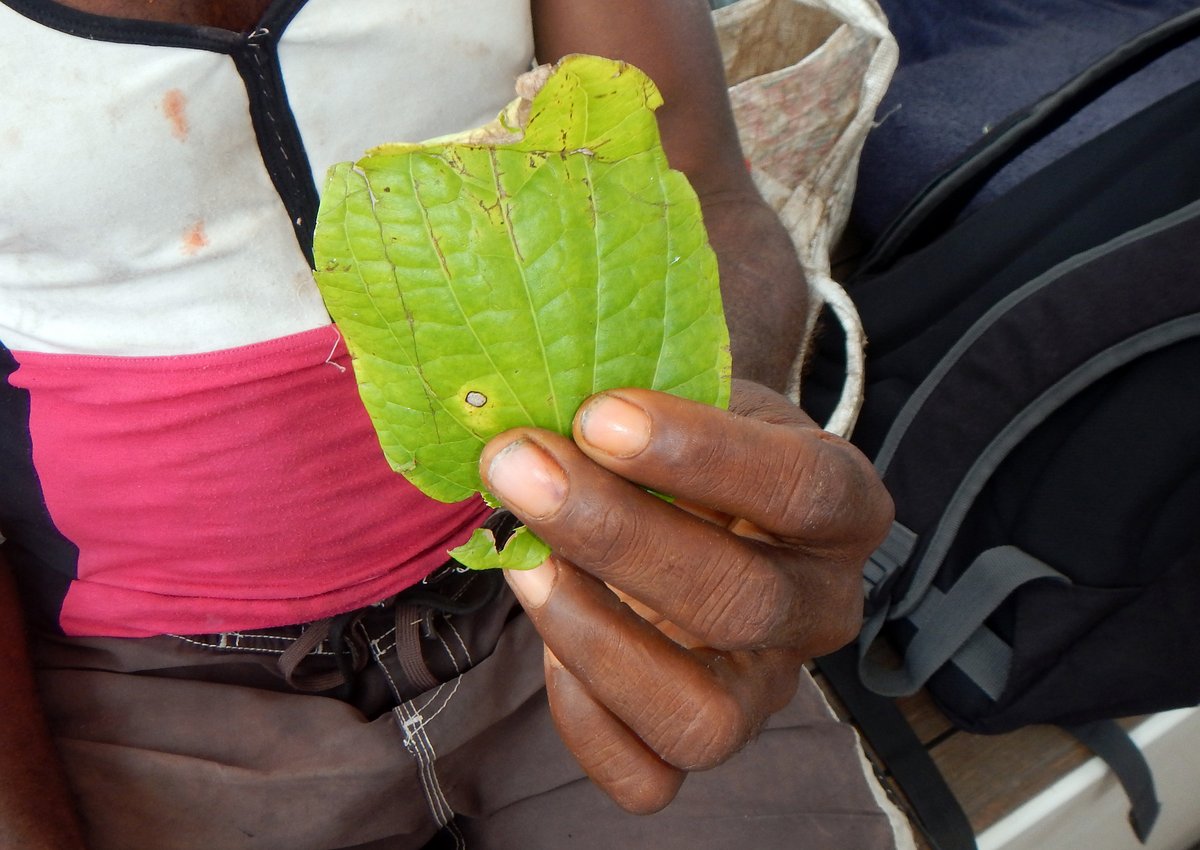

The lime powder is made from heating coral in a fire. It is also known as quicklime and is a caustic alkaline chemical called calcium oxide. When mixed with water (e.g. saliva), this turns into Calcium Hydroxide and is used in traditional building methods to make plaster, mortar and lime-wash (paint). Not surprisingly, this highly caustic powder causes damage to teeth, ulcerated cheeks and mouth cancers.
To partake, first take the husked nut between your back teeth and crack it near the stem. Prise it open with your finger, pluck out the kernel and chew it in your mouth to one side. You’ll suddenly be producing large amounts of colourless saliva - don’t swallow as you can get a bit nauseated, so find somewhere where you can spit.
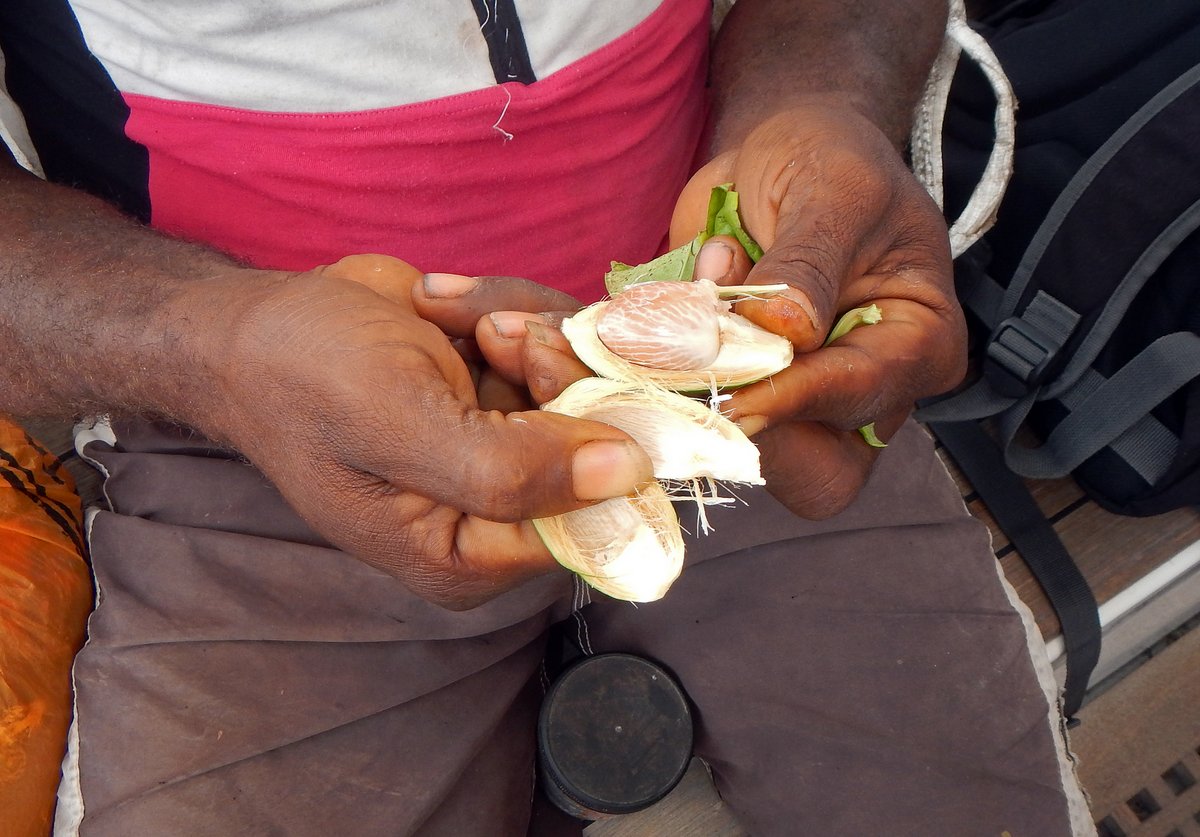
Next moisten one end of a rolled mustard leaf in your mouth and dip it into the lime powder so that a few millimetres are frosted with the lime. Bite off the Frosted Mustard Leaf in the back of your mouth, chew it all together and spit. Repeat, chew and spit.

This is when your projectiles will turn a vivid red and, with luck, you’ll feel the “rush” come on. It can sometimes be a little head-spin or it can be stronger - the effect will depend on your technique and you might be disappointed with your first try. Watch how others do it.
Seeing a foreigner eating Betel-nut “kaikai buai” will bring broad smiles across the faces of local people and you’ll immediately make friends. Be warned, however, that until you are practised, you’ll almost certainly make a mess as the voluminous red spit escapes your mouth, runs down your chin and ruins your favourite t-shirt.
I think that I’ll give this one a miss, but it's intriguing - who on earth thought of this combination? I imagine two guys meeting a few hundred years ago:
“Hey, you know that nut that you found the other day?”
“Yeah, tasted bloody awful and made us spit a lot.”
“Well, give it a try with some mustard leaf…”
“Wow man, that’s not too bad. Perhaps if we burnt some coral in a fire and ate the caustic white powder, it would turn our spit bright red and give us a mild hallucinogenic hit…”
On the way back to the boat, we stopped off to do some snorkelling, which was okay, but the water is still a little murky even in the middle of the lagoon.
Just after we’d got back to the boat, Frank paddled up with two lobsters for us, plus a couple of Nautilus shells - Glenys has been hankering after one of these for a year now, but refused to buy one from a tourist shop. He also brought us some more papaya and a yam. Frank said that one of the papayas was gathered by his son Michael, who wants a wind-up torch - it sounds like word has spread rapidly. We traded him a torch for his papaya, some fishing line and hooks for the lobster and a chopping board and knife for the other vegetables.

Glenys beavered away in the galley in the afternoon, making bread, cooking the two lobster and making Lobster Pizza for dinner. I went out and tried snorkelling in a different place, closer to the channel through the reef and found that it was more a interesting reef, but still had lots of sediment in the water.
Back at the boat, I checked the anchor and found that the chain had wrapped itself around a coral head. The two sets of fenders had then got tangled together and twisted around the chain as we spun around in the light winds. What a mess. I eventually had to cut one set of fenders away; dive down 12 metres to unhook the chain from the coral head and then pull up some anchor chain to re-attach the fenders.
John paddled over later in the afternoon, bringing his son and a nephew, plus half a dozen more Nautilus shells. Apparently, they are fairly common here and the guys find them floating on the surface of the sea as they paddle around. Glenys just HAD to have another two, so she’s now the proud owner of four Nautilus shells.
We dragged out some clothes so that John could choose something for the shells and he sorted through it, but couldn't make up his mind. He liked the look of three pairs of men’s shorts, a cutting board, a bag and a hat, but needed to choose which one. He was like the old analogy of the monkey with its fist in the cookie jar - he wanted it all, but couldn't get it.
As we chatted, John said that he wants to make us a wooden plaque with Alba carved on it and we asked for some bananas and green beans, so it was a perfect way for him to take the items that he wanted, without it looking unfair. We've arranged to scramble over to the village on the other side of the island tomorrow as long as the weather is fine and he’ll probably come with us.
16 July 2015 Panasia, Papua New Guinea
We had a restless night with huge gusts of wind hammering at our bimini and rain panels. The morning brought dark overcast skies and rain showers, so we hunkered down below.
Just as we were about to have lunch (Lobster sandwiches, of course), a couple of guys paddled up in their canoe. Sam is the pastor of Small Panasia and the brother-in-law of John; his friend was called Graham. We were more interested in having lunch than talking to the locals, so we chatted to them for a few minutes with them staying in their canoe. Eventually, Sam said that they’d come over to share a few stories, so we invited them on board and Glenys made some more sandwiches.

We chatted for a while and then Sam produced a necklace (which he’d got from his wife, presumably after hearing from Frank that Glenys was interested in local jewellery). This was made from Bagi - a type of red shell, which is highly prized in Papua New Guinea. In the past, there was a method of ceremonial trade between neighbouring islands where Bagi necklaces were used as a form of currency. In these ceremonies, prized gifts were exchanged as well as any surplus vegetables and fish. The necklace is made from 4mm diameter disks of Bagi shell, which have been hand filed and drilled to make beads. There are about 200 Bagi disks on this necklace, which is a lot of work.
Having shown us the necklace and Glenys saying that she would like it, the conversation turned to what would Sam like for it. After a moment’s thought, he said that he’d like my guitar, which he’d spotted hanging on the wall of our saloon. In your dreams! I explained that sorry, my guitar was not for trading. With a look of desperation, Sam kept saying things like it would be very good for his church to have a guitar and I kept saying no. I eventually told him that I would trade my wife, but not my guitar and that seemed to make the point…
Sam was then faced with the dilemma of what he wanted for the necklace. I brought out some bags of clothes and other things and he started to accumulate quite a pile until Glenys told him that he had to choose a few of the things not all of them. Ten minutes later, we had a deal for a small rucksack, a bolt of material, some thread and needles, some clothes, a bit of kitchenware and, of course, a wind-up torch.
Having agreed everything, we turned to Graham, who had brought some snake beans and a big bunch of cooking bananas. He managed to get away with more clothes and kitchenware, but no, we didn't have any more wind-up torches... I told them both to tell everyone that we had no more torches left.

Sam came here from Misima about fifteen years ago, specifically to dive for Sea Cucumbers, which the local people used to sell to Korea, where they are known as Beche de Mer. The locals don’t eat them, but were happy to gather them, dry them over a fire and export them. Unfortunately, the harvesting was too intense and the Papua New Guinea government stopped the collection of sea cucumbers seven years ago. Sam is waiting to be allowed to start again because it was a very useful source of hard cash.

We had a discussion about Betel-nut and both Sam and Graham said that they know that they should stop chewing it because it is ruining their teeth, but they can't live without it now. They chew about 20 Betel-nuts per day and also smoke a cigarette after every chew - a double addiction.
They were both carrying small bags, which contained their supply of Betel-nut and they showed us how to chew. (They promised not to spit red gloop on our boat.) At about one inch long, the nut kernels are surprisingly large. Sam showed us how they roll the mustard leaf and dip it in the lime powder - they consume quite a lot of the caustic quicklime and with 20 chews a day, I'm not surprised that they are ruining their teeth. I told them that they couldn't smoke on our boat, so they soon left with the urge to smoke a cigarette preying on their minds.
Twenty minutes after they left, Robinson (Frank's nephew) paddled up on Frank’s surf kayak. He’d brought some cooking bananas all the way from Small Panasia. We invited him on board for a chat and he said that the bananas were from his Bo-bo (elderly relative). He looked disappointed when Glenys told him that she didn't need any more bananas. I asked him what his Bo-bo would have wanted and, quick as a flash, he said … a wind-up torch. Like yeah, this old lady wants a wind-up torch. He looked crest-fallen when we said that we didn't have any more.
After fifteen minutes, we managed to politely evict Robinson, with a small gift of a t-shirt as compensation for our terrible lack of torches and thankfully returned to our own little world.
17 July 2015 Panasia, Papua New Guinea
We woke to strong gusts of wind and driving rain - a really horrible day. The forecast for tomorrow looks better, so we’re planning to leave and sail onto Port Moresby in the morning. It’s 365 miles, so we’re expecting to arrive there on Tuesday 21st, which hopefully, will give us time to get our Indonesian visas and leave before the end of next week - we need to be getting a move on to Indonesia.

In the evenings, I’ve been chatting to Karen on “Red Herring” using our SSB radio, but my transmission signal is very weak. I went through all of the connections for the antenna and the earth, which look okay as far as I can see and then I found that our antenna tuner was not operating.
After tracing all the wiring, I found a fault in the wire supplying the 12V power to the tuner. I crimped the wire and now I'm booming out a strong signal. In fact, the transmission signal is so powerful that all the LEDS on our switch panel flash when I speak. This can’t be good for our electrical systems, so I need to talk to a keen radio ham and find out what’s going on.
The skies brightened up a little in the afternoon, so went ashore to John’s house. We chatted to him for a while and then went for a walk along the shore line, looking for shells.
Back on the boat, we got ourselves ready for sea, tidying up and putting the dinghy on deck. John called by late in the afternoon and brought us a carving that he’s made for us for, a piece of Creosote wood. We've had a very interesting time here and the people have been very friendly - we wish that we could have stayed for longer than a few days.
18 July 2015 Panasia to Port Moresby, Papua New Guinea (Day 1)
The weather was much brighter this morning, but the skies were still overcast. The anchor came up without any problems, so the fenders on the chain did their job well. The light was poor but, we found a way through the reef and out into 2 metre waves and 25 knot winds - quite a shock after the relative calm of the anchorage.
Our route to the pass next to Uruba Reef was very hard on the wind, so we motor-sailed for three hours, only achieving 4 knots because we were constantly stopped by the large head-on waves. We cleared the pass by half past eleven and were finally able to ease the sheets a little. But it was still tough for a few hours because the wind was 25 knots at 60 degrees off our port bow.

As the afternoon progressed, the wind settled down to 15-20 knots and backed, so by sunset we were on a pleasant broad reach doing 6-7 knots. To get to Port Moresby, we’re following the south coast of Papua New Guinea, aiming to stay 20 miles offshore and, for some of the night, we picked up a favourable ½ - 1 knot current, which is pushing us along nicely. We have to sail 365 miles and if we get lucky with the current, and average 6.5 knots, then we might be able to make it with just 2 nights sailing.
Apart from dodging a few ships, the night was pleasant, but very, very dark with no moon - at least we’ll have a new moon when we do the next leg, after staying in Port Moresby for a few days.
19 July 2015 Panasia to Port Moresby, Papua New Guinea (Day 2)
There wasn't really a sunrise, just a gradual lessening of the darkness to give us a very grey morning with overcast skies. After I’d uploaded our passage blog posting and downloaded the weather, Glenys went to bed and left me to cope with the squalls that caught us up every hour - in some the wind picked up from 20 knots to 30 knots with heavy rain and others just gave us rain.
It cleared up in the afternoon, but the wind picked up a little to 20-25 knots and we had 3 metre waves making it a boisterous ride.
There’s quite a lot of shipping that is following our route, so we've been monitoring the AIS, which certainly makes our lives easier. Without AIS, when we spotted a ship, we’d have to figure out whether it was a danger to us. With AIS, we look on our chart plotter and it tells us the name of the ship, course, speed and Closest Point of Approach (CPA). If we’re not happy, we can call the ship up by name and discuss a plan of action.
Just before dark, I rigged up our spinnaker pole to port in anticipation of turning more downwind as we follow the coast line. It was a wild night. The wind wasn't too bad at 25-30 knots, but the waves were large and steep making the boat slew around and surf up to 10 knots. It was hard to relax when on-watch and very hard to sleep when off-watch.
20 July 2015 Panasia to Port Moresby, Papua New Guinea (Day 3)
Dawn was a little brighter than yesterday and the sun poked its head through the clouds occasionally during the morning. By eight o’clock, we’d done 170 miles in 24 hours - our best run ever. We only had 45 miles to go, so we looked forward to getting to Port Moresby in the late afternoon.
The wind continued at 20-25 knots from the SSE. We gybed the main as we turned the corner following the coast and then continued on a fast broad reach on starboard tack. We had a good angle to sail through Basilisk Passage and, once inside the barrier reef, had a lovely sail into Port Moresby in calm seas.

We arrived at the Royal Papuan Yacht Club Marina in the early afternoon and, as instructed, anchored behind their breakwater (which they call The Pond). The charts show a depth of 1.1 metres on the approach to the marina, but we saw nothing less than 4 metres. We weren't too happy about the holding in the Pond because we dragged the first time having picked up some plastic sheeting with our anchor, but other cruisers have been fine there.
The marina office arranged for customs, immigration and quarantine to come out to the boat, so we had our formalities completed and were safely docked in a marina berth within two hours. The only fees were $20USD for the animal and vegetable quarantine and $50USD for health quarantine.
After a little bit of tidying up, we strolled into the yacht club, which is huge. It's more like a country club for rich Papuans and ex-pats (3,000 members) with a nice restaurant, a huge bar and even a big gym. We used one of the two ATM machines to get some kina and retired to the bar for a cold beer or three.
At the marina office's suggestion, we called in at a big 50 foot power-catamaran called “Utopia” and talked to a guy called Brian. He turned out to be a 73 year old, white Papua New Guinean and an ex-cruiser having sailed 40,000 miles on his ketch “Duck Soup”. After plying us with wine, cheese and stories, Brian offered to get his driver to take us to the Indonesian Embassy tomorrow, which we gratefully accepted.
21 July 2015 Port Moresby, Papua New Guinea
Brian drove us to his company, which is the largest estate agent in Papua New Guinea, employing over 50 people - a wealthy man. From the office, we were driven around by Paul, one of Brian’s five sons, accompanied by Steve, who sailed with Brian and now looks after his boats.

Steve wanted to go to a vegetable market, so we accompanied him walking around the closely packed stalls. There are hundreds of thousands of people living in Port Moresby with over 80% unemployment, so there are a lot of people living in poverty and the city has a very bad reputation for hold-ups and theft. We're always very careful about our belongings when in local markets and we were especially careful here, but I didn't notice two rascals following us.
As we were the only white people (Dim dims) in the market, everyone was looking at us, so it was hard to for us to notice these two guys. However, the market stall holders spotted them and suddenly one stall holder leapt up and gave one of the rascals a huge slap around the head and started to scream at him. Within seconds, the rascal had twenty people haranguing him and he was chased out of the market. The stall holders all apologised to us, which was nice.
Paul then took us to a large computer store to buy a couple of things. On the way there we passed hundreds of people sitting on the sidewalks, in the dirt, with small selections of things for sale - limes, betel-nut, a few cigarettes. What a difference at the store, there were guards on the gate into the car park, guards on the door, guards inside the store. The store was huge with wall-to-wall high tech equipment, marble floors and air conditioning. There's an incredible difference in wealth here.
We were taken to the Indonesian Embassy, were we filled in a very straight-forward visa application form. We applied for a 60 day Social visa (211/60), which we can extend for another 30 days when we're in Indonesia. For each application, they wanted one photograph, one copy of a sponsorship letter, one copy of our Cruising permit (CAIT) and 120 kina ($40USD).
We told the visa officer that we wanted to leave Port Moresby on Friday 24th July. Thursday is a public holiday, so the guy said that he'd process it quickly for us and we could go back the next day.

Back at the boat, we had a couple of hours chilling out and sorting out emails then walked up a large supermarket, which is 10 minutes outside the secure fence of the Yacht club. It's bizarre to walk out of the decadent luxury of the Yacht Club onto the streets where the locals are trying to sell stuff or waiting for a bus and chewing betel-nut. There are betel-nut husks scattered around everywhere and the white concrete pavements are covered in blobs of bright red spit - it's disgusting.
The government is trying to stop the habit and has made it illegal to chew and spit in public places within the city limits. There are signs on the shops and gates into private businesses - "No chewing betel-nut", but the poor locals just ignore it all. I guess that it's as addictive as smoking, so will be difficult to stop. Brian hates the habit and forces his employees to brush their teeth on arrival at his office.
In the evening, we retired to the luxurious Yacht Club bar and had a few beers with Rob and Irene from “Peggy West”. They are also heading off to Indonesia to join the Sail Indonesia rally.