
21 April 2017 Thinadhoo to Fulangi Reef, North Huvadhoo Atoll
The anchorage in Thinadhoo is good, but it’s hot and we’re unable to swim, so we pulled up our anchor and headed back north to investigate a couple of anchorages that looked good on Google Earth.

We first dropped the anchor at 00°35.00N 073°03.14E in 18 metres between coral patches. It looked like a nice spot, but was exposed to the south and the 10 knot south winds were kicking up some wind waves. We decided that if the wind increased, it would be uncomfortable, so we ran away.
An hour later, we slowly edged our way between a couple of shallow reefs (at 00°37.215N 073°06.346E) and dropped the anchor at 00°37.26N 073°06.28E in a small 80 metre diameter patch of sand close to the protecting reef. I’m calling this Fulangi Reef - it’s a fabulous spot, totally surrounded by reef and good holding in sand in 12 metres depth. We dropped the anchor closer to the south reef and then placed another anchor slightly behind us to the north, just in case the wind backs to the north in a squall.
As usual, we were soon off snorkelling and tried a couple of places. The reef to the south-east of the was unimpressive, with lots of silt on the dead coral. We then went to the west of the anchorage and anchored on the inside of the reef, where we found that we could just swim over the reef into the channel, which was much more interesting.
We spotted a turtle and two octopuses who were in neighbouring holes. As we dived down, they rapidly changed colours and shrank down into their holes. I’m guessing that they were mates because one kept sneaking a tentacle over to touch the other one, which was cute.
22 April 2017 Fulangi Reef, North Huvadhoo Atoll
In these light south winds, this is a beautiful anchorage, so we stayed another day. In the morning, we went snorkelling in the pass at 00°37.34N 073°05.82E. At less than 20 metres, the whole pass is quite shallow and the water was so clear that we could see over to the other side of the channel. Fortunately, we arrived at slack water (just before high water) - I would think that the current is wicked in full flood.
The coral was mostly dead, but there were thousands of parrotfish gathered together for spawning. This was a spectacular event, with dozens of males rushing about following a female, who would shoot vertically towards the surface and then dart back down. At the top of this very fast dash, a cloud of eggs and sperm is released. We watched them for an hour and the water slowly became more and more cloudy as presumably millions of eggs were released. Unfortunately, the dashing about was just too fast for me to capture on camera.
This spawning event hadn’t gone unnoticed by other fish and there were large black snappers swimming around gulping in the cloudy water, obviously enjoying a treat of caviar. Meanwhile, a few Blacktip Reef Sharks were cruising about and large groupers were lurking, both waiting for an unwary parrotfish.
In the afternoon, we went out to a Thila (pinnacle) about a mile east of the anchorage at 00°37.33N 073°07.25E. The coral was in better condition than other places with about 30% alive and the water was fairly clear despite being in the atoll. In the shallows on the east side, there were scores of anemones loaded with Maldive Anemonefish. The west side had a steep slope and some interesting fish.
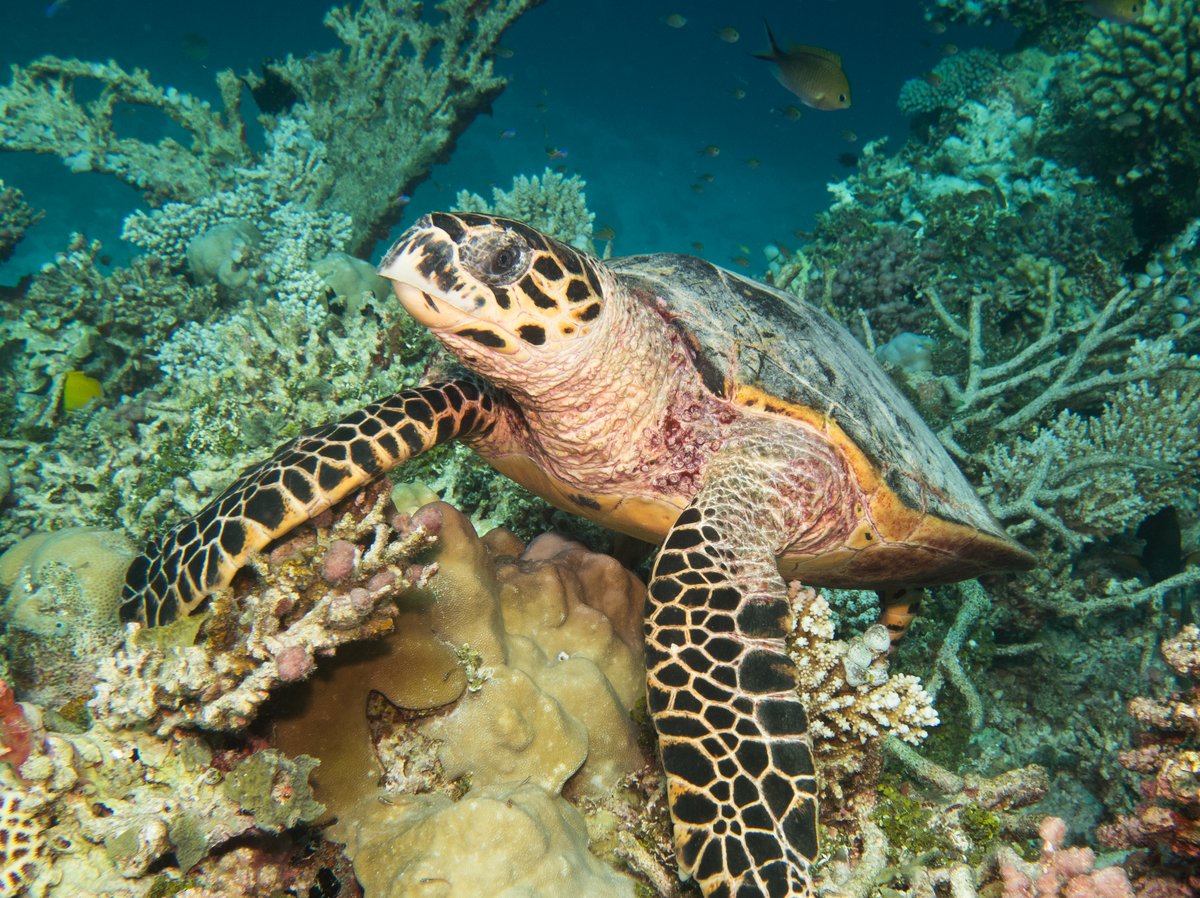
We came across a very friendly Hawksbill Turtle resting on the coral at about ten metres, who seemed unconcerned when we dived down close to it. I must have approached within one metre with my camera and took some good pictures. After we had dived down a couple of times, it swam up to the surface for some air and then went back to a nearby spot, so we let it in peace.
23 April 2017 Fulangi Reef to Boduhuttaa, South Huvadhoo Atoll
We’re now 100 miles north of Gan, which is the southern-most point of the Maldives and is the port where we’ll clear out. For the past few days, I’ve been monitoring the weather forecasts looking for a possible weather window to sail from Gan to Chagos, which is a 300 mile passage - two or three nights.
There are two main forecasting models - GFS and ECMWF, which unfortunately show completely different winds on the route for the next two weeks. GFS shows a constant 10 knot west wind from 26th to 29th April, whereas ECMWF shows light, variable winds for the same period. Both models show light to variable winds for the second week. The problem seems to be that Gan and Chagos are just south of the Equator and under the influence of the Inter Tropical Convergence Zone (ITCZ). This is an area of unsettled weather about 300 miles wide, which is very difficult to predict and is subject to squalls and zones of no wind.

Using GFS GRIBS and my qtVlm routing software, I think that the 27th April might be a good day to depart for Chagos, but the GRIB forecasts are normally only reliable for a three day forecast, so I need to wait a couple of days to see if the west winds form as predicted. This leaves us with a dilemma because we are still 100 miles from Gan and have to give two days’ notice to get our clearance papers. Also we need to provision and get diesel. So with all this in mind, we decided to leave the beautiful Fulangi Reef anchorage and head south, probably sailing/motoring to Gan tomorrow.
The 25 miles trip down to Boduhuttaa was a boring motor in nil wind conditions and a glassy calm sea. We anchored at 00°11.91N 073°12.85E in 4.5 metres on sand. The sandy shelf is about 80 metres wide and shallows very slowly - it’s a nice spot, with three small, deserted islands in front of us.
We both spent an hour cleaning the hull in the afternoon. There was a lot of green slime and hundreds of small barnacles, which we knocked off. I cleaned the propeller which only had green slime. The Jotun Seaforce 90 antifoul paint has only been on for four months, so it’s a bit annoying to have barnacles already.
I re-checked the weather forecast in the evening and the weather window still looks good on the 27th April, so we’re going to go down to Gan tomorrow and will make a final decision on our departure date tomorrow evening. It takes a few days to get a revised Cruising Permit for Chagos, so I’ve sent off a request to BIOT to get our dates changed to start on the 29th April - I can always change it again if we leave later.
24 April 2017 Boduhuttaa to Gan, Addoo Atoll
The alarm went off at 05:00 and we pulled up the anchor before the sun came over the horizon. We motored out of the south pass and into a long, smooth swell coming from the south-east, which was causing impressive waves to break on the reef either side of the pass. The wind was from the south -west, so it was 20-30 degrees off our starboard bow and meant that we had to motor-sail, but it was a light 5-8 knot wind with no big waves to stop us.
Around 08:00, we crossed the Equator for the third time on our circumnavigation. There are longstanding traditions and ceremonies to thank the god Poseidon and to wish for luck. In the past we’ve shared a tot of alcohol with Poseidon, but being so early in the morning, we had simple ceremony involving a glass of orange juice and a biscuit. We’re now in the southern hemisphere again.

We had a very uneventful ten hour trip, and arrived at Gan at four o’clock. Most of the other rally boats are already here, so there was no room in the small, shallow harbour next to the causeway. We spent 15 minutes, looking for some where to anchor, but it’s all incredibly deep. Eric on “Hokulea” suggested that we anchor next to them on a sandy spit at the entrance to the small harbour. We had two attempts at anchoring in 17 metres, but dragged both times.
Finally, we anchored at 00°41.06S 073°08.77E in 10 metres depth and the anchor bit well. We’re not in an ideal position, being very close to “Hokulea” and in the entrance channel to the small harbour, but there’s not much else we can do other than anchoring in 30 metres, which is a serious challenge because we only have 60 metres of chain.
In the evening, we went to the Equator Resort, which serves cold beer at $4US for a large can - luxury! We tied our dinghy up to the iron ladders next to the Coast Guard dock in the small boat harbour and then walked a few hundred metres to the resort entrance. We had to sign in as guests at the gate, but everyone was very friendly.
Most of the other cruisers were at the bar, so it was good to catch-up with everyone. Three of the boats are trying to get outward clearance and sail to Chagos, but there have been some problems and, after waiting for 5 days, they still haven’t been cleared out.
Many people have paid money to the rally for their clearance, but the rally organisers haven't paid the relevant government fees, so people have been waiting a long time to leave. There's now a worry that the rally organisers have spent all the money on something else and can't afford to pay the fees. I’ve been dealing directly with the agents and haven't paid anything to the rally, so I'm hoping that we'll get away quickly.
25 April 2017 Gan, Addoo Atoll
I checked the weather forecast and found that the two models (GFS and ECMWF) still don’t agree, but the GFS Model shows 10 knot west winds on the 27th and the ECMWF shows light, variable winds, so we’ve decided to clear out and leave on the 27th. At worst, we’ll have to motor the 280 miles to Chagos.

After breakfast, we tied the dinghy up to the Coast Guard dock and walked a kilometre into town. Gan is a small town, but there are several small supermarkets and vegetable shops, so Glenys was able to buy most of the provisions on her list. The biggest supermarket is called S3 Mart and is located on the sea front opposite the petrol station in the town’s main harbour.
While Glenys was in the supermarket, I walked down the road to the office of Masood, our local agent in Gan. I handed over our documents including passports and paid the balance of our clearance fees. In total, we’ve paid $1,067US for our 38 day stay – at 38US per day, it’s one of the most expensive places that we’ve visited (I think that only the Galapagos was more expensive).
Masood told me that he would have the clearance completed by tomorrow afternoon, which was good news. He was a bit cagey about the exact reasons for the delays with the rally clearances, but told me that they (Real Sea Hawks) were trying to help the cruisers, but they couldn’t do anything until the rally did their side of the administration.
We left four big bags of shopping at the S3 supermart and walked back to the dinghy, stopping at a few small supermarkets and greengrocers to add to the provisions. Back at the dinghy, we zipped into the town harbour and picked up the groceries from the 3S supermart. In retrospect, it’s a lot easier to tie the dinghy in the town harbour rather than walking from the Coast Guard dock.
After lunch back on the boat, we pottered about – Glenys stowed her provisions and I ran the water- maker. Glenys defrosted her fridge because the freezer compartment was heavily blocked up with ice. It takes ages to melt the ice and we resorted to using a hair dryer to speed up the process.

In the evening, we were all at the Equator Resort. “Luna Blue” left this morning in a huff, without any clearance papers, but “Hokulea” and “Ngalawa” received their documents today, so they leave in the morning. Most people stayed for dinner – chicken curry and cold beer – bring it on...
26 April 2017 Gan, Addoo Atoll
Our mission today was to get our clearance documentation and refuel at the petrol station in the town harbour. On our AIS, we could see that “Jackster” and “Relax” would be arriving in the anchorage at about 10:00, so we waited until they were anchored, so that we didn’t lose our lovely shallow anchorage spot – very sneaky...
As we entered the town harbour, a local tourist boat followed us in; roared past us; turned about 2 metres in front of our bow and went onto the fuel dock. We had to wait for ten minutes while they refuelled - obviously the “quick and the dead” applies here. It took great restraint not to give him “the finger”...
Once we were on the fuel dock, we then had to wait for 30 minutes while they refuelled two large coaches. We were then given the diesel hose, but nothing came out – they’d run out of diesel! It took 1½ hours for the fuel bowser to arrive and to transfer the fuel to the station’s tanks, then another 15 minutes to fill our tanks. We didn’t get back to the anchorage until 13:00.
While we were on the fuel dock, Masood had brought over our clearance documentation, so we spent the afternoon, tidying up and getting ready for sea. We’ll won’t be able to access the internet for 6 weeks, so we finished off a few admin chores.
In the evening, we all went to the Equator Resort.....
27 April 2017 Gan to Chagos (Day 1)
A squall passed through in the middle of the night with strong winds, forcing me out of bed to check that we weren’t swinging into the reef. All was well, but I didn’t get much more sleep before the alarm went off at 05:30. I checked the weather and the two forecasting models still don’t agree, but GFS shows 10 knot west winds. The local weather forecast from Accuweather showed thunder storms for the next two days, but we decided that the forecasts were good enough to leave.

We stowed the dinghy on deck; prepared for sea and by 06:50 we were on our way. After motoring out of the southern pass, we were able to sail, but the wind had more south than forecast, so we were hard on the wind and only able to lay a course over the ground of 170 degrees – 30 degrees off our rhumb line of 200 degrees. There’s a very strong 1 to 2 knot east setting current, which is giving us 20 degrees leeway – we’re steering 190 degrees, but only achieving 170 degrees over the ground.
We bumbled south in the light winds and sunny skies, then a huge squall system appeared from the south-west and remorselessly headed for us. By starting the engine and speeding up, I managed to avoid the first rain squall, but the second one hit us with a vengeance. The wind veered by 30 degrees, which allowed us to steer a better course, but it quickly picked up to over 30 knots with torrential rain.
We ran downwind while I put two reefs in the main and then came back on course, which was a tough beat upwind. A couple of times, the wind became so strong that I was forced to run downwind again to ease the pressure on the sails. We had a horrible hour before the skies brightened and the wind dropped to 20 knots. The winds and seas were terribly confused for the next 30 minutes, so we motor sailed to maintain our momentum, but gradually, the sun came out and things settled down, so we were able to turn the engine off.
After lunch, the wind stayed at 15 knots from the west allowing us to sail on a course of 200 degrees over the ground – we were 8 miles downwind of the rhumb line, but at least we were heading towards our destination. Glenys took advantage of the settled conditions to make dinner – she normally makes two meals before we leave port, so she’s kicking herself because she didn’t bother this time.

We were both expecting light wind conditions with a lot of motoring, so this nasty squally weather was a bit of a shock – perhaps we should have taken more notice of the local Accuweather forecast, which predicted thunderstorms, and delayed our departure for a day.
I went to bed for my afternoon off-watch nap leaving Glenys motor-sailing, slowly edging back towards the rhumb line. When I got up 90 minutes later, the wind had backed by 45 degrees and another huge squall system was bearing down on us. We headed south-east to try to get out of the way and were able to turn off the engine as the wind increased. Fortunately, we managed to out-run the squall system and then the wind gradually veered, so that we could steer almost south. Our track since leaving Gan looks like the weaving of a drunken sailor.
The skies looked better as we ate our dinner, with no signs of squall systems nearby, but the skies were overcast and unsettled. We had a spectacular sunset with the sun going down behind towering clouds causing a couple of impressive rays of light streaming into the sky.
As darkness fell, a Red-footed Booby land on our solar panels. This happened a lot in the Pacific Ocean, but we haven’t had one for ages. They see our 6ft * 6ft solar panels as a perfect landing platform. While it’s nice to see birds really close up, we end up with hard-crusted guano all over the solar panels and it’s a devil to clean off. Our friend was not for moving, so after he snapped at my hand a couple of times, I gently prodded him off with a pole.

At the start of my 7-10 watch, the wind backed and dropped to less than 10 knots, forcing us nearly south-east, so I started the engine and headed back south, motoring directly into the 8 knot wind and waves – very, very frustrating. At least we were heading towards Chagos albeit at 4 knots to conserve fuel. The stars came out at about 21:00, but with no moon it was a dark night.
28 April 2017 Gan to Chagos (Day 2)
At dawn, we were greeted by lovely blue skies and fluffy white clouds, but the winds had dropped to 6 knots – we’re definitely in the Doldrums now. We had a go at sailing, but we were forced 40 degrees off course and our boat speed dropped to less than 2 knots, so it was back to motoring on a SSW course directly towards Chagos. We’ve had a poor start to the passage, only doing 108 miles in 24 hours. With 180 miles to go, we’ve resigned ourselves to three nights at sea.
One of my major concerns is that we only have 500 litres of fuel on board and we won’t be able to buy any more until we get to Rodrigues, which is 1,200 miles and six weeks away. I have figures for our engine fuel consumption and know that we use more fuel if the engine revs are higher, so I grabbed my calculator and worked out what our ideal engine revs should be for the remainder of this passage.
At 08:00 on Friday, we have 170 miles to go:
| Revs | Litres/hr | Speed Over Ground | No. Hours | ETA | Fuel Used |
| 1500 | 1.6 | 3.7 knots | 46 | Sun 06:00 | 74 |
| 1800 | 2.4 | 4.6 knots | 37 | Sat 21:00 | 89 |
| 2000 | 3.3 | 5.3 knots | 32 | Sat 15:00 | 105 |
Running the engine at 2,000 rpm means that we’ve got a chance at arriving tomorrow afternoon, but there will be pressure on us to maintain 5.3 knots and if anything goes wrong, then we risk having to heave-to on Saturday night. If we go at 1,800 rpm then we’ll arrive at night and have to heave-to. So, the best plan is to run the engine at 1,500 rpm, which will get us there early on Sunday morning and will use less fuel. Another advantage is that if the wind picks up enough, we’ll have time to sail slowly and save even more fuel.
After breakfast, we picked up the AIS signal from “Atea” who were 14 miles away. I tried calling them on the VHF radio, but didn’t get an answer. They’ve been having problems with their radio, so we altered course to intercept them. Around midday, we were within 4 miles of them and were able to chat via their portable VHF radio.
They left 12 hours before us, but with 1,200 miles to go to the Seychelles, they’ve been conserving fuel and sailing whenever they can. They managed to miss the nasty squalls that we had yesterday, so they’ve had a comfortable if slow passage so far. They’re heading south-west past Chagos looking for the south-east trade winds to take them west. We wished them well on the remaining 1,100 miles and turned back on course for Chagos.

It was a hot, boring day motoring at 4 knots in very calm seas. By the late afternoon, we were surrounded by large squalls and at one point, took a 50 degree detour to skirt a 6 mile long system. Fortunately, it fizzled out and didn’t give us any strong winds, but we kept the radar on as night fell, so that we could try to spot any still lurking about.
We had a very quiet night – motoring and motoring. It was very dark, but there were lots of stars around with a few big cloud systems occasionally becoming visible as they were lit by lightning flashes. I flicked the radar on a few times, but there wasn’t any rain within 48 miles.
29 April 2017 Gan to Chagos (Day 3)
As the sun came up, Glenys was faced with a dark wall of cloud ahead of us. Alarmed, she switched on the radar, which revealed a massive squall system 12 miles wide and 3 miles deep. We were heading for the middle of it, so she turned 90 degrees to starboard; headed west and at 06:30 dragged me out of bed for moral support.
We kept an eye on the radar and it took us an hour to skirt around the huge system, keeping it two miles from our port side. The wind never rose above 18 knots, but we could see bolts of lightning in the squall, so we were very glad that we’d managed to keep our distance. It was interesting to watch the squall system on the radar – it dissipated rather than moved away.
By 08:00, we were out of danger and heading south towards Chagos again. The weather remained overcast with grim looking clouds dotted about, but there wasn’t any rain and the wind gradually settled down to south-east at 8 knots – by 10:00 we were actually sailing, albeit at only 3 knots. By this time, we only had 50 miles to go, so there wasn’t any hurry.

The sun came out at noon and the rest of the day was very pleasant with 6-12 knot south-east winds - it was nice to be sailing again. We hooked a fish in the afternoon, but the fishing line snapped and the fish took the lure before I could get to the rod. I didn’t have the reel clutch very tight, so I don’t know what happened – I’m worried that the no-brand 50lb line that I bought in Male is no good.
The Chagos Archipelago is part of the British Indian Ocean Territories (BIOT), who only allow cruising boats to anchor in two atolls – Peros Banhos and the Salomon Islands. The anchorages permitted in Peros Banhos are on the west and south sides of the atoll and don’t look particularly protected from the prevailing south east winds, whereas the Salomon Islands atoll offers protection from all directions.
We were hoping to visit both atolls, but we’ve decided to head directly to the Salomon Islands because we have south-east winds & swell and the weather is unsettled with strong squalls. At sunset, we were only 30 miles from the entrance into the Salomon Island atoll, so we reefed the sails and bumbled along at 3 knots.
The wind dropped at 20:30, so I turned on the engine and we motored slowly until 01:00, when we hove-to about 5 miles from the Salomon Islands atoll.
30 April 2017 Gan to Chagos (Day 4)
Dawn was lovely, with blues skies, fluffy white clouds and 8 knots of wind from the south-east. At 07:00, we started to sail slowly towards the entrance into the Salomon Islands Atoll, intending to enter around 10:00 when the sun would be high in the sky, giving us good visibility of the many coral reefs in the atoll.
Unfortunately, by 08:00, a huge black line of clouds approached us from the north-west. Looking on the radar, we could see that the squall system stretched ten miles either side of us, so there was no escaping it. An hour later, when the front was a couple of miles away, we turned north-west, motoring away from Chagos and headed directly into the storm.

It wasn’t too bad, we rolled away all of the sails and motored into the wind, which didn’t get much above 25 knots. Using the radar, we were able to steer a course between the heaviest rain patches and we only experienced light rain. At 0930, we turned around and approached the pass into the atoll, but the skies were still overcast, so we hung about outside for a further 30 minutes.
By 11:00, it had brightened up little, so we finally crossed the bar at 05°18.490S 072°14.510E, which was easy even in the poor light that we had - the minimum depth was 6 metres at low tide. As we motored across the atoll, it was difficult to see the shallow reefs in the flat light, but the Navionics charts are pretty accurate. “Luna Bu”, “Hokulea” and “Ngalawa” were already anchored off Ile Fouquet, so we headed over there.
We looked at an anchorage on a sandy patch at 05°20.66S 072°15.43E, but the depth dropped below 3 metres very quickly and we felt that there wasn’t enough swinging room for our 2 metre draft. The other boats were anchored in 20 metres a long way offshore and we like to be anchored in shallower water, so after carefully checking the depths, we finally anchored on a sand bar next to Ile Fouquet at 05°19.97S 072°15.86E in 5 metres depth. It’s a pretty spot and our anchor slammed into the soft white sand.
The 80 hour passage was more difficult than expected, mostly because of the very changeable conditions around the many squalls - we found it difficult to relax, constantly watching out for wind shifts in front of bad weather. We motored for 52 hours and used about 100 litres of diesel, so we have 3/4 of a tank left for the onward journey to Rodrigues in a few weeks' time, which is a relief.
Glenys rustled up Bacon & Grilled Tomatoes butties for lunch and then we both had a nap to catch up on some sleep. We had an early night, looking forward to exploring the Chagos islands and reefs over the next four weeks.
There are more photos in our Photo Album section.
- << Prev
- Next