
21 September 1992 Ria de Barquero
We had an unsettled night. The wind went from NE10 to SW25 gusting 30 knots, turning our nice anchorage into a lee shore. The two anchors that I had put out held fine. The barometer had fallen 8mb overnight. We decided to go over to the other side of the bay off Punta Castro Vilela.
The wind was coming down from the hills, giving us gusts from all directions, so I put down two anchors and dived to check that they were in OK. We nervously went to bed with light winds and rain – will we ever get used to anchoring?
22 September 1992 Ria de Barquero to Ria de Cedeira
We had a major struggle getting the anchors up. We had swung around during the night, twisted the two anchor cables around each other and swept up at least three lobster pots. I had to snorkel down in 12 metres of pretty cold water to free two of them. We pulled up the second anchor and had to untangle the main chain from it. We then pulled up the main anchor which had another lobster pot attached. It took half an hour to sort it all out and I was exhausted.
I’ve decided that I should learn to scuba dive and buy a set of scuba gear in case this sort of thing happens in deeper water.
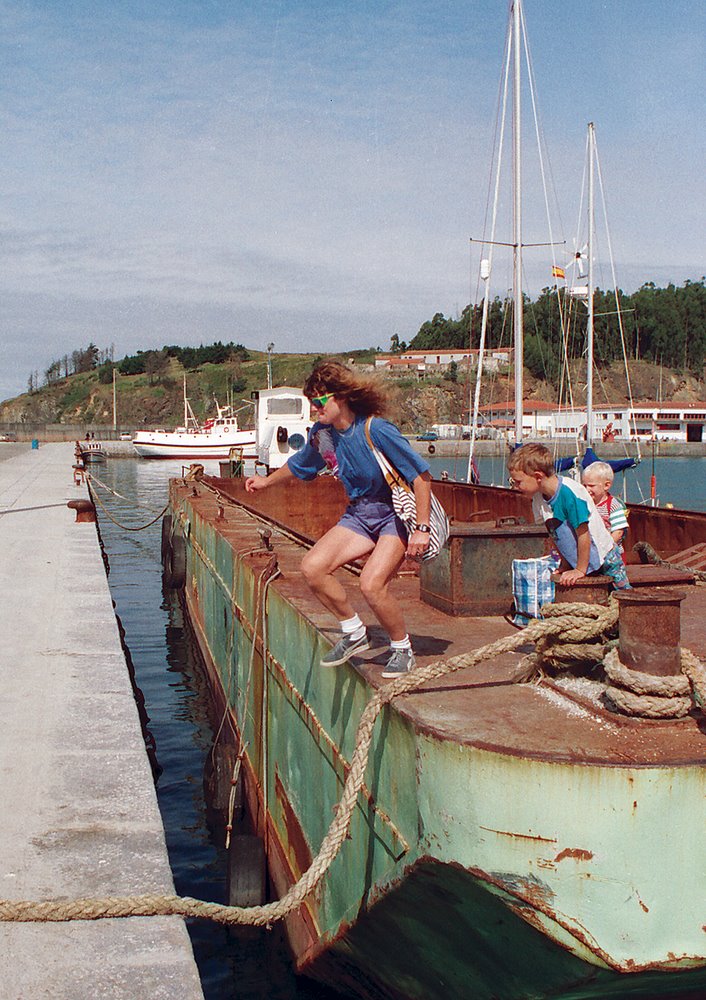
We left Ria de Barquero at ten o’clock into a 4 metre swell and 20-25 knot winds but the passage was OK. The coast line around here is very rugged. We tied up next to a French and Swiss boat who were tied up to a big dredger. Both boats had children on board which are the first families that we have met.
The only way to get ashore is to get onto the dredger and then jump a one metre gap which Glenys finds a bit daunting.
23 September 1992 Ria de Cedeira
We did some fishing and caught four mullet. In the afternoon, we went into town, had a big lunch and went to the beach. I had a jumper on and was still cold – the boys were running around naked. Cediera is a lovely place.
24 September 1992 Ria de Cedeira to La Coruna
We left Cedeira at half past nine and had a really nice sail. The wind was against us again – will we ever sail downwind?
We have a few degrees list to port which I’ve not managed to sort out, even though I’ve moved gear around in various lockers. We really noticed a difference between port and starboard tack when hard on the wind – we have to reduce our sail area when on starboard tack, which makes life a bit more difficult than necessary.
We picked up a mooring at four o’clock at La Coruna. There are two yacht clubs side by side which was a little confusing when we went to check in.
25 September 1992 La Coruna
We went to the fuel dock to fill up. It was a bit of a shuffle having to move along in a queue. We ended up moving 3 times before being able to fill up. The Swiss boat “Josua” that we met in Cediera was there (Danny, Erica, Bengy and Milano). We went back out to the mooring and then went into town to look around and do a bit of shopping. It rained a lot today. We’ve spent a week without a marina berth and it hasn’t bothered us much. We shower after a passage when the water is hot and the water lasts at least a week with as much as we want to use.
26 September 1992 La Coruna
It’s absolutely howling and there are heavy rain showers.
We visited the Torre de Hercules which is an ancient Roman lighthouse on a peninsula about 2.5 kilometres from the centre of La Coruna. The name Coruna is derived from the ancient word “columna”, meaning column. The lighthouse is 55 metres tall and is almost 1900 years old, it’s the oldest Roman lighthouse still used as a lighthouse.
The boys liked the myth that Hercules slew the giant tyrant Geryon after three days and three nights of continuous battle. Hercules then buried the head of Geryon with his weapons and ordered that a city be built on the site. To commemorate this legend, the coat-of-arms of Coruna contains the lighthouse on top of a skull and crossbones, representing the buried head of Hercules’ slain enemy.
27 September 1992 La Coruna
The weather was even worse today. We went to the Science Museum to find that it was closed, so we went to the windswept beach, had a meal and visited Josua.
28 September 1992 La Coruna to Lage
We set out from La Coruna at eight o’clock in the morning bound for Bayona. We had a pleasant wind to start with and had a nice sail until we rounded Islas Sisagas when the wind increased to 25 knots and the seas got rougher. Just off Lage, we decided to carry on because we have to meet Ceris at Bayona in three days time. Glenys was starting to feel seasick, Brett threw up and Craig and I were weary of the constant slamming of the hull against the seas.
By three o’clock, the wind was gusting up to 35 knots so we decided to head back to Lage. I’m glad that we did because we were getting 45 knot gusts as we headed in.
While we were bashing back upwind, Craig and Brett were playing in the back cabin. Suddenly Craig started to call up for Glenys, sounding pretty upset, so I rushed down, thinking that he’d hurt himself, only to find out that he was just frustrated because he couldn’t fit a hat onto a Lego man!
We didn’t anchor at Lage but went to a small cove (Pt Cabello Bay) with 4 other yachts – one of whom was Josua. I anchored at about five o’clock in 12m of water with 60m of chain out. The anchorage was good being sheltered from the SSW wind, but half way through the night the wind dropped and the swell rolled in and rolled in and rolled in. I got up at four o’clock and put up the mizzen which calmed the rolling a bit. We had a very rough night.
29 September 1992 Lage to Bayona (Day 1)
We upped anchor at eight o’clock in the morning. The windlass is driving me crazy – I’ve not managed to get hold of a replacement chain stripper, so the chain constantly jams every 3 metres.
We decided to motor to Bayona because the wind was directly against us. The swell was about 5 metres high but very smooth, so we made very good progress and expected to arrive in Bayona before midnight, which would give us a day to get ready for Ceris’ arrival.
Then at about 3 o’clock in the afternoon, just off Cabo Finisterre, there was a terrific amount of vibration from the engine. By the time I’d taken the engine out of gear, the prop shaft coupling had sheared its bolts. Although the winds were very light and against us, we decided to continue to Bayona under sail. In the next 5 hours, we only made 5 miles towards our destination!
As night fell a dense fog descended, but at least the wind picked up. It is very strange in the fog – no horizon and very dark.
30 September 1992 Lage to Bayona (Day 2)
We had fair winds until one o’clock in the morning – over the five hour period we made 17 miles which was better than the previous 5 hours. At one o’clock, the wind headed us by 20 degrees but we foolishly stayed on the same tack, causing us to sail out to sea for 8 miles and lost us about 5 hours - another lesson learned.
The wind gradually dropped so by 5 o’clock in the morning, we had only made another six miles. Between six and eight o’clock we averaged 1.5 knots. Being becalmed is character building.
At eight o’clock, the wind picked up to a SE 10 knots and we headed in towards land. By midday, we were becalmed again. We continued to drift towards the shore and after lunch we picked up a sea breeze, which allowed us to head directly towards Bayona. Our spirits rose – we would be there before midnight!
By three o’clock in the afternoon, we hit fog again and by five o’clock we were becalmed again - drifting along just off Isla Ons. I was more than a little worried about the sharp, pointed rocks near to the island only about a mile away.
At midnight, we had only moved 4 miles and we were still in thick fog. It was very eerie and worrying to hear the loud blasts of fog horns from big ships going in and out of Vigo. I gave a few blasts on our “fog horn” which is a small gas canister similar to those that you hear at football matches - pathetic. You can feel the deep bellow of a ship’s fog horn in your chest...
- << Prev
- Next