
1 October 2011 Spanish Water, Curacao
We were very brave last night and went to bed with no mosquito screens and all the doors open. It was great to have a strong breeze going through the boat again. I actually felt cold in the middle of the night and no mosquitos – we’ve gone to MOSCON 3.
We went to the supermarket in the morning. The supermarket sends a free bus to the fisherman’s dock every morning to take yachties shopping. There are two chandlers close by the supermarket, so I went and checked them out before joining Glenys with her shopping trolley.
We dropped off our laundry at a small supermarket in Spanish Water. The shop was shut up, but there was a guy lying on a bench outside who said it was OK to leave it there. Strangely trusting, we left two huge bags of clothes there.
We had lunch and then chilled out for the afternoon. “Flawless D” came for sun downers.
2 October 2011 Spanish Water, Curacao
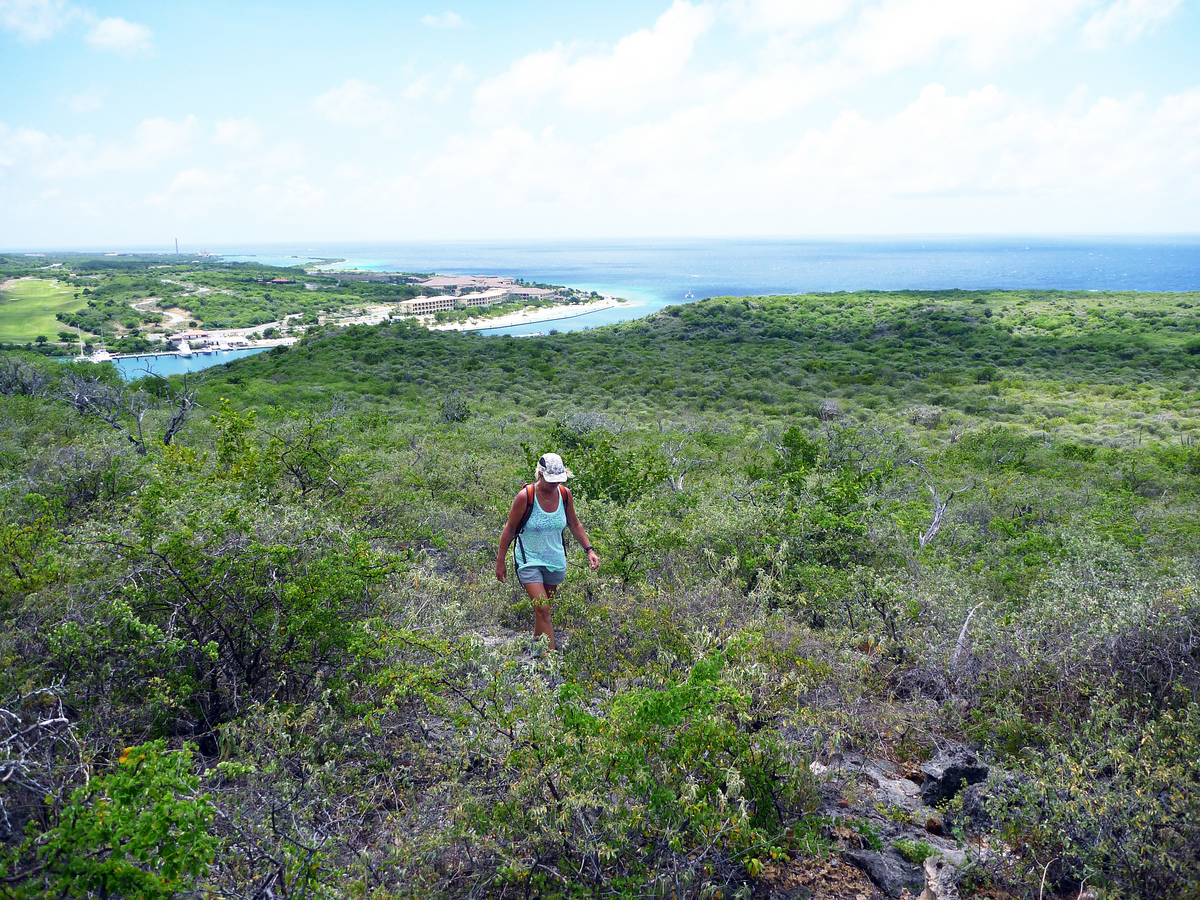
We went to a small flea market/boat jumble in the morning and then went for a walk to the top of a hill overlooking the anchorage. There’s a really nice beach about five minutes walk from the dinghy dock and apparently there’s a small tugboat wreck somewhere at about six metres depth. We’ll have to go snorkelling one day.
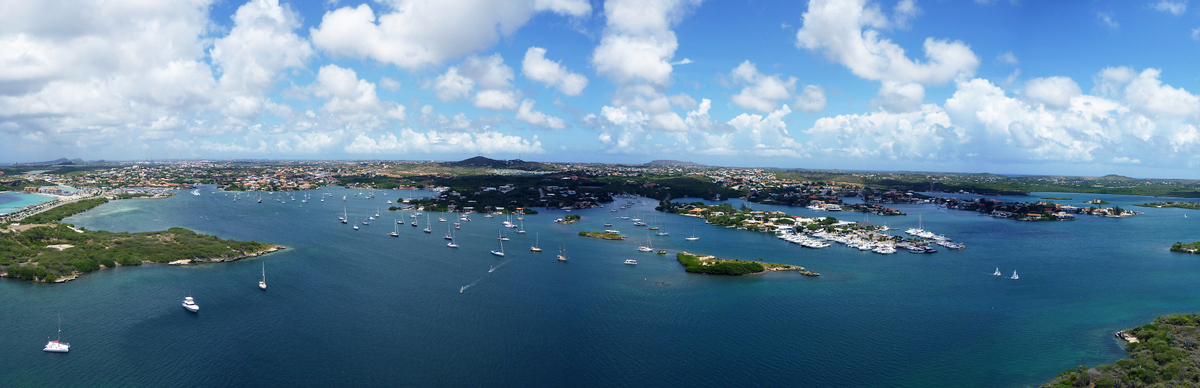
The walk was very easy, we called in at a small fort on the way and were still at the top of the hill in an hour. There’s a great view of the whole of Spanish Water from up there. We had our lunch with our legs dangling over the edge of a cliff.
We mooched about in the afternoon. I have decided that I ought to upgrade our website software, so I spent a few hours researching how to do it and backing up the existing website. I’ve started to practise the clarinet again – very frustrating because my lips are exhausted after only ten minutes.
3 October 2011 Spanish Water, Curacao
We spent the morning doing small jobs. Glenys cleared the front cabin and washed down the insides of cupboards and the lockers under the bed. Everywhere in the front cabin still had salt deposits from when we got wet while bashing upwind past La Blanquilla.
I found it very hard to motivate myself to do anything – I’ve definitely got out of the habit of doing jobs. I managed to do a few very small things and then spent the rest of the day upgrading a test version of my web site. What a nightmare – the upgrade takes about fifteen minutes, but then there are loads of things wrong with the layout of the website. I’ve decided that I need to reconstruct the template from a blank template, which will be a lot of work.
We went to “Flawless D” for a drink or two. They are very quick at topping up one’s glass and Glenys went raving mad with the red wine. After three hours, we poured ourselves into the dinghy and Glenys managed to make dinner before slumping drunkenly on the back deck for an hour before I sent her to bed.
4 October 2011 Spanish Water, Curacao
Glenys was not too well this morning. I went up the mast and did some small jobs. Glenys, meanwhile, washed the hatches and deck surfaces in between hauling me up and down the mast.
After lunch, we both chilled out for an hour and then I finished off modifying the template for the website and testing the upgrade. Glenys occupied herself cleaning the stainless steel fittings on deck – it got her out in the fresh air and was a suitably mindless task for her delicate state.
We had an early dinner and went to bed.
5 October 2011 Spanish Water, Curacao
This is a fantastic anchorage - the wind blows constantly, so the temperature at night is very cool; yet the water is very calm. I’m sleeping very well for a change and feel like I’m recharging my body after a couple of weeks running about.
We went shopping on the supermarket bus in the morning and picked up our laundry, which amazingly, had made it to the laundrette and returned clean.
The afternoon was another chilled out affair. I upgraded our live web site and after a few traumatic hours managed to get it all working. I hope that I don’t have to do that again for a couple of years.
I continued with my clarinet lessons. I’m now up to lesson 19 in “A Tune a Day”, which unfortunately, has now moved onto the upper register, which is no doubt excruciating for Glenys and our neighbours.
The beer fridge is making gurgling noises again, so I think that we have another refrigeration leak. I’ve decided that we should turn it off overnight because the batteries were quite low this morning and I suspect that the fridge is running constantly. This is not good news – we might have to start drinking warm beer.
6 October 2011 Spanish Water, Curacao
I put out a call on the cruisers net this morning for the name of someone who can repair fridges. Within fifteen minutes, Larry from “Navigator” was on board and working on our fridge. He agreed with me that we have lost refrigerant and recharged the system. We have a clever hull fitting which acts as the condenser, using sea water to cool the refrigerant. He thought that this wasn’t working properly, so after he left, I donned my scuba gear and went scrubbing the fitting with a wire brush. It seemed to be a little bit better.
The fridge was still making gurgling noises, so I read the manuals and found that the compressor can run at varying speeds between 2000 and 3500 rpm. It was set to run at 2000 rpm, so as an experiment I’ve changed it to 3500rpm. This will draw more current from the batteries, but should pull the temperature down quicker. I’ll see how it performs.
We spent the afternoon doing a few more small jobs; Glenys is on a mission to clean everything on the deck. We went for dinner on “Flawless D.”
7 October 2011 Spanish Water, Curacao
We’ve been living on Alba for six months now. Time seems to have flown by. I worked on our accounts this morning and reconciled our bank accounts. September was a good month because we received some interest from a two year ISA and our income was greater than our expenditure for the first month since we retired.
We rely on the internet for all of our banking, which is great as long as it works properly. We’ve had a problem with the Halifax website and Glenys has been locked out by the security team. We spent 15 minutes on the telephone to the UK and eventually they said that they enabled the account for login again, but we still can’t log in – very frustrating. I’ll wait a week and try again.
The fridge seems to be behaving itself and is not gurgling anymore. I’m now in a dilemma about the compressor speed - should I set it back to 2000 rpm or not? It seems to draw about 5 amps at 3500 rpm and about 3.5 Amps at 2000rpm. I guess that I should be more scientific and monitor its performance, but I can’t be bothered at the moment, so I changed it back to 2000 rpm and we’ll see what happens.
I decided to remove the windlass and reseal it to the deck to make sure that we don’t get any more sea water inside the front cabin. According to the manual, I should just have to remove four nuts and then lower the motor and gear box down. Unfortunately, the shaft jammed in the gearbox – probably corroded slightly. After two hours of levering, hammering and cursing, I only managed to move it 6 mm. I gave up and put it all back together - I need to get some kind of puller device.
8 October 2011 Spanish Water, Curacao
I asked on the cruiser’s net if anyone had a puller for the windlass. Brad from “Seafari” kindly loaned me a three legged puller. It’s the correct size, but unfortunately, there’s a bulge in the gearbox that is fouling one of the legs. I need to get a two legged puller from somewhere.
Timo, who lost his yacht in Sotavento, lives on a house boat just in front of where we’re anchored, so I went over to see if he knew where I could get hold of a puller. We had a good chat and he gave me some interesting information about the island.
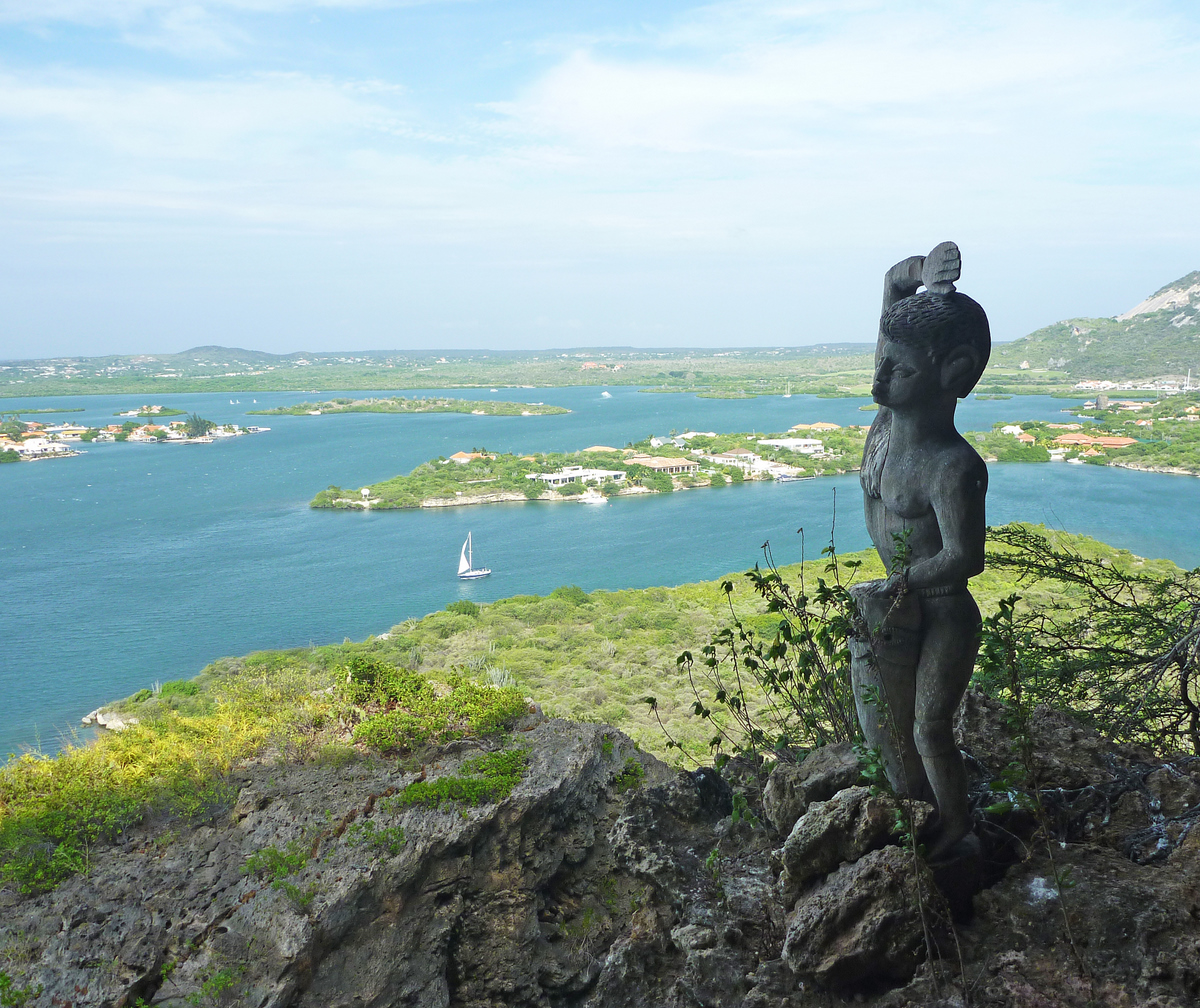
The fridge seems to be behaving itself, so I’ve left it at 2000 rpm. We did a few more small jobs for the rest of the day and then went for a walk with Timo and his two dogs in the late afternoon. Timo has cleared some paths by himself under the cliffs on Goat Hill. It took him eight months with a saw and shears, but he now has his own private paths where he walks the dogs every day. He’s even installed a statue inside a cave in the cliff, which he lights up at Christmas. He was a good guide, pointing out interesting plants like the Brazil Tree and Indigo bush, both of which used to be used for making natural dyes. He obviously loves Curacao.
I played the clarinet before dinner and, having practised every day, I’m doing much better and my lips are getting stronger.
9 October 2011 Spanish Water, Curacao
It’s Sunday today, so we declared it a holiday and went for a walk. I printed off a screen shot from Google Earth, which showed some paths around a lagoon called Jan Thiel. Our route took us past local houses which look very posh, past a couple of hotel complexes and then into a totally deserted area of scrubland. The path went along the edge of the rocky shore, across the edge of the lagoon and brought us out by another hotel complex where there is a Seaquarium.
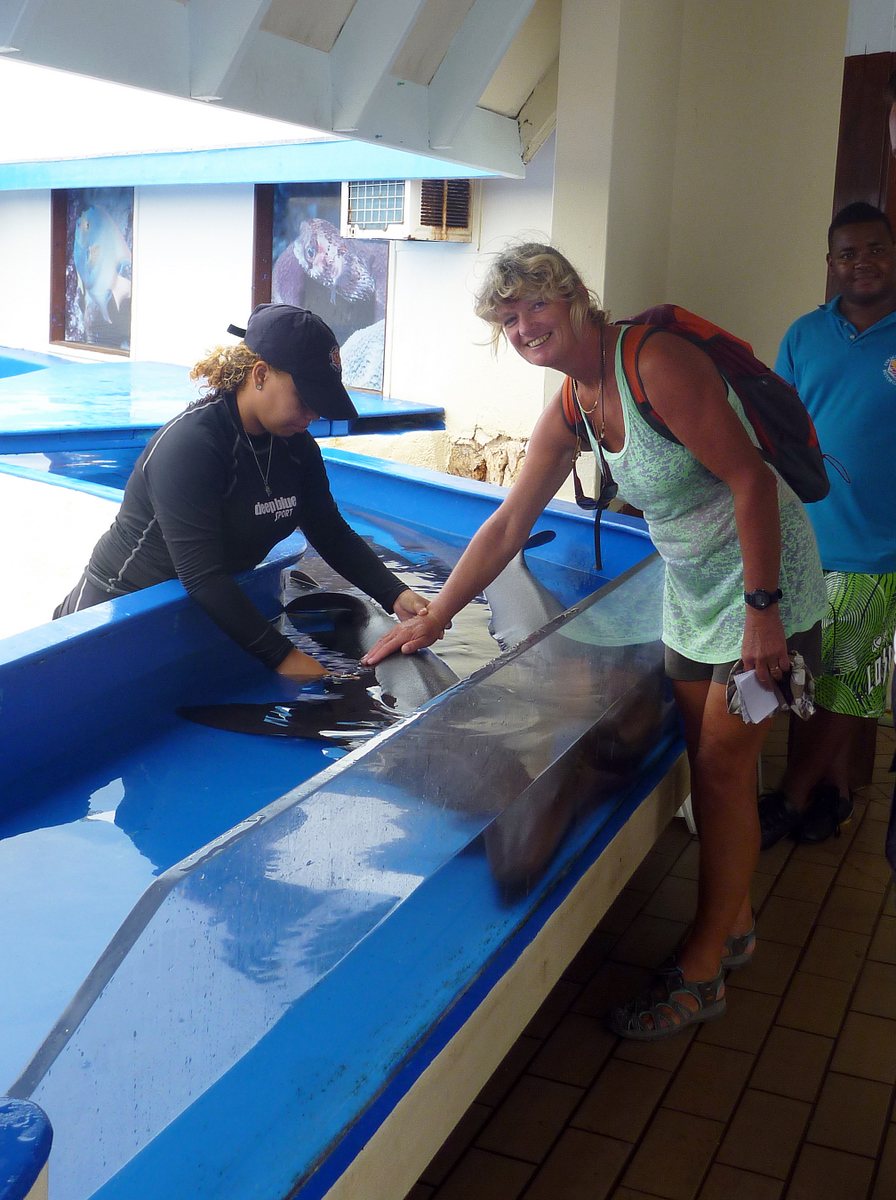
We’d been walking for 90 minutes, so decided to visit the Seaquarium. It’s a small place, but they have a Dolphin Academy, where one can swim with the dolphins (for an additional fee of course). We saw a sea lion show, a shark feeding and a nice little dolphin show. All in all, it was a pleasant three hours.
Our walk back took us deeper into the Jan Thiel lagoon area and we saw quite a bit of wildlife including flamingos, parakeets and an osprey which came out of the bushes about ten metres in front of us and then ran down the path before heading back into the bushes – weird.
Flawless D came for sun downers. It’s Kath’s sixtieth birthday next Thursday, so Glenys volunteered to cook dinner for her on Alba. We also decided that we’ll take them out for a day trip on Alba. If we have light winds, we’ll take them to Klein Curacao which is 12 miles to the east, otherwise Fuik Bay is only a few miles away and Timo has told me that it’s a nice anchorage.
10 October 2011 Spanish Water, Curacao
The Curacao government made a declaration last week and today is now “Independence Day” - a new public holiday.
I’ve decided to have a crate of stuff delivered from the UK, so I spent most of the day working out what to buy and sending out emails to suppliers to get quotes. I’m getting everything sent to my friend, Mike Johnson, who has agreed to go down to Geest-line and pack it all into a “personal effects” crate for me. He only lives about five miles from the Geest-line warehouse, so it’s not too much of an imposition. The crate is scheduled to arrive the week before Brett and Craig come to Grenada for Christmas.
The main item that I’m buying is a series drogue which will take up 60% of the crate. I’m also getting quotes for a cruising chute and all the bits and pieces to convert the running backstays to Dyneema rope with two new winches for the stay sail. I can save myself the UK VAT on expensive items if I get them delivered directly to the Geest-line warehouse, so I’m hoping that things will be significantly cheaper than here in the islands.
11 October 2011 Spanish Water, Curacao
We caught the ten o’clock supermarket bus and went shopping. The driver said that we had to be on the return bus at eleven o’clock so I rushed off to the hardware stores. I bought a few screws from the chandlers and then rushed off to a hardware store to buy a puller tool to help me take the windlass apart. They only had a small one, so I bought it and rushed off to Napa where they had a larger, six inch puller which cost £60. I bought it. I was now running out of time, so I jogged the half a mile down to Caribbean Fasteners. The bolts haven’t arrived from Trinidad – I’ll try again next Monday. I ran back to the supermarket and arrived sweating at 2 minutes to eleven. The bus didn’t turn up until half past eleven…
Back on the boat, we did a few small jobs; I don’t want to touch the windlass until after we’ve been to Klein Curacao on Thursday.
The wind’s been blowing hard for the past few days and I’ve been enviously watching the wind surfers scream past the anchorage. I dinghied over to the windsurfing centre and booked a lesson for Saturday morning. I’ve not wind surfed for fifteen years, so I’ve organised a one hour private lesson to run through the basics.
12 October 2011 Spanish Water, Curacao
I received some quotes back for cruising chutes and they range from £1,350 to £2,500. I put out a call on the Cruisers Net asking if anyone had a cruising chute for sale. Bob from “Freestyle” responded, so we went over to have a look. They have a 43 foot catamaran and the sail has never been used. It’s seven years old and looks to be in good condition. The sail dimensions are six feet shorter in the luff and the foot than the sails that I’ve been quoted, so I’m not sure if it’s right. They want $1000US for it and we were surprised how bulky it is. It’s packed into a very large holdall - so where on earth are we going to store it?
While I was chatting to Bob, I discovered that they also have an old Pactor modem for sale which interfaces to a short wave transceiver and allowing email to be received over the radio. I’ve been agonising over how to receive weather forecasts when we are in remote places. Up to now, I’ve relied on getting an Internet connection to receive weather charts and forecasts. When we start heading back up-wind and up-current to Grenada, we need the winds to be as light as possible, so it will be really important to get an accurate wind strength forecast for a 72 hour period.
I spent the rest of the day, investigating Pactor modems and how to get weather from the radio. I down-loaded a couple of ham radio programs which pick up weather faxes that are transmitted by various radio stations around the world. I managed to get the radio interfaced to my laptop, but failed to receive any weather faxes. We’ve also got a Navtex receiver on board which should pick up text weather messages automatically. I found out that there is a Navtex station in Curacao, so I tried to get that working as well without any success.
It was a frustrating day.
13 October 2011 Spanish Water, Curacao
It was Kath’s 60th birthday today. I picked her and Jim up from “Flawless D and we motored over to Klein Curacao. It took us about 2½ hours. Klein Curacao is a very small island similar to those in Aves de Sotavento and we anchored on the edge of a sandy shelf that drops off very quickly. Glenys rustled up some bacon and egg sandwiches, which we ate while gazing at the beautiful waters and beach.
After our brunch, I took Kath through some basic diving theory, so that I could take her on a short “Discover Scuba” dive. We then went to the beach where I ran Kath through the basic confined water exercises such as how to breathe underwater, how to clear a regulator & mask and a short underwater swim.
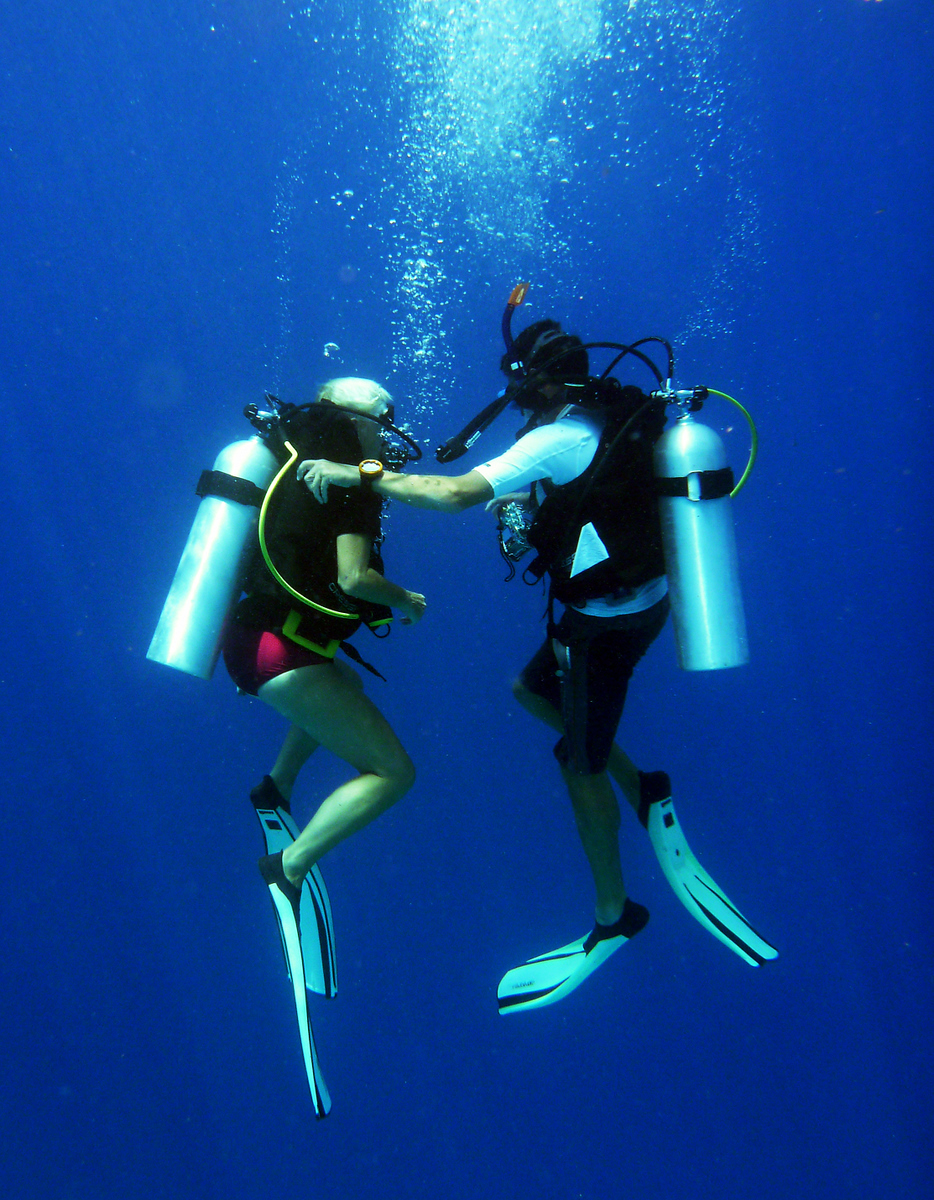
We piled all the gear back into the dinghy and tied up to the back of Alba for the dive. It’s a bit of a faff getting the scuba gear on in the dinghy and getting into the water, but Kath coped with it well. She hasn’t done much snorkelling and was extremely nervous, but we managed to do a short five minute dive before she had a problem with water in her mask and wanted to come up. It wasn’t the best dive in the world, but I think that she enjoyed the overall experience.
We had lots of air left in the tanks, so I took Jim out for a quick dive as well. He had exactly the same problem with water in his mask and we had to cut his dive short as well. Glenys and I do lots of diving and snorkelling and we’ve become used to having a bit of water in our masks. Both Jim and Kath only had a tiny bit of water, but didn’t like the feeling of water around their noses.
Glenys prepared a nice lunch and we popped open a bottle of Cava to celebrate the birthday girl. I dropped Kath and Jim off by the beach, so that they could go snorkelling in shallow water, then Glenys and I went and free dived on the edge of the drop off. The reef wasn’t very good where we were anchored.
A guy came along in a dinghy and asked us if we had heard about the weather. He’d heard that there was a strong possibility of a wind reversal, which wouldn’t be pleasant where we were anchored. He explained that his name was Jack and he was helping an inexperienced couple sail their boat (“Polaris”) to Bonaire. Unfortunately their engine had packed in and they wanted help to get the yacht onto a strong mooring a bit further along the beach. His boat was back in Spanish Water and he wanted to be back on board in case he needed to re-anchor in a west wind. I agreed to give them a hand to move “Polaris” and give Jack a lift back to Spanish Water.
I tied my dinghy alongside “Polaris” with front and aft springs and used my 15hp engine as propulsion. It took us about 20 minutes to move them onto a large mooring about 400 metres along the beach. The couple looked shaken by the whole episode and were very worried about the dreaded wind reversal. We tried to reassure them, but by then it was three o’clock and we needed to leave ourselves.
It took us 2 ½ hours to motor back to Spanish Water. It turned out that Jack has been cruising for 20 years and has spent time up in Nova Scotia and Newfoundland, so we had a chat about the various places and the best time to be there. It sounds like fog is a major problem north of New York even as late as July, so we might have to change our plans a little bit.
Kath and Jim came for dinner on Alba and we polished off a substantial number of bottles of wine.
14 October 2011 Spanish Water, Curacao
We both felt a little “dull” this morning, so we had a very quiet day. I read some more about Pactor modems and offered Bob $200US for his. He’s going to have a think about it.
We’ve been given a couple of old cruising guides for sections of the east coast of the States. After our conversations yesterday about Nova Scotia and the east coast, Glenys started reading up on routes and places to go. I realised that I hadn’t got a clue about the geography of the area, so I spent the afternoon on the Internet finding cruising web sites about Chesapeake, Maine, Nova Scotia and Newfoundland and then looking up where places are on Google Earth. Don’t you just love the Internet…
We confirmed that it can be cold, wet and foggy in June and July, so we’ll aim to get to Chesapeake in June, take it slowly and see how far we get.
As an added complication, we need to get US visa for our passports. Normally, UK citizens can enter the USA under a “visa waiver” programme, but that only applies if you come with a recognised airline or shipping company. Arriving on a private yacht is a bit more complicated. To get a B1/B2 visa, we need to fill in an online questionnaire which asks all sorts of questions about our past including a list of all the countries that we have visited in the past five years. In our case, that’s quite a few.
Once the questionnaire has been submitted, we can then apply to have a “face to face” interview at a US Embassy. The only ones in the Caribbean are in Caracas, Trinidad or Barbados. There is no way that we’re going to Caracas, which is the third most dangerous city in the world; Barbados is another 120 miles upwind; so it looks like we’re going back to Trinidad for a couple of weeks. Perhaps we’ll be able to go to Tobago this time.
The result of these investigations is a set of slightly modified plans:
| Nov | Back up-wind to Trinidad & Tobago |
| Dec | Grenada (to meet Brett and Craig) |
| Jan | Leeward Islands |
| Feb | British Virgin Islands (to meet my brother Andrew) |
| Mar, Apr & May | Bahamas |
| Jun | Chesapeake & New York |
| Jul, Aug & Sep | Maine, Nova Scotia & maybe Newfoundland |
| Oct & Nov | Chesapeake Bay |
| Dec | Florida |
| Jan, Feb & Mar | Cuba |
15 October 2011 Spanish Water, Curacao
I had another go at receiving weather faxes and managed to receive a full page, but there is a lot of noise on the signal. I’m going to have to take apart all of the radio antenna and ground connections, clean them and make sure that they are tightened up. There seems to be a fair amount of electrical noise from the laptop and its power supply, so I think that I’m going to have to methodically put noise suppression on all of the leads around the chart table of which there are many.
Glenys went into to town to do some clothes shopping, while I had my windsurfing lesson. I did okay considering that I’m a fifty five year old duffer and haven’t done it for fifteen years. The winds were a bit too light, but I managed to plane a couple of times. I’ll rent a board a few more times and then think about buying one.
I took the opportunity of having a mega clarinet session while Glenys was out. I’m doing a bit better and have started to play tunes on sight. I can play the notes, but there are several ways to do many notes and I’m struggling with choosing the correct fingering for the different sequences of notes. At least my lips are getting stronger, so I last more than a couple of minutes.
Rob from “Arita” came over and introduced himself. He’s a friend of Timo and heard that I needed a shaft puller, which was nice of him. I told him that I’d already bought one and we chatted a while. He and his wife, Lauren, are heading east to Los Roques at the end of next week. They’ve had a seven day forecast that says the wind will be light for the next few days and then come south westerly – an ideal time to go east. We might go with them. Rob invited us to their boat for a beer tomorrow.
16 October 2011 Spanish Water, Curacao
I spent three frustrating hours filling in an on-line Visa application to go to the States. The Internet connection was very slow, probably because it’s Sunday and everyone is surfing the Net. Glenys then spent two hours doing her application, but at least they are ready to submit to the Embassy when we get to Trinidad.
I had another go at the windlass. My new, expensive puller fitted perfectly and it was easy to move the shaft 30mm. Then it jammed. This was my nightmare scenario – I’d pulled the shaft out so much that it seemed impossible to get it back. I struggled for ten minutes trying to move it, but no joy. In despair, I sat in the cockpit reading the manual while Glenys made a sandwich for lunch.
I finally decided that the shaft has pushed upwards, instead of pulling the gearbox down and just managed to get two nuts to hold enough that I could pull the two parts together. Six big blows on top of the windlass with a hammer and my karma is restored – a working windlass. I reckon that I’ve damaged a shaft seal and bearing, so I’ll order a new set of parts and hope that the damaged ones last for a couple of months.
After the trauma of the windlass, I chilled out for the rest of the afternoon and we went to “Arita” Rob and Laurie for a few beers. The seven day forecast is still predicting westerly winds, so we’ve decided to leave here on Thursday and head straight for the Windward islands and then to Trinidad. It means that we’ll be missing out on re-visiting the beautiful Aves and Roches, but this is too good an opportunity to miss.
17 October 2011 Spanish Water, Curacao
It’s the start of another week. We had very light winds this morning and the forecast is still looking good for leaving on Thursday. We now need to get ourselves ready for the trip back east. It’s 420 miles to Grenada and we’ll have a 1 – 1.5 knot current against us, so we’ll probably only average 4 or 5 knots. By my calculation, we’ll be at sea for 4 or 5 days.
We caught the supermarket bus and went shopping. I walked down to Caribbean Fasteners, but the bolts are still not here. They are apparently in the country and should be here tomorrow. I’ve given up and will get some in Trinidad.
Back on the boat, I did a few jobs. I changed the primary fuel filter on the engine. I know that it’s dirty and I think that we’ll be doing a lot of motoring on this trip. I also spent a couple of hours tracing and cleaning the earth wiring for the SSB radio. We have a separate grounding system leading to a sintered plate bolted on the outside of the hull and it’s important to make sure that all connections are clean and tight. It’s a frustrating job because any improvement is very subjective and it’s difficult know if it’s better or worse.
18 October 2011 Spanish Water, Curacao
I was up early at 0640. Cleaning the earth connections on our SSB radio seems to have made a difference, because I managed to hear a weather forecast from “George” for the first time. I am also having more success with receiving weather faxes from NOAA. The weather still looks good for leaving on Thursday.
I spent the day catching up on a few small jobs and getting ready to leave. We ran the water maker and filled up our water tanks.
At half past five, we were preparing to go out for a beer on “Flawless D” when Glenys heard a strange vibration. A bit of investigation showed that the fresh water pump was running constantly. I’d left the watermaker flush valve on (again!) and dumped all of our water overboard. I’m gutted because the tanks were completely full. We started the water maker running and went for a commiseration drink on “Flawless D”.
19 October 2011 Spanish Water, Curacao
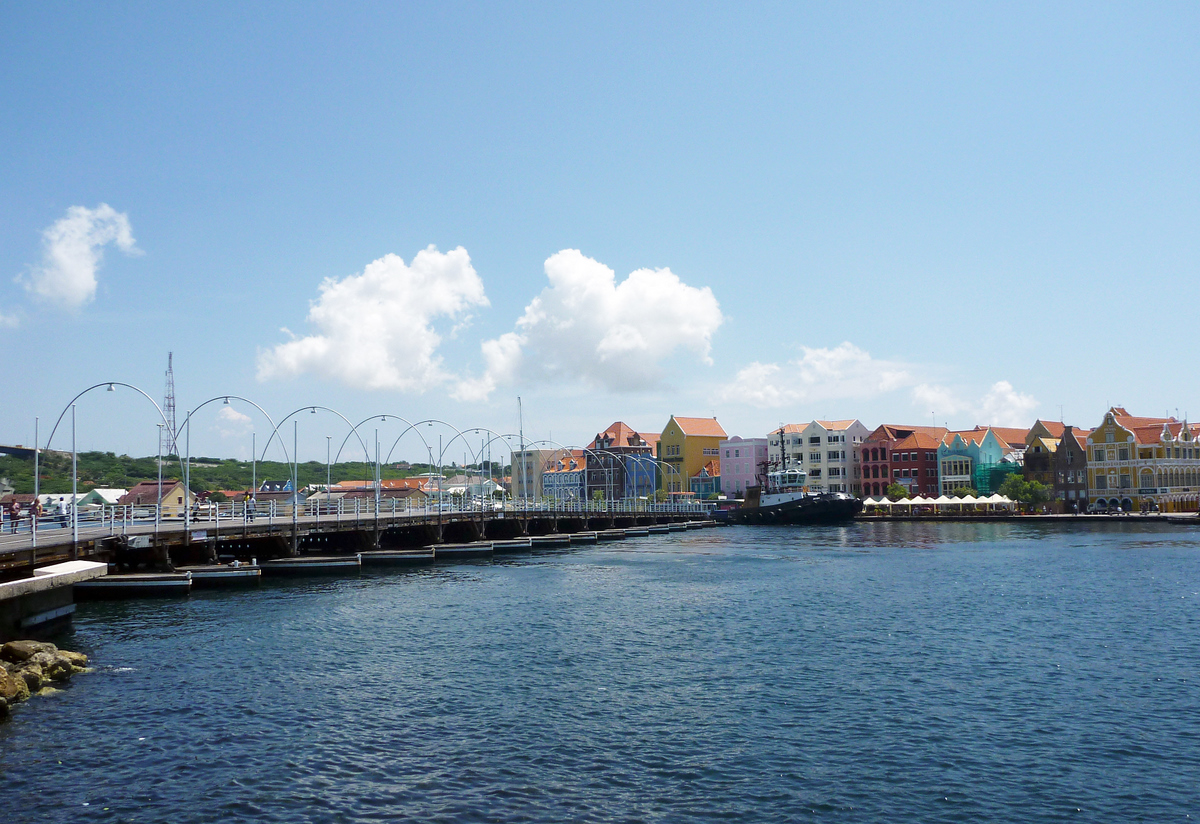
I went into Willemstad and cleared out. The Immigration office is on the other side of the harbour and there’s a floating bridge that swings open whenever a ship wants to enter or leave. Today the bridge was open while a navy frigate was leaving, so I had to catch a ferry across. It’s free and quick, so it was a nice change from walking in the beating sun.
When I arrived back on the boat, I found that Glenys had been running the water maker for over two hours and had almost got the tanks full again. Five minutes later, the water maker high pressure pump stopped. Panic! I tried to start it again but no joy. The pump and the motor were very hot, so I guess that it had over heated and stalled the motor. I hope that the pump is not seized because that will be very expensive. I left it to cool down for a few hours, but it still won’t start. Ah well, at least we’re going to Trinidad where I can easily get it fixed.
We started to lift the anchor to get some fuel, but it was snagged on something. We tried the old tricks of motoring backwards and forwards, but no chance. I donned snorkelling gear and dived down to find that the anchor chain has tied itself in a half hitch around a ½” steel bar sticking out of an old concrete mooring on the sea bed. It took me five minutes to untangle it.
After filling up with diesel, we did the final jobs to get ready for sea and put the dinghy on the deck. “Flawless D” came for a farewell beer or three.
Glenys and I have been picking at each other for the last couple of days, while we prepare the boat and wait to head east. I’m worried about the weather. The forecast is for the wind to be northerly and then become variable as we head towards the Windward Islands. There’s a weak Tropical Wave approaching the islands, which will pass over us on Saturday or Sunday. My big worry is that there will be thunderstorms and squalls and give us bad weather like we had coming down to Curacao.
Alba is ready to go. We have full fuel tanks, which will allow us to motor for four or five days if we need to. Our water tanks are nearly full and we have enough food to last a couple of weeks. I’ve checked the engine and done all the small jobs, so all I can do is wait. The anchorage this evening is glassy smooth, with no wind at all. I suspect that I’m not going to sleep well.
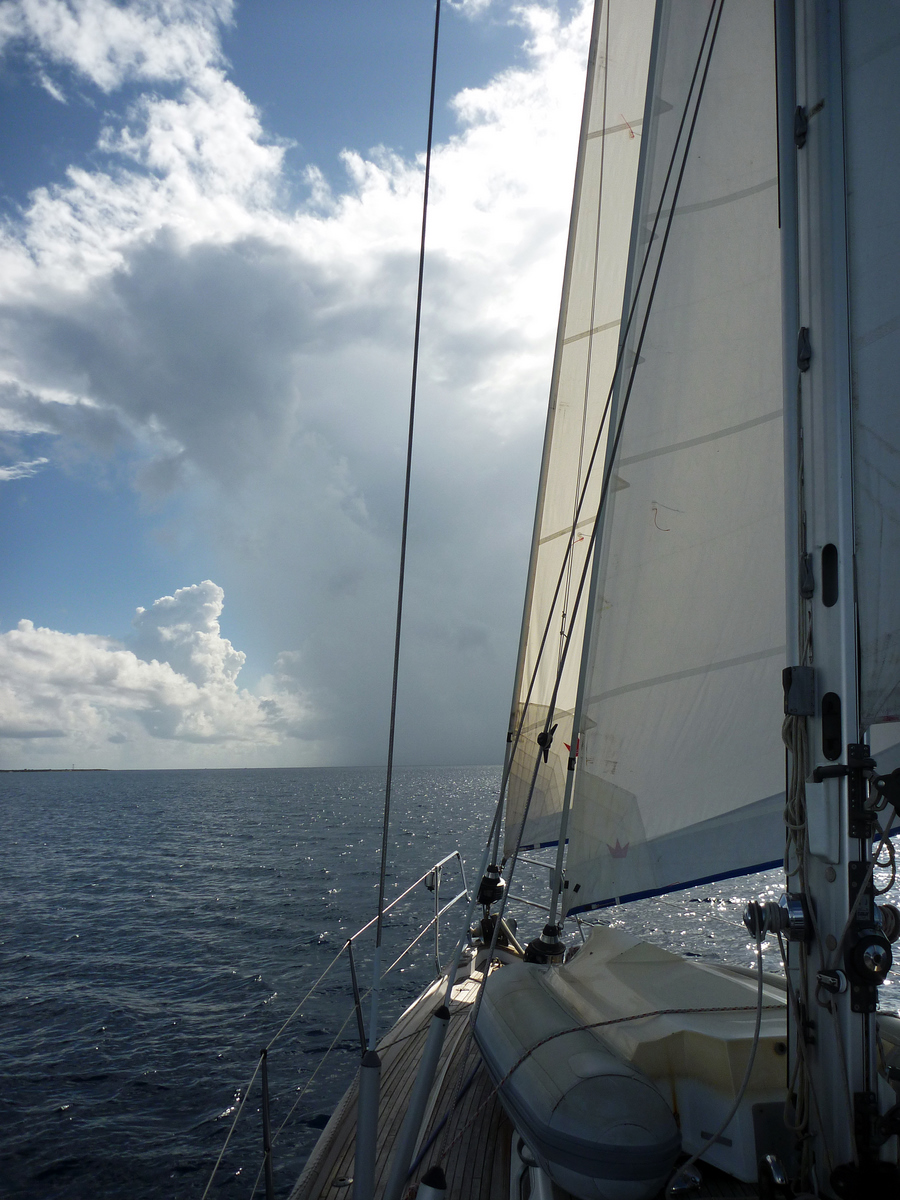
20 October 2011 Spanish Water, Curacao to Trinidad (Day 1)
We had a restless night. A few mosquitos took advantage of the airless night and found us, so I was up at one o’clock rubbing anti-histamine cream on bites. Then it rained at five o’clock, so had to get up and check the hatches.
I checked the weather at seven o’clock and nothing much has changed, so we pulled up the anchor and left at half past seven. We picked up a ten knot north wind, which gave us a lovely sail along the coast of Curacao. I rigged up the stay sail and we managed to go along at 5 knots in the flat sea.
Unfortunately, the wind dropped as we cleared the end of the island, so we started to motor sail towards Bonaire. A pod of Common Dolphins came to play on our bow wave and stayed for twenty minutes. After a couple of hours, we ran into a big squall system, which gave us rain and 20 + knots from the North, so I got wet through while reefing the main sail. Once the squall had passed, we had a welcome 12-15 knot northerly wind, which allowed us to sail for another 2 hours.
As we were approaching Bonaire, we could see a massive squall to the south of the island, right in our path. By this time we were committed to going around the south of the island, so we just went into it. It looked worse than it was. The wind went slightly over 20 knots – bizarrely switching from the north to the south west in about 2 minutes. We had very heavy rain, so I took the opportunity to have a refreshing shower and collected some water in our tanks by creating a small dam with a towel around the deck filler and letting the water pour in.
The sun came out as we passed the south end of Bonaire, but the wind was from the north east at ten knots. We were planning to pass to the North of the Aves, but decided to go around the south side to take advantage of the more easterly wind. Unfortunately, the wind was less than ten knots, so we had to motor sail. I went down below to work out the new waypoints and put them into our GPS and was attacked by some damn mosquitos that had stowed away, so I had to “Bop” the whole boat.
During the night, we passed to the south of Les Aves and then turned more North to pass to the North of Los Roques. It was a fairly quiet night with a couple of patches of 20 knot winds as we went under big Cumulus cloud systems – nothing bad, just a few anxious moments staring into the darkness.
21 October 2011 Spanish Water, Curacao to Trinidad (Day 2)
Dawn found us near the north of Los Roques. I managed to turn the engine off and sail for an hour which was a relief, but by seven o’clock, the wind dropped and we had to motor sail again. A couple of hours later, we picked up a nice 12 knot breeze and were able to sail at about five knots for six hours.
I hooked a SAILFISH just before breakfast. The line screamed from the reel as the fish made spectacular jumps into the air, it’s big sword and fin clearly visible. I started to put tension on the reel clutch, but the fish was still pulling line out and leaping. I started to worry about how much of the 475 metres of fishing line I had left, so I applied more pressure to the clutch too soon and the fish got off – the hook snapped in half. I think that the sail fish had taken 300m of line when it escaped. I was gutted…
Two hours later, I hooked another fish, but it also managed to get away. I think that I’m putting too much pressure on too soon. I’m hooking bigger fish out here and obviously need to “play” them more.
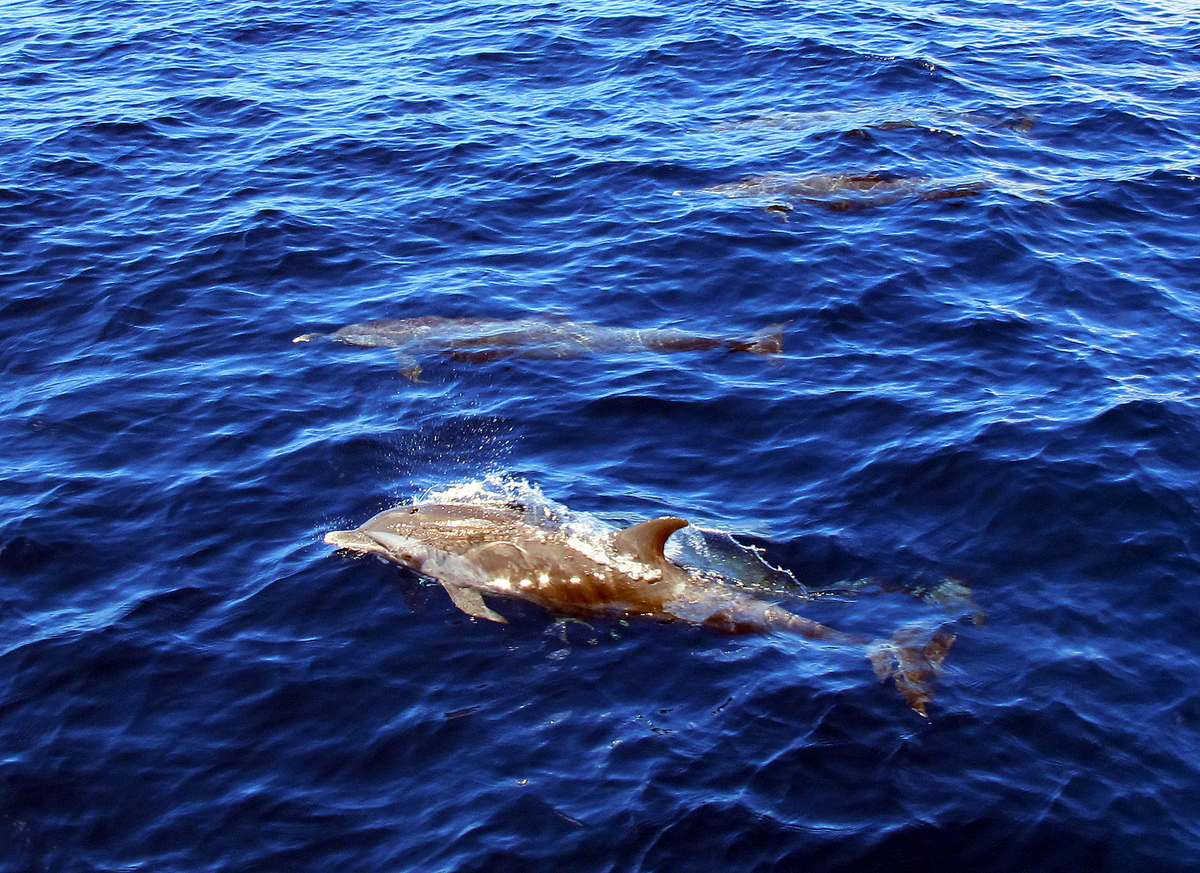
Later in the afternoon, the wind became more variable, so we motor-sailed whenever our boat speed dropped below 3 knots. The wind dropped at dusk and we resigned ourselves to motor sailing over night. Another pod of Common Dolphin came to visit us as the sun went down.
We’ve had a very pleasant day and we’ve relaxed into the routine of being at sea again – we were both pretty tense yesterday especially while sailing between Les Aves and Los Roches at night.
22 October 2011 Spanish Water, Curacao to Trinidad (Day 3)
We motor sailed for most of the night, with a couple of brief spells of sailing near big Cumulus cloud systems. There are more ships around this area, which kept us attentive during the night.
At dawn, we were just north of La Banquilla – over half way. We’d done 256 miles in 48 hours - an average of 5.3 knots which is pretty good against the prevailing east wind and current. We had 165 miles left to go, but the wind disappeared and we have encountered a 1 - 1½ knot current against us. We are managing 5½ knots boat speed by motor-sailing in the calm seas, but our speed over ground is reduced to between 4 to 4½ knots. It looks like another two nights at sea before we get to Grenada.
Following my disastrous fishing episodes yesterday, I decided to beef up my arsenal. I now have three lures trailing behind us - a sinking lure on the on the fishing rod, a skimming lure on a hand line and a small squid on the end of my string of “birds”. I’ve fitted stronger hooks onto stainless steel leaders.
The wind died completely at ten o’clock and we motored all day in calm seas. The lack of wind made the sea into a mirror and the lack of wind made it very hot. A pod of Pan-tropical Spotted Dolphins played in our bow wave for ten minutes in the afternoon providing a bit of light relief.
We are trying to conserve diesel as we only carry 440 litres and we’re not sure how much diesel the engine uses per hour. We’ve decided that 2000 rpm seems to be the right engine speed allowing us to motor at 5.5 knots in these flat seas. According to the engine manual this should only use 3-4 litres of fuel per hour. At four o’clock in the afternoon, the engine had been running for 45 hours, so I estimated that we’d used 30% to 40% of our fuel. The current seemed to die off to ½ knot as we cleared La Blanquilla and the Los Hermanos islands, which improved our progress east.
As the sun went down, I pulled in my three fishing lures having caught no fish.
23 October 2011 Spanish Water, Curacao to Trinidad (Day 4)
It was a very boring night, motoring with hardly any wind – we even had to roll away the jib because it kept backing.
During my 10-1 “midnight” watch, I checked our progress and it looked like we could possibly make landfall in Grenada by late afternoon today. We had a couple of options, we could stop in Grenada for a day’s rest and then set off tomorrow evening to sail overnight to Trinidad or we could head directly for Trinidad and arrive tomorrow morning. When we changed watches, Glenys agreed that we get it over with and go straight to Trinidad.
The Peninsula de Paria on the Venezuelan coast is a high risk area for attacks by Venezuelan “pirates”, so I plotted a course which continues towards Grenada and then heads for a point half way between Grenada and Trinidad to keep out of the more dangerous region. There is a danger that we will arrive at the Boca de Monos in Trinidad while it is still dark, so we need to keep our average speed down to 4.5 knots, which should get us there at dawn tomorrow.
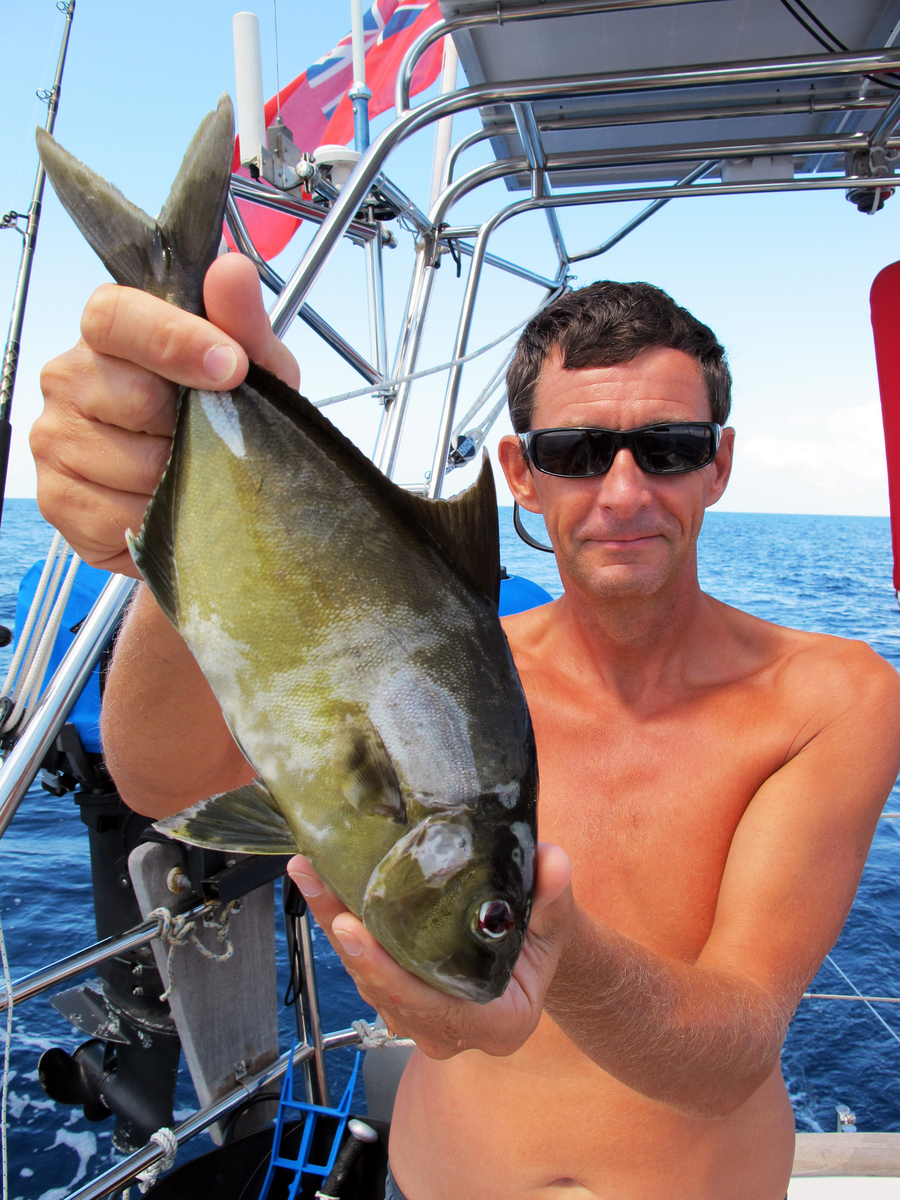
We turned towards our Trinidad waypoint at dawn and the wind picked up enough that we could sail at four knots for five hours which was very pleasant. I put out all three fishing lures and was rewarded by catching a small Jack on a small lure towed behind my “Birds”. We had it for lunch – from fish to dish in two hours…
In the afternoon, I spotted a big flock of sea birds diving into the sea. This normally indicates that smaller fish are being driven to the surface by tuna and other pelagic fish. We weren’t under any time pressure and the seas were very calm, so we spent a fun hour trolling around and through the diving birds. Unfortunately, we still didn’t catch anything.
The wind remained light all afternoon. I was expecting to encounter a stronger current against us as we passed to the south west of Grenada, but there seemed to be very little current if any. We had to reduce our engine revs down to 1500 rpm, so that we could maintain 4.5 knots to get our landfall at dawn. There was nothing to do except read books and sleep through the afternoon.
As night approached, we ran into a group of huge thunder clouds just south of Grenada. As darkness fell, we were getting 20+ knot winds and heavy rain. I didn’t know if it was going to get any worse, and we needed to slow down, so I completely rolled away the main and we sailed with a heavily reefed jib only.
24 October 2011 Spanish Water, Curacao to Trinidad (Day 5)
It was a varied night with patches of light winds and stronger squalls with some rain. The wind was veering about in the squalls, so it was a tiring night, constantly adjusting the sails and turning the engine on and off.
We passed the gas rigs just after midnight and made a perfect land fall just as the sun came up. A school of Bottlenose Dolphins came and swam in our bow wave and stayed all the way through the Boca de Monos channel. I love the way that dolphins turn on their sides and look at us – they are almost as interested in us as we are in them. We’ve found that if we stand on the bow and wave and shout hello at the dolphins, they seem to get more excited, jumping out of the water more.
We picked up a mooring just off Power Boats at seven o’clock. It was a very pleasant four day passage with very varied conditions. We had to motor-sail ¾ of the time, but we averaged 5 knots, which is not bad against the prevailing wind and current. We were hoping to stay in the ABC area for a few more weeks, but in retrospect, I’m glad that we took the opportunity of the weather window - Curacao now has a big low sitting over it with heavy rain.
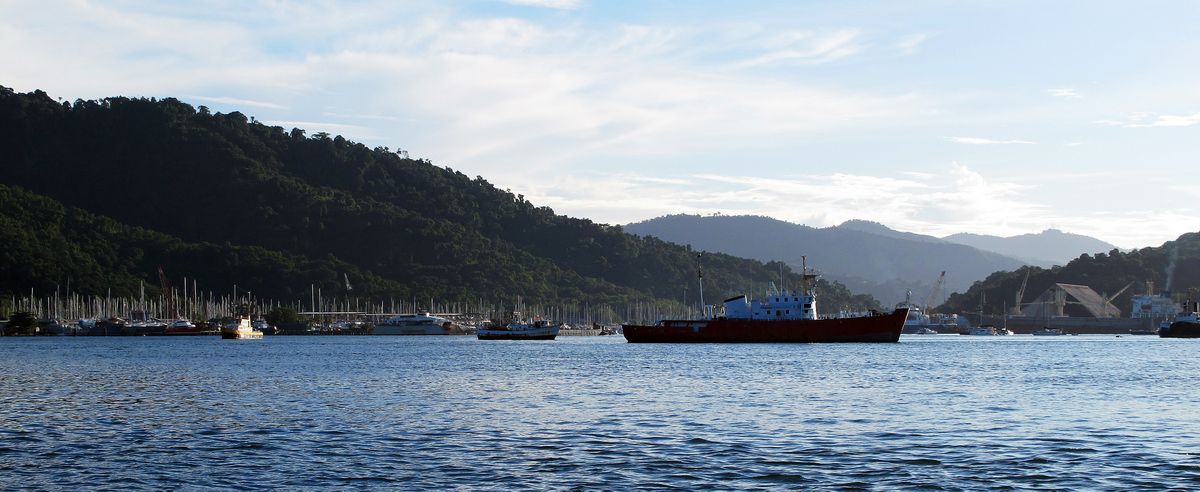
Glenys rustled up bacon and eggs for breakfast and we’d cleared in by half past ten. The main reason that we are here in Trinidad is to get our US Visas, so we submitted our on-line applications and caught a bus into Port of Spain and went to the Post Office to pay $140 each, for the privilege of applying for a visa. Once that small task was done, we were starting to feel pretty weary, so we ate a roti on a bench in Independence Square and caught the bus back to Chaguaramas.
We were back on the boat at two o’clock. I logged onto the Internet and arranged our appointments at the US Embassy for next Thursday. We then slept and chilled out for the rest of the afternoon, before going to the “Pot Luck” barbeque at TTSA. It was like coming home – we knew about half of the people there and had a great time catching up with everyone (and drinking our first beers for four days.)
25 October 2011 Chaguaramas, Trinidad
I spent most of the day on administration. We have all of our remaining possessions stored in the UK at Glenys’s brother’s house. Gareth has sold his house and is moving out at the end of next week. This is a bit of a logistical nightmare because our sons (Brett & Craig) are living in rented flats and don’t have anywhere to store our things. Brett is moving into a three bedroom house in a month, so I’m organising a lock-up store near where Brett lives and then will need to get the stuff moved from Lymington to Stevenage. Thank God for the Internet and email.
We had a little walk-about in the afternoon, trying to get a few things sorted out. We didn’t have much luck, because tomorrow is the Diwali holiday and most places had already started to shut down. Glenys managed to get a load of washing done in the launderette in Power Boats.
We had a quiet night in and went to bed early.
26 October 2011 Chaguaramas, Trinidad
It was the Hindu festival of Diwali today, so most of Trinidad was shut down. We had a quiet morning, doing admin and other things on the boat.
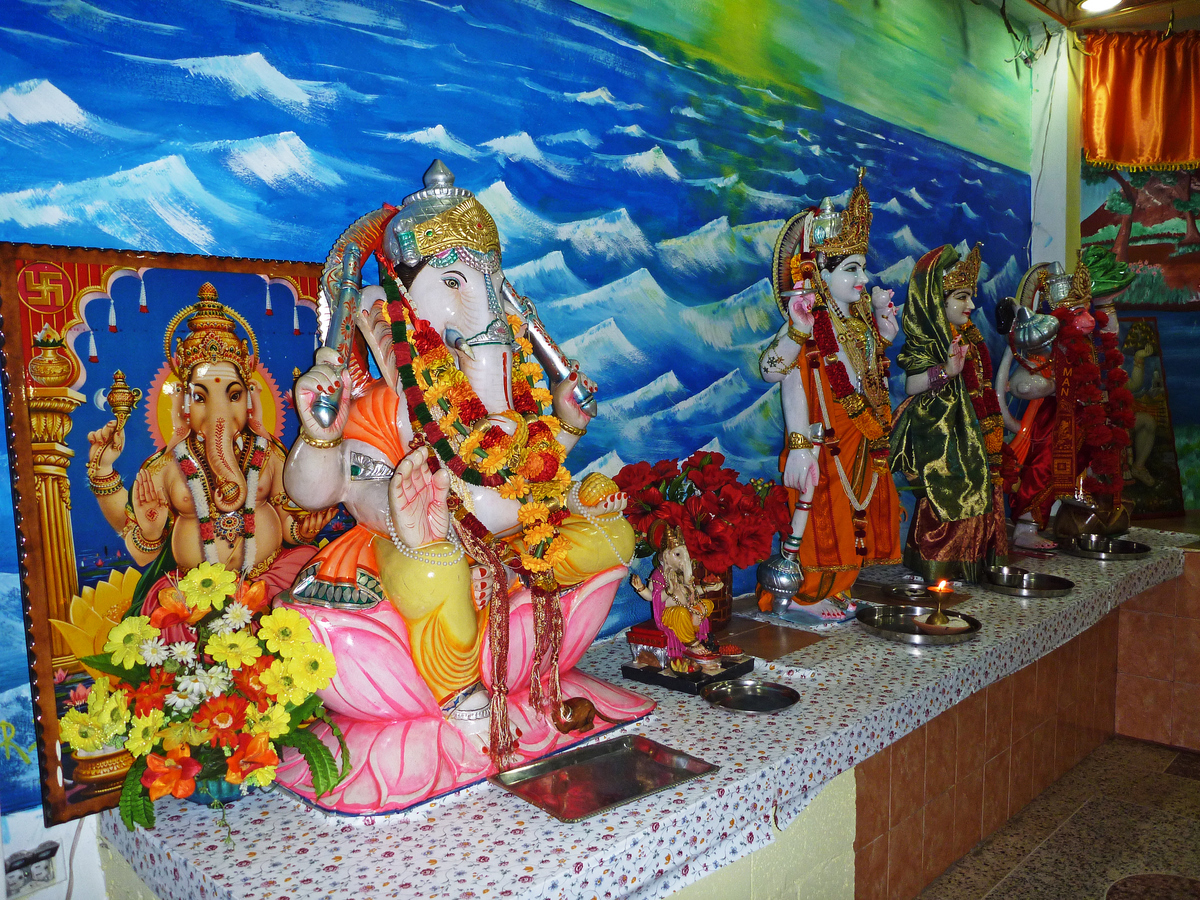
In the afternoon, we went on a trip that Jesse James, a local taxi driver, had organised to a Hindu community to take part in the Diwali celebrations. It was a big turnout with fifty or so cruisers packed in three buses. When we arrived, we were shown into a Hindu temple which had an impressive display of statues an paintings of the Hindu gods worshipped in this festival. One of the temple officials explained that although it’s a Hindu festival, Trinidad is one of the few places in the world where Diwali is a public holiday observed by people of all denominations.
We had a demonstration of Tassa drums, performed by a small band of three guys. Tassa is a traditional form of Indian music brought into Trinidad by “indentured” Indians in the 19th century. In a typical Caribbean way, Tassa ensembles have flourished in Trinidad and have the same sort of following in the Indian community as the Carnival Pan Bands have - it’s very loud. We then had a traditional meal of vegetable curries, served on banana leaves and eaten with roti bread.
After the meal, we walked around the streets. Diwali is the “Festival of Lights” and is held on the night with a new moon between mid-October and mid-November – this is supposed to be the darkest night. The locals set out lamps and candles on bamboo frames or lay out intricate patterns on the floor outside their houses. The traditional lamp is a small bowl filled with coconut oil and a wick. There are also big statues erected showing the various gods and demons that feature in the Diwali festivities.
It’s a fun, family oriented festival. We walked along the main street looking at the lights, accepting small gifts of sweets and dodging the firecrackers thrown by children.
27 October 2011 Chaguaramas, Trinidad
I’m still trying to get an engineer to look at our broken watermaker, but the only person that they can send is not at work today, so I’ll try again tomorrow. This left me with no great plans, so I spent the morning sorting out moving of our stuff in the UK and catching up on our web site. Glenys went into West Mall to do some cathartic shopping.
I feel a little trapped again – we’re waiting for the US Visa appointment in seven days’ time and I have no idea when the watermaker engineer will come out.
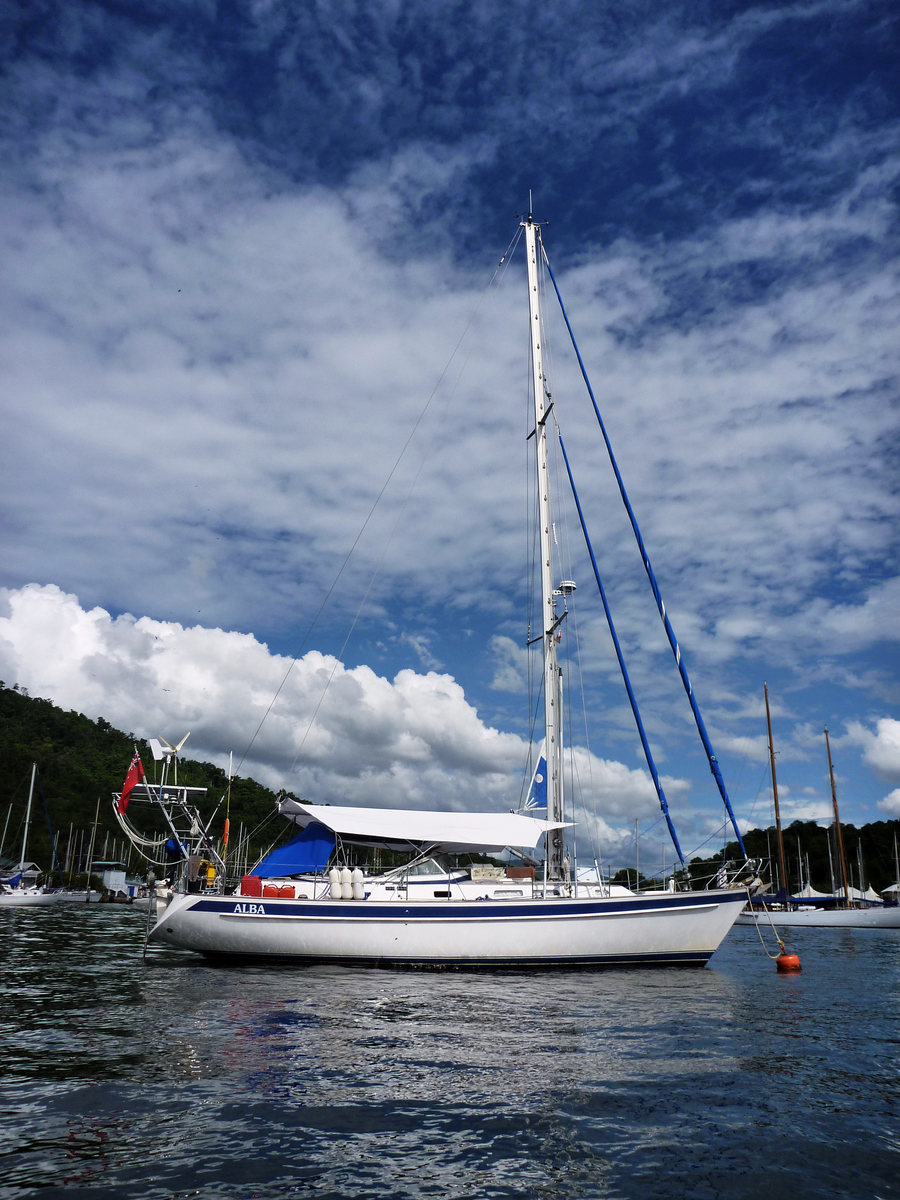
We’re having very heavy thunderstorms at the moment. The weather is pleasant first thing in the morning, but the clouds are building up before lunch. We’ve had some very close lightning strikes and huge claps of thunder before heavy rain starts. This doesn’t make it easy to do any jobs on the boat and the danger of a direct lightning strike on Alba is very real. Two yachts were struck a couple of days ago and had their entire electronic equipment blown out, including fridges controllers, generator panel and navigation equipment. It would be a real nightmare if that happened – we’d be trapped for months, while we replaced everything. Let us pray.
28 October 2011 Chaguaramas, Trinidad
I rang the water maker company and they will send somebody out first thing on Monday morning. We now have to make our fresh water last for another three days.
We have two water tanks connected together -the lower one is below the saloon floor and the other is under the port seat in the saloon. There’s a water gauge that should show the amount of water remaining in the lower tank, but it’s never worked. This has not been a problem before, because while we were making water, we always kept the top tank half full. After a week without running the watermaker, we’ve now emptied the top tank and it would be good to see how much water we actually have left in the lower tank.
I decided to remove the sender for the water gauge from the lower tank. This should have been a simple matter of unscrewing the sender from the inspection plate at the top of the tank, but this is a boat and nothing is easy. It was seized. As I put more force on the spanner, the whole plastic body crumbled apart. I then had to remove the whole inspection plate and spend 30 minutes with a small screwdriver scraping away the plastic from the threads in the inspection plate. I was left with a 40mm diameter hole in the inspection plate with nothing to screw into it.
I took the remains of the sender to Budget Marine, but they said they would have to import one from the USA and it would take a week. I decided not to bother, it’s more likely that it will take longer than that and I don’t want to be trapped in Trinidad any longer than necessary. I bought some “Starboard”, which is ½” thick plastic board and spent a couple of hours making and fitting a replacement inspection plate. So, after five hours of effort, I still don’t have any way of seeing how much water we have left…
29 October 2011 Chaguaramas, Trinidad
I started to make a table top for my fish preparation table that I had fitted to the stern arch. I cut it out from the remainder of the Starboard using a jigsaw on the back deck. It took three hours to measure up and cut the two pieces. Cutting the Starboard produces lots of small plastic flakes, which blow around in the slightest breeze and stick with static electricity to anything. I was covered from head to toe in the stuff. We’ll be finding these bits of plastic all over the boat for months.
In the afternoon, we went to the movies and saw Real Steel – a fun movie. It was great to be cold again in the air conditioned cinema. Back on the boat, I decided to publish some small videos to YouTube and added some pages to our website linked to the videos.
30 October 2011 Chaguaramas, Trinidad
It’s Sunday today, so we decided to go for a walk. Despite being in the Chaguaramas National Park, there aren’t a lot of places to go. The anchorage is surrounded by very steep hills with dense jungle, but there aren’t any paths close to us. A sketch map in the cruising guide shows a road up to the top of a nearby hill, but when we walked to the start of the road, a big sign said “restricted access”. As there’s still a State of Emergency in force in Trinidad, we decided to err on the side of caution and retreat.
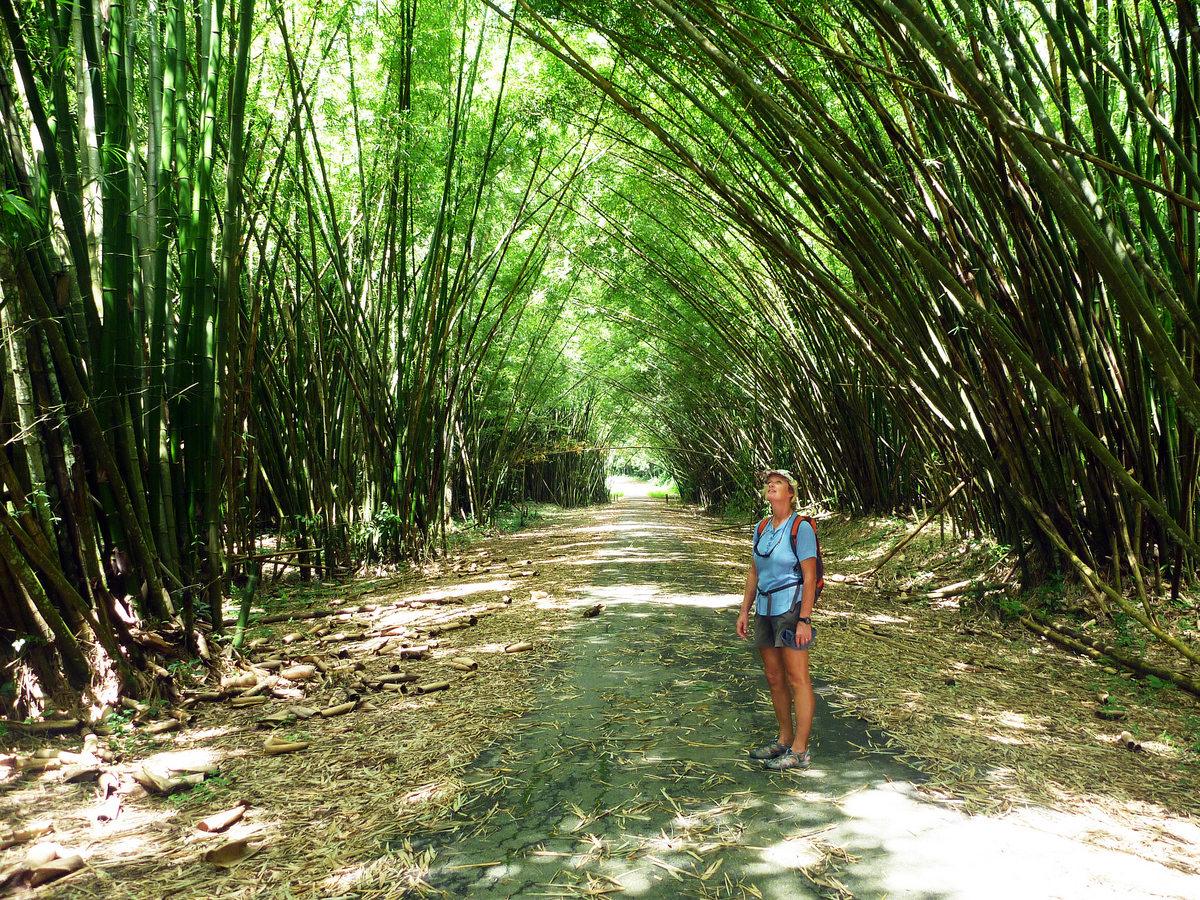
Fortunately, we had a Plan B. We walked three miles along a road to the Macqueripe National Park. It was a very long straight road with a couple of slight bends – very boring apart from seeing a few brightly coloured birds. When we arrived near the entrance to the park, we took a small detour following a sign to the “Bamboo Cathedral” which was beautiful - the track goes through a an area of very tall bamboo, which has grown in sweeping arcs across the road creating a tunnel twenty metres high – a lovely visual effect.
After walking up to a cliff overlooking the north coast of the island, we retraced our steps and went into the park, which only comprises a café and a beach. It’s advertised as the most beautiful beach in the area, but that description ought to be taken with a pinch of salt. We had a coke and walked back to the main road.
We arrived back on the boat at three o’clock. It was only a four hour walk, but we were tired – we’re not used to walking any more. We chilled out for the rest of the afternoon and then went for Ribs and Chips in the bar at Power Boats – we’re back in Chaguaramas...
31 October 2011 Chaguaramas, Trinidad
I picked up the Eco-tech electrician from the Power Boats dock and he agreed with me that the starter capacitor looked damaged after our overheating episode. He removed the whole pump and motor assembly, which was a struggle in the tight space at the bottom of a cupboard. The poor guy was suffering from a flu virus and after 30 minutes of struggling in the rolling boat, he looked pretty grim and somewhat seasick. He retreated in to the cockpit with a glass of water, while I carried the pump assembly and his tools into the dinghy. Hopefully, he’ll check everything today and we’ll get it back tomorrow.
Our wind generator has been playing up ever since I had the bearings changed a couple of months ago. When it has been running for a while in 25 knots winds, it goes into a “Free-wheel” mode and rotates at a very fast speed. I’ve had to switch it off a few times. While dropping off the Eco-tech electrician, I bumped into Doug who owns the company that manufactured the wind generator. I described the problem and he said to drop it in and he’ll get one of his guys to have a look.
We’ve been using Glenys’s brother’s house as our mailing address. Now that Gareth has sold his house, we’ve decided to move our mailing address to my brother Andrew. We suspect that Gareth is going to be moving again within the next couple of years, so it will be less hassle to move our mail to a more stable address. We prepared a list of thirty or so companies that need to know our new address and Glenys made a start by spending a few hours on the Internet changing addresses on line and printing off forms.
We went to the supermarket at Crews inn and called into see Bonnie & Maury on their Hallberg Rassey 43 called “Smidge”. They come from the Chesapeake area and we’ve picked up a bit more local knowledge on that area.
We went to the pot luck barbeque at TTSA in the evening and drank more beer.