
12 September 2011 Mount Hartman Bay to Los Roches, Venezuela (Day 2)
When we changed watches at four o’clock in the morning, Glenys said that she’d been a bit worried by lightning flashes in clouds ahead of us. By six o’clock, we seemed to be catching up a huge thunderstorm emitting spectacular bolts of lightning every couple of minutes. There was another one upwind and to the south of us. Half an hour later, the wind had veered to the south west and a big line of black clouds was heading towards us from the south. I decided to try to slip between the two systems, so I heavily reefed the main, rolled away the jib and motored north-west into the rising seas.
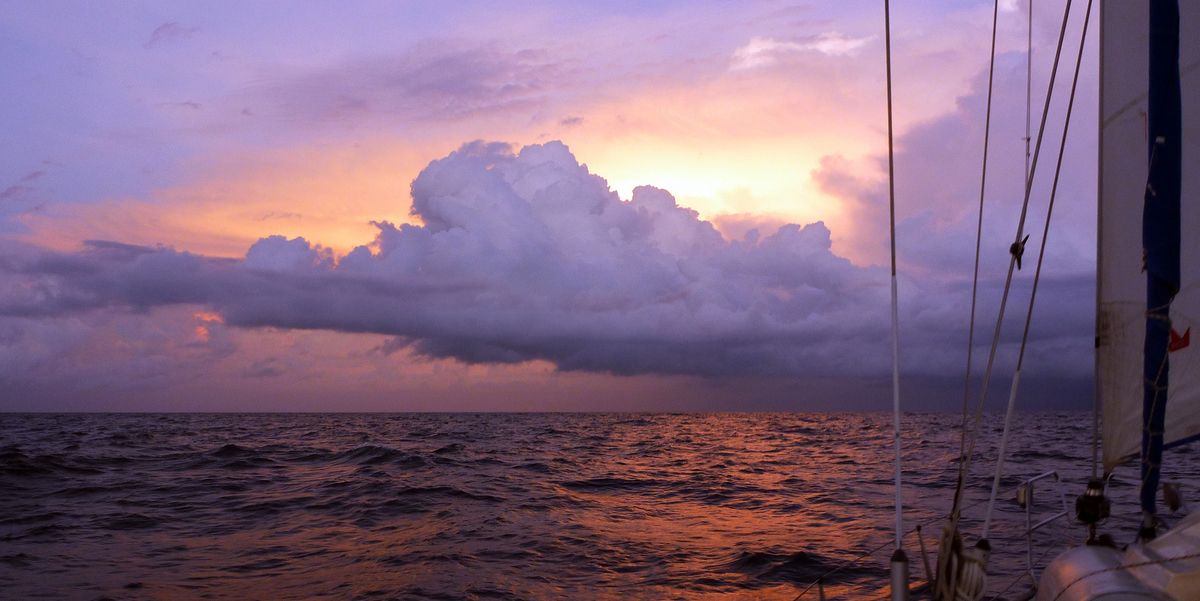
At half past seven, we were clobbered by 40 knot winds from the west and driving heavy rain. We kept heading north west, hoping that it would go past us, but an hour later, we still had 25 to 35 knot westerly winds and the seas were getting worse with 12 foot waves. It was very confusing – why were we getting west winds? We decided that it was a small low pressure system/ridge caused by Tropical Storm Maria, which is 200 miles north of us. Treating it like a mini-tropical storm, we tacked and headed south west as hard on starboard tack as we could. An hour later, the wind had abated to 20 knots, still from the west, but there were brighter skies ahead. The seas were still pretty horrible, but we managed to keep a south west course.
We debated what to do. Our options were pretty limited. We were originally headed for La Blanquilla, but the anchorages all face south or west and would be untenable. Other options included heading for mainland Venezuela to the south of us; going back to Grenada or continuing to bash westwards for another 24 hours and go to Los Roches. We decided that the wind would go back to the south east eventually, so we carried on motor sailing south west around the high, rocky Los Hermanos islands. After lunch, the wind backed and we were able to start sailing west again.
We surveyed how the boat had coped in the heavy winds and seas. A block on the main sail outhaul had been ripped apart, so I had to replace it with a spare. That took me 40 minutes, hanging onto the boom on the pitching deck. Glenys found that the front berth was soaking wet and everything inside a small cupboard under the windlass was wet as well. We hadn’t closed off a Dorado vent and, because we had two feet of solid water washing across our front decks, the sea had forced its way past the baffles and down into the cabin. I also suspect that we have a leak in the windlass or the hause pipe which has wet the inside of the cupboard - another job for the list.
We sailed past La Blanquilla and the wind continued to back. By sunset, we had 12 knots from the south and were on a nice reach doing 6 knots directly towards Los Roches.
This is our second night at sea and we’ve fallen into a regular three hour watch pattern. We had dinner at six o’clock, then Glenys does seven to ten, followed by me at ten to one, then one to four and four to seven. Breakfast at eight o’clock and the day continues.
13 September 2011 Mount Hartman Bay to Los Roches, Venezuela (Day 3)
It was another wonderful moonlit night with the wind continuing to back to 20 knots from the south east.
Just before dawn, I had a nail-biting hour while we passed a mile to the north of the low-lying island of Orchilla. I could see a light house, but the light was flashing every nine seconds and there was nothing on my chart that matched that signature. I assumed that it was a lighthouse on the west side of the island, but was it? The GPS chart plotter was telling me that we were on course, but should I trust it? Sometimes the chart plotter doesn’t tie up to the GPS position and shows that we are on land when we plainly aren’t. As the sun rose, I could see the island a good mile away, so I could relax again.
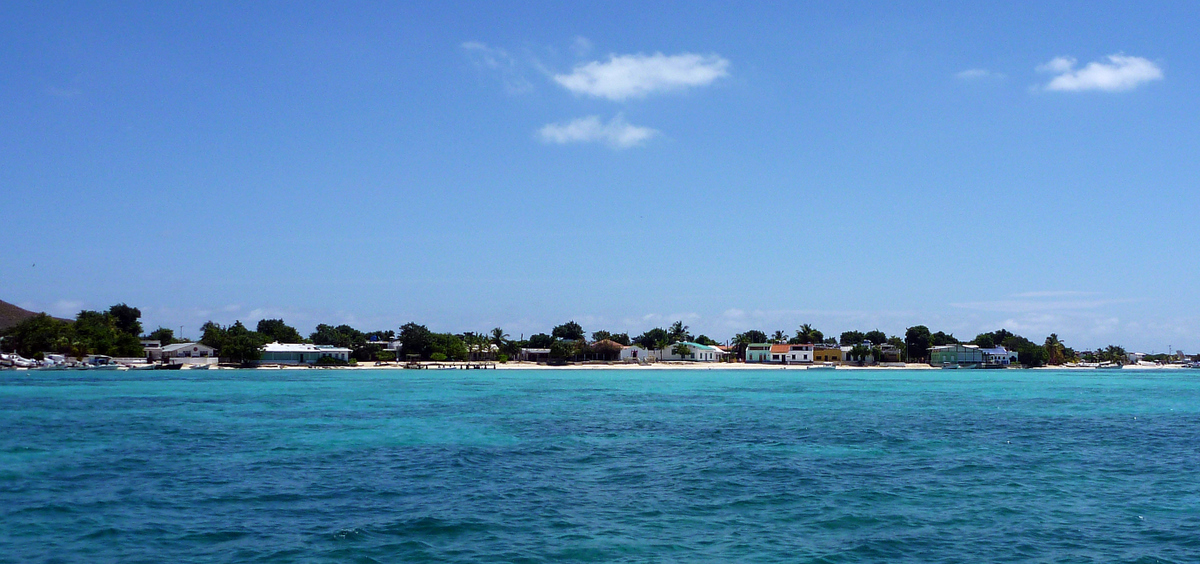
We arrived in Los Roches at eleven o’clock in the morning and anchored off the small town on El Grand Roche. I put the dinghy into the water and we went ashore to clear in. It took us four hours to sort everything out –mostly our fault because we couldn’t speak Spanish and no one spoke English. We made a mistake and went to the Guardia Nacional first, thinking that it was the coast guard. The officer booked us into his ledger and stamped the back of our exit papers from Grenada. We went to the Parks Authority (Inparques) and booked in there. They said that we didn’t need to see the coast guard, which confused us because we thought that we already had. In contradiction, they also seemed to say that the coast guard would tell us how long we could stay.
We went back to the Guardia Nacional (who we still thought were the coast guard) and they said that we should go to the “Armada”. One of them escorted us past the Parks Authority to the Coast Guard building– duhhhh. We were duly entered into their ledger, given a document and told that we had to go to get stamped by the Parks Authority, the Guardia Nacional and the Los Roches Authority (Authoridad Unica). The coast guard officer would only let us stay 24 hours and we should come back with the stamped form.
We went back to the Parks Authority, but that was now closed for lunch. The Guardia Nacional guy was surprised to see us again, but duly stamped the form. We eventually found the Los Roches Authority building, but that was also closed for lunch. The sign on the door said it would reopen at two o’clock, so we went to a restaurant and had lunch.
It took over an hour to get served and we baked in the heat even though we were shaded by trees. It’s a good job that we had a long lunch because the Los Roches Authority didn’t open until three o’clock. They quickly entered us into their ledger and stamped our form. We walked back to the Parks Authority and then onto the Coast Guard. The officer still wouldn’t officially give us any more than 24 hours, but using a chart, he indicated that unofficially, as long as we keep going west, he wouldn’t mind if we stopped a couple of places as we leave. He took the form from us and placed into a drawer in his desk, so we walked out without any documentation – very strange. They were all very friendly and it was incredibly frustrating to be unable to talk to them properly.
When we got back to the dinghy, we found that there were loads of kids playing on it and the wind had changed causing it to bash against a very sharp piece of metal on the rusty dock. The surface of the tube has been badly scratched, but fortunately no punctures. We upped anchor, motored a mile to a small island called Francisqui and collapsed – we were both very tired and dehydrated.
The small island has a beautiful white beach, and is obviously a place where the tourists are brought for the day. Fast pirogues rush between here and El Grand Roche, blaring out loud music - not quite the idyllic, deserted island paradise that we're looking for. Fortunately, they all disappeared before sunset.
A guy called Josh came by in a kayak for a chat. He’s skippering a catamaran for a rich Venezuelan and has been based here for a year. We invited him on board for a beer and he was glad to talk English for the first time in a couple of months. He says that there are very few foreign boats come here, the majority are Venezuelan. He has an unlimited internet connection via satellite ad gave us the pass code for his wireless network. When he left us I was able to get a weather forecast – it still shows SE 20 knots.
14 September 2011 Los Roches, Venezuela
I woke up at half past six wondering where I was – it took a few seconds to realise that we were in Los Roches.
I jumped out of bed, feeling much refreshed after an undisturbed night’s sleep. We pottered about and tidied up the boat, drying the front cabin and the £200 of engine spares that were in the front cupboard. It was blowing a consistent 20 knots from the southeast, so it stayed cool in the boat all day. There’s a kite surfing centre on one of the other small islands in this atoll and Josh came screaming by waving at us – so that’s what he’s been doing out here for a year.
We went snorkelling. The water wasn’t as clear as I expected and most of the coral is dead, but there are lots of fish around. We saw Ocean Triggerfish which are not common in the West Indies and loads of Barracuda. Hopefully the snorkelling will be better in other places in the Roches.
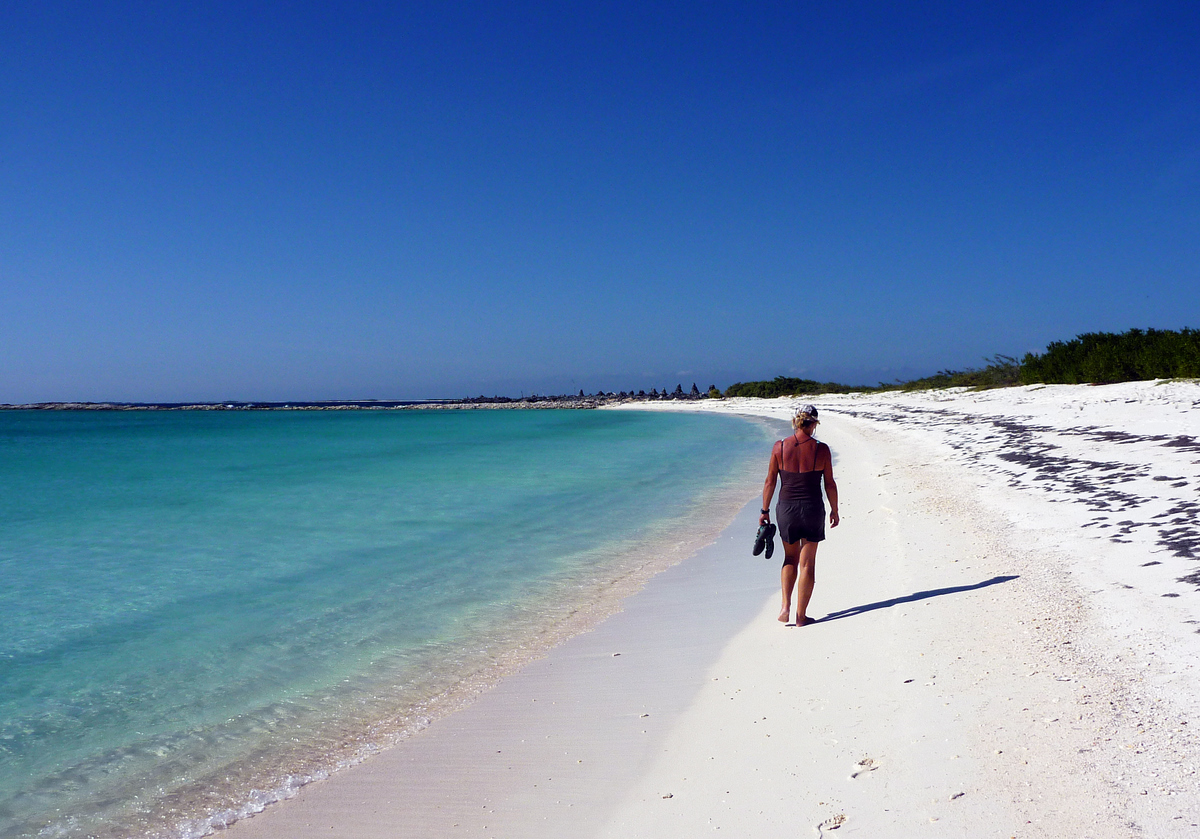
After lunch, we headed west. It was tempting to stay for another day and play with some of Josh’s toys, but we thought that we should honour our gentleman’s agreement with the Coast Guard. We sailed five miles with just the jib out. I reckon that the electronic charts on our chart plotter are about ¼ mile out – the GPS position shows us to be ¼ mile further south east than the chart. So without accurate charts, it’s a little scary sailing around the reefs, but the water colours are so bright that it’s easy to see how deep the water is.
We anchored off Crasqui Island about 400m from the beach in 3.8 metres of water. I guess that we could have gone further in, but our bottle went. The beach is stunning white sand, so we walked the full length of it – about a mile. There is a small beach bar at the south end where we found a small group of tourists who had been dropped off for the day. No loud music though which was nice.
It was a fabulous sunset, but no green flash. There are only four boats here and the closest is ¼ mile away - I like it here.
15 September 2011 Los Roches, Venezuela
We pottered about until ten o’clock waiting for the sun to get higher, so that the light is better for navigating around the reefs. It was only a short 5 mile hop to Sarqui so we motored there. We skirted around the south side of Espenqui following the reefs which are easy to spot in the brilliant light. However, we did have to make a ninety degree turn as we approached Espenqui because I’d misread the chart and there was a very shallow bar in our path.
The anchorage at Sarqui is on a fairly small, shallow strip of sand. There were already four boats anchored there, so we anchored in deeper water among the coral heads. I don’t think that we touched any with our chain, but I felt nervous in case any Park Authority boats came along, especially because officially we should have already left. We went for a snorkel, had lunch and then sailed to Carenero.
The anchorage of Cayo Remanso is lovely. There are mangroves to the east where pelicans dive down to gulp up small fish and to the west is a large lagoon stretching into the distance. We went snorkelling on the outside of the reef, but again I wasn’t impressed – most of the coral is dead and the fish are very wary of us.
Just after the sun went down, the black mosquitos arrived, so we hid down below and then put up the cockpit mosquito netting while we had dinner. I felt incredibly tired in the evening and suddenly had to rush to the toilet with spectacular results. I took some Immodium and went to bed before nine o’clock.
16 September 2011 Los Roches, Venezuela
I only just managed to drag myself out of bed before eight o’clock. I felt much better after sleeping for eleven hours.
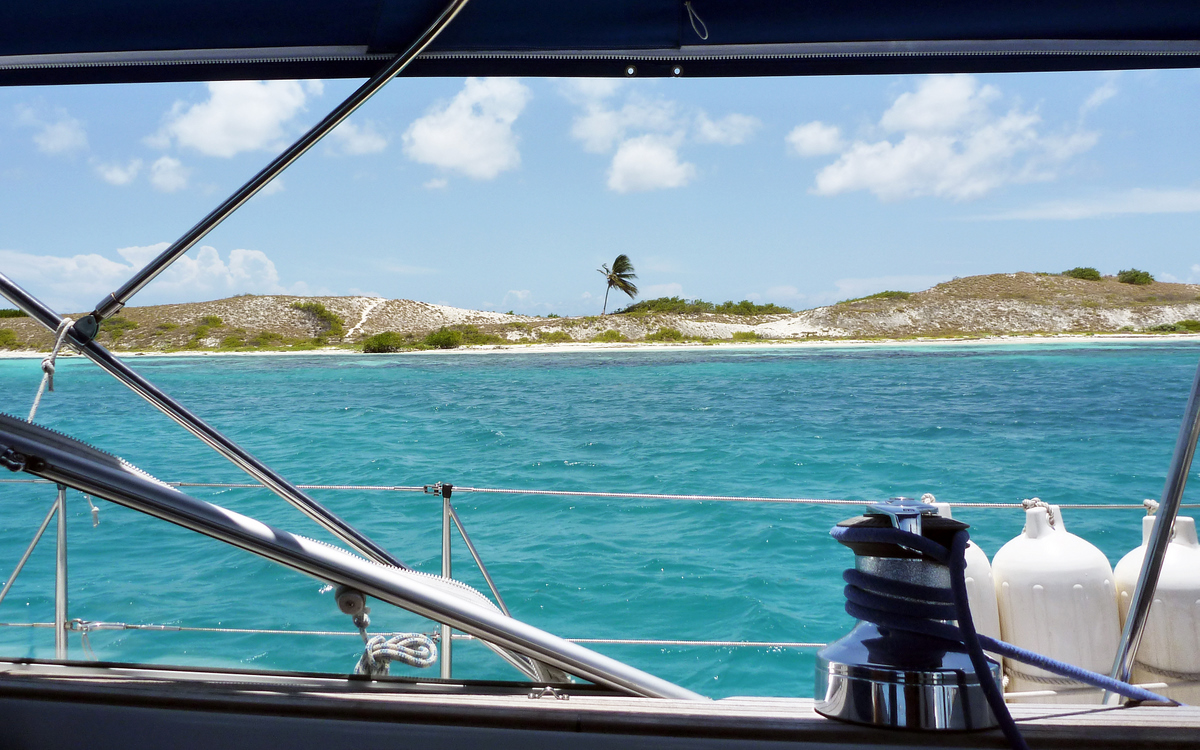
We sailed down to Cayo de Agua, which has an approach through shallow water with coral heads sticking up. It wasn’t too difficult to get into the anchorage which is beautiful and well protected. We anchored off the beach and after lunch went for a walk. The island gets its name from the water that can apparently be found a few feet below the surface. It is a very dry desert island apart from a couple of groves of palm trees that look like an oasis. We walked over to the palm trees, but didn’t spot any of the water holes mentioned in our pilot book.
There is a small anchorage on the south side of the island that looks stunning. It's exposed to the south and would only be good in very settled weather.
I felt really tired in the afternoon again and had a nap for ½ hour. We had a couple of rain showers come through later in the afternoon, but it settled down in the evening. I couldn’t motivate myself to put the dinghy on the front deck and get ready for sea, so we decided to stay another day and go to Les Aves on Sunday.
17 September 2011 Los Roches, Venezuela
I woke up aching all over and feeling very tired - I’m still suffering from a stomach bug. The symptoms aren’t too bad, so I decided to let it run its course and didn’t take any more Immodium. It was probably the salad with the meal that we had in El Gran Roches when we arrived. We’ve been very lucky that we’ve not had any problems with food or water until now.
We had a very lazy morning, reading and we went snorkelling for an hour. After lunch, I felt so tired that I went to bed for 1½ hours in afternoon. It took a major effort to drag myself out of bed. I put dinghy on front deck ready to go tomorrow, which exhausted me again.
I managed to stay awake through dinner and sloped off to bed at quarter to eight.
18 September 2011 Los Roches to Aves de Barlovento, Venezuela
I was up at seven o’clock feeling much better. I still had a couple of runs to the toilet, but it seemed to be manageable. We picked up the anchor just after eight o’clock and picked our way out of the anchorage between the coral heads.
There was only 10-12 knots of wind and we were going directly downwind, so it was a nice slow, gentle passage. I rigged up the spinnaker pole to hold out the jib and we ran down wind at 3-4 knots. I had a couple of fish pick up my fishing lure, but neither were hooked – I guess that we were going too slow. Glenys spotted a big shape in the water and, to our amazement, a five foot sail fish swam past our starboard side – I was praying for it to take my lure, but no chance. I wonder if it was attracted by my new “bird” teaser.
We arrived at Aves de Barlovento in the middle of the afternoon and then motored through the reefs to a stunning anchorage. The colours are even more vivid than Los Roches. There are about ten yachts anchored here, which was a surprise. When we were here fifteen years ago, we were the only yacht anchored in this area.
We said hello to Kim on “Gabrielle” (USA) who has been out here for four months. We then went snorkelling and I managed to spear two reasonable sized grouper with my pole spear. The snorkelling was very good with live coral and lots of fish.