
21 October 2013 La Chunga, Darien, Panama
A huge tree came floating down the anchorage this morning, missing “Grace” and “Windsong”, but heading straight for Alba. “Grace” and “Lil Explorers” managed to push it aside with their dinghies and tied it to the river bank, so that it wouldn’t come back on the flooding tide. The damn thing must have been 20 metres long and 2 metres in diameter – it was big enough for people to stand on and would have caused chaos if it had snagged on someone’s anchor chain in the strong three knot current.
We got on with some jobs during the day. Glenys got out her sewing machine and replaced the webbing loop on our main sail – her Sailrite swing machine is worth its weight in gold. The pump which drains our front shower tray has stopped working – we’ve been hand bailing the water out into the sink for over a week now. I had a spare pump, so it only took an hour to change it over, I now need to service the faulty pump – two jobs off the list and another one added.

“Windsong” left at midday. Ann had stepped on a rotten plank on the boardwalk yesterday, punched through it and has badly twisted her ankle, so they’re getting out of here. If it doesn’t get any better in a few days they can then head back to Panama City to get some medical attention.
The rest of us went into the village in the late afternoon. Again, lots of the villagers came out to see us in the central meeting place. I’d printed out some photographs that I took yesterday and handed them out to various people – they liked that small gesture.
The evening meal was prepared in typical home – thatched roof, open on three sides, on stilts using a log carved with steps to get up. The cooking was done on an open fire on a big stone slab. I found it interesting how they didn’t use the flames, but kept the logs smouldering, pushing the embers beneath the pots. I guess that it’s more controllable –similar to a charcoal barbeque. The lady made some kind of chicken stew and served it with rice. It was tasty but we had some questionable bits of chicken – backs, necks, etc.
The sun had gone down by the time that we got to the dinghy, so it was a little fraught going down the small tributary.
22 October 2013 La Chunga to Punta Garachine, Darien, Panama
This was our last day in La Chunga, so “Lil Explorers” invited the villagers to come for a typical American breakfast on their 55 foot catamaran and about 10 adults and 20 kids turned up. Glenys fried up all of our remaining bacon, Ann from “Grace” produced a big pan of scrambled eggs and Shannon produced the pancakes in “Lil Explorers” galley. Everyone was well behaved and mostly sat around patiently waiting for their meal. It was a nice departing gesture.

At eleven o’clock, we left the lovely anchorage with “Grace” because we had an outgoing tide allowing us to drift down stream. We arrived at the mouth of the Rio Sambu at low tide and anchored for a couple of hours wait for the mid rising tide.
At half past two we pulled our anchors and motored out of the river to cross the mud flats. I led the way and basically reversed the route we followed coming in – the shallowest depth was 2.9m, so we got it right. Also, thankfully, there were no long, fixed nets in our way, although I had to slightly dodge a couple of fishing boats putting out nets in a 100m circle.
We had a nice 15-20 knot wind, so once we were clear of the mud flats, we put up our sails and had a cracking beat up wind. The repair to the main sail looks good. We sailed up to Punta Garachine, but the recommended anchorage looked to be too close to shore for us, so we headed further south towards some mangroves and anchored in seven metres in good holding mud. This anchorage is nice and protected from the west, but would be hell with any east in the wind. The jungle on the peninsula is interesting with huge trees sticking out of the canopy.
We’ve had an interesting ten days in the Darien region. It started off a little slow because we hadn’t done enough research of the area enough before we set out. Travelling with a group of boats worked very well in this isolated region, giving some security in the case of a breakdown or grounding and also we’ve seen other aspects of the Wounaan and Emberá cultures that we wouldn’t have seen by ourselves – the children on “Lil Explorers” were certainly great ice-breakers.
I’ve produced some navigation notes for the area which can be found in our Cruising Notes page.
23 October 2013 Punta Garachine to Isla Espiritu Santo, Las Perlas, Panama
I was woken up at half past six by the sound of voices fairly close to us. It turned out to be one of the fishing boats which lay one mile long nets in the bay. They circled us and looked suspiciously like they were planning to drop one end of their net close to where we were anchored. I didn’t fancy getting ensnared by a net, so I dragged Glenys out of bed and we left fifteen minutes later. By this time, the fishing boat had anchored just behind us and looked like they were waiting for either the tide or for us to move.
There was very little wind for the 30 mile trip back to Las Perlas, so we motored most of the way apart from a couple of hours bobbing along at 3-4 knots on a beam reach. I put out our fishing lines and had five strikes. Three Dorado managed to throw the hook by leaping out of the water; one big fish took one of my lures by snapping the 60lb monofilament line and I landed a nice 3-4ft long Dorado. Glenys made fish sandwiches for lunch – it’s nice to be back at sea.

We anchored in Isla Espiritu Santo in the early afternoon and collapsed in the heat – reading and catching up on a little sleep after our early start. “Windsong” are here and also another boat called”Eyoni”, who came over to say hello.
24 October 2013 Isla Espiritu Santo, Las Perlas, Panama
We had a quiet day, staying in one place for a change – we feel like we’ve been constantly on the move for two weeks, so it was nice to just chill out again. We ran the water maker, which we’ve not been able to do in the Darien Rivers because of the silt, then Glenys did some laundry washing some of our smalls, which have been building up for three weeks.
Ethan from “Eyoni” and Andrew from “Windsong” came over and said they were going spearfishing off the south-east side of Isla San Pedro, so I went along. This was the first time that I’ve been snorkelling in the Pacific and it was interesting. The visibility was very poor at five metres, but I still managed to see some unusual fish (to me anyway) – I spotted a large Scorpionfish of some kind and some strange looking fish that looked like grouper but with unusual patterns – I’m going to have to buy a book to identify these Pacific fish. However, the most exciting thing was hearing the eerie calls of Humpback Whales every time that I dived down.
After our lunch (Dorado sandwiches of course), the heat got to us and we had a little siesta. By four o’clock, it had cooled down enough to do a few little chores like cutting my hair which has been driving me mad for over a week. I also dived down to check that we hadn’t damaged the propeller when we hit a couple of logs going up the Rio Sambu – it’s fine.
We had a classic little conversation this evening. A squall was passing over with heavy rain and the odd roll of thunder; I was down below playing the guitar and Glenys was up in the cockpit. I wanted our iPad because I have some music scores stored on it, so I asked Glenys, “Do you have the iPad?” Her answer was “No, it’s in the oven.” Of course, where else would it be?
25 October 2013 Isla Espiritu Santo, Las Perlas, Panama
We had very quiet day in. I spent most of the day down below editing photos and catching up on my blog. There’s no internet connection or even a mobile phone signal here, so I can’t publish anything to my website, but at least it’s all ready to upload.
Glenys got out her sewing machine and was very enterprising, making some scatter cushions out of two of her molas.

26 October 2013 Isla Espiritu Santo, Las Perlas, Panama
It was another chill out day. I got it into my head that I should publish some navigation notes about the Darien region, so I spent most of the morning writing that.
The annual subscription for our satellite phone email expires in a couple of days and the provider (Ocens) wants $240 for the next year. I’ve decided to switch to a UK provider (Mailasail) who charge a little less, but include a blog page, which I can publish to using my satellite phone. I think that a blog page will be useful when we do our 3000 mile passage to the Marquesas next year.
Anyway, I decided to load the Mailasail software and after a little bit of effort got it to work and send test emails to Mailasail. Unfortunately, my laptop is now confused and the Ocens software won’t load, so I can’t download any more GRIB files to look at the weather. It’s very frustrating because we need a weather forecast, so that we can plan our passage to the western end of Panama, which will be an overnight passage.
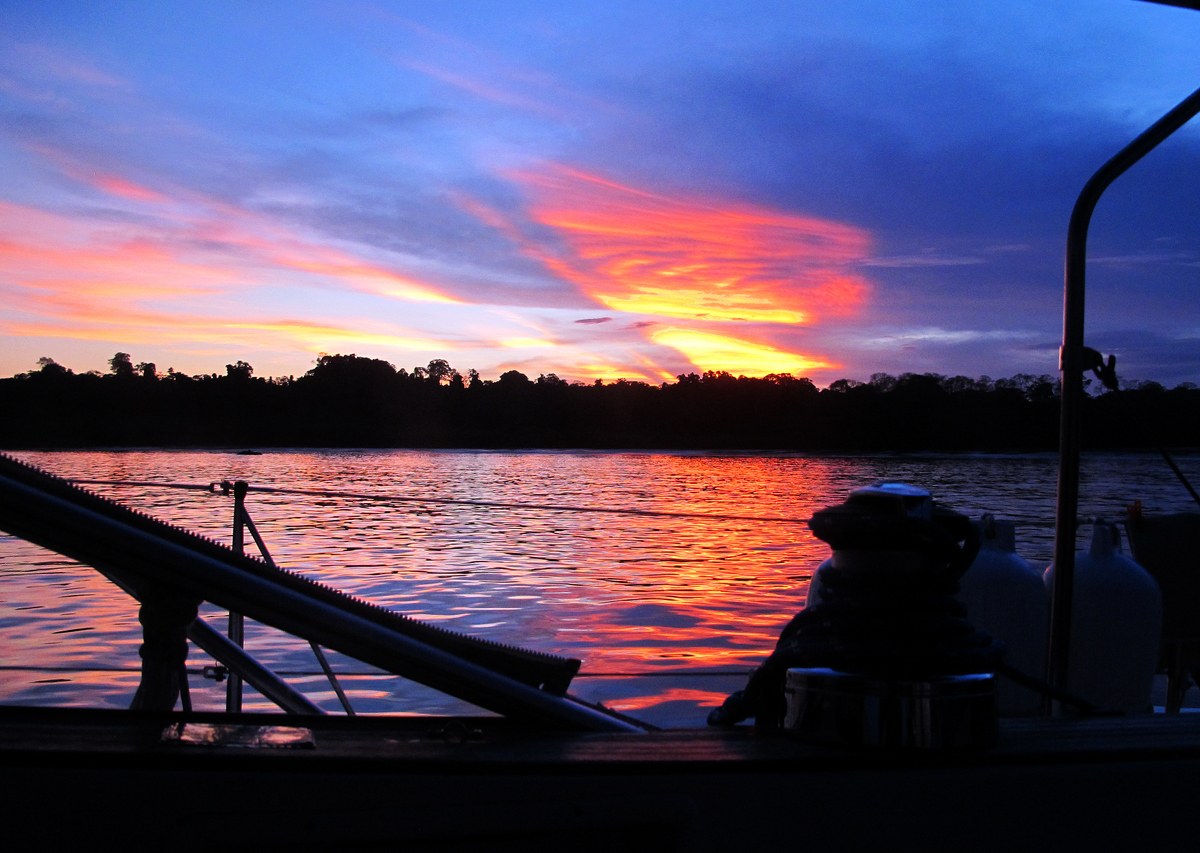
In the afternoon, we went for a walk on the small island to the west of the anchorage and ended up walking around the whole island because it was low tide. It’s pleasant to be walking around again - we haven’t been off the boat for five days. We spotted some Agoutes - a rodent that looks like a huge brown guinea pig.
Grace and Windsong came over for farewell drinks – they’re off to Panama City tomorrow and we’re going to move on as well.
27 October 2013 Isla Espiritu Santo to Punta Cocos, Las Perlas, Panama
We were going to go to Isla Contadora to get some more provisions because we’re running out of drinks again, but we’d be heading back north and can’t be bothered, so we went down to the south end of Isla Del Rey – we feel like it’s time to start heading towards Costa Rica.
We made a valiant attempt to sail, but there was very little wind and it was veering around all the time – I’m resigned to motoring in this area. I’m starting to get a bit worried about diesel now – we’ve used up half of our tank since leaving Shelter Bay marina and there’s nowhere in Las Perlas to buy fuel. We’ve got 350 miles to go before we get to Golfito in Costa Rica and we’ve got enough fuel to motor 400 miles, so it will be a close run thing if we continue to get no wind.
I had a poor day’s fishing and only hooked one big fish, but it threw the hook by leaping dramatically out of the water - I think that it was a big Wahoo because the paint on my Cedar Plug was all torn up.
We first went to the Rio Cacique Bay, but the swell was coming straight into the bay and would have been very rolly. So we motored across to Punta Cocos which was much more protected – a little bit of swell gets around the corner, but it’s just a nice rocking motion. It’s a pleasant anchorage with some dramatic cliffs on the headland. There’s a “Servico Maritimo” base here with a very nice new dock.
28 October 2013 Punta Cocos to Isla San Jose, Las Perlas, Panama
We woke to another flat calm day and motored across to Isla San Jose. I had a good fishing day – five strikes and I landed five fish. I initially caught two small Bonito and thought that I’d try to get another Dorado or a Wahoo (which continue to elude me.) A big 15-20lb Horse Eye Jack hit the lure on my birds, but I didn't like the look of it, so I let it go. Then we must have run through a shoal of Tuna because two big 10lb Bonito hit both of my lures – took me a while to land both of them.
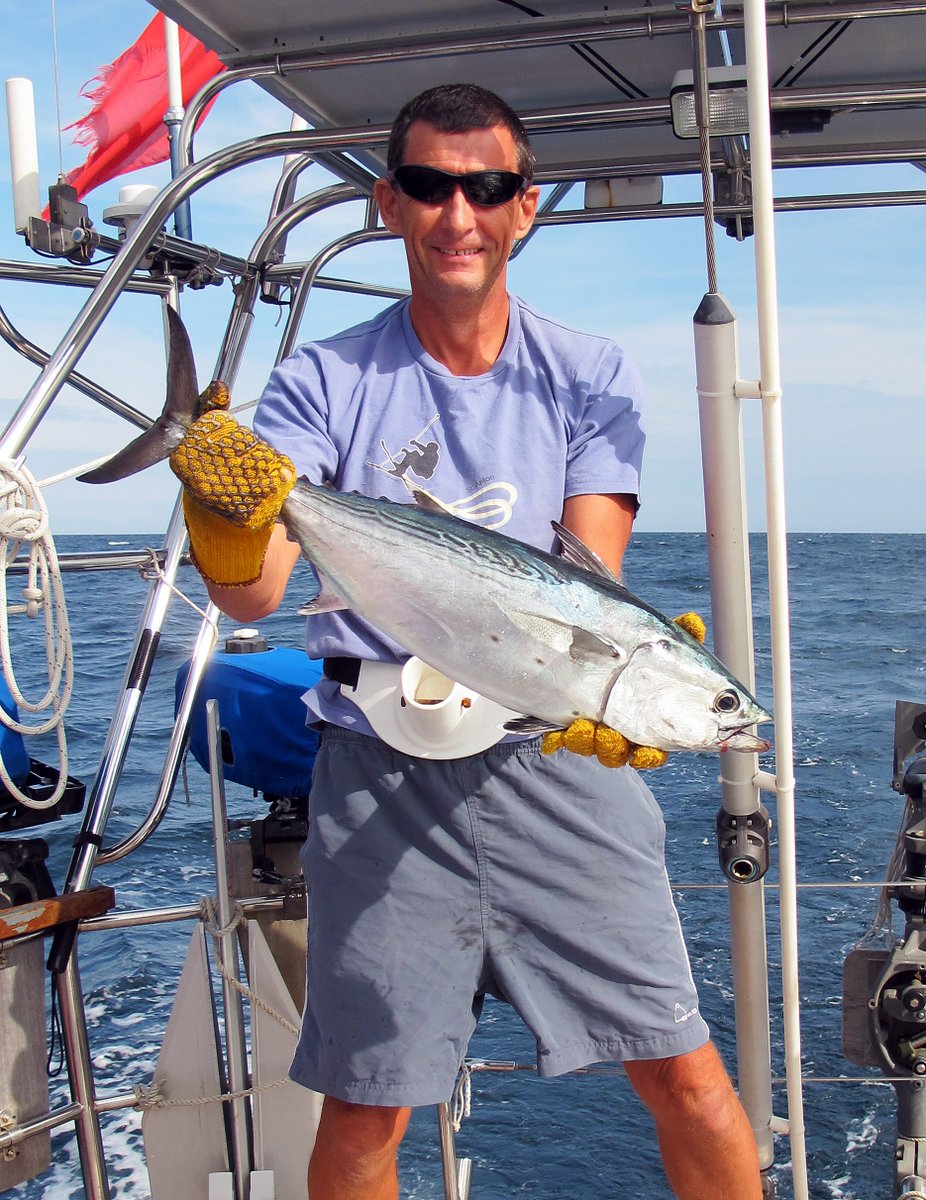

I'm having some good luck with fishing and I think that using birds is very effective. I have a train of five small Birds skipping on the water about 50 feet behind the boat with a squid lure “chasing” them. The birds are there to splash on the surface of the water to attract the attention of fish. I then have another lure attached to my fishing rod, which is trailing further behind the boat. I've started to use a Cedar Plug lure on my rod, which has proved to be very productive even though it’s just a simple torpedo-shaped piece of wood. I think that it works well because it jigs around a lot and the fish don’t have time to really look at it.


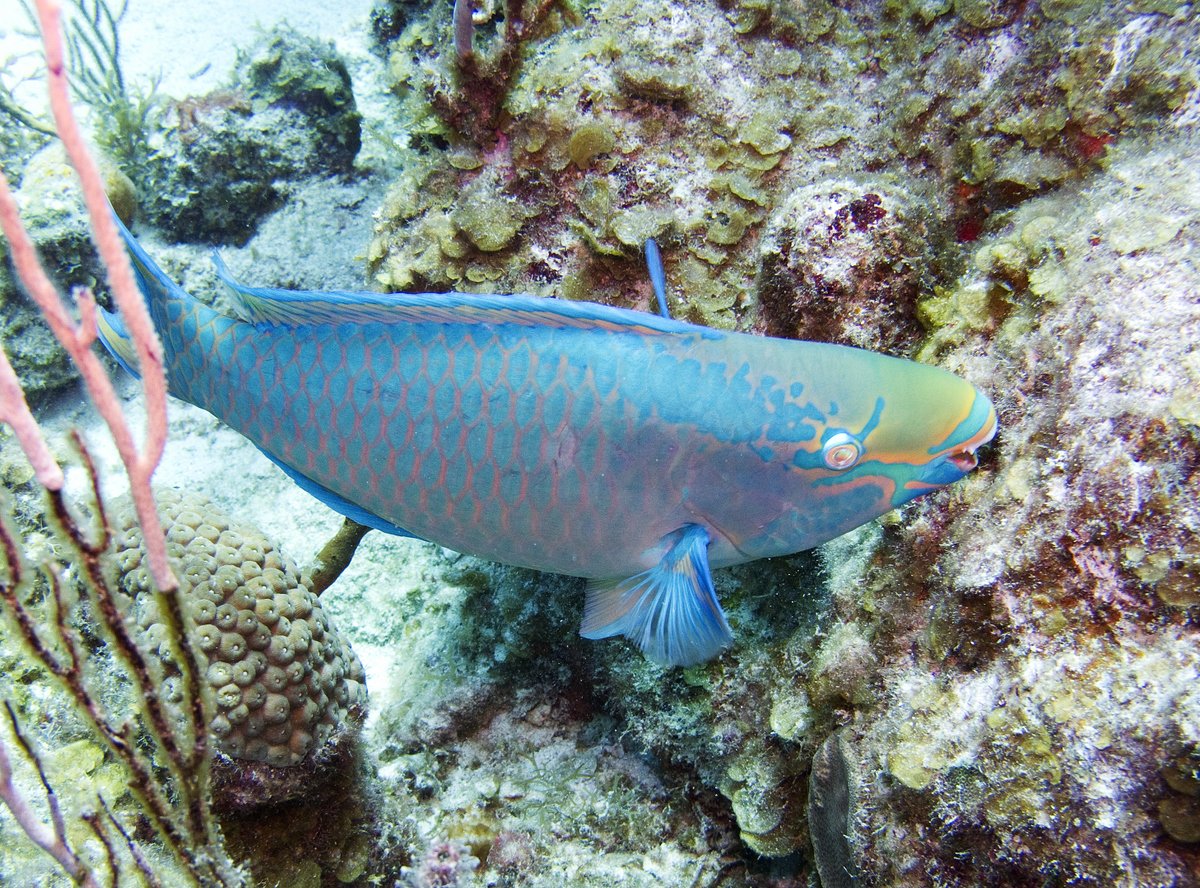
We tucked ourselves in the western corner of Ensenada Playa Grande, which is a lovely looking anchorage. There’s a long dark brown beach and lots of rocky outcrops for snorkelling. The water looked clear, so we went snorkelling on a small headland, which was good. The sea bed is mostly rock, but there is some coral around. We spotted quite a few huge Parrotfish – they’re definitely bigger than the ones in the Caribbean.
Las Perlas were named by the Spanish conquistadores because the islands produce some of the best pearls in the world. While snorkelling, I noticed a very bright shell on the sea bed, which looked to be a fragment of a pearl oyster with beautiful mother of pearl lining the inside of the shell. This gave me enough of a clue to identify the Pearl Oysters and I picked up two, but alas, there was nothing in them apart from some ¾” long baby lobster…

I managed to sort out my satellite email. After uninstalling, rebooting and reinstalling several times, I gave up on the Ocens software and emailed the sales team at Mailasail using their test account. They were very good and enabled my email account before I’d actually paid for it. Thankfully, I was then able to download a GRIB file, which shows that the wind around Peninsula de Azuero should be less than 10 knots tomorrow night. It will be against us, but at least it will be light. There’s a headland called Punta Malo (Bad Point) which gets strong currents and overfalls, so we don’t want to be going around that in heavy winds. The GRIB file shows that the weather will get worse over the next few days, so we’ve decided to head west tomorrow.
29 October 2013 Isla San Jose to Ensenada Naraja, Panama (Day 1)
The alarm went off at ten minutes to six and, five minutes later, we had a heavy shower – not a good start. We were unsure whether to go or not, so I downloaded another GRIB file, which showed that it was still going to be light winds tonight and get worse in a few days, so we tidied up and left just before seven o'clock. As we were leaving the anchorage, we saw lots of Manta Rays jumping out of the water, some doing somersaults – I must find out why they do that.
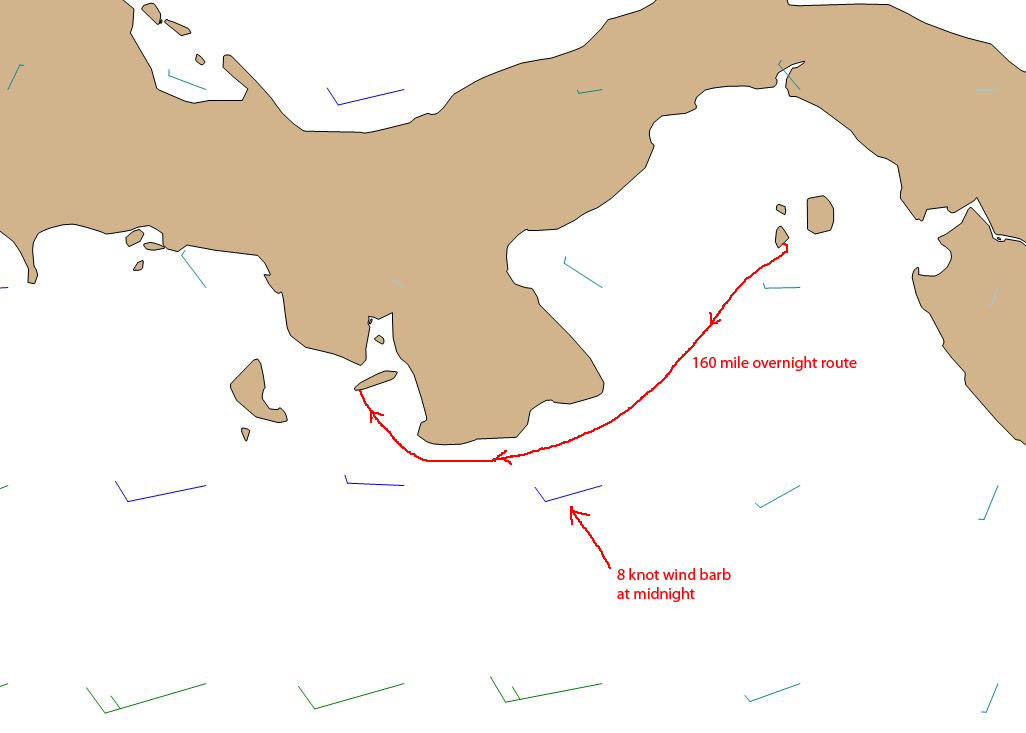
There was no wind for the first hour and it rained a few times, but gradually brightened up. We then had a pleasant 10 knot wind from the North West giving us a nice reach until one o'clock, when it dropped off again. I was feeling dynamic and pulled out our asymmetrical spinnaker out, but the wind was too light and we were only making 2-3 knots, so after ½ hour we gave up and turned on the old iron topsail.
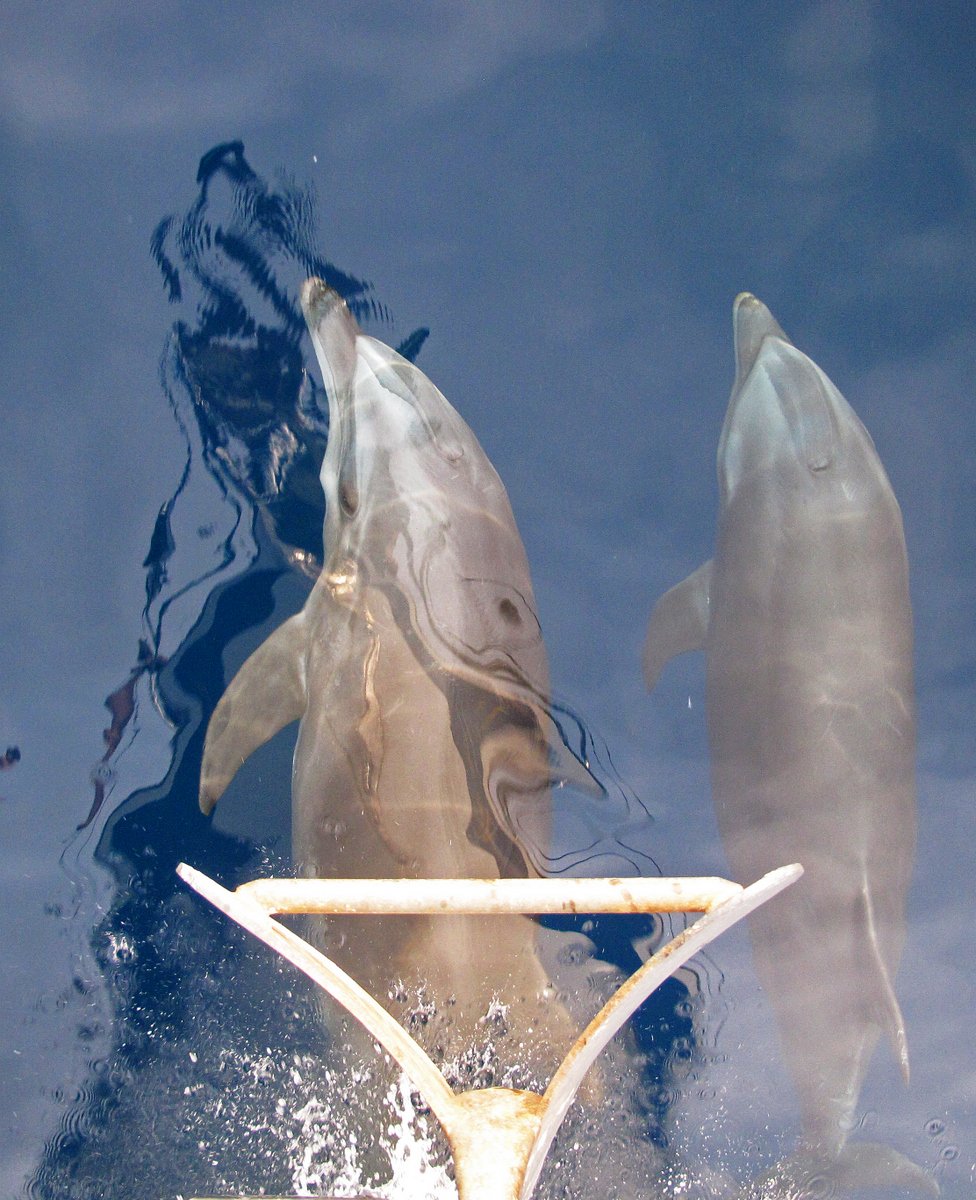
We came across lots of Bottlenosed Dolphins who cruised in our bow wave and accompanied us for long stretches of time. We also kept catching glimpses of some fish showing a single dorsal fin sticking out of the water. It was definitely a fish with a folding fin, not a shark, but the fin didn't seem to be long enough to be a sail fish – it’s a mystery.
To continue the wild life theme, as darkness fell, we had a flock of Swallows that tried to hitch a ride. They were on our winches and cockpit spray hood and even landing on us in their desperation to rest for the night. Only two managed to ride with us all night and by morning, we found them dead on the deck. This happened to us many times over our years of sailing – why do these birds land on sailing boats and then die of exhaustion?

By sunset, we were twelve miles from Punta Malo and the wind had picked up to the forecast 5-10 knots from the west. An hour later, the wind had increased to 15-20 knots, giving us 20-25 knots of apparent wind on the nose. To make matters worse, the prevailing two metre swell was from the south west and we had one knot of current from the east. So that’s two metre rolling waves from the south-west, one metre wind waves from the west and current against the wind causing the seas to get very confused. It was horrible - like being in a washing machine at times, the boat would slowly pick up speed and then get stopped dead by a big wave with a huge crash.
To add to the stress of the wind and waves, it was pitch black, the sky was overcast and there were constant flashes of lightning coming from all directions, plus it kept raining with torrential downpours. After an hour of trying to motor directly west into this maelstrom, we decided that we weren't getting anywhere and turned 30 degrees to port to get some wind in the main sail. This gave us more power and we made better progress, but were now moving across the paths of the ships.
Ships? What ships? Ah yes, this is one of the major routes for ships going to or leaving the Panama Canal. They come around this peninsula and head off across the Pacific to the Far East. At any one time, we had 10 ships within 15 miles of us. It’s as busy as the English Channel, but there are no charted shipping lanes, so the ships come from all directions and are constantly calling each other on the VHF to confirm which side they are going to pass each other.

We were in the middle of this mess, with a very faint radar signature and poor visibility, so we needed to keep calling up ships to make sure that they had seen us. Thank God for AIS. We’ve always had an Automatic Identification System (AIS) receiver, but we’ve never used it in anger. All large ships carry a transmitter, which sends out an AIS message on VHF frequencies - this gives information about the ship - position, course, speed and most importantly the name of the ship.
The charting software on our laptop (OpenCPN) plots the positions of the ships and allows us to read the AIS information. OpenCPN also calculates the Closest Point of Approach (CPA) which tells us how close the ship is going to get to us. Armed with this information, we could see which ships were going to pass close to us and could call them on the VHF directly. It’s great to know the name of the ship instead of calling up “Ship at position 07 21N 079 48W”, which would be almost useless in this situation.
We were calling up a couple of ships every hour all night:
“Genco Acheron, Genco Acheron, This is Alba, Alba. Over.”
“Alba, go ahead”
“Good evening, we’re a sail boat approximately 6 miles ahead of you. Can you confirm that you’ve seen us?”
“No, we haven’t seen you, what is your position?”
“07 13 North, 080 04 West, on a heading of 210, at 4.5 knots”
Pause.
“We will make a correction to starboard and pass you on your port side.”
“Thank you. Alba out.”
It’s not quite as simple as that most of the time because there seems to be a preponderance of Slavic crew on ships and a lot of them can hardly speak any English – they sound like Chekov from Star Trek. Fortunately, they seem to have a set of standard phrases which they all use and it’s almost like a code – “Shall we go Port to Port” being a favourite.
It was a busy, miserable night.
30 October 2013 Isla San Jose to Ensenada Naranja, Panama (Day 2)
There was no respite all night and we didn’t sleep very well. Glenys had a scare on her 4 to 7 watch because she had a ship that was coming straight towards us with a potential head-on collision. She called him up on the VHF, but she couldn’t understand him. She got me out of bed and I managed to get the guy to agree to pass “Port to Port”.
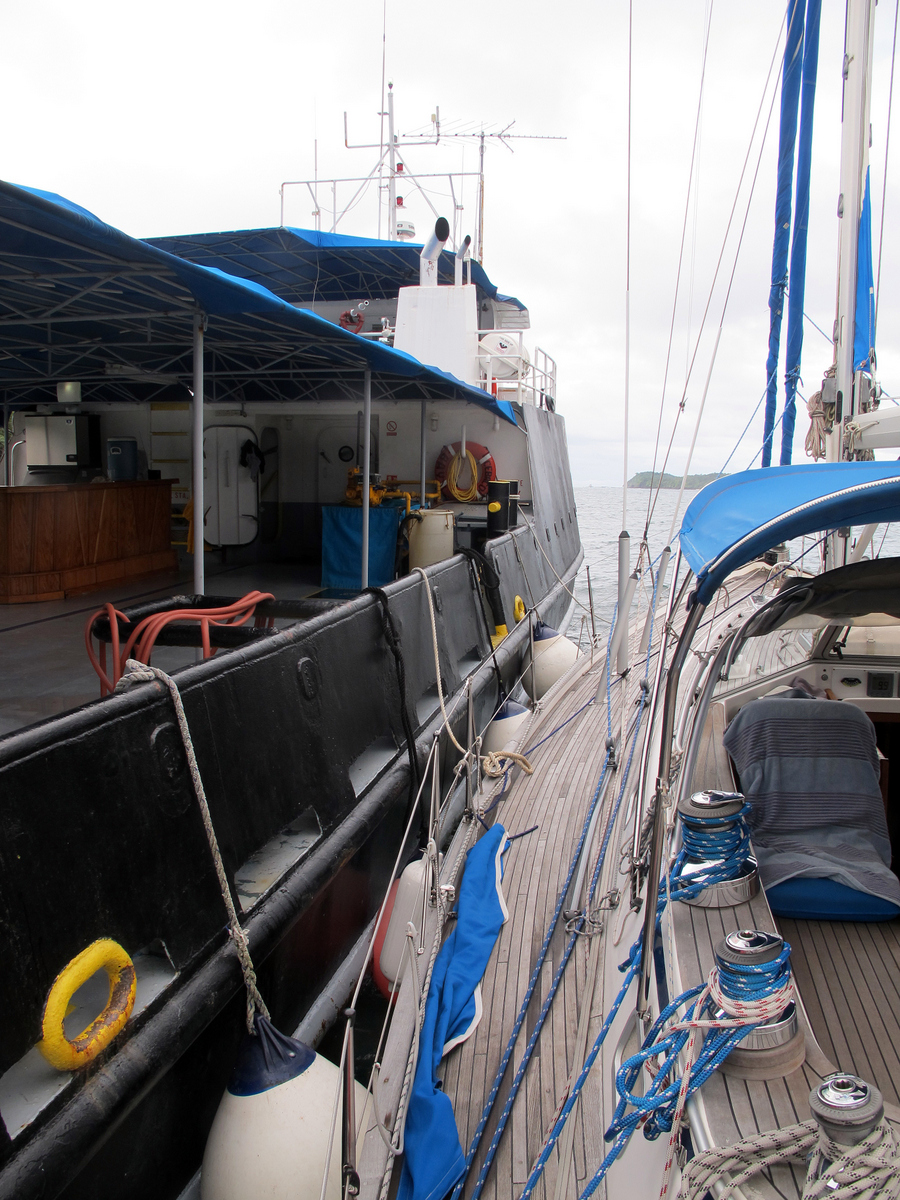
At dawn, it was still pouring it down, but the wind abated a little and we were finally out of the shipping lanes heading towards Punta Mariato - still motor sailing, but finally the end was in sight. Once around the headland, the wind was kinder to us and we were able to sail for four hours, which was very pleasant after the horrible night. We anchored in Ensendad Naranja on Isla Cebaco at around four o’clock – a long, hard passage.
Ensenada Naranja is an odd anchorage. There’s a dark brown beach which looks very nice with the breaking waves caused by the swell hooking into the bay. Unfortunately, breaking waves and yachts don’t go well together, so we’re expecting a rolly night. The south-east corner of the bay is a little bit more protected from the swell, but it’s been taken by moorings and a small ship that is permanently moored here. In the winter, the bay is occupied by sport fishing boats and the ship does a roaring trade selling diesel, but now it’s very quiet.
Once we were anchored, I went over to the ship, “Cebaco Bay” and asked if they had any diesel. Yes, they do, but it’s very expensive at $6.50/US Gallon. I don’t have much choice because we’re down to a quarter of a tank, so I arranged to go alongside tomorrow and take on 50 US gallons, which is half a tank and will be enough to get us to Golfito, even if we have to motor all the way.
We were pretty knackered by now, so Glenys rustled up a quick meal of pan-fried fish with potatoes and we watched a movie before collapsing into bed.
31 October 2013 Ensenada Naranja to Bahia Honda Town, Panama
As expected, it was a very rolly night because the wind dropped and we turned sideways onto the two foot swell after the wind dropped. We weren’t that bothered because we were so tired that we passed out.
After breakfast, we went alongside the fuel ship and bought some diesel – I now have ¾ of a tank and feel much more relaxed. Having sorted ourselves out, we headed towards Bahia Honda. The weather was still very unsettled with rain showers and constant wind shifts, but again the wind was predominantly directly against us. We sailed for three hours, beating upwind in 10-20 knots, but by midday, we’d only gone a third of the way and were in danger of not getting there before dark, so we turned on the old engine again – I’m so glad that I bought some more diesel.
We arrived off the small town in Bahia Honda at around half past four. Looks like a nice little place. Edwin who runs a local bar and tienda came out to say hello and was very friendly – he told us that there are 500 people living here. Apparently, the 2nd, 3rd and 4th of November are public holidays, so we might get to go to a party.
By half past five, the sky was as black as the ace of spaces and it was coming down in stair rods – not that I like to mix my metaphors. We had a quiet night in.
- << Prev
- Next