
22 June 2013 Portobello, Panama
It was an absolutely horrible day. There’s a Tropical Wave passing through the area and it brought heavy rain and thunderstorms for most of the day, turning the water in the harbour into a horrible brown colour. We hunkered down and got on with doing our own thing. Glenys spent most of the day looking at reading up about the San Blas islands where we’re going to go when we get back from the UK.
I spent most of the day working out a project plan for when we get hauled out when we get back from the UK. We've got to replace the bearings on the rudder, stop the water that is leaking through the floor of the aft locker, put on a couple of coats of anti-fouling paint, replace the timing belt on the engine and sort out the oil leak on the generator. I've broken it down into small tasks and worked out that if everything goes to plan, we should only be out on the hard for seven days – I've always been an optimist.
It carried on raining all evening, so we cracked open some beers and watched a movie.
23 June 2013 Portobello, Panama
It was another unsettled morning with showers and sunny intervals. I downloaded a GRIB file and it looks like it will be unsettled for the next week, with a series of Tropical Waves marching remorselessly west. We’re planning to go 20 miles west to Shelter Bay marina on the 30th June, so we have a week to sail around this area – we’ll have a look at the sky tomorrow morning and maybe head 10 miles around the corner to another bay. We need to make some water and I’m not making it in this harbour – it’s very murky.
We pottered around in the morning, starting to gather things together ready to take back to the UK. I sorted through our paper charts. I was going to take a load back to the UK, but eventually decided that it’s not worth the effort because in the past two years we've hardly looked at them. I’m going to keep some very large scale paper charts of the Caribbean and Atlantic Ocean as an emergency backup in the unlikely event that all of our electronic charts fail. I can’t think what to do with the remaining 50 or so charts – I’ll try to give them away, but I guess that they’ll probably end up in a skip.
It’s Sunday, so we went out to town and had lunch at Captain Jack’s bar, where we were able to get internet connection and catch up on our email. Glenys booked a five star hotel in Panama City for the night before our flight to the UK using some of the air miles that we’ve accumulated over the past twelve months. It’s getting imminent now and we’re both looking forward to seeing our family – only 10 sleeps to go now.
We bumped into Peter Lee on “Raven Eye” who we met in Trinidad over a year ago, along with his daughter Kati. Unfortunately, he wasn't very communicative and is deeply distressed because Kati is presumed lost at sea. She left St Martin at the beginning of April on the Lady Domina with four Scandinavian men bound for the Azores. The passage should have taken 2-3 weeks, but after ten weeks nothing has been seen of the 75 foot yacht. What do you say to a man who has had such a tragic loss? I guess that the worst part is that he doesn't know what happened – gives me goose bumps every time I think about it.
24 June 2013 Portobello, Panama
We woke up to the sound of heavy rain again. So we lurked around in the morning, waiting to see if we could go around to Green Turtle marina which is twenty miles away. By eleven o'clock, it was still raining, so we decided to stay here for another day.
This miserable weather is really taking it out of our batteries. I've been relying on our 380W solar panels and our wind generator to keep the batteries charged, but with not much sun and very little wind, we've been running the batteries down, so I had to run the engine for an hour just to charge the batteries because I don’t want to run our generator because of its oil leak.
Glenys did a stock take of our medical supplies and read up on what we should have. We want to make sure that we have enough drugs to be self-sufficient until we get to New Zealand next November. Our main concern is having strong painkillers and antibiotics because we’ll be spending a long time at sea or in remote places where it will be difficult to get medical assistance.
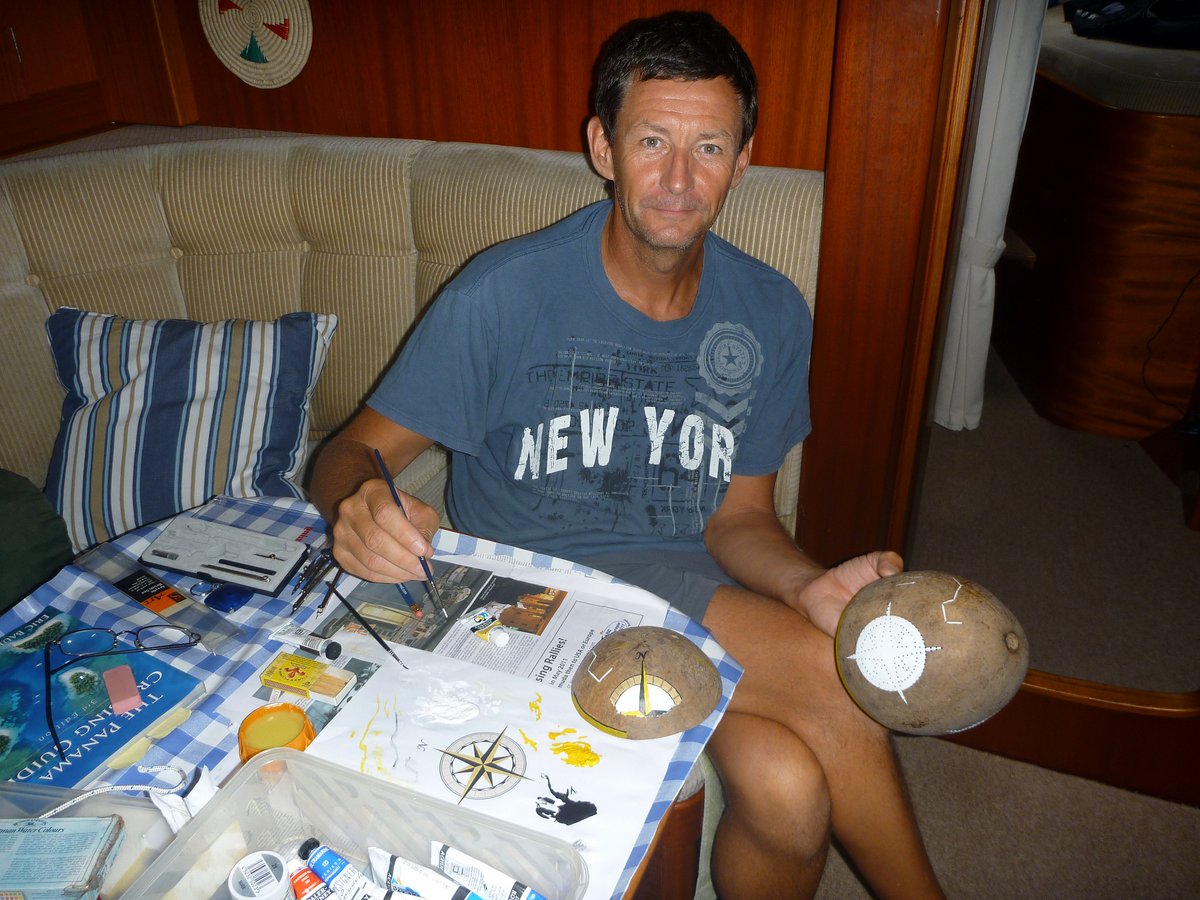
I updated my website and edited a load of photographs that have been building up and then had another go at my calabash lampshade. After drilling the remaining 200 holes, I tidied up the bottom edge and sanded it all over with fine sandpaper. I then dug out our acrylic paints and painted a test piece to work out the colours and to make sure I could actually paint the design. The test came out okay, so I took a deep breath and started painting. I didn't manage to finish it off, but I've not got too much left to do.
25 June 2013 Portobello to Shelter Bay Marina, Panama
It looked a bit brighter first thing in the morning, but by eight o'clock, we’d had our first shower. I downloaded another GRIB file and the weather is remaining unsettled for the next week, with more Tropical Waves on the way. Glenys and I had a discussion about what to do. There seems to be little point in going 20 miles east to Green Turtle marina, because we’d be going further away from Shelter Bay Marina where we’re planning to leave the boat – our worst case scenario is being trapped somewhere and not being able to get to Shelter Bay. We’re both getting weary of Portobello, so we decided to get our zarpe to leave directly for Shelter Bay.
I went ashore at nine o'clock and the immigration officer told me that “El Capitan de Puerto no esta aquí”. She told me to go back at half past ten. Frustrated, I went back to the boat and kicked my heels for an hour. The guy didn't turn up at half past ten, but I was told that he’d be there soon, so I went for a wander around town for half an hour. No sign of him at eleven o'clock, so I managed to persuade the Immigration Officer to ring him and was told that he’d be there at noon. All I could do was go back to the boat and wait again, which was doubly frustrating because the sun was now shining and it was perfect weather to leave.
Thankfully, the Port Captain turned up at noon, so I filled in the interminable form, paid my $20 fee and left before I lost my temper. We were under way ten minutes after I stepped back on the boat, but it took two hours before I’d calmed down and stopped ranting about officials in third world countries.
We motored for four hours to the breakwater outside the Colon Harbour, which is the entrance to the Panama Canal and one of the busiest ports in the world. Fortunately, there wasn't too much traffic and we only had to heave to and wait for one large ship to go through the narrow entrance through the breakwater. As soon as he passed us, we nipped in behind, scurried through the breakwater and headed towards Shelter Bay Marina. The marina manager John, was waiting at the dock and we were soon tied up in what would be our home for the next month or so.
I had a quick chat to John, who in passing, said that he used to own a boat called “Alba 2”, which he’d bought 20 years ago from a English guy called Sergio – the same guy that we bought our boat from - it’s a small world.
By the time that we’d plugged in the air conditioning unit, it was five o'clock, so we cracked open a cold beer and relaxed in the cockpit before going for a long shower and checking out Happy Hour at the marina bar. We gate-crashed a table with a group of eight Americans and had a pleasant evening with them. By the end of the evening, we’d agreed to share a minibus with them on the 27th to go on a shopping trip to Panama City.
26 June 2013 Shelter Bay Marina, Panama
We now have a brilliant internet connection, so we spent most of the day down below in our lovely, cold air-conditioned saloon, surfing the internet and preparing a long list of things to buy on our shopping trip tomorrow. This will be the first time that we've had access to decent shops since we left the USA in December, so we have a long, long list.
I met the Boat Yard Manager, Dave and discussed the various projects that I have to do when we haul out. It sounds like there are enough skilled people around to give me a hand as required. Getting hold of the anti-fouling paint that wanted proved to be a challenge. The local suppliers of Petit and Micron are said to be unreliable, so Plan A was to get a company called Marine Warehouse to ship some out to me. This company is in the USA and sends a shipment of parts out to their Panamanian agent, Arturo every two weeks. Unfortunately, I've missed this week’s shipment, and the next shipment might not arrive in time for when we haul out. However, Arturo told me that he knows someone who has a 3 gallon tin of Micron CSC in blue which he wants to sell for $465 US – this is 60% of the USA price, so I snapped his hand off. It will be delivered on the 28th – I can tick that off the list.
We met Bill & Lara who are cruising on “Sunrise” with their four year old daughter Isobel. They’re going through the Panama Canal on Sunday 30th June and asked us if we would be line handlers for them. I immediately agreed because it'll be interesting to see exactly what goes on before we make our transit in a couple of months. We’ll be going through the first lock on Sunday afternoon, picking up a mooring ball in Gatun Lake overnight and then transiting the other two locks on Monday. We should be in Panama City mid-afternoon and will catch the express bus back to Colon. It should be an interesting two days.
We fly out to the UK on the 4th July and our days are rapidly being filled up, so we've already started to pack our bags.
27 June 2013 Shelter Bay Marina, Panama
We jumped onto a mini bus with eight other people and drove for two hours into Panama City – it was a busy, “Shop Until You Drop” day. We went to a big general store first, then a chandlers, then another general store, ate a sandwich from Subway in the van, then two auto stores, then a material shop in the high street, then a hardware store and we were back at the marina by six o'clock – knackered…
Panama City is a huge sprawling place, with a mixture of run down areas and American-influenced, modern shopping malls with very well equipped stores and the inevitable American fast foods outlets. Everything is very spread out, so we were glad to be driven around to the various stores. We also got our first glimpses of Kuna Indians, who were walking around the streets in their brightly coloured traditional clothing made up from hand-sewn tapestry panels called molas.
We spent a lot of money, but managed to tick many items off the list. We ended up with a varied collection of things – engine filters, sunglasses, printer paper, sandpaper, snorkels, bilge pump switch, huge box of breakfast cereal, etc, etc. We even bought three new fire extinguishers (which weren't on the list, but cheap) and a huge piece of foam, which was 6 foot by 5 foot by 2” thick - it was a challenge to fit into the already packed mini bus.
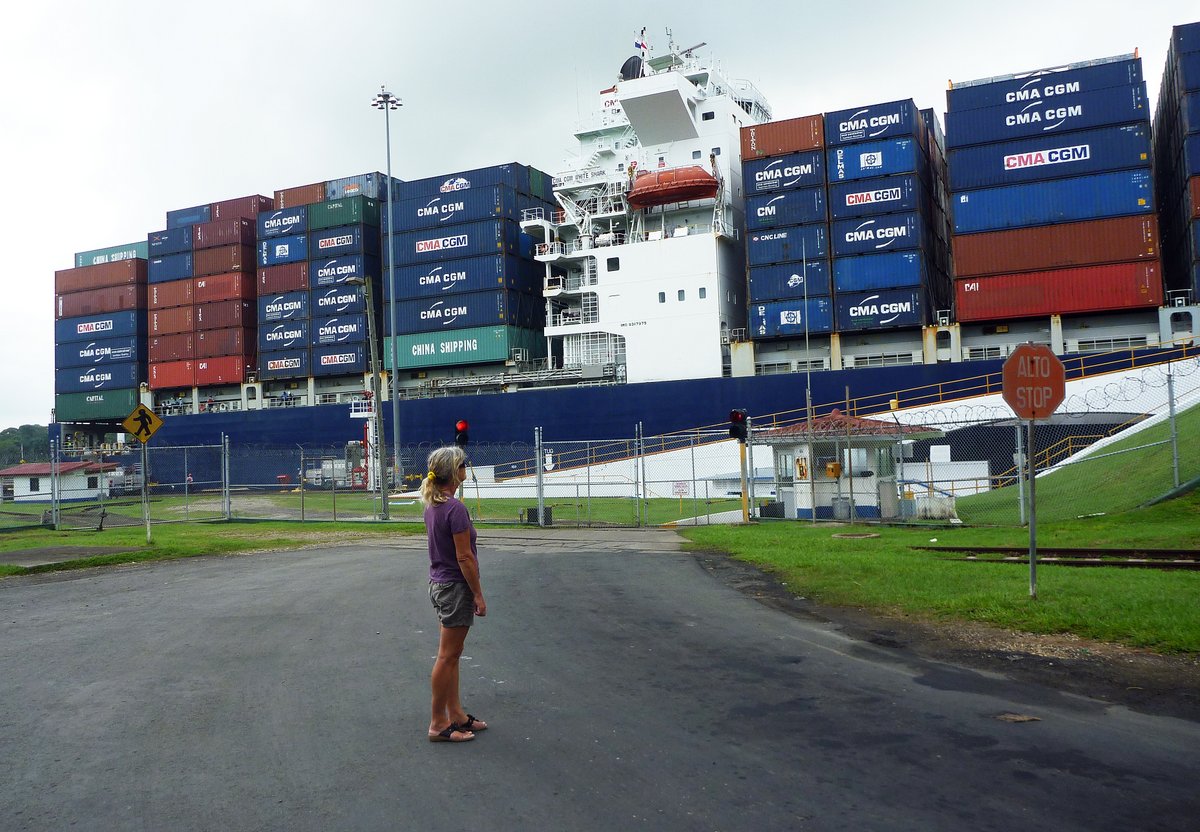
The road to Panama City crosses the Gatun Lock on the Panama Canal – we were held up both going and coming back by lock gates being opened for ships. We watched one of the huge Panamax ships inching its way into the lock. These are specially designed freight ships that just fit through the locks. They’re 950 feet long (50 foot shorter than the locks) and 106 feet wide (only 4 feet narrower than the locks) – it’s amazing how they manoeuvre these massive vessels with so little clearance at the sides.
While we were out, our friends Bonnie and Maury on “Smidge” arrived, so we went to the marina bar to have dinner with them and catch up on their adventures since we last saw them nine months ago. They had a great time in the San Blas islands especially in the more remote eastern islands, so we’ll be picking their brains over the next few days.
28 June 2013 Shelter Bay Marina, Panama
We spent the day sorting through yesterday's purchases and doing a few small jobs like fitting the new fire extinguishers in place and sorting out our laundry. Arturo delivered a huge 3 gallon tin of anti-foul paint, which I've shoved in the front heads. I finally managed to get hold of the Port Captain and cleared in – it’s only taken me four days.
In the evening, we went to the bar as usual and managed to resist eating there - we've still got food that we need to eat before we go back to the UK.
29 June 2013 Shelter Bay Marina, Panama
We caught the courtesy bus to the local shopping mall (Quatro Altos), which is provided by the marina every day. The supermarket at the mall is good and there's small branch of the chandlers that we visited in Panama City. The other stores are adequate, but the hardware store is not very good. I've been told that there's a bigger one only a short taxi ride away, so I'll try that next time.
Our afternoon was spent doing some more small jobs, preparing the boat to be left for three weeks. "Smidge" came for dinner and we gave them the "Spanish Inquisition" about the San Blas islands.
30 June 2013 Shelter Bay Marina, Panama
I woke up all excited about going through the Panama Canal. The morning dragged by slowly doing some admin and a bit more preparation to go to the UK.
After lunch, we climbed on-board "Sunrise" and met Rocky who was the third crew member helping Bill and Lara. Isobel who's only four years old, was very excited to have so many people on-board. We left the marina at half past one and motored across the harbour to the small craft anchorage called "The Flats".
Bill ran through the canal transit procedures with us. In order to go through the canal, each yacht must have four 150 foot long, one inch thick shore-lines; adequate fenders (normally car tyres covered in black plastic bags) and four crew to act as line-handlers. In addition to the captain (Bill), every vessel has to have an Advisor, who keeps in contact with the Canal Authorities and tells the captain when to enter the locks and generally guide the yacht through the process.
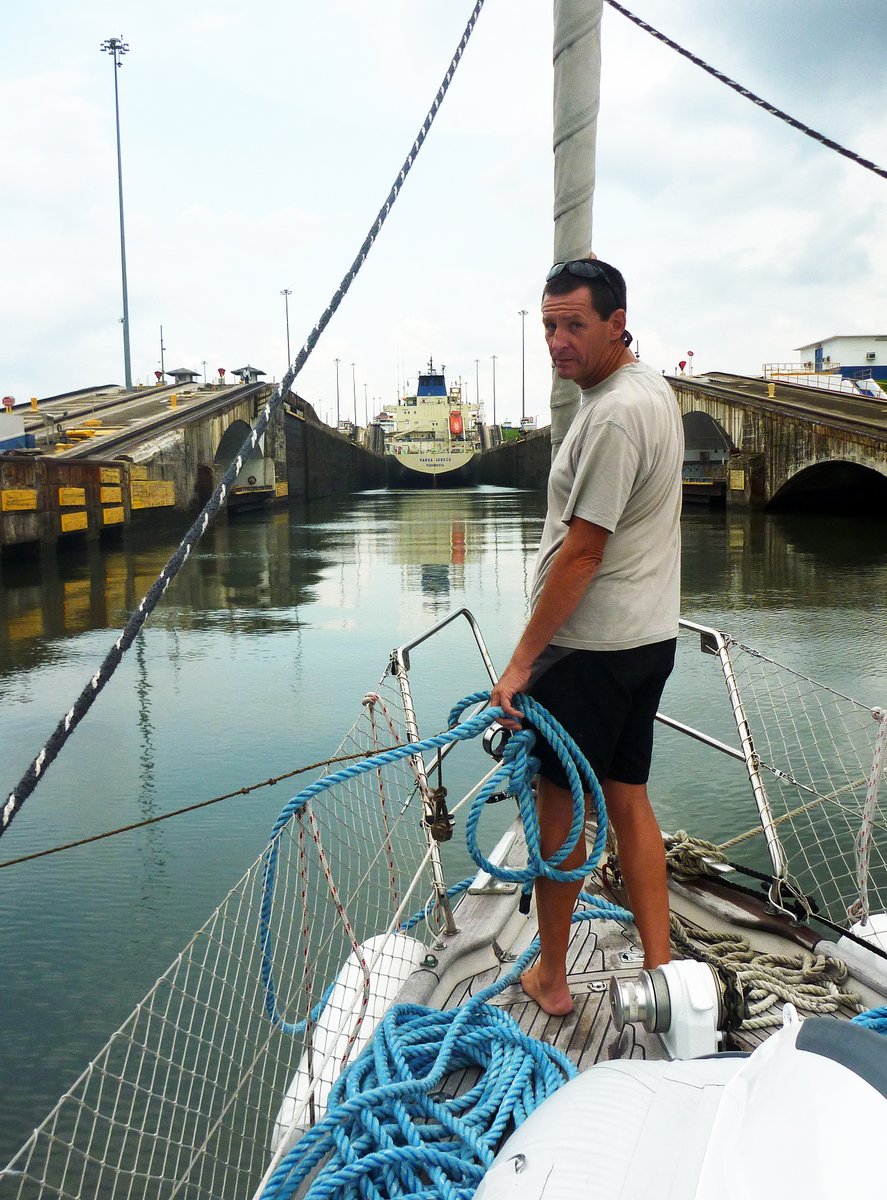
At around three o'clock, a Canal Authority transport boat approached us and our Advisor, Roy leapt on board. After a quick check that we had all the necessary people and equipment, he got us to weigh anchor and we headed towards the Gatun Lock closely followed by a French catamaran who was to transit the locks with us. Just outside the lock gates, Roy had us raft alongside the catamaran and together we motored into the lock following a large freighter, who took up the front 2/3rds of the available space.
As we entered the locks, two line-handlers on the shore threw thin 1/4" diameter "messenger" lines, weighted with monkey fists to us. Rocky and I grabbed the messenger lines and tied them to large 3 foot diameter loops that we'd already tied into the shore-lines. Two line-handlers on the catamaran were handling ropes on the starboard side of our small raft. On a signal from the two Advisors, the shore line-handlers started to haul on the messenger ropes, pulling our heavy shore-lines up to the lock side, where they dropped the big loop onto a bollard.
Safely positioned in the middle of the lock by the shore-lines, the lock gates closed and water flooded in to raise us rather quickly up to the level of the second of the three chambers in this lock. There's a huge amount of turbulence in the water when the lock is filling up, so we were grateful for the thick shore-lines.
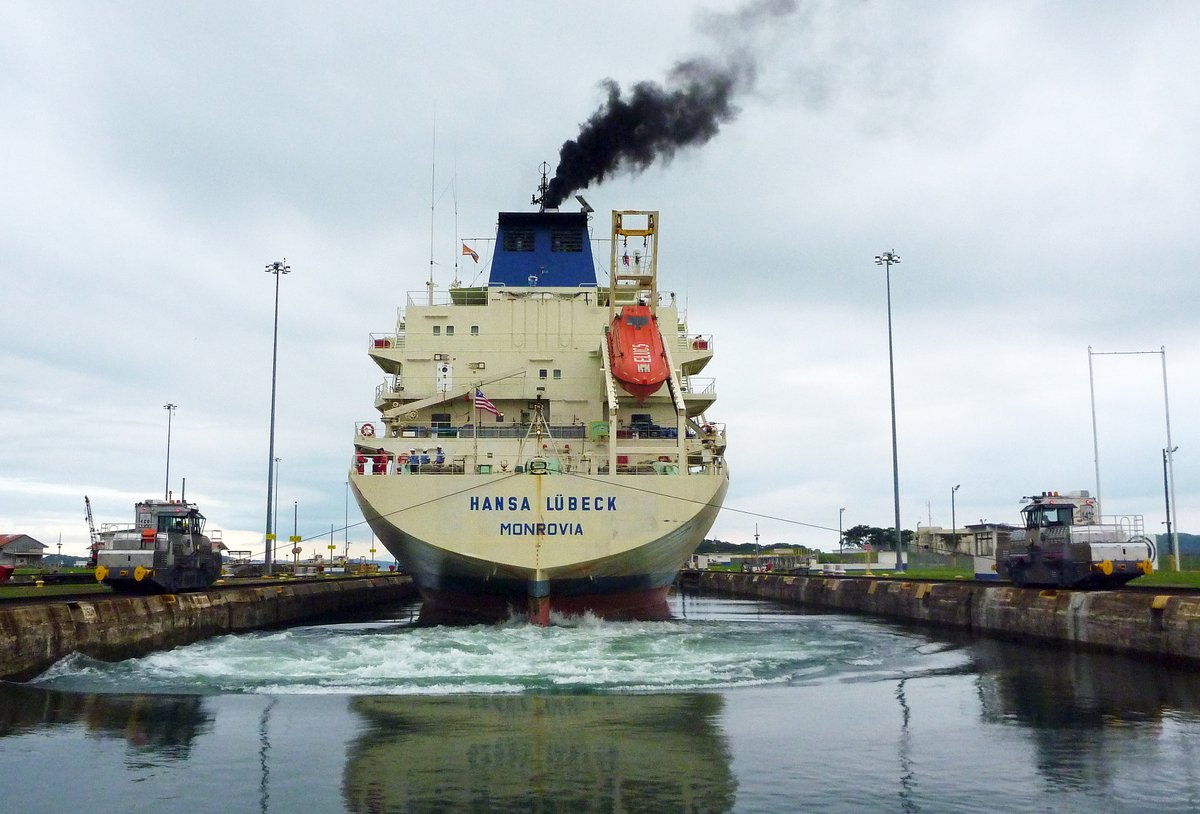
Once the upper lock gate was opened, the freighter powered forward, causing lots of prop wash. The Advisors wisely waited a couple of minutes for the turbulence to die down before instructing the shore line-handlers to take the shore-lines off the bollards, allowing us to pull the heavy ropes back on board. The shore line-handlers then walked alongside holding the messenger lines as we powered our raft forwards into the next chamber.
There are three chambers on the Gatun Lock and it took over an hour to get up to Gatun Lake. It was interesting to watch the freighter being guided in the lock. The shore-lines for big ships are very large steel hawsers connected to train engines (called Mules) that run on railway lines alongside the length of the lock. The railway lines go up 45 degree inclines at the lock gates and run on rack and pinion tracks.
The ships have Canal Authority line-handlers who handle the steel hawsers on board the ship. Roy told me that this is a very dangerous job because the steel hawsers sometimes snap under the tremendous loads causing the hawser to whip around causing major injury and occasionally killing people.
Once safely through the Gatun Lock and into Gatun Lake, we separated from the catamaran and under Roy’s guidance motored to a large buoy where we tied up for the night. Gatun Lake is a large freshwater reservoir formed by damming the Chagres River and all the water for filling the locks on both sides of the canal comes from this huge 20 mile long lake.
Before dinner, most of us had a quick dip in the fresh water despite the fact that there are big crocodiles living in the Lake.
- << Prev
- Next