
15 April 2012 Isla Culebra, Puerto Rico
It was a very blustery night, with 25 knot winds from the north-east, so we had a restless night with the anchor chain snatching in the strong gusts.
It was quite sunny for most of the day but the wind was gusting to 25 knots, so we stayed down below. We sorted out our grab bag, which contains the various things that we want to take with us in the unlikely event that we sink and have to take to our life raft. It’s only a five day passage but anything can happen so we depressed ourselves with this task.
The rest of the day was spent on reading, internet and clarinet practise. Glenys painted a Bahamian courtesy flag because we've been unable to buy one in the BVI or here in Puerto Rico.
At the end of the afternoon, dark rain clouds started to head our way, so we had a quiet night in. Glenys made a brave attempt at Piononos for dinner. Unfortunately, the recipe calls for plantain strips to be held together in a kind of ring with cocktail sticks and we didn't have any, so it collapsed into a heap. It was very tasty, but looked a bit like road kill. I look forward to the next attempt.
16 April 2012 Isla Culebra, Puerto Rico
The weather forecast hasn't changed much. Today is nice 20 knot winds from the north-east, but horrible big seas. Tomorrow should be perfect, but I'm a little worried that we’re going to run out of wind after a couple of days. We had a quick debate about leaving today, but decided to stick to our original plan and leave early tomorrow.
We went ashore to get some cash and go to the supermarket to buy fresh food for the passage. As the supermarket has its own dinghy dock, it’s very convenient to get heavy stuff, so we invested in six cases of beer – people have told us that beer is $90US a case in some places in the Bahamas - that works out to about £6 per pint…
 We dropped off our garbage and then cleared out in the afternoon, which was very quick and easy. In the evening, we went on a mini pub crawl and for a meal at Zaco’s Tacos for our last night out with “Flawless D” and “Blackthorn Lady”. It was very convivial.
17 April 2012 Isla Culebra to Mayaguana, Bahamas (Day 1)
The alarm went off at quarter to seven and we leapt out of bed to do the last minute preparations for sea – outboard and dinghy on deck, check the engine, fishing lures, make sandwiches for lunch, etc.
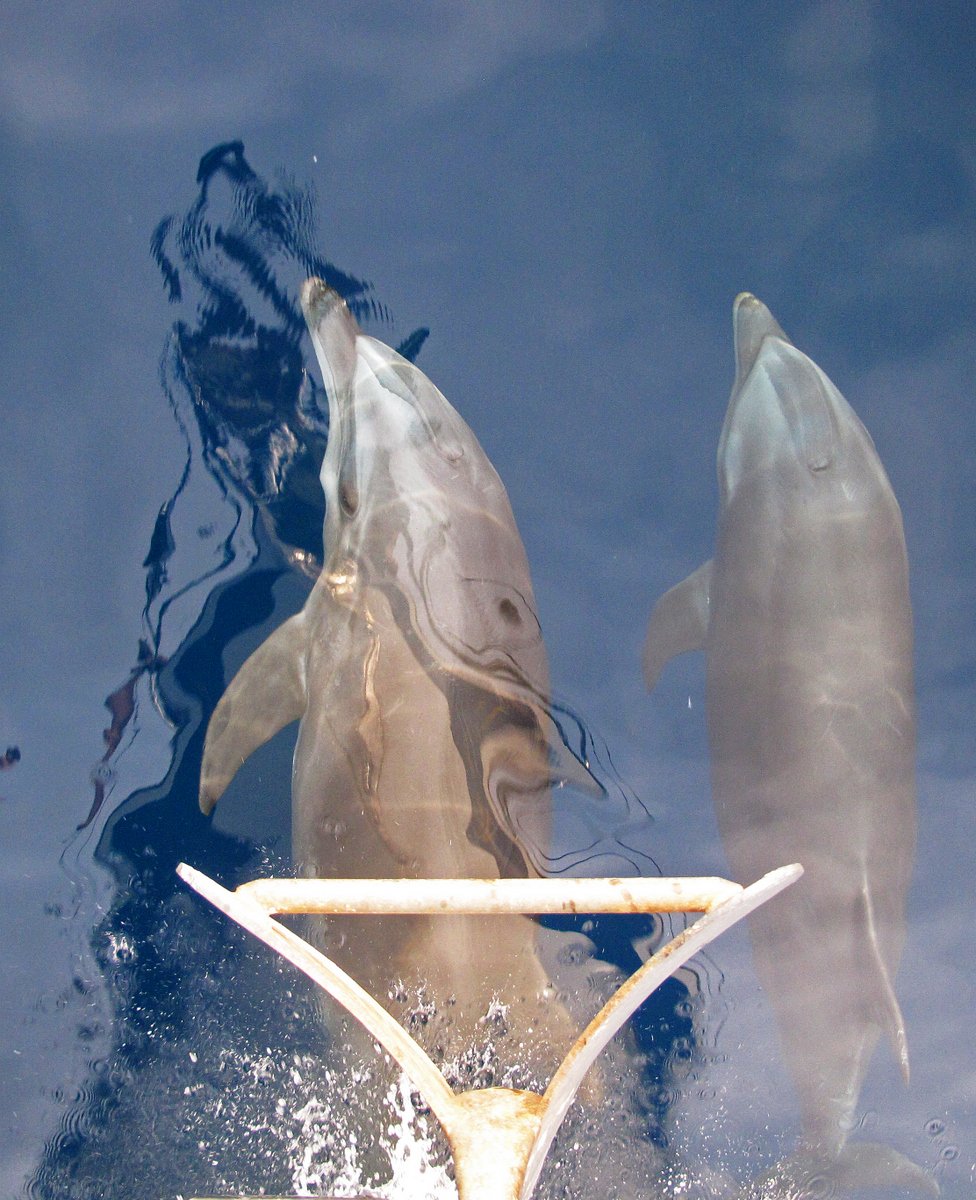
We upped anchor and left at eight o'clock. I put up the main and then realised that we hadn't fitted the rudder for our Hydrovane wind-vane steering, so I had to don swimming shorts and climb down the swimming ladder to fit it in place. Just after we passed the two entrance buoys, a Bottlenosed Dolphin came to say “hello”, which I regard as a good omen.
As we rounded the south-west tip of the island, we picked up a nice 15-20 knot wind from the east, which allowed us to sail past the outlying small islands and reefs, out into the Atlantic Ocean. Once clear of the reef, I put out two fishing lines – the fishing rod and a hand line with my “birds”.
I overheard two boats chatting on the VHF about going to the Bahamas, so I contacted them and had a chat. Jan and Karen on “Bella” and Larry and Beverley on “Chandelle” are both heading to Georgetown and are a few miles behind us. We’ll probably stay in touch with them on the way.
Once out at sea, the waves were a little large at 6-9 feet, but it was fairly comfortable because we were on a reach. The wind settled to around 15 knots, so I unfurled the stay sail and we romped along with all sails out doing 5½ - 6 knots.
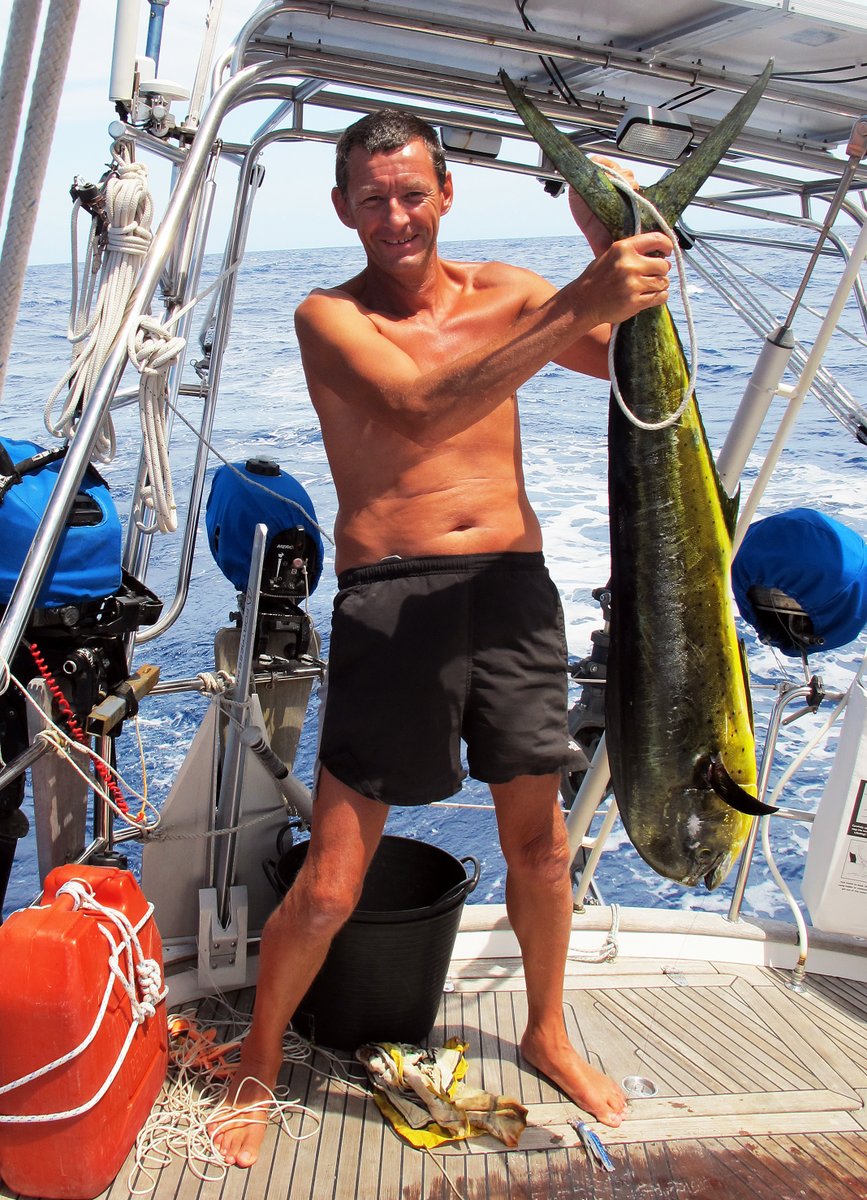
After lunch, we must have sailed through a school of Dorado, because I suddenly hooked two fish. I increased the friction of the fishing rod reel and concentrated on the hand line. I managed to get the large fish to the side of the boat when, with a sudden panic attack, it managed to throw the hook as I was about to lift it on board. I played the second fish for a while and was very pleased to land a large 18lb female Dorado.
I filleted the fish and Glenys packed it away in zip-lock bags in the bottom of our drinks fridge, covered by cold beer cans. We’re not very well geared up for catching a lot of fish because we have limited freezing capacity. The galley fridge has a small freezer compartment, but that is usually full of meat. Our other fridge is normally packed full of cold drinks. Perhaps when we do these longer passages, we should turn the drinks fridge into a freezer, so that we can stock up on fish when it is available.
We chilled out for the rest of the afternoon, going along nicely at 6-7 knots. Yesterday, Glenys made a beef stew in the pressure cooker, intending it to be our dinner for the first two evenings, but as we have nice fresh fish, she rustled up Dorado Catalan with mashed potatoes – yummy!
I went to bed at seven o’clock at the start of our three hour watches. The wind had been gusting up to 20 knots and we had been doing over 7 knots in the gusts. However, the wind was forecast to drop, so I left out all of the sails. I didn’t sleep very well – nervous about the passage and we seemed to be crashing along. Sure enough at nine o’clock, Glenys called me up because the wind was gusting 25 knots and we were over pressed. We ended up putting 1½ reefs in the main and a deep reef in the jib.
18 April 2012 Isla Culebra to Mayaguana, Bahamas (Day 2)
It was a dark night with only a sliver of a waning moon appearing an hour before dawn, but at least the clouds cleared away and we had a beautiful starry sky. At usual, it was hard to get into the three hour watches - only the thought of a Dorado sandwich got me out of bed at four o'clock in the morning.
The wind had dropped to 10-15 knots by dawn, so I shook out the reefs and we slopped along at 3½ knots in the four foot swell. It was cold last night and I had to wear long trousers for the first time in a year. However, by seven o'clock, the sun had warmed up and I was back in shorts.
At quarter to seven, I managed to report into Dennis’s weather net. He forecast 8-10 knots for today and 10-15 knots for tomorrow. He also mentioned a trough of low pressure that is forming over Florida, which he's going to investigate and give more information tomorrow. At eight o'clock, we’d done 150 miles in 24 hours which is an average of 6.25 knots, which isn't a bad start to the passage.
At nine o'clock, I listened into a conversation between “Bella” and “Chandelle”, but I had difficulty hearing them clearly and they couldn't hear me because they are a lot further west and ahead of us. They've picked up a forecast from Chris Parker’s weather net and it sounded like the low pressure area in Florida is going to turn into a cold front and bring strong south winds to Georgetown on Sunday 22nd which is when we plan to arrive there. This was not good news, so we turned on the engine hoping to catch up and be able to talk to them to confirm what we had overheard.
I spent the rest of the morning looking at charts and pilot books to work out where we can go if the weather turns nasty on Sunday. I also tried various frequencies to try to pick up weather forecasts on the SSB radio with very little luck – I'm getting a lot of background noise. There’s obviously something wrong with my setup – I need to get an expert to look at it.
I’ve become too reliant on getting weather from websites and really struggle whenever I can’t get an internet connection. Ideally, I want to be able to hear SSB radio stations and also be able to request and receive weather information by email. There are two methods of having remote email – either using a satellite phone or a “Pactor” modem on an SSB radio. Either system will involve spending $1,000 to $2,000 US to install new equipment and a monthly fee for connection and email compression, but I need to get it sorted out in the USA before we go any further afield. It’s very frustrating (and potentially dangerous) being unable to get a decent weather forecast.
We motor-sailed all day and, in the afternoon, I finally managed to contact “Bella” who confirmed the cold front arriving in Georgetown on Sunday with 25 knot squalls. Both “Bella” and “Chandelle" have made the decision to go for Georgetown - by motoring hard to maintain seven knots, they are expecting to arrive midday on Saturday 21st. In the evening, the wind picked up to 10-12 knots, which was allowing us to sail at 4 knots, but we've decided that we’ll motor-sail all night and re-appraise our position tomorrow.
Sailing in light winds is the bane of our lives. We only have three sails on board – a main, a jib and a stay sail. They're all heavy duty cruising sails which perform very well in winds over 15 knots, but very poor in light winds. We spent some time this afternoon debating whether we should bite the bullet and buy a cruising chute (which is a kind of spinnaker) which would help to resolve this problem. Unfortunately, it will cost £1,500 and will be very bulky, which will give us a storage problem.
With the weather communications and cruising chute, it looks like we may be spending a lot of money in the USA this summer.
19 April 2012 Isla Culebra to Mayaguana, Bahamas (Day 3)
It was a very quiet night with an 8-10 knot wind from the north-east. We motor-sailed all night with the wind on our starboard beam and, at eight o'clock this morning, we'd managed to do 166 miles in 24 hours, which is an average of 6.9 knots. On the negative side of things, we've clocked up 22 hours motoring since we left Culebra.

Ian on “Blackthorn Lady” gave me a relay on the SSB radio to Dennis, who confirms that we’re going to get a cold front coming down into the Bahamas on Sunday 22nd, which could have gale force winds. It was difficult to hear what was being said, but I think that the winds will go southerly and then swing around to the north-west as the front passes over.
I spent most of the morning re-looking at alternative anchorages and revising our route and waypoints. We’ve decided that it’s unlikely that we’ll be able to get to Georgetown in the Exumas before Saturday evening without thrashing the engine for 48 hours. Instead, we’re going to head for Mayaguana, which is supposed to have a good “all weather anchorage”. If we continue to average 6.5 knots then we should arrive tomorrow afternoon (Friday). We can then spend Saturday getting ready for a big blow on Sunday when the front arrives. We can clear into customs in Mayaguana and then take our time going to Georgetown when the front has gone through.
I had a nap before our lunch of Dorado sandwiches and then I cleaned the electrical connection between the antenna cable and the backstay which acts as our SSB antenna. Hopefully, it will improve our reception of the weather forecasts tomorrow. Glenys had a nap in the afternoon while I chilled out reading another book – thank goodness for our eBook readers because we get through a lot of books on passage.
We continued to motor-sail all day to ensure that we keep up our boat speed and make it to Mayaguana as soon as possible tomorrow. The anchorage is inside a very shallow reef, with lots of coral heads, so it will be important that the light is good enough for eyeball navigation.
Just before dinner, I managed to talk to Jan on “Bella” and he tells me that Chris Parker’s forecast for Georgetown is now 30-40 knot squalls from the north-west on Saturday pm and Sunday, but the effect of the cold front in the south-east Bahamas is less with 30 knot squalls on Sunday pm through to Monday. It sounds like we’re making the right decision by stopping at Mayaguana. The wind picked up a little bit, but we need to keep motoring in order to arrive midday.
We saw no sign of land, ships or yachts for the whole of today, just the endless sea with the rolling swell. Dusk came a lot later this evening – it’s 30 minutes later than in Culebra. With the dark, came the loom of lights from the towns on the Turks and Caicos off our port side – our first sign of land for three days.
20 April 2012 Isla Culebra to Mayaguana, Bahamas (Day 4)
At midnight, I went down below to write a position entry into our log book and heard a loud vibration coming from the engine. I looked in the engine compartment and found that we've got a nasty, grinding vibration coming from the stern gear. I wasn't sure whether it was the gearbox, the propeller shaft seal, the cutlass bearing or the propeller, but whatever it was, it didn't sound good. I went back into the cockpit and put the engine out of gear. To my horror the engine stalled and I couldn't get it started again.

I was in the pit of despair, we couldn't continue motoring and the wind was so light that there was no way that we would make it to Mayaguana in daylight – this meant another night at sea. I spent thirty minutes poking around in the engine compartment and finally decided that the bearing surfaces on the propeller shaft seal are breaking down and causing the horrible grinding noise. This would be very bad news because, if we try to use the engine and the bearing surfaces seize up, then it could potentially rip the rubber bellows holding the seal and water would gush into the boat. The only way to replace the shaft seal is to get hauled out and the nearest possible place is Georgetown 150 miles away. I sank deeper into despair.
Glenys took over her watch at one o'clock, by which time we were sailing at 3 knots. I had a restless three hours in bed, dreaming of boats sinking. After breakfast, I had another look at the problems. I was able to start the engine straight away, so I don’t know why it stalled last night – perhaps it was sulking because we’d been running it constantly for 40 hours.
I looked at the grinding vibration and decided that the shaft seal looks okay – it’s leaking slightly and I was intending to change it when we get hauled out in the USA, so I think that it’ll be okay for another few months. I also don’t think that it’s the gearbox, so it has to be the cutlass bearing, the propeller or maybe something wrapped around the propeller. In any case, we decided not to motor unless we really have to.
I had a very faint contact with Ian of “Blackthorn Lady” on the SSB and didn’t learn much new about the weather – the front is still coming through on Sunday.
The wind continued to drop during the day. By lunch time, it was down to 5 knots from behind us giving us a pathetic 1½ knots boat speed. We still had fifty miles to go and I was worried that we could get becalmed and wouldn't even be able to get into Mayaguana tomorrow. The wind was so light that I decided to go into the water and snorkel down to have a look if there was an obvious problem with the stern gear.
We rolled away the jib, pulled the main in tight and hove to. It’s a little bit disconcerting to jump into water that is 2½ miles deep, in the middle of nowhere. I cautiously climbed down the swimming ladder, checked that there were no pelagic sharks lurking under the boat and then dived down to have a look at the stern gear. The propeller looked OK with nothing wrapped around it and the propeller shaft was tight enough in the cutlass bearing – no problems there. On the second breath, I noticed that the rope stripper is very loose. After a few more dives down, I now think that the rope stripper is causing the vibration. I'm still very reticent to use the engine for very long, but this is a major relief because as I should be able to sort out the problem when we get to the anchorage in Mayaguana.
The wind didn't pick up, so in the middle of the afternoon, we turned the engine on and motored for an hour at low revs to test it and to get a few miles under our belt. The wind picked up gradually and, by half past six, we had 10-15 knots with only 30 miles to go, so we rolled away the main, reefed the jib and bobbed along at 3 knots.