
16 January 2016 Hsipaw to Palaung Village, Myanmar
It was very cold last night forcing us to have three thick blankets on the bed. When we got up at seven o’clock, there was no electricity and it was so cold that we couldn’t face having a shower. Breakfast was in the freezing cold restaurant, but I had a really tasty traditional Shan soup - Glenys opted for the more traditional scrambled egg on toast.

Our guide Winco picked us up at 08:30 and after a short ride in a Toe-toe, we set off walking up to the hill village of Palaung. The morning was very misty and cold, but we soon warmed up with the exercise, hiking along a pleasant path. The sun quickly started to peek through the mist and by half past nine, we had blue skies.
The nice path soon degenerated into a dusty road, which we ground up for four hours. Fortunately, we had a few breaks and chatted to a guy riding a Water Buffalo. We made it to the village just after one o’clock and dropped our bags off at the homestay where we would be spending the night. They had prepared a big lunch of noodles, rice and two vegetarian dishes. The Shan people in this village are vegetarian.

After an hours rest, Winco took us for a two hour walk along a lovely path above the village, where we walked past tea plants, which are harvested for green tea drinks and also made into the fermented tea salad that the Myanmar people love. Back at the village, we stopped by at another traditional house where a couple of ladies served us green tea while we sat around their open wood fire, which is in their main living room. They couldn’t speak any English, but seemed to be delighted with us just being there.

We’re now in the Northern Shan province of Myanmar. The Shan people number seven million are and the second largest and we’ve been told that they are still fighting in the mountains against the Barma Government. The area to the north of here, on the border with Thailand is known as the Golden Triangle and used to be the main Heroin smuggling region. We were told that the governments have eradicated the heroin trade in the region.

In the evening we had very filling and tasty dinner – rice noodles, tofu, stir fried vegetables. There are five other tourists staying in the same house which apparently belongs to the chief of the village. He seems to have a monopoly and gets first choice of tourist staying. The other house that we visited has nobody staying tonight, which seems a shame – I’d like to ask to move, but no doubt someone would be offended, so I kept my mouth shut.
It was very cold. We were both forced to wear a fleece and a hiking jacket and we sloped off to bed at half past eight. It was very much like sleeping in a mountain hut. Everyone was allocated a thin mattress and blankets with mosquito nets overhead. There were seven tourists and guides on the first floor and the family were relegated to the ground floor – I have no idea how many they were... Glenys and I were given a bed in a partitioned off area, but after we’d gone to bed, one of the family came in and laid a mattress on the floor at the foot of our mattress – it was very cozy.
17 January 2016 Palaung Village to Hsipaw, Myanmar
What a cold night – I hadn’t arranged my blankets very well, so I kept getting arctic gales coming in under the side of my blanket. Some Russian guy was snoring for most of the night and a Dutch lady kept telling him (ineffectively) to shut up every so often, so it wasn’t the most restful of nights. I think that the village cocks started to crow at four o’clock in the morning and continued until the sun rose.
At around half past six, the small village monastery next door sounded off eight loud dongs on their gong, telling the villagers (and us) to get out of bed. There are 400 people living in Palaung village and their monastery has two adult monks and 10 or so young monks. Every morning the villagers prepare rice and other food to donate to the monastery. In big towns, the monks have to walk around and beg for their food, but here the villagers deliver food to the monks.
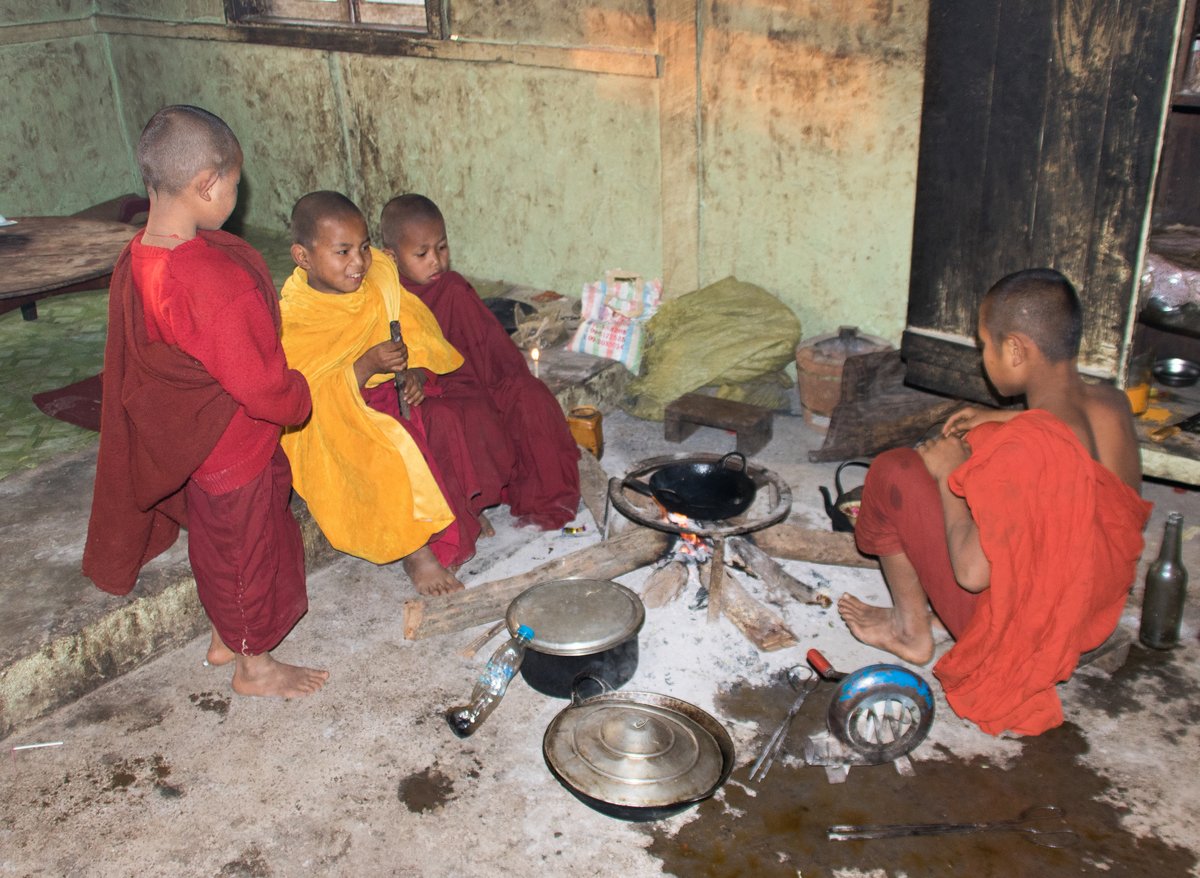
When someone says monastery, my first impression is of a towering granite fortress at the top of a snowy peak. This village monastery is more like a village hall – a single story, wooden building with a corrugated iron roof. It has a central area with a statue of Buddha, a couple of shrines around the place, a kitchen, a study and a large meeting/praying area in front of the Buddha. The place is a practical combination of a living area for the monks, a religious school and a village meeting hall.
Before breakfast, we wandered over to the monastery, saying “Com Sa” (Good Morning) to the villagers who were bringing food into the main hall. They all say a short prayer, kneeling before Buddha and then place cooked rice into big pot and take the other food into a kitchen where the bigger boys warm it up on a gas stove.
The young monks range in ages from five to sixteen years old and all come from the village, so they have known each other for all of their lives. There’s no silent devotion here – the young boys are pushing and punching each other to establish the kind of playground pecking order that one can see all over the world. However, they were a nice bunch of kids and happy to have their photographs taken. Winco tells me that many of them are orphans or children of single parents who can no longer afford look after them, so the monastery also acts as a welfare centre.
Breakfast was good and filling – rice, green beans, soup and a fried egg. As we walked out of the village, we met an old lady dressed in traditional Shan clothing, who let us take her picture and lamented that the traditions are being lost because the younger people don’t want to adhere to the traditional ways and clothing. It’s the same all over the world.


The walk back down to Hispaw was very pleasant and this time we avoided the monotonous road. We were back at the hotel just after lunch and chilled out for the rest of the afternoon. In the evening we went out to the Café Terrace restaurant for a couple of beers and ended up staying for dinner. I had poached fish in lemon sauce which is a local speciality and very good.
18 January 2016 Hsipaw to Mandalay, Myanmar
Our driver, Win, picked us up at the hotel at half past eight and took us to the railway station to catch a train to Nyaung Cho which is a third of the way towards Mandalay. There’s only one train a day that goes in that direction and it leaves at 09:40, so I thought that we were getting there way too early. But, after watching Win stand in a short queue of tourists for half an hour, I’d changed my mind. Goodness knows what the ticket guy was doing, but he wanted passports and wrote in several ledgers before he issued the tickets.
The train arrived roughly on time and all of the twenty tourists were piled into one Upper Class carriage. It cost us 1,700 Kyats ($1.40) each for the five hour journey and I believe that ordinary class was steerage was 700 Kyats. First class had comfy padded seats whereas ordinary class was wooden seats.

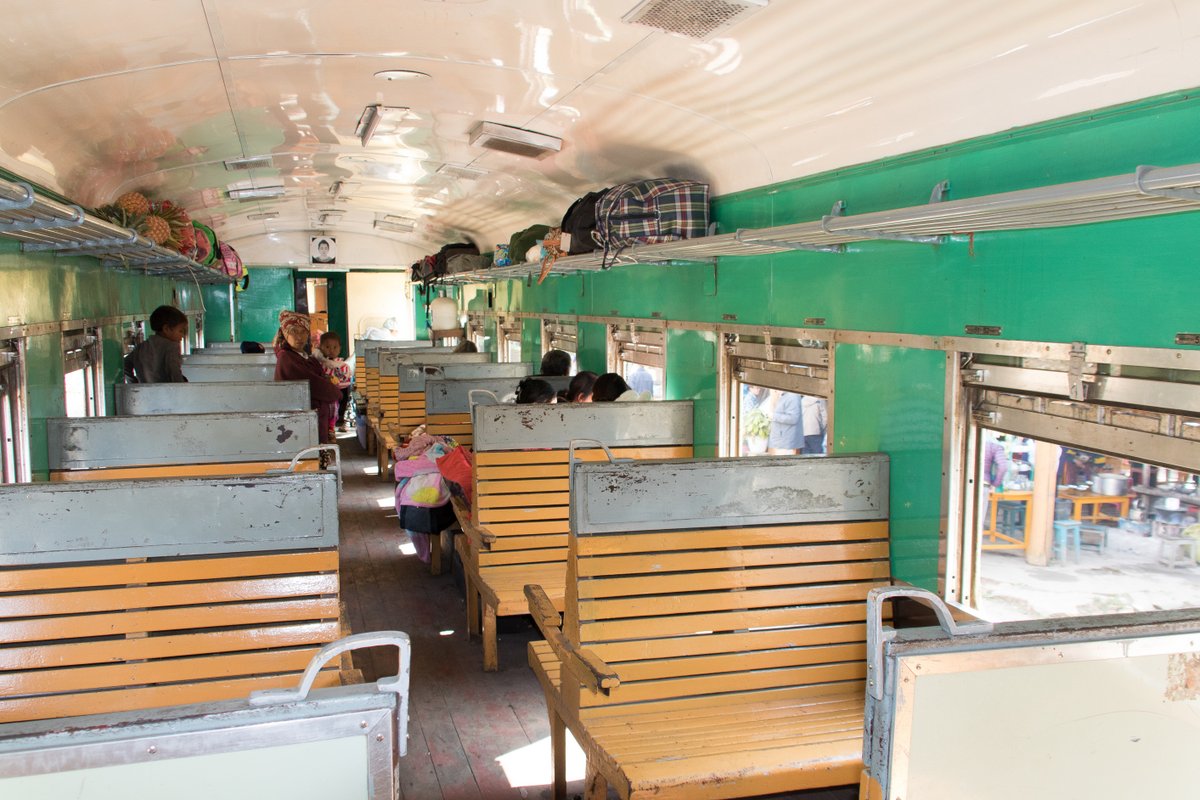

We’d been allocated seat numbers and I was very annoyed to find that our seats were facing the rear of the train, so that we would be going backwards. I had a complete sense of humour failure. Mr Win noticed that I was unhappy and called a guard over. To my amazement, the guard pressed a foot pedal and the whole double seat swivelled 180 degrees, so that we were facing forward – even the Swiss don’t have that technology on their trains!
As usual in Hsipaw, the morning was very cold (fleeces and a jacket), but that didn’t deter any of us from opening the windows on the carriage – it’s great to be sat by an open window on a train.
The diesel engine pulled us away from the station and the first thing I noticed was the strange rocking motion. Five degrees to the right and then five degrees to the left - it doesn’t sound a lot until you see the other carriage doing the opposite and feel yourself being tossed side to side every two seconds.
Fortunately, the top speed of the train was about thirty miles an hour, with an average more like fifteen, so the motion wasn’t too bad. We “sped” through rocky gullies with the walls very, very close – you could reach out and break your arm. The branches of shrubs occasionally swept in through the open windows as we wandered past, and through, the thick undergrowth lining the track.
When going up slight inclines, an oscillatory, up and down motion started which was so intense that the aged suspension on the train carriages couldn’t cope and there was an ominous, teeth rattling thumping coming from underneath the floor - it was all jolly good fun.
We stopped off at a couple of stations, where vendors flocked to the side of the train, carrying trays of snacks on their heads. By this time, the sun had started to break through the mist and we eagerly jumped off the train to bask in the sun, watching the colourful locals touting for business. The stops were quite lengthy at 30 minutes, so we had time to buy a few snacks – rice cakes, fermented tea salad and fresh pineapple with chili powder – interesting flavours.
Finally after four hours, the main objective came into view - a steel bridge over the Goeik Hteik Gorge, which is an impressive piece of engineering spanning a very deep gorge. We took the obligatory photos hanging out of the windows and waved at the locals walking about on the railway track - this is a popular destination for locals as well as tourists.

Win was waiting at Nyaung Cho station and we started heading back to Mandalay, stopping off at a waterfall. It’s a popular place for locals to visit, but wasn’t terribly interesting apart from doing some more Monk-stalking, taking pictures of monks having pictures taken with their visiting families. At one of the many small shops dotted around the waterfall, we bought some strawberry wine which is a local speciality - very sweet and strange.
We also called into a large impressive Buddhist Temple before a long drive back to Mandalay, arriving back at the Yuan Sheng Hotel in the afternoon. In the evening, we went out for a meal at the Aye Myitta restaurant on 81st street between 36th & 37th streets. It was a fabulous atmosphere, with very efficient and friendly waiters. The food was fabulous and inexpensive, they even had Myanmar beer.
19 January 2016 Mandalay to Bagan, Myanmar
The alarm went off at the ungodly hour of half past five. We picked up our two breakfasts-in-a-box and Win drove us to the Irrawaddy River where he loaded us onto a 100 foot river boat that was to take us on the eight hour trip to Bagan. The boat was nicely set-up for the long journey with sections of very high-tech red seats more suited to fast Hydrofoils than a slow chugging river boat.
There was a section with dining tables and a upper deck with outside seating, but it was far too cold to be exposed out there. We cowered down below and quietly read our books, ignoring the hundreds of golden topped pagodas sliding by on the distant river banks.
The ferry service included a pleasant breakfast in a box consisting of a hard-boiled egg, a croissant and a small Danish pastry, which supplemented our hotel’s breakfast in a box, giving us the opportunity to have a second breakfast mid-morning. They served us a choice of the ubiquitous Fried Rice or Fried Noodles for lunch.
The river is ¼ mile wide and there’s not much to do, so I camped down at one of the dining tables and caught up on my blog and editing photographs – I’ve taken and kept over 250 photographs in nine days, so I need to be more ruthless.

It was funny when we arrived at the riverside at Bagan. As soon as the boat had stopped moving, a dozen young men swarmed aboard, leaping from the boats next door. They came climbing through the windows like pirates and scrambling over the luggage that was piled up - and asking everyone if they needed a porter.
We politely declined, rescued our two cargo bags from the pile of luggage and ran the gauntlet of dozens of taxi drivers and would-be porters trying to take our bags as we struggled up the river bank. Fortunately, Pee Sue, our new driver, was waiting for us and whisked us off to the Hotel Zfreeti.
The hotel is very, very posh with a swimming pool and nice rooms. We couldn’t be bothered to go out for a meal and had our dinner in the bar next to the swimming pool – pizza and grilled pork chops for a change.
20 January 2016 Bagan, Myanmar
Breakfast was very good – too good in fact. There was a special egg chef, so I just had to have two fried eggs, with ham and baked beans, a croissant and a slice of toast. My waist line is expanding rapidly.
Aung, our guide for the day, met us at nine o’clock and we went to find a laundry as we were rapidly running out of clothes. The hotel charge $1US per item, which is outrageous, but we found a back-street place that did two bags for $12US.
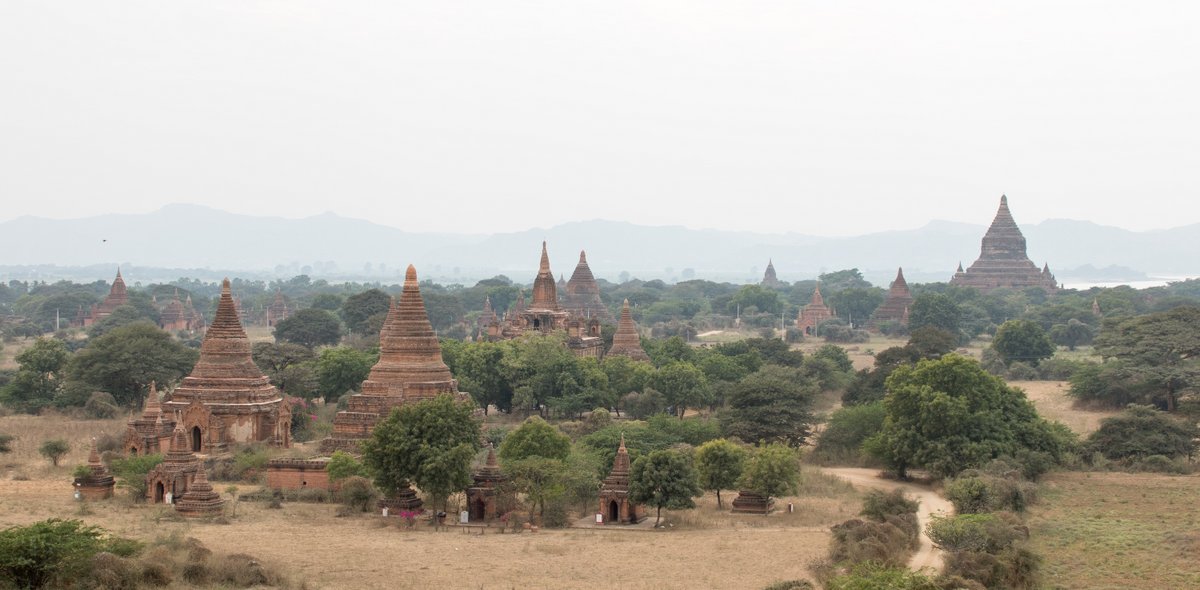
The morning was a blur of looking at Pagodas and Stupas (you can go inside a Pagoda, but Stupas are solid). Bagan was in its glory between the 11th and 13th Century.
In 1044, the Bamar King Anawrahta came to the throne and at the time Myanmar was in a period of transition between Hindu to Theravada Buddhist beliefs. Anawratha became a Buddhist and after being told that he couldn’t have any sacred texts, marched his army and seized some for himself including 32 sets of the Tripitaka. He then started a great programme of building, which continued for 200 years. In 1287, Bagan was overrun by the Mongol horders of Kublai Khan
As a small diversion, we were taken to a village, where the locals have set up a guided tour to show their way of life. It’s all a bit contrived, but is pleasantly done and the young lady that showed us around was very keen. They grow their own cotton then spin and dye it before weaving it into material. They also grow peanuts and turn it into oil. All very industrious.

Lunch was at a traditional Myanmar restaurant called “New Moon” in New Bagan and was very good, with the usual plethora of small dishes accompanying the main curry. It was far too much for lunch, but what the hell, we’re on holiday.
The afternoon was a bigger blur of temples, Pagodas and Stupas and we were told endless facts about Buddhism. I found it interesting that Buddha was born over 2,500 years ago, as Prince Siddhartha Gautama , becoming enlightened at 35 and passing away when, at 80, he achieved Nirvana. He taught that only by reaching a state of complete wisdom and non-desire can one attain true happiness. According to Buddha there are four noble truths:
- Life is Dukkha (Unsatisfactory)
- Dukkha comes from Tanha (Selfish desire)
- When one forsakes selfish desire, suffering will be extinguished.
- The Eightfold Path (Morality, Concentration, Wisdom and Insight) is the way to eliminate selfish desire.
So basically, life is horrible, so you need to meditate and have no desires (which will probably make you miserable) and then you die, but at least as a Buddhist you will be re-incarnated.
One of the “Highlights” of a trip to Bagan is to watch the sunset from a temple. The most popular place is a temple called Dhammayangyl, but it gets very crowded, so we asked Aung to take us somewhere quieter. We arrived at a temple an hour before sunset and to our delight found that there was only one other person there. Then people started to roll up and by sunset there were about thirty people perched on top of our temple.
The sunset was very bland, but the temples looked ethereal in the soft light of dusk.
