
26 January 2016 Inle Lake, Myanmar
It was very cold last night and I didn’t sleep well, mostly dreaming of spiders and cockroaches crawling out of my rash. To add to the restless night, there was a terrific thunderstorm in the early hours followed by driving rain.
In the morning, we dressed in long trousers, socks and every fleece that we had and went for breakfast. We had a very tasty Mohinga as a starter and followed it with egg on toast – I could get used to this. Nan, our guide, arrived at nine o’clock and, dressed in full waterproof clothing, we stepped into the river boat.

The local boats are very elegant craft - narrow and very long. They are made from teak wood and have a single cylinder Chinese engine on the back. The long-tail propeller shaft is more sophisticated than the ones that we’ve seen in other parts of South-east Asia, with a levered mechanism to lift the propeller out of the water. This in turn means that they have to have a universal joint where the propeller shaft comes out of the stern – and probably a kind of stuffing box (but I won’t get any more technical.)

The area at the south end of Lake Inle (near Inn Dein) is a set of canals with villages built on stilts. Being on a lake, the predominant industry is catching fish and the locals can be seen paddling about in slender wooden dugouts.
We spent the morning travelling around the lake visiting a temple, a silk weaving factory, a fishing village and a blacksmith’s shop. All of these businesses are based in stilt buildings far from the shore. At the weaving factory, we discovered that they make fabric from Lotus fibres. They can only get the fibre from the pink flowered Lotus and the extraction process is very manual involving breaking the lotus stems, pulling the fibres out of the plant and spinning them into thread.

I was interested to see that the weaving looms are designed around a “flying shuttle”, which holds the weft thread and is “fired” through the warp. This is a much more sophisticated method than the traditional hand weaving that we’ve seen before. Not to bore you too much, but I originate from Lancashire in the UK which was a major cotton weaving area in the 1900s. The Flying Shuttle was invented by a man called John Kay who lived only 6 miles from where I was brought up.

Before lunch, we were taken to a hotel which is famous for breeding Burmese cats. These are not just cats that live in Burma, but a breed of cat that are worth up to $500US each. They live on a small island in a small pond in a hotel and have their own little house. They only let tourists in to see the cats for one hour a day. It’s very weird, but about fifty tourists were there, to see (errr…) a load of cats sitting in their little house…
After lunch, we were shown some of the famous Floating Gardens. The native people, called In-Thars, grow vegetables on floating islands, which are a collection of floating weed and water hyacinth. These floating islands can be cut, dragged by boats and even be sold like a piece of land. Floating gardens are found mostly in Kaylar, Inchan and Zayatgyi villages.
We were taken to a lovely monastery called Nga Hpe Chaung, which is interesting because it is built in a traditional style where the Buddhas are all in a raised platform in the middle of the building allowing people to walk around all four sides. This monastery used to be famous for its performing cats. Allegedly, the monks were so bored, that they trained their cats to jump through hoops. It became a huge tourist attraction, so big that the abbot banned the activity because tourists were not coming to look at his monastery for the right reasons.

After picking up our bags from the hotel, we had a long boat ride to the small town of Nyaungschwe. On the way, our boat driver stopped briefly to watch some traditional fishermen. Well, actually, it was a very contrived little show put on for tourists in return for “donations”. They were very good and it was fun to watch them paddling their oars with their feet and larking about with their traditional fish traps posing for us.
We checked into the Inle Apex Hotel which is basic, but clean. We went out for a meal in the evening at a small restaurant, which was supposed to do traditional Myanmar cooking, but the service was very poor and the food was disappointing - tourist fare…
My rash hasn’t spread anymore, but has turned more pronounced (bumpy) and is starting to itch. I’m now thinking that it’s caused by too much dodgy soap powder when they washed my clothes in Bagan (or they draped one of my shirts over a Poison Ivy bush to dry).
27 January 2016 Inle Lake, Myanmar
It wasn’t too bad a night and my rash seems to be calming down, which is a relief. We had another huge breakfast and met Nan in the hotel reception. The day started off much brighter than yesterday, but we still put on full waterproof gear and we were glad of it as we zoomed into a cold wind at 15 knots. The boat drivers provide umbrellas that act as excellent wind guards, although I was a little distressed that mine was Barbie Pink.
On the 1½ hour journey up the lake, we saw the local fishermen. It was reassuring to see that they do actually use their feet to paddle and that it isn’t just a tourist circus show. It all makes sense when you see them stood on the very end of their canoes, using their feet to paddle, while using both of their hands to pull in their nets. We also saw guys out pulling weed out of the lake, which they put on their gardens as fertiliser and to retain moisture.


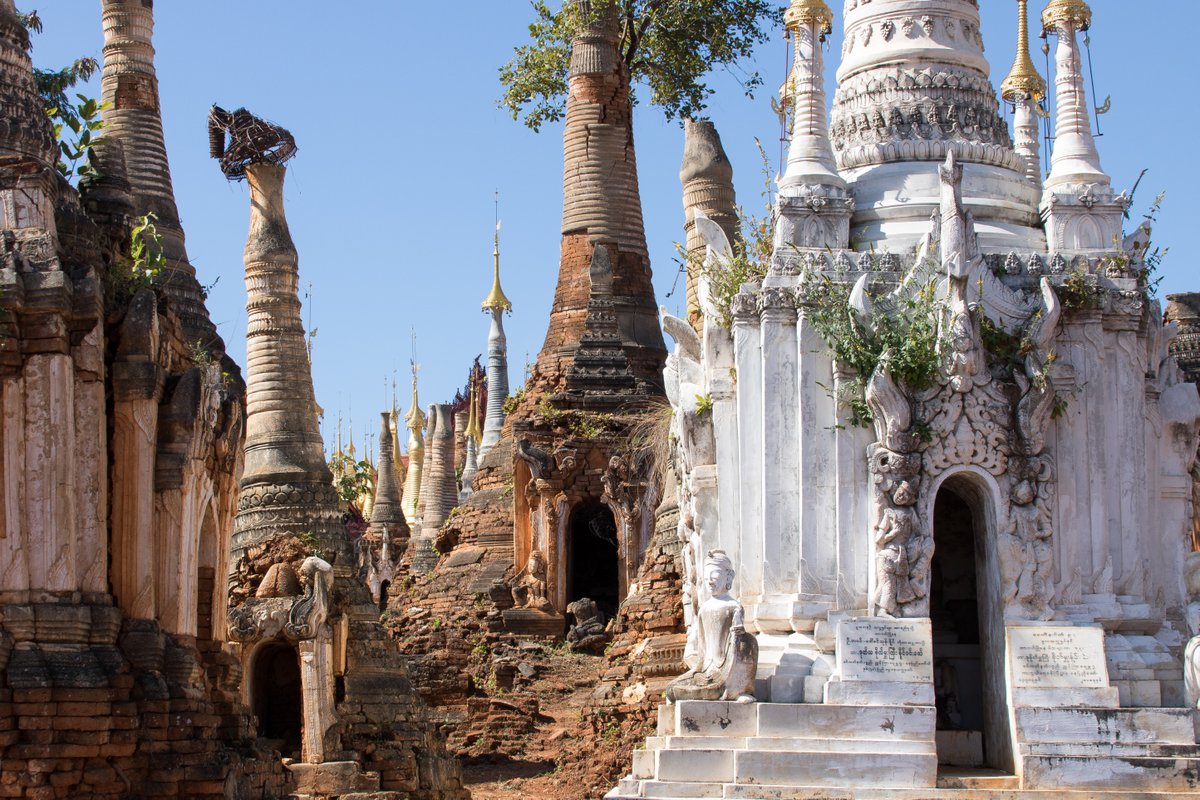
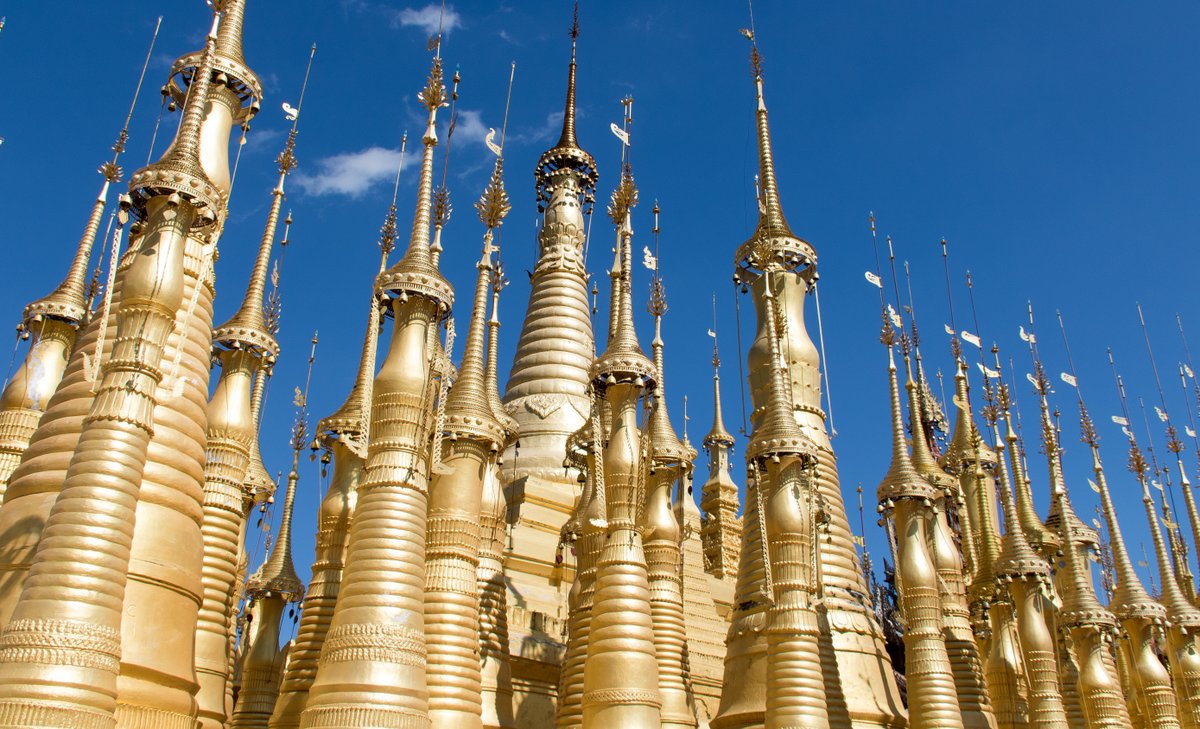
Nan took us to the Inn Dein temple area, where we saw many old stupas that date from the 17th century. Most of them are in a poor state of repair and, as late as 1950, they were completely covered by trees and vegetation. There are stupas with trees growing out of the top, and temples with 300 year old Buddha statues, half covered by rubble – it’s an amazing place, very Indiana Jones.
We carried on up to a well maintained temple, which had many reconstructed stupas. The locals pay $300-500US to have a stupa rebuilt, which I guess gives them lots of Buddhist Merit. Most of the reconstructed stupas have plaques that make it very clear who donated the money and exactly how much money that they gave. This seems strange to me – you donate money to offset any bad that you’ve done on your path to enlightenment, aiming to cast off any worldly desires, yet you tell everyone how rich you are.
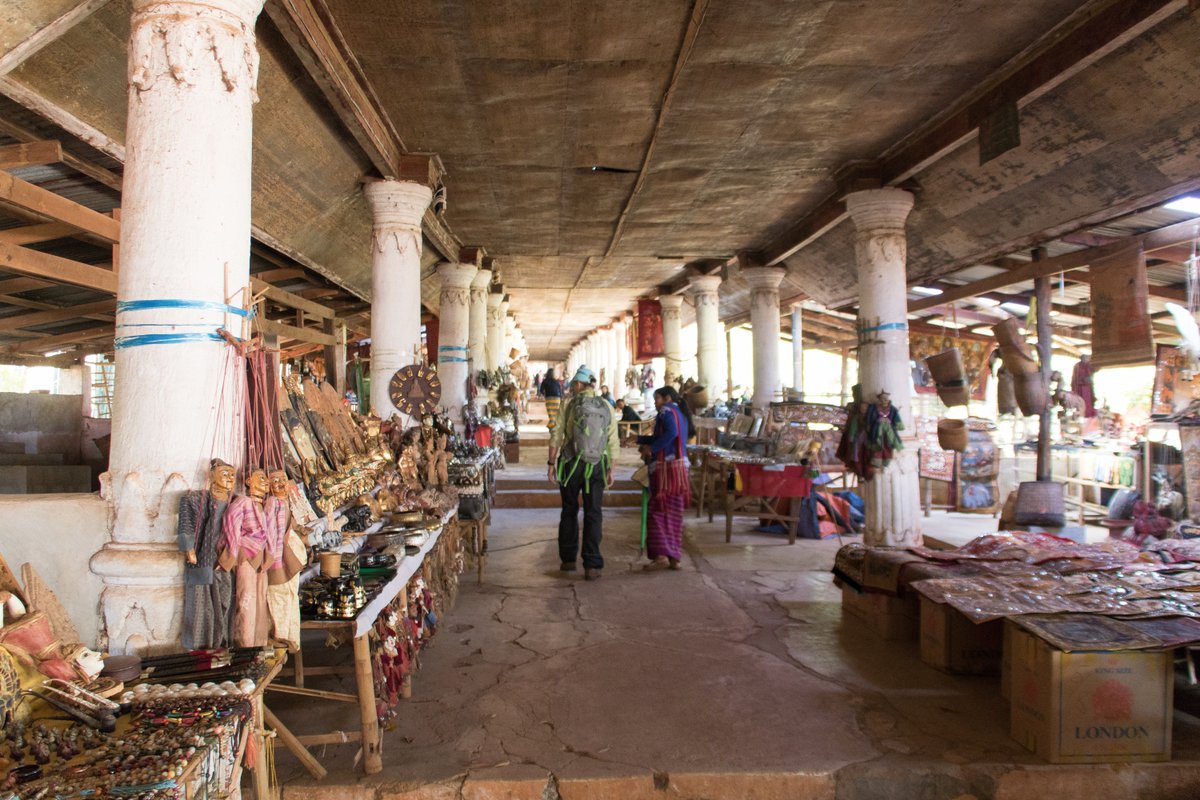
The covered walk way up to the temple is packed with stalls selling carvings, weaving, bags, t-shirts and a myriad of souvenirs – there are literally hundreds of stalls and thousands of tourists wandering around. It’s not quite what we want to see, but it was amusing to hear a British guy loudly berating his wife for spending too much money on tourist rubbish – he’d obviously seen too many markets.
We were taken to a silver smith and given a guided tour, watching the process from silver ingots to the finished product. They buy 99.99% pure silver bars and add 7.5% copper to make it harder and more resilient – apparently 92.5% silver is the standard. Everything is done by hand - producing the 92.55 alloy in a charcoal fire; producing silver foil and wire; weaving chain from the wire; filing, cutting and drilling the silver pieces all using manual tools.
It’s very interesting, but we were soon led into the salesroom, where I was ignored while the staff concentrated on Glenys, showing her beautiful, traditional, solid silver Myanmar necklaces and jewel encrusted earrings. Fortunately, Glenys didn’t succumb and we escaped without any expensive souvenirs.
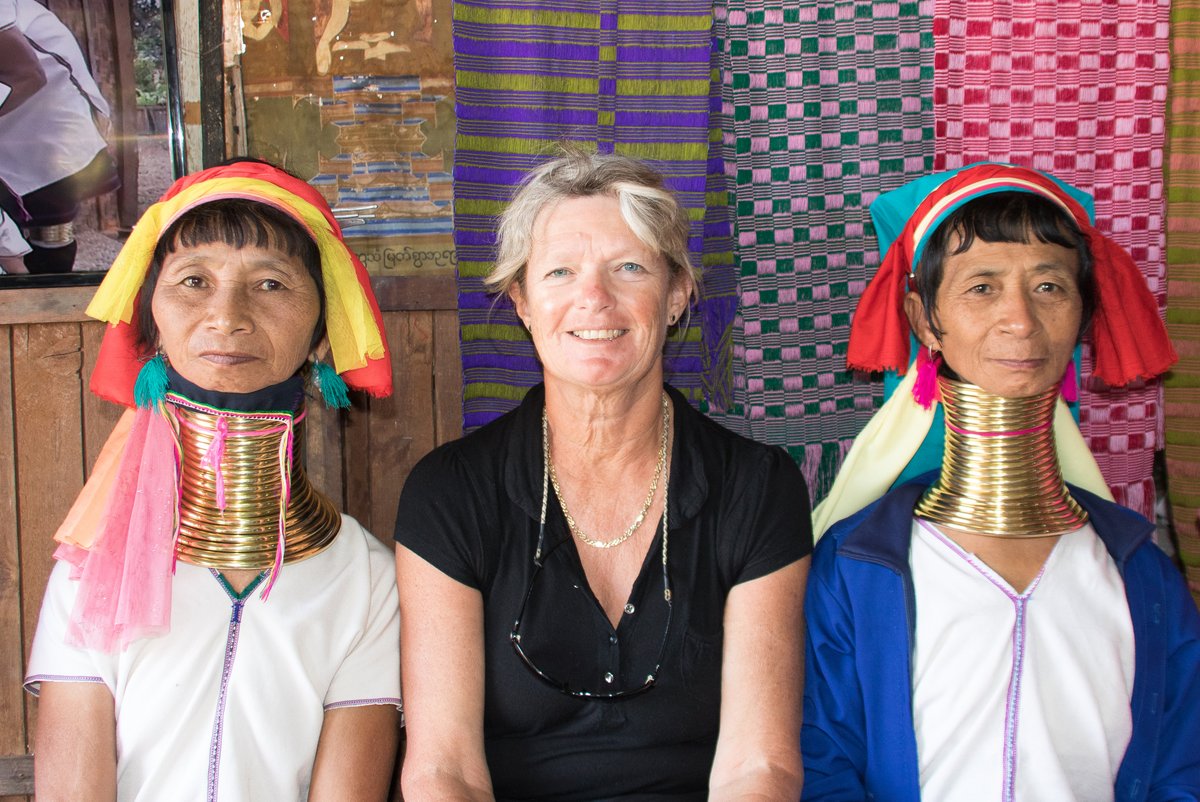
Nan then told us that we were going to see the “long neck ladies”, which seemed too intriguing to ignore. The women of the Padaung Tribe from the north east of Myanmar have a tradition of placing solid ½” thick brass rings around their necks, which extend the length of their necks. More rings are added as the woman grows and the older ladies have more than 20 of these heavy rings with their necks stretched to over 12” long. There’s a group of these Padaung people who have set up a shop in the lake where tourists can see the ladies and buy souvenirs.
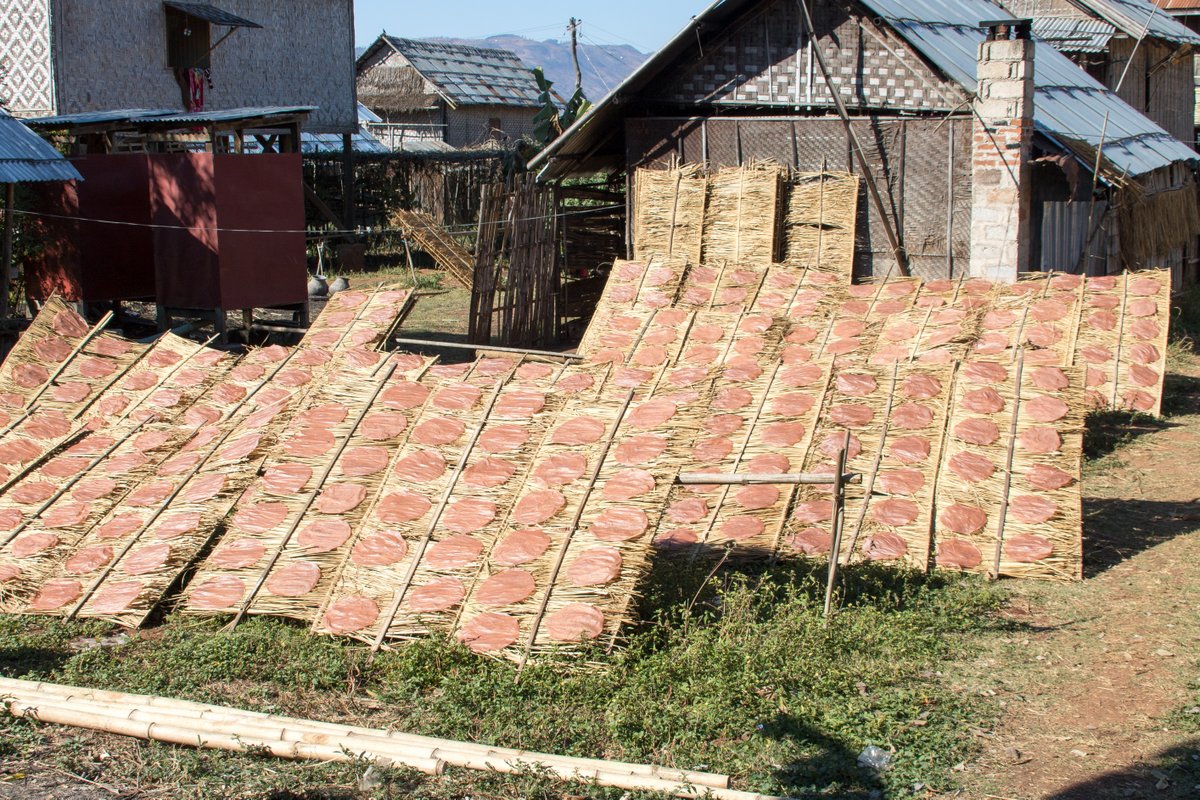
After a very pleasant and substantial lunch, we walked around a small village where they farm tomatoes on their floating gardens and also specialise in making 1 foot diameter rice crackers which are seen drying on mesh frames all over the village. Once dried, the crackers are pan-fried on a hot fire and sold around the lake. They’re very tasty and moreish.
In the evening we ate out again, but found a better establishment this time.
28 January 2016 Inle Lake to Yangon, Myanmar
After another huge breakfast, we squeezed ourselves into a car and Nan took us to a monastery on the edge of town, which was a very attractive wooden building. We watched a lesson being given to some novices, who were obviously finding it difficult to concentrate with a handful of tourists wandering about taking photographs. The monastery has some very photogenic oval windows and it’s a prime place for Monk-stalking, but no monks walked past an oval window while I was there.

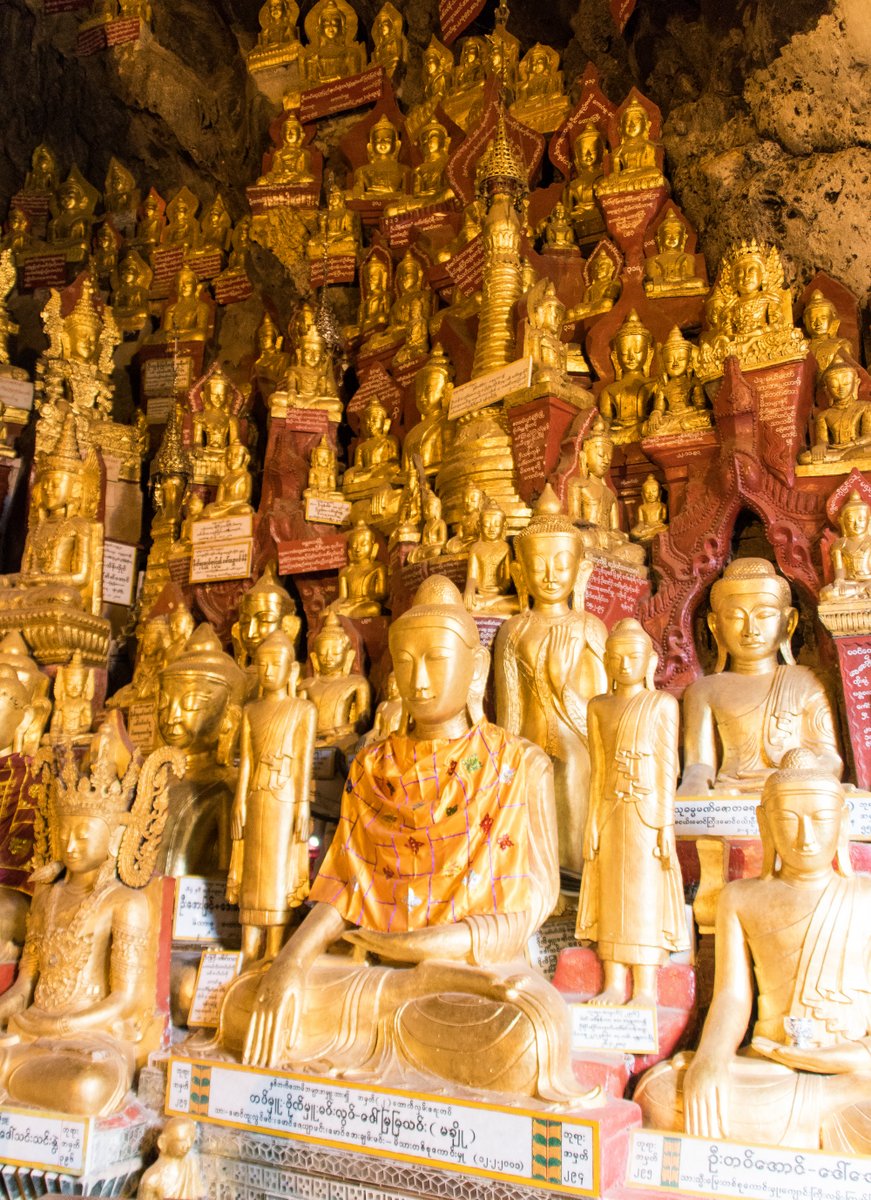
We drove for two hours to Pindea, where there are some caves that the locals have packed full of 10,000 Buddha statues. It’s quite impressive, but the most interesting part was a small cave where a famous monk stayed and meditated for ten years! There’s a small shrine inside the 3m diameter cave.

Our flight to Yangon didn’t leave until half past five, so Nan was trying to occupy us for the day. She took us to a place that makes paper by hand from mulberry bark, which interestingly is the same bark that they use to make tapa cloth in Samoa, but the process is very different. Here they soak the bark for a few hours and then bash it with a mallet to break the bark down into fibres.
A tennis ball sized lump is placed in a litre of water and agitated to break the fibres apart. A one metre square panel made of gauze is suspended in a bath of water and the fibre mixture is spread evenly on the gauze. When the panel is lifted out of the water the fibres are left as a thin mat on the gauze. This is dried in the sun for four hours resulting in a thick but remarkably tough piece of paper. As well as producing the paper, they manufacture a range of products from bamboo including parasols and fans – Glenys bought a nice fan for a couple of dollars.
We had lunch at a very flashy tourist restaurant, but only had two bowls of soup and a tomato salad – three big meals a day is starting to get a little wearing now. With three and a half hours to go until the flight, Nan was getting a little desperate for things to do with us, so we went for a walk around the town market and visited a small monastery. We drew the line at a further trip to see chick pea rice crackers being made and told her to take us to the airport.
Heho Airport is a small domestic airport and is mildly chaotic. Nan insisted on checking us in and while she was over at an immigration desk, some guy came over, tied a label on our bags and without saying anything took them away - disturbing... After half an hour of wandering around outside, we braved the security check and went through to the departure lounge. There are no nice information screens, just a lot of confused travellers milling about.
The flight to Yangon was only 90 minutes on a comfortable twin turbo prop plane. After a bit of a “slammer” landing, we were put onto buses and taken to the Yangon International Airport terminal, which was chaos. Luggage was brought on trolleys pulled by a tractor and the bags dumped on the ground outside the building. Confusion reigned as tourists and locals jostled to get to the front of the crowd, with most finding that their bags weren’t there.
Slowly more trailers appeared and the bun-fight continued. We kept out of the way realising that having checked in early our bags were bound to be at the back of the pile. Sure enough, (with some relief) we spotted our bright red cargo bags on the last trolley.
A driver met us at the exit and took us into the central area of the city, which took ages. Apparently, some Buddha relics (some of his vertebrae we think) have been brought from India to the Shwe Dagon pagoda and they go back to India tomorrow, so lots of people are clamouring to get to the pagoda to see the relics. We got caught in a Buddha crowd – kind of like a football crowd, but with more aggressive driving.
It took 90 minutes to drive 14 kilometres and we arrived at the Central Hotel at half past eight. The hotel is a bland, multi-story hotel of the kind you find in the centre of most cities. Glenys had been feeling ill all day with nausea and having to run to the toilet, so she went to bed while I sloped off to the hotel restaurant for a quick Thai curry, which was mediocre.
29 January 2016 Yangon, Myanmar
Glenys was still feeling ill, so after a couple of slices of toast at breakfast, she sloped off to bed and I went out for a walk. Yangon is a bustling city full of Burmese, Indians, Chinese and tourists. The city is laid out in a very rectangular grid, with two or three narrow streets between wider major roads. All of the buildings seem to be at least six stories high and, in the narrow streets, there are balconies jutting out from the apartments. There’s a colonial feel about the buildings, which reminds me a little of Cuba.
I wasn’t wandering aimlessly - I had my sights on the British Embassy. When I was eighteen, I shared a flat with a Burmese guy called Myo Aung. He’d come from Burma to go to a UK university and we met at a training centre where we were working for six months. At the time, I found Aung fascinating, telling stories of being a monk and showing me some martial art katas, which he’d learned in the army. He came to visit my parent’s house a few times and my Mum and Dad had some correspondence with his parents.
I thought that it might be fun to try to locate Aung. Unfortunately over the last 35 years, my parents and I have lost his address in Burma, so it’s a vain hope. The Burmese don’t have a surname like us, so one has to know their name and the name of their father to identify a person uniquely . To make matters worse Myo Aung is a very common name.

Aung must have had special documentation and visas to enter the UK as a student because, in 1973, the military had taken over the country and were implementing radical socialist policies restricting contact with the west. I would think that his parents were either very wealthy; in the military; in the government; or were political exiles.
I had thought of approaching the Myanmar authorities directly to try to locate him, but with Myanmar’s record of human right’s violations, what would happen if Aung’s family turned out to be anti-government activists? I imagined being seized in a government department then being taken to the notorious Insein prison and being tortured to find out my connections with Aung.
Hence my visit to the British Embassy in Yangon - I hoped to have a 5 minute chat with a consular officer about the political situation, see if they had any suggestions and maybe they could look for Aung’s visa records from 1973? When I arrived at the Embassy, a Burmese guard at the front door thrust a piece of paper at me containing telephone numbers and said that I had to ring a help line to make an appointment. My protests that I was already at the Embassy fell on deaf ears and I was pointed at the nearby post office to use the telephone.
In the post office, a nice lady started to help me, but using a telephone didn’t seem to be something that she could arrange. Eventually, a young passer-by offered to let me use his personal mobile. I rang the number and had a difficult conversation with a Burmese national, who finally said that I should go to the front door of the embassy. I said okay, I’d be there in two minutes.
Back at the front door of the embassy, the guard contacted reception on an intercom and I think talked to the same person that I’d talked to on the phone. Apparently, he’d told me to go to the front door to get the piece of paper containing the telephone numbers and I now had to send an email. Exasperated, I demanded to see a Consular Officer “right now” and pointed to a paragraph on the piece of paper that said in an emergency situation, I should be able to see a Consular Officer immediately.
There was much babbling on the intercom and finally, they said that someone would see me. I must admit I felt a bit guilty about scamming my way in, but I felt it was my right. What ever happened to the old days where one could pop into the Embassy for a cup of tea and a chat about the political situation in the colonies?
A very nice chap met me in reception and took me into a small interview room. He listened very politely to my little story, but they only keep visa records for two years and he didn’t think that the Myanmar authorities would be of much help after 35 years. His best suggestion was to try to find Aung through Facebook, which the Burmese people have really taken to. I’ll give it a go, but I don’t hold up much hope.
Glenys was asleep when I got back, but said that she felt a little better. We stepped out and had a naughty KFC Zinger on the basis that Glenys needed stodge to help her recuperate. We had a walk around the local area, so that Glenys could experience the chaos, but it soon exhausted her and we retired back to the hotel room to have a quiet afternoon.
In the evening, we had a stroll through the packed streets of the Indian and Chinese quarters, down to the Sule Paya temple, which is in the middle of a roundabout – it looked pretty scruffy, so we didn’t bother to go in (I found out later that it’s over 2000 years old…) We walked to the nearby Mahabandoola park, which was packed with locals taking a stroll and is surrounded by many fine colonial buildings.
There are thousands of small food stalls set up in any available space, where the locals were eating curry, kebabs and cakes. In due deference to Glenys’ dodgy stomach, we passed by them all and called in at a nice little Indian restaurant called Titu's Indian Banana Leaf Restaurant just around the corner from our hotel. I tucked into a superb mutton curry, dal, rice and a nan, while Glenys picked at a very small portion.
30 January 2016 Yangon, Myanmar
Glenys was still feeling ill, so we abandoned our planned trip to Shwedagon – it’s just another Buddhist pagoda after all - here’s a description of what we missed…
No visit to the Union of Myanmar is complete without a visit to the 2,500 years old Shwedagon Pagoda, which enshrines strands of Buddha's hair and other holy relics. Located west of the Royal Lake on 114 -acre Singuttara Hill in Yangon, Shwedagon Pagoda is the most sacred and impressive Buddhist site for the people of the Union of Myanmar. From a humble beginning of 8.2 meters, the Shwedagon Pagoda today stands close to 110 meters.

Shwedagon Pagoda is covered with hundreds of gold plates and the top of the stupa is encrusted with 4531 diamonds; the largest of which is a 72 carat diamond. It is clearly one of the wonders of the religious world. Shwedagon Pagoda is a repository of the best in Myanmar heritage – architecture, sculpture and arts. The Shwedagon Pagoda consists hundreds colorful temples, stupas, and statues that reflects the architectural era spanning almost a 2,500 years.
Ah well! Fortunately, the hotel let us keep our room until the middle of the afternoon and we had a quiet morning with Glenys reading and sleeping, while I caught up on editing photographs. I nipped out to the famous Bogyoke Aung San market, which is basically a very large market selling clothing and jewellery to both locals and tourists. I managed to buy a couple of T-shirts including one with the Myanmar beer logo.
For lunch, we had a couple of bland, non-spicy sandwiches on white bread that I picked up from a nearby supermarket, which Glenys was able to eat. Our driver picked us up at 14:30 and we endured a 90 minute battle against the Yangon traffic to the airport - an average of 5 miles per hour.
The flight to Bangkok was just over an hour and we were sent through a fast channel to the domestic departures lounge. At Bangkok, I was thrilled to find the three gods of western food (McDonalds, KFC and Burger King) all in a line. Well, it had to be a Whopper. Glenys was still feeling very delicate, so I had to eat alone, while she despairingly picked at a few fries.
The flight to Phuket was just over an hour, but Glenys didn’t enjoy it much. She had a nap, but when she woke up, she had to retired to the toilet with a sick bag - perhaps she shouldn’t have had the fries after all. We caught a taxi back to Boat Lagoon and arrived around midnight, looking forward to a lie-in tomorrow.
It was a fabulous holiday in a diversely interesting country, we hope to return to Myanmar.
- << Prev
- Next