
1 March 2010 Tour de Famelon (2138m)
We got up at quarter to seven and went down for breakfast. Mark, Mike and Omar were at breakfast with us, but Silvano didn't show up until eight o'clock when we were all leaving. Glenys and I had already packed our rucksacks (about three times), so we were down in reception ready to leave as planned at quarter past eight.
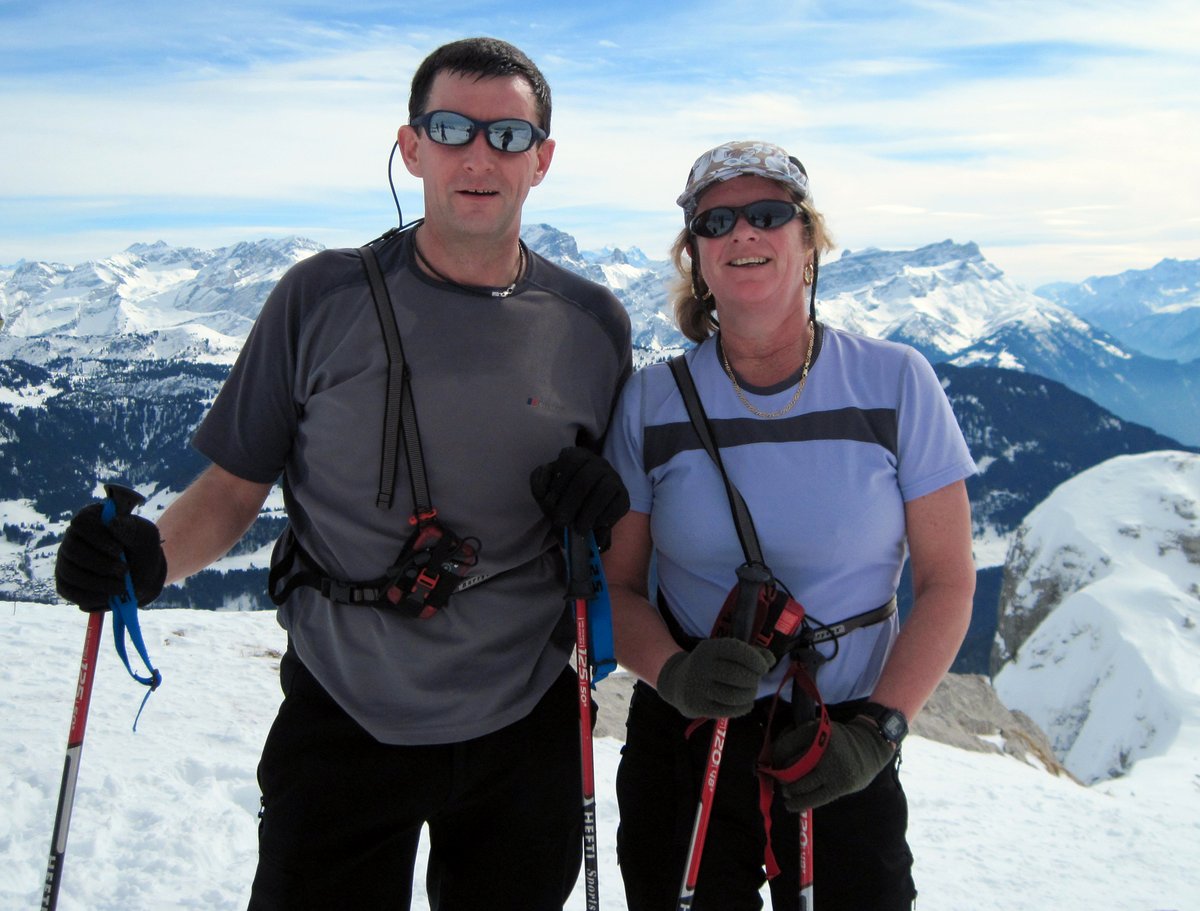
The others arrived haphazardly over the next fifteen minutes, with their kit in various states of array. Silvano told Terry that he had already lost his shovel. Terry was not at all pleased and just told Silvano that he had to find it. Eventually, Silvano gave up and went out for the day without his shovel. (It magically appeared in his room the next day, so we guess that he had left it in the bar and the cleaner had locked it away somewhere.)
We finally walked down the road to the top of the nursery slope and skied down to the ski lift station. Terry went and bought the ski passes for the day and we went up in the tele-cabine. After a bit of a briefing about the current Avalanche Forecast, we skied down to the top of the Tete d’Ai ski lift, where there is an avalanche rescue training area.
We spent a couple of hours playing in knee deep powder, burying transceivers in “transmit” mode to act as avalanche victims, and then trying to locate them with our transceivers in “receive” mode. It’s interesting how the system works. The receiver has two or three aerials arranged at ninety degrees to each other and these pick up the signal along what is called “flux” lines which radiate out from the transmitter like the flux lines on a magnet. This means that when following the signal to the victim, you actually follow a curved path to them. However, even with this technical problem, it is fairly easy to find the victim.
Once the victim has been roughly located, the rest of the team push the probes into the snow to try to physically find the victim. Apparently when you find a victim with your probe, you should leave it jabbed into the victim’s body because it reassures them. I guess that it would be a bit worrying being buried, unable to breathe properly and wondering if any one will find you. Imagine the relief when a probe jabs into you and the despair if the probe was then removed..
Once the victim is located, the team then start digging down hill of the victim’s marked position, with one person digging and the others removing the dug-out snow.
We had an early lunch, then skied across to the top of Les Fers chairlift to prepare to go up to the top of the Tour de Famelon (2138m) - an ascent of 460m.
The avalanche risk for the day was at Level 3 which is “Considerable”. The official explanation of this level is:
The snow pack is moderately to weakly bonded on many steep slopes. Avalanches can be triggered even through low additional loads mainly on steep slopes indicated in the bulletin. In certain conditions, some medium and occasionally large natural avalanches are possible. Isolated exposed sectors are endangered and some safety measures recommended in those places. Partially unfavourable conditions. Experience in the assessment of avalanche danger is required. Steep slopes of indicated aspects and altitude zones should be avoided if possible.
The risk of avalanche was very much in our minds as we looked up at the slopes directly above where we were standing - where there was the remnants of a big avalanche, which was triggered yesterday.
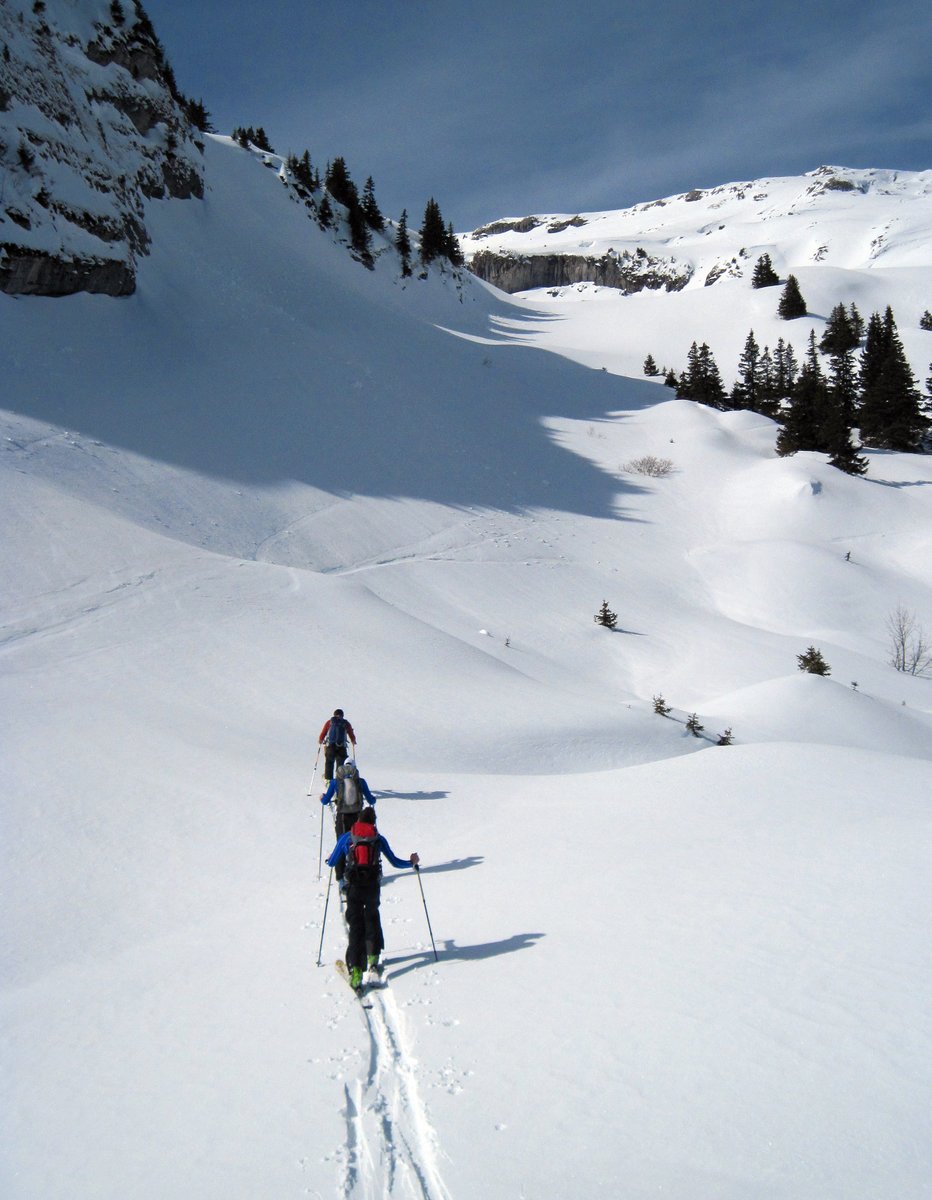
We put on our skins and then started on our way up the mountain. Terry led us off to the side of the slope above us through some trees to avoid the potentially unstable slopes. We were then presented with a pristine slope beckoning us up the mountain.
The sun was beating down and I stripped down to a single base layer, but was still sweating profusely with the heat of the sun and the effort of climbing. I had sweat running down my face, fogging up my sunglasses and carrying suntan lotion into my eyes, which doesn't half sting.
After about half an hour, we started up a steep section and I noticed that I kept slipping back as I weighted my ski. I persevered up a nasty steep traverse and had another 15 minutes of struggling in the deep snow before I thought of checking the bottom of my skis. I took one off and found 40 cm of hard packed snow stuck to the bottom of my skins. No wonder that I was struggling. Glenys and Silvano stopped where I was and we found that Glenys’s skis had the same problem. We scraped the snow off with our ski poles and continued up trying to catch up with the others.
Just before the peak of the Tour de Famelon, there is a very steep section and Terry’s line was at about 30 degrees. Both Glenys and I were struggling because our skis had balled up again. I took a slightly shallower line and we managed to get up. Terry told us that balling up is a known problem with pure synthetic skins. The better and more expensive skins have mohair in them which helps prevent this problem. The way to prevent the problem is to wax the skins, which we will do tomorrow. Everyone else in the party has Mohair skins - great!
We all walked up to the top of the peak which was pretty icy and steep, so we had to kick steps and use a fixed chain to get up. There was a great view of Leysin from the top.
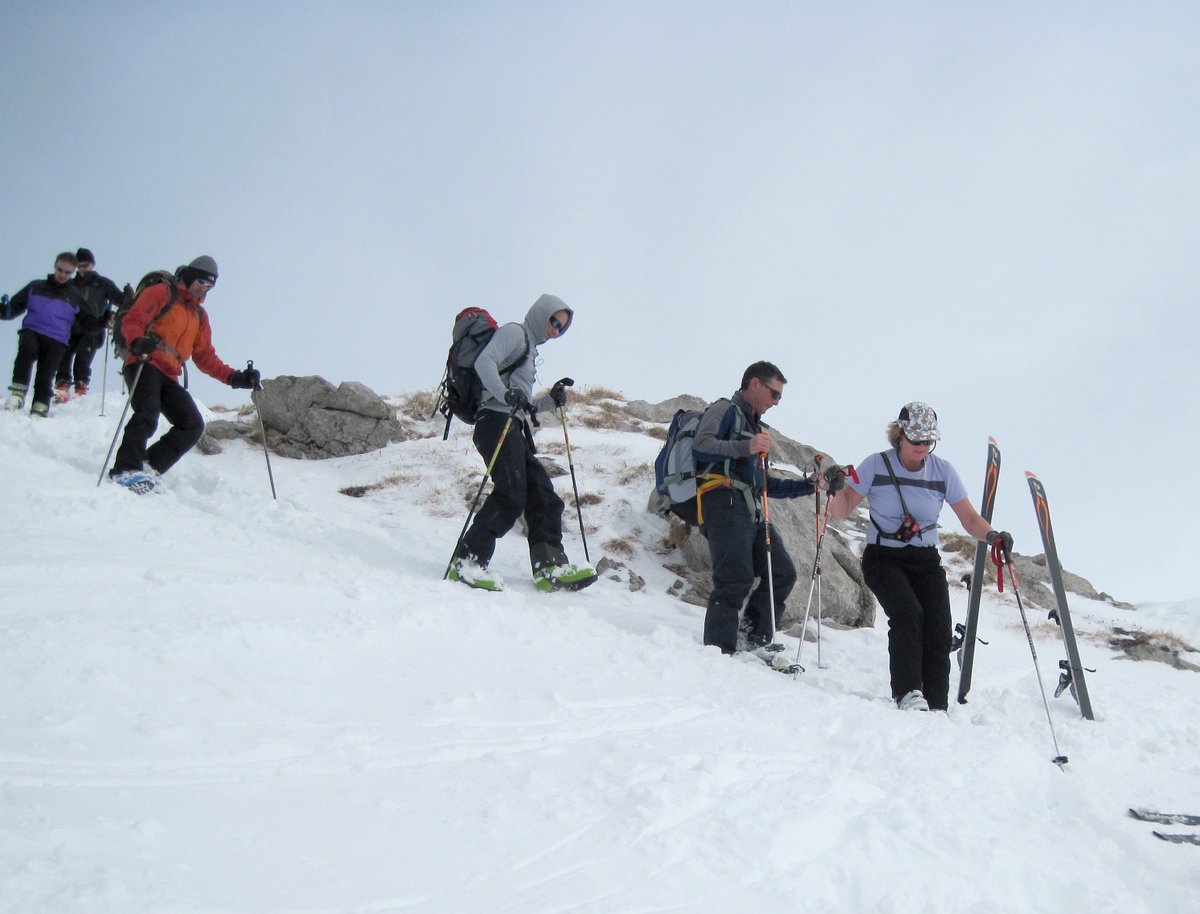
The ski down was difficult. We walked down to our skis and then, for the first section, we had to ski down the very steep slope one at a time - there's nothing worse than every one watching you. Terry decided to ski down the other side of the mountain to Solepraz. Initially it was icy with a steep traverse, but once we were in the valley the snow turned into something resembling thick porridge with a crust about 20 centimetres down.
I had a confidence crisis. I had to use lots of effort to turn and then as I weighted the ski, I broke through the crust and disappeared into the deep snow. It’s amazing how exhausting it is to keep having to pick yourself up out of deep snow. Within 20 minutes, I was exhausted which made everything even harder. The only consolation was that everyone else (except Terry) was struggling as well.
Once at the bottom of the slope, we then had a pretty exhausting time snow-ploughing down a foot path trying to slow down, which really make the thighs burn. We wended our weary way back to Leysin on the piste and arrived back at the hotel at about half past four.
No rest for the wicked, Terry wanted us to meet at six o'clock so we just had time to have a shower and hang up our damp clothes before going to the bar for an Avalanche Awareness lecture, which was very good. We had dinner with the others and collapsed into bed at nine o'clock We found out that Omar runs in hundred mile ultra-marathons. (Please God, don’t let him go at the front...)
2 March 2010 Pic Chaussy (2351m)
We managed to organise ourselves and set off at half past eight. Steve Monks joined us and it was great to catch up with him again. I'm slightly surprised to see Steve, he normally comes over to the Alps in the summer and spends winter in Australia. He's a self-declared climbing specialist and told us that he hasn't skied for 15 years. His partner (Zoe) has taken a full-time job in Europe, so he's decided to spend a couple of years in Europe with her - hence needing to brush up on his winter skills.
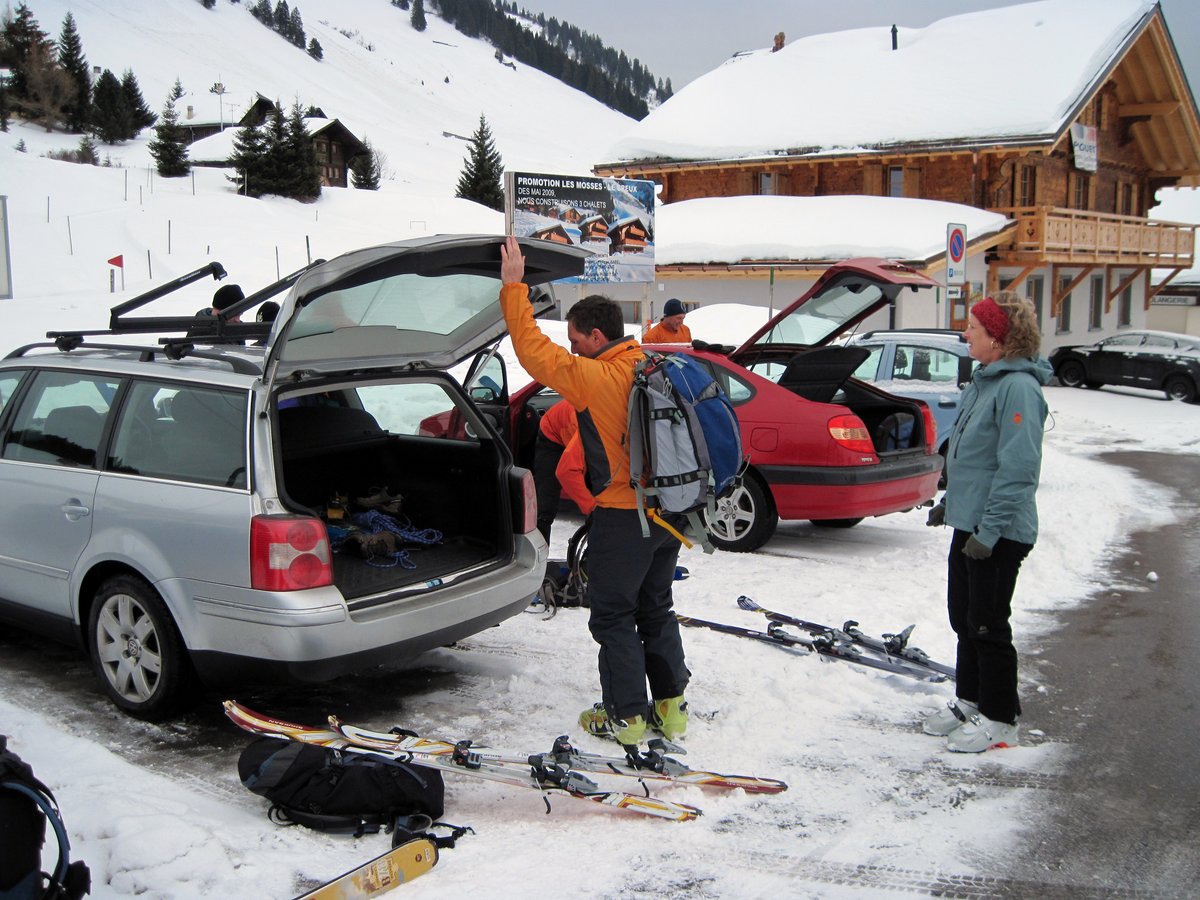
We drove around to Les Mosses and parked at the bottom of a disused ski drag. We sorted out our gear and Glenys and I waxed our skins. It was lightly snowing when we set off up the old piste next to the drag lift. The forecast was for it to improve, but the Avalanche Risk remained at 3.
At the top, we went across a very flat meadow and then up a wide path leading to a small mountain restaurant next to a frozen lake. Unfortunately, the restaurant was closed for the winter, so we had a quick chew of our sandwich in the biting cold before setting off up the mountain. The pace was OK, if a little remorseless - these guides just don’t stop. There was a lot more avalanche debris on the south facing slopes showing signs of the current instability.
Eventually, we reached a col, where, after a short rest and a “mountain mix” refuel, we turned left and set off up a towards the summit. Terry skinned up a slope which had large cornices overhanging on the right and huge cornices above our route. His only comment was: Don’t go too far to the right and pray that the cornices above us don’t decide to drop off...
We continued up towards the cornices in fairly deep powder, which looked good for the descent. We arrived at a steep slope defended by an other overhanging cornice with a worrying amount of big blocks of hard snow that had fallen from it. Terry continued up a zig-zag path and eventually broke through the lip of the cornice.
Mike had a bit of a problem when he tried to get over the lip. He leaned into the slope instead of standing upright. It’s counter-intuitive because you want to lean into the ground, but that actually makes it worse because your skis start slipping away. He ended up on his side scrabbling away trying to get up over the lip obviously hyperventilating about falling into the abyss. After that, we all approached the lip with some trepidation.
Once over the lip, we were faced with a very icy, wind-swept slope. The route continued up at about 20 degrees, but there was a huge drop off to the left which quickly turned into a 45 degree slope, which descended to the valley floor a kilometre below. Fortunately, Terry had made us put on our ski crampons at the Col, which helped a lot.
The main problem with ski crampons is that, for them to be effective, you have to set the “heel lifters”, so that your feet are flat with the ski. This allows the ski crampon spikes to really stick into the ice/snow. Unfortunately, this also means that the tops of your already tired thighs really start to burn - imagine walking up and down stairs for two hours and then, in a couching position, walking up the stairs for ten minutes. Combined with the fear of the icy slopes and a huge drop on our left, it was a bit stressful.
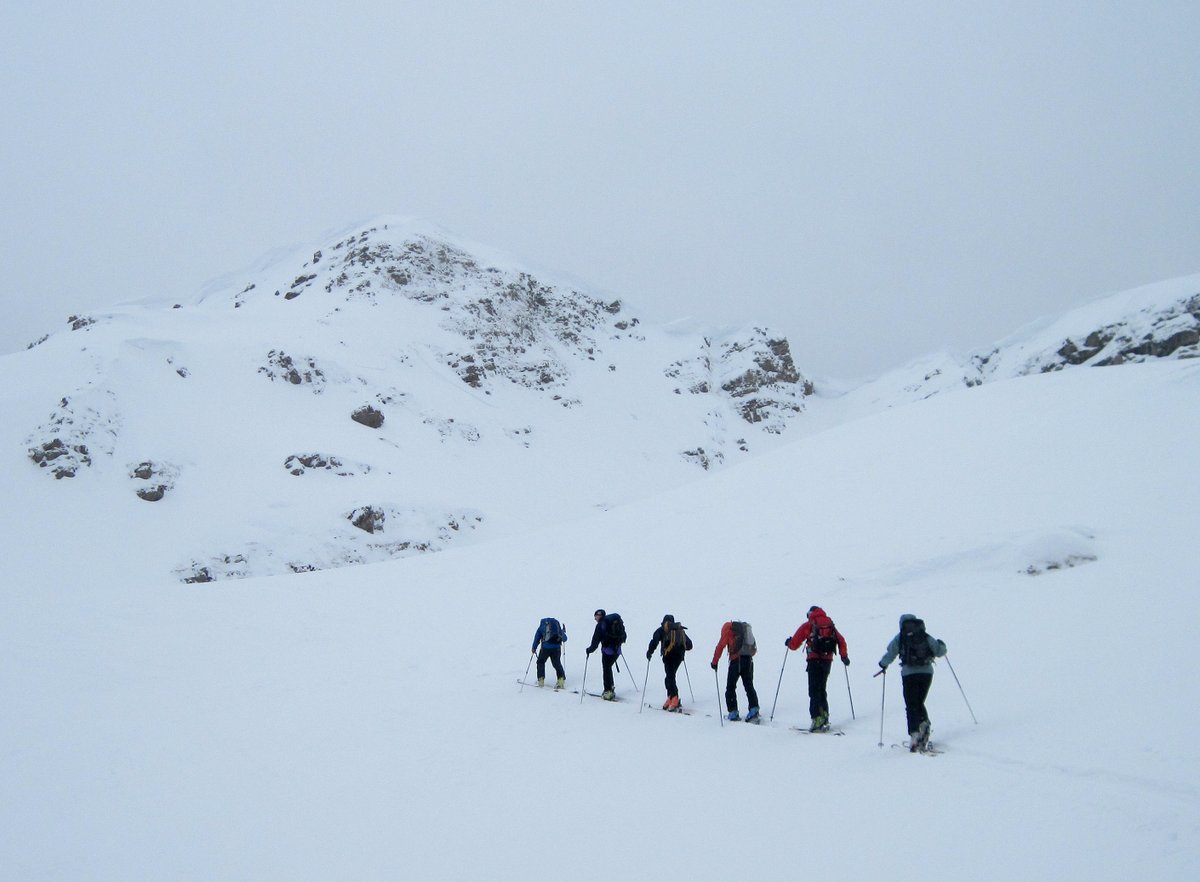
It was even more stressful for Mike - he didn't have any ski crampons because the ski shop had given him the wrong size (Note to Self: Remember to CHECK all my ski gear before I go onto a mountain.) He had to keep zig-zagging up the scary slope with the huge drop to the left and the lethal overhanging cornices to the right.
We all made it to the top. Is the fear greater than the actual danger? There's a great view of Leysin from the top. We lurked around for ten minutes, having a “mountain mix” refuel and set off down.
I was fairly apprehensive before we set off, but if one ignored the kilometre drop off to the right, it was a very simple (if icy) traverse down to the cornice lip. There was a bit of faffing past the cornice and then onto a steep powder slope. Unfortunately, it was very over-cast and the light was very “flat” which meant that we couldn't see the angle of the slope or even if there was a huge drop in front of us. We skied cautiously down the gloriously deep powder.
Terry stopped at the top of a couloir, which initially looked like it dropped away vertically, but wasn't too bad once we’d gone over the initial lip. The slope was very variable with some powder patches, turning into a very difficult section with snow over avalanche debris making it very bumpy.
We trudged back across the meadow and skied down the old piste back to the car. We went into a bar and had a well deserved drink and cake. The pace was better than yesterday and the snow conditions were much better. We did 900 metres ascent in about three hours and it took us 30 minutes to get back down.
We drove back to the Grand Chalet hotel and spend 20 minutes sorting out crampons for our boots before staggering to our room for a shower. Terry gave us another briefing at six o'clock, telling us that we were going to the Lammerenhutte for three days and what equipment we should take. We had dinner and were in bed by nine o'clock.