10. NOSY BE AREA
10.1 Anchorages
Anchorages are listed heading south.
|
Hellville, Nosy Be (13°24.450S 48°17.044E)
2016 Adina - 13°24.450S 48°17.044E 8m,Mud. If checking into Madagascar you need to visit the police who act on behalf of immigration and can be found in the port in a small portacabin (13 24.462S 48 16.834E). They are corrupt - they show you a hand written note in a book stating check-in is now 80,000Ar (26USD) for a "droit d'arraisonnement", we saw in their receipt book they were charging yachts in 2016 anything from 60,000Ar to 240,000Ar (20 to 80USD). You need 2 copies of your last port of clearance plus 2 copies of your crew list. You pay them the fee plus standard visa costs and then return to collect your passport at a time they tell you. After this you need to clear in with the Port Captain (building at 13°24.4201S 48°16.7349E). Walk out of the port gate, follow the road that bends to the right, they are on the corner on the right. They will issue a cruising permit for Nosy Be and surrounding islands, we were told the minimum length issued is 1 month, we paid 59,310Ar for this 1 month permit. They didn't ask for any extra fees and used official documents. If you don't speak French it may help to use one of the "boat boys" like Jimmy and Cool who will charge you 30,000Ar (10USD) but to note they do as the officials tell him. Jimmy and Cool are helpful for looking after your dinghy (5000Ar half day/10,000Ar full day), getting fuel/water and any other information. Jimmy wears a red Mount Gay Rum baseball cap. We later did a domestic clearance with the Port Captain. This required 4 crew lists - he stamped and signed all 4 and kept one. We were given a domestic clearance document - no charge. Tuk-tuks to town are cheap at 500Ar per person, good fresh market, Shampion supermarket and assorted restaurants - Nandipo is where yachties hang out and Oasis Caf‚ for coffee and cake fixes! 2016 Tintin - 13°24.347S 48°17E, very muddy, 7 meters. We arrived in Hell Ville (Andoany) 27th August at 0830 hrs for our Port Clearance, the 2 month Madagascar Visa and 1 month Cruising Permit for Nosy Be. Just as we dropped anchor we were met by Jimmy and Cool who had canoed out to welcome us. These guys have a good reputation with cruisers and were recommended to us for assisting with all the check in formalities. They also saved us time re finding the ATM and Mobile Phone shop, the 2 most important things we need in any new country, ie local currency and Wifi. The guys also organised a babysitter for “Snowy” our tender as the port, though rather small is very busy and there is just nowhere to leave your tender. The Clearance Process (NB Saturday) was relatively pain free with no real surprises. We were taken to a small tin shed where at least 12 Police, mostly females were watching TV, one was doing her fingernails and the majority were on their mobile phones. We paid for our Madagascar 2 month Visa and the Police Fees for who knows what???, we did get a receipt and waited for our passports to be stamped, and waited we did! The Police were interrupted firstly by the Minister of Police and Immigration, secondly by the photographing of the Police with 3 men caught for robbing a yacht or 2 in Crater Bay and finally the arrival by boat of a famous “Pop Group” here for the festival that night. We can’t complain, it was very interesting watching the above and once we got our passports back and stamped it was off to the town centre in a Tuk Tuk to explore, have lunch and a cold beer. BTW the festival was held just opposite where we were anchored it started around 2100 and finished around 0600……..can’t say we enjoyed the music either!!! On Sunday we headed off to Nosy Komba, then back to Hell Ville Monday to pay for our Cruising Permit as the Port Captain was closed over the weekend. Another day in Hell Ville to complete Checking-In formalities and pay for 1 month Cruising Permit for sailing around Nosy Be, then off to the Market to buy fresh fruit and vegetables. The daily market is both in the town market building (a permanent structure) and hundreds of stalls lining several streets, running all the way down to the waterfront. This market is the best fruit and veggie market we have been to since leaving Thailand, however we were put off buying any fresh meat or seafood because of the huge amount of flies. The streets surrounding the market building are full of stalls selling everything from exercise books to coal for cooking. We love visiting the local markets as it is a great way to mix with the locals, and see and buy the local produce. This is the spot to buy the local vanilla and a variety of spices and all kinds of pepper. We found the Malagasy people to be friendly and welcoming, humble and warm, however they do not like confrontation. There is far less rubbish here, and hardly any plastic "water bottle litter" on land or water. The majority of Malagasy people can't afford to buy water in plastic bottles, most go to the local well, so therefore far less litter, very different to the "huge " amount of plastic bottles littered all over Indonesia, Malaysia, Thailand, Sri Lanka and the Maldives. Interesting note, we hardly saw any elderly people. According to the latest WHO data published in 2015 life expectancy in Madagascar is: Male 63.9, female 67.0 and total average life expectancy is 65.5 years, which gives Madagascar a World Life Expectancy ranking of 137, FYI Australia is: 83 years. Also the Malagasy people must pay to send their children to school, if you cannot afford the fees, your children do not go to school. Many of these children work as labourers in the fishing industry, wander the streets trying to sell food snacks in the hot sun, or as domestic servants. 2007 Ocelot - S13°24.4 E48°17.0 31' (9m) mud Shoals rapidly towards land. We anchored off Hellville town at S13°24.4 E48°17.0 in 31' (9m) over mud. Be careful going far into the bay - it looks nice and open but it shoals rapidly near the edges (probably an old reef). If you haven't already, read the cautions on dinghies here, written above. 2016 Camomile - Tuesday we motored back to Hellville to see our friends on Norsa and Solstice arrive from Mayotte. We all went ashore so they could check in and then met up later for lunch at our favourite cafe called the Oasis. Built in a Parisian street cafe kind of style the food is very good but the best are the chocolate brownies with a nice cappuccino. Yum Our first full week in Madagascar started with the chaos that is Hellville, the biggest town on the island of Nosy Be. The name means ‘big island’ and is pronounced ‘nossy bay’. It’s thought it was settled as long ago as 1649 by the English but the colony failed due to hostile natives and disease. They have had various arrivals since, Arabs and Comorans, but it finally came under the protection of the French in 1841. More recently Europeans have created a holiday resort of the island with many French and Italians settling there. We anchored at 13°24.375S 048°17.059E Hellville was named after Admiral de Hell a former governor of Reunion island further south rather than an evocation of the state of the town. It’s one of the places yachts can check in. A lot has been said about the government officials here and it’s very difficult finding any common ground. There are two locals here called Jimmy and Cool, Jimmy will walk you around the various officials which, if you don’t speak French, is necessary and Cool will mind your dinghy for you as there’s no dinghy dock. It will be moved around but we felt they needed to be trusted and we had no complaints. We work on 4,000 Ariary to 1GBP and Jimmy charges 30,000 and Cool 10,000 for the day to look after your dinghy so we aren’t talking big money. Unfortunately our photo of Jimmy didn’t come out but he’s on the left of this photo in the the red t-shirt. This also shows the chaos where you have to come ashore. We went ashore first thing on the morning of Monday 29th August and the fun began!! The first people to see are the police, they have an office/portacabin on the waterfront. They filled in an arrival form for us then said the person to stamp the visa wasn’t there so Jimmy took us to their office in the town. The tuktuk fares are 500AR per person for any journey which was 25p for the two of us. We got off at the bank to get some money out of the ATM. It issued us with 10,000AR notes which are worth about 2.50 so Bill ended up with wads of money in his pocket which is never a good idea. Continuing on to the visa office but the guy we needed to see wasn’t there either. A little word about tuk tuks, forget doors and windows, forget MOTs, forget health and safety, just go for a ride! We went back to the police dock and said we couldn’t find him and, after various suggestions, all of which would have cost ‘bribe’ money, it was agreed we would go back later. Then it was onto port control who were very efficient and it cost AR61,000 for a 1 month cruising permit for the Nosy Be area. (Note to sailors following us , you only need a permit for the month you’ll be in this area even if you have a visa for 2 months as we did.) The next stop was the Orange shop to set up a sim for the phone with internet access passing the local prison on the way. Remind me to behave here, can’t imagine the squalor that would be behind these walls. Continuing along to the market. We made our way back to the port to meet Jimmy at 2.30 to get our visas stamped. The guy still wasn’t anywhere to be seen and it was suggested we go to the airport to find him. I refused that because it wasn’t a weekend and I knew it could cost 30,000 plus in a taxi each way. The police were also after their ‘payment’ asking first for 120,000 but we refused saying other cruisers have paid 80,000 which they accepted. This is only about GBP20 but as we knew it was simply a ‘bribe’ we weren’t happy about paying but you have no choice. If you don’t pay they won’t check you in and can then arrest you – having seen the prison, we paid. We went back to the boat and finally at 4pm he turned up and we were able to get our visas which cost AR100,000 per person. At the end of the day we paid less than GBP100 for the whole thing which was far less than the other countries in the Indian ocean but it all felt a bit tacky. At last we were able to host the Madagascan flag I had made. The next morning it was back into town for shopping. This is the car park outside the supermarket. Isn’t he lovely? Its called a zebu and they are every where including on the meat counters for sale! The supermarket had a lot of French products and wine so we had a little stock up. The fruit and veg weren’t as good as the market but we found in the following days that certain days after a delivery the stock was better. We’ve got various leaks in Camomile’s water system and Bill needed some tubing. This man was very helpful with his little bit of English and Bill using a little bit of french he managed to get what he needed. The traffic is a bit chaotic here with a mixture of cars, tuk tuks and zebu carts. Back at the port we watched the most extraordinary scene where they were loading cars and fairly big trucks onto a local ferry. I’ll try and post a video on facebook. How they didn’t sink I’ll never know. Jimmy was watching and our dinghy had been pulled up onto the side. This is why you need to pay Cool his AR10,000 to watch your dinghy. The truck was held up while our dinghy was launched. 2015 Totem - 13°24.438S,48°17.068E,27,Mud, Easy in. Excellent holding, but exposed to the SE trades, which blow more at night as day has a land that locally, reverses trade winds. 2014 Inifini - S13deg24.459min/E048deg17.039min. We spent the entire morning (0715 to 1215) checking into Madagascar with Officialdom. We had made arrangements to meet our boat boys at 0730, and they were at the wharf promptly to take our dinghy and petrol jerry jug to allow us to meet our taxi. The boat boys here ensure the safety of the dinghy because there is no proper place to tie up to. I took my outboard engine key and fuel lines with me when I got out of the dinghy....Unfortunately, the taxi guy never showed up, and after waiting 45 min we used another taxi driver and had a pleasant chap, Sergio, along as interpreter. (Details: we used Jimmy as boat boy 0328479237, and Sergio 0347238698) It got a bit complicated as we had to first check in with the Policia, then go to the bank for local money (all fees have to be paid in Ariary), then Immigration, then Customs, then Treasury, then the Port Captain, and finally back to the Policia for the final stamps and signatures into our passports. Everyone was very pleasant and total monies were approx $125USD for two people for 3 month clearance. We then took a lunch break at the Papillon Restaurant (rated highly), went to the Orange shops for SIM cards for phone and data, and did a bit of shopping at the Champion and the "big market" (Ahkam Market). We had hired the taxi until 5pm and returned to the wharf at 5 pm sharp where our boat boys helped load the dinghy and we returned to Infini tired but a bit ahead of the game. Tomorrow we'll get diesel, pick up our laundry, and do more provisioning. Also of note is that the anchorage here in the present SW wind is quite rolly and uncomfortable, so the sooner we provision and get going the more sleep we'll get.... We topped off with diesel (gazole) at 2860Ar/liter and gas/petrol (essence) at 3560Ar/liter. At this time, the exchange rate is $1.00USD is 2360 Malagasy Ariary; 10000MGA's is $4.24USD. Going to the bank is interesting; you walk away with over a million Ariary in your pocket; no bill is over 10000Ar, but it all goes fast! Free internet and pretty good, very thin pizza can be found at the Nandipo Cafe. Jimmy and his helper had deposited our jerry jugs on the side deck of Infini, met us at the wharf, and we loaded up the dinghy with more provisions, this time fresh veggies and fruit from the market in the center of town. This is a large market, taking up a city block, and has lots of great fresh stuff. We couldn't wait to get back to the boat and prepare the huge prawns we had bought there, along with the fresh baguettes and salad makings. There was a nice rain shower during the evening and the decks finally look a bit better. 2013 Two Oceans – As we approached the pass between Nosi Be and Nosi Komba we had to roll the jib and resort to motoring. Both islands have a lot more vegetation than the ones we saw in the north. We came into Hellville’s bay and started looking for yachties to ask for information about the place to fill up water and to put the dinghy when going ashore. The only people we noticed were two young Malagasies on a Dutch flagged ketch; when we presented our questions they said:"Just anchor, we’ll come and give you all the information". They came by with the ketch’s dinghy, jumped on board before we could say "NO!" and pointed the dock where water could be had. Those two were our introduction to the Hellville boat boys, who will energetically do everything to earn their livelihood. We squeezed between a barge which was being filled with beer crates and a dilapidated cargo boat. More boat boys showed up trying to take a part in the operation and hopefully the gains. After our tanks were full we went back to anchor. Abdou, who also calls himself Jacques, called when we were on the way to the bay. Anselm, who gave us his number called at least three times to make sure we contacted his man. We put a big laundry bag and our garbage in the dinghy and rowed ashore. Everybody we met warned us about outboard theft and so we followed the advice and left ours inside the boat. We could see that all of the yachts in the bay were doing the same thing. On shore we met Jacques, who came ready with a lad to take care of the dinghy and a taxi driver to take us to wherever we needed to go. First to the Air Madagascar office to try a arrange a place for Gili on a flight from Nosy Be to Antananarivo; we tried that in Antsiranana but were told all the flights were full and the only one we could only get was Antsiranana to Tana. Again, no success. Jacques suggested the way Gili should go, which is take a fast ferry to the nearest town on the mainland and then go by taxi 5-6 hours to the airport. He called a friend from Antsiranana who would be able to do the trip. Gili is not pleased at all but that’s the only option. Next the ATM for more Ariary, the "Shampion" supermarket, which is supposed to be the best in town, the local market for fruit and veg and back to the port. The boy with the dinghy appeared mysteriously and we rowed back to the boat. Gili hoped for dinner ashore but that operation is so complicated, we gave it up for a pasta dish "at home". 2013 Two Oceans – At dawn the local boats bringing goods from the mainland started flocking into the harbor; engineless and using sails only, they glided into the bay, dropping the lateen sails and coasting to rest on the muddy bottom which the falling tide revealed. We went Ashore for a few things we wanted to do. Jacques was waiting for us and together we went to the harbor master for what I expected to be a courtesy visit. It turned out to be a very different matter. The HM wanted to see my papers and especially my port clearance from Diego (Antsiranana). I had a paper that I believed to be the right one on which the words:"Valid for all ports" etc. appeared. The HM said this was not enough and that I had to have a clearance to leave Diego. I was very upset, because I specifically told the lady at Diego port control I was going south and she assured me I had all the papers I needed. The harbor master, with Jacques helping in translation, showed us a document which stated that if you go out without the required document you have to pay a fine of 1.000.000 Ariary. Yes! one million! That’s about 430$ U.S! A long discussion ensued, with calls to the chief in Diego; it took quite a while until Gili succeeded softening the man in Diego. We ended up by having to write a letter of explanation of the mistake or misunderstanding that occurred and just paid the 35000 for the clearance we should have gotten in Diego. You can never be too careful with the authorities in countries like that, especially when the language is a challenge. Then to the market, where Jacques took us to meet his wife, who works in a food stall in the market; it was nice to see the way he related to her. "She works more than most men" he said. He also took us to see his home, where we collected our laundry, which he took care of. The way people live here stresses how fortunate we are with our standard of living and our way of life. We got Jacques’ phone number as a fiberglass repairman, but he turned out to be a general guide about town and a great facilitator in all our needs. If anybody needs a helping hand around Hellville – I warmly recommend him. His phone number is 0320415896. Gili is leaving the boat tomorrow, going to Antananarivo and catching a flight home via Johannesburg the next day. Her taxi to Diego will pick her up from a place called Enkify. We decided to sail and pass the night there. We had difficulty finding it; our C-Map chart was a bit confusing. Following local boats we finally got there and anchored near that uniquely looking place, a terminal of wooden huts built on stilts at the end of the main road leading inland. |
|
Nosy Be Land Trip(xxxxxxxxx)
2015 Tintin - We spent a day touring Nosy Be by land, Nosy Be means "big island" in Malagasy, though the island has several nicknames including “Nosy Manitra” (the perfumed island). Firstly, we visited Lemur Park, a natural and botanical reserve in the middle of a plantation of centenarian ylang ylang trees. We saw fauna and flora endemic to Madagascar, including a wide variety of endemic lemurs, wild ducks, the Madagascar Boa, beautiful chameleons, the green Gecko, a 206 year old Seychelles Giant Tortoise, crocodiles, and turtles. Lemur - Gidro Varika, usually live in groups of 3 to 12 individuals with multiple males and females We also visited the MCPS (Sociéte Products Perfume of Madagascar) distillery founded by the missionary Fathers in 1889, and world's largest producer of ylang ylang. Ylang ylang actually means “flower of flowers” and was given this name because of its sweet, floral scent. Ylang ylang oil is one of the key ingredients used in the beautiful perfume Chanel No. 5! The tree’s barely visible golden-yellow flowers are prized for their sweet, precious perfume. At maturity, the base of the petals becomes tinged with red, which is an indicator of harvest-readiness. Picking takes place throughout the year and early in the morning, ending at 0900, to preserve the aroma as much as possible, as it is reaches peak concentration at this time of the day. Ylang blooms all year, with an intensified flowering period between November and March. The very fragile flowers quickly lose their scent, so they are processed the day of harvest. Ylang Ylang complete essential oil is obtained by steam distillation of the flowers. The distillation process is very long, requiring about ten hours. The oil is exported to France. Next stop was the sacred tree. This is an important part of the Cultural Heritage of the people of the Sakalava (the majority Tribe of Nosy Be people). The sacred tree is a giant banyan tree that dates back more than 200 years. Apart from its age, it’s amazing reforestation extends up to 5,000 m2. We had to dress in the sacred dress and enter and exit the sacred tree area with right foot first. The trees roots are draped in red and white material, the colours of the Sakalava Royalty. This place is a place of prayer, where the locals come to pray for help, wealth and health. They bring offerings of red and white tissues, honey, rum, zebu and zebu blood.The Sakalava people believe that when men die, their spirits are reincarnated and they are the ones who watch over the living. After lunch we drove up to Mount Passot a volcanic hill in the centre of the island with views across Nosy Be Bay, the Radama Islands (south) and Mitsio Islands (north). With its 329 meters above sea level, Mount Passot is the highest peak of the island. There are eleven volcanic lakes on the island, that are supposed to provide fresh water for drinking and irrigation??, and we were informed full of crocodiles. We passed through the village of Dzamanzary the second largest town place in Nosy Be. Dzamanzary people relied mainly on the sugar business and the derived products (sugar, rum), however the main activities are now the plantation of Ylang Ylang and tourism. Fady's are rules that concern situations as well as people, animals, locations or a certain behavior. For example, a location that is used for sacrifice and only open to certain persons can be fady (sacred). However, it can also be fady (forbidden) to wear red clothing during a special event such as a funeral, fady to go to the bathroom in one place repeatedly, fady to fish on a Thursday, wash clothes on a Tuesday, point a finger at graves, fady that you must wash hands and mouth before entering a boat and the list goes on and on. Very interest, very confusing. People, places, actions or objects may be the subject of fady, which vary by region within Madagascar. The taboos are believed to be enforced by supernatural powers, and are particularly connected with Malagasy ancestor worship. So now back to Hell Ville to stock up tomorrow on food and local rum and enjoy lunch at Nandipo where yachtsmen and ex-pats mingle, before exploring more of main island of Madagascar and the islands. 2016 Camomile - Sunday we headed back to Hellville to meet up with Solstice and Tintin ready for our day trip around the island of nosy Be. Monday 19th saw the 8 of us going ashore and getting into a reasonable 10 seater minibus with air-conditioning for our day trip. It had been arranged through Roland, the guy who runs the chandlery in Crater bay. First we went to Lemuria land where we saw several types of Lemur such as ring tailed lemurs, crowned, and black and white ruffed lemurs. There were also crocodiles, chameleons, iguanas, tortoises, to name but a few. The group continued on to the ylang ylang distillery where girls had picked sacks full of the flowers to be weighed and registered to their name. They are expected to pick in the region of 20kgs a day, which is a lot of flowers, and they would be paid the princely sum of the equivalent of $5! It would take them most of the day to do this so very low wages. The flowers are distilled into essential oils and of course there was the obligatory shop where we were offered a juice and some little tidbits while we looked around. The prices were very reasonable so I treated myself to a few things. Back on the bus and on to the ancient sacred banyan tree. It was necessary to be covered for the visit and we were all ceremoniously wrapped in sarongs before we could enter the grounds. The tree covered a vast area, it was difficult to find the original trunk. Many of the branches had sent out shoots which hang down towards the ground and take root forming branches of their own. It was eerily quiet as we walked around the path in between the many branches with our guide. The last item on our itinerary for the day was Mont Passot, the islands highest point. On the way up we passed a series of deep blue crater lakes said to be the homes of the spirits of the Sakalava and Antakrana princes and some rice paddy fields. We stopped to take photos but sadly the area had been taken over by tourist stalls. Continuing to the summit of 326m which gave us the most amazing views. The last section was walked and led to a series of platforms so that you could get clear views in all directions. (Although the photos didn’t come out very clear) There was a bit of an afternoon heat haze but it was possible to see all the way north to Nosy Mitsio and south west to Russian bay and beyond. Stunning views. During the drive back our guide was able to give us lots of information about the Malagasy people, it was a great day out. The average life expectancy is 62 for men and 65 for women. 1 in 5 children die before the age of 5. There’s no welfare state and school in not compulsory. Many families can’t afford to send their children to school and there’s a 35% illiteracy rate. It was a interesting day. The whole trip for 8 of us including the van and driver, English speaking guide, and entrances fees but not the lunch cost 210 euros which was 53E per couple plus some tips which we all agreed was good value. Roland’s details are This email address is being protected from spambots. You need JavaScript enabled to view it. (photos for all this when we get to south Africa) 2014 Inifini - Road trip to Ankarana National Park and Diego Suarez. (We took a mooring at Crater Bay Marina (20000Ar/day) for our trip north. After a taxi ride to Hellville, our Malagas friend, Sergio, accompanied us and everything was so much easier with him interpreting and leading the way. He seems to know about everyone everywhere, and we were definitely in good company. We arranged for the fast boat from Nosy Be (Hellville) to Ankifi. This is a 30 min ride, compared to the 2.5-3 hour trip on the regular passenger or car ferry. Once there, we wondered about the fast boat, as the taxi-bus we chose waited an extra two hours for a few tardy passengers, thereby negating our time advantage. Oh well…”mora, mora” is what is said locally. It means “slowly, slowly…” We finally got going close to noon, and made it to Ankarana by about 4pm. The road is some of the worst you can possibly imagine. A 4 x 4 was a very expensive option instead of the taxi bus but, believe me, no one can negotiate the deep ruts, holes, broken road, and drop-offs that much faster than anyone else. Most of the larger taxi-buses are Mercedes diesels, and have really racked up the miles going back and forth from Ankifi to Diego Suarez. At any rate, our impressions of the ride are numerous, and I’ve tried to give a flavor of it all. Here goes…because we got such a late start, dozens of school children were walking single file down the road to (from?) school. Their blue shirts stood out, but everyone, small children included, know to jump way off to the side of the road when they hear any vehicles coming. You see, the buses are swerving all over the road and shoulders of the road to try to avoid the holes; an impossible task, but one that makes for a slow ride and allows time, if one is a tourist, to take everything in. People were tending the road, their fields, and their small yards. Chickens and zebu are numerous. There’s no electricity or running water anywhere, so villages are composed of small stick huts, with a small open fire to cook by. The countryside is beautiful, and long grass sways in the wind. Mango trees and baobob trees were numerous. Smaller trucks and buses carried way too many people, their belongings piled 6 feet high on the roof and tied down. Many people rode bicycles, stopping frequently for ruts and drop-offs. Building materials and vegetables for the market place were carried in large wicker baskets. There weren’t that many motorbikes, and a compulsory helmet law is in effect. Police check-points are placed to effect security, and the passengers are scrutinized, driver’s papers are checked, and a small gratuity is usually made to ensure rapid transit (or you may sit and wait). The men were dressed in shorts and T’s or button down shirts; women wore colorful sarong-like dresses, often with a matching head and neck scarf. Many women carried heavy filled baskets on their heads, and many people carried those ubiquitous yellow rectangular containers filled with water. Each container probably is 5-6 gallons; so probably about 40-45 pounds of weight there. This is a very poor, agrarian existence in one of the poorest countries on the planet. Sergio had arranged “reserved” front seats for us next to the driver, so our views were unobstructed. Let’s see…where are we…ah, Ankarana. At Nosy Komba, we had met a young Belgium woman who works for an NGO with abused children from the Diego Suarez area. She had told us about the Chez Aurelian, a complex of bungalows just outside the Ankarana National Park east entrance. Aurelia, his son Z-Z, and many of the staff speak French, Malagas, Italian, English, know a bit of Arabic and a few words of German thrown in. These folks were delightful, and we stayed in a small, plain cottage with a separate, but very basic, ensuite, and mosquito netting above our heads. Electricity was on from 6pm-10pm; that’s it. Depending on the size of the cottage, prices ranged from 25000-35000-50000Ar/night. On a smaller scale without ensuite, prices were 10000-15000/night. We ate our meals there; food was good, prices were also. This same afternoon of arrival, we went to the Park to find a guide and make hiking arrangements. The Park is set up like an a la carte meal; that is, there are numerous trail heads and viewing areas; price is based individually depending on what you do. Guides are compulsory, and their cost also varies depending on what you have chosen to see. We chose to do two days of various hikes, and the experience was dramatic. We saw lemurs (3 different species), snakes, many different birds, several kinds of chameleons, centipedes, and a number of tree species. We saw dried river bed and underground caverns, walked two suspension bridges over the tsingy canyons, and also walked on top of the tsingy, which is pointed limestone rock. If you fall…let’s not go there…you definitely don’t want to fall….the edges of the limestone are very sharp and unforgiving. We hiked miles of forest and our legs felt like jelly. It seems like it’s all or nothing when cruising; no serious exercise, or times like this when we really pay for it with sore knees, legs and backs. Picnic lunches must be purchased from the lodge, there are no facilities in the park. We took our own food and water. We also planned one sunset walk, and ended up on the top of a very tall mountain about 5 km away; that was a very special place. Also, my cell phone finally worked as there were cell towers in the distance! By noon the second day we were ready for a rest, and returned to shower and get on the taxi bus to Diego Suarez. There are numerous sites around Diego to go see, but we went to see our friend and the town, just too tired to consider more hiking. The road from Ankarana to Diego was every bit as bad as the first half from Ankifi. We arrived to town in the late afternoon and ended up staying at the Suffren Hotel. Clean, ensuite, security, convenient location, a bit loud outside as it was Saturday night, but the price was right: 20000Ar/night. We walked around and sampled the local food; good and affordable also. Sunday, we went out of town as we had arranged to get together at the Hotel Suarez. This is a very upscale place with prices commensurate. Our friends weren’t staying there; they just use the pool and sunbathe every Sunday, as the hotel will allow that as long as you buy a beer or eat there. Nice. We returned to town by 5pm, and packed for an early departure back to Ankify. The taxi-bus left at 0300, and went direct from Diego to Ankify. If there’s one thing worse than the road as I described above, it’s that same road at night when you’re in a taxi-bus with only one functioning head light as it’s twisting and turning to try to avoid the holes….what fun….We arrived at the fast boat ferry area by 0900, and were back in Hellville by 1030. What a trip. Not for everybody, and certainly maybe not in the fashion that we did it, but one with lots of great memories and a fantastic overall experience. Pictures will be forthcoming. Thanks for hanging on to this long-winded narrative! Details: Sergio: 034 72 386 98. Suffren Hotel: 261 32 59 209 67. Chez Aurelian is in Mahamasina. At this time 10000Ar (MGA) equals $4.14USD. |
|
Crater Bay, Nosy Be (13°24.03S 48°13.10E)
2015 Yolo: Crater Bay is just west of Hellville. It has the only marina in Madagascar. The marina has no slips and the moorings are questionable. Very basic yacht services can be secured at the marina or in the nearby community. Food and banking services are available nearby. The marina has a clothes washer that sometime works, 6,000 Ar ($2 USD) per load. The cafe/bar has cheap beers, 3,000 Ar for 650 ml. A pig roast brings many of the yachties together once a week. If you need fuel it can be delivered to the floating dock. One cubic meter of drinking water can be purchased from the hose attached to the floating buoy in the bay near the dinghy dock. Cost, 30,000 Ar, about $9 USD. There is a one cubic meter minimum purchase, which can be used all at once or secured in small amounts every few days. About a dozen charter cats operate out of the marina. Warning: When you approach Crater Bay you will see a big circle of moored and anchored boats. The apparent hole in the middle of the anchorage looks very appealing...DO NOT anchor there, unless you want the underwater rocks and coral to remove your bottom paint at low tide. 2013 Wapiti - There are many yachts here, mostly local. Ashore there is a small yacht club with a landing stage for dinghies. There is a small bar/restaurant built on an old cane railway locomotive. It is a 20 minute walk to the local town where there is a good small supermarket. Some chandlery is available. Only cash can be used and there is nowhere to change money except possibly at a nearby resort. Potable water is available. 2015 Totem - 13°24.038S,48°13.105E, 53ft, Mud, Easy in. Anchored near Crater Point. Afternoon breeze creates anchorage slop, but dies down at night. There are reportedly some bommies in the anchorage - didn't see any but does require some caution. 2015 Totem - 13°23.993S,48°13.161E, 52ft, Mud, A little further out, but similar to last time here. 2014 Inifini - S13deg23.966min/E048deg13.172min. We anchored in 45' outside about 30 other boats. Most are on moorings from the marina here, run by Rudy (0320442667). Many yachties leave their boats here to do land cruising, and we decided to check things out. Crater Bay has kind of a mixed reputation; in years past there have allegedly been some unsavory characters around. Rudy, himself, cautioned me to not hire any locals; the marina provides security and he felt that was good enough. One is, of course, free to do whatever one chooses, and having a boat boy aboard to ensure night time security is always an option. Rudy suggested stowing everything down below, outboards included. In the afternoon we walked to the intersection of the small town of Dar el Salam (sp?) and took a taxi into Hellville to go to a travel agency as well as do a bit of shopping. After, we ate a delicious pizza and had a few beers in the marina bar/restaurant (total cost 20000Ar, about $9USD) and talked over our upcoming travel plans. Nothing was decided; what a surprise there.... 2013 Two Oceans – Visit finished, we turned west towards Crater bay, where Rudi’s business was located. I played a bit with "pure sailing" going through a tack to windward, but as the wind turned more and more to the west northwest, I acknowledged defeat and started an engine. Crater bay is full of yachts and the atmosphere is more relaxed than that in Hellville. Still, most of the yachties hide their outboards in the yacht and row ashore. In the evening we went to Ambatoloaka for dinner. We were lucky to take a taxi; the road from the "marina" to that small touristic town is unpaved and passes through unlighted neighborhood.The place is known for sex tourism and you can see a lot of European men, clearly past their prime, walking around proudly with young local girls, "dressed to kill"; not a pleasant picture. The restaurant, "Chez Angeline" was nice but the food and the service a joke. Our main dishes arrived before the starters and were mediocre. Best food is on the boat! 2007 Ocelot - S13°24.0 E48°13.0 26' (8m) mud Protected, long trip to town. When we left the boat to travel inland we left Ocelot in Crater Bay (S13°24.0 E48°13.0) in 26' (8m) over sandy mud. For security we had someone from a charter company (now defunct we hear) sleep on the boat, and keep a daily look-out. This bay was less hectic than Hellville, seemed more protected from the shifting winds, but once ashore you have a long walk then taxi ride to town. Crater Bay did attract a small pod of humpback dolphins who leisurely patrolled the anchorage at high tides. |
|
Nosy Sakatia (13°18.048S,48°10.693E)
2016 Adina - 13°18.048S,48°10.693E 7m,Sand. Lodge further south, Leon's place ashore when he is there",Yes,"Anchorage does have some coral and small shallow shoals so proceed with caution. Well sheltered but can get a little lumpy depending on tide and wind at times. Ashore Leon Swanepoel lives in one of the houses from July to September and loves yachts to visit for sundowners (daily 4.30pm) 13 18.0252S 48 10.4817E. He monitors VHF67 (not always on). He can arrange transport to Hellville, provide guides for hikes, boys to look after your dinghy etc. Sakatia Lodge (13 18.771S 48 09.296E) nearby offers diving, guided walks. To see the turtles snorkel the seagrass at 13 19.08S 48 09.40E - some big ones and not bothered by snorkellers - keep looking you'll find them! 2016 Tintin - 13°18.094S 48°10.675E, Mud and 9 meters. As it was getting dark we (SV Camomile and SV TINTIN) decided to anchor off Nosy Sakatia also known as the Orchid Island and then head down to Hell Ville for our Port Clearance, the 2 month Madagascar Visa and 1 month Cruising Permit for Nosy Be in the next day or so. Once anchored we were invited to join Leon (South African) for sundowners the next evening on his veranda overlooking the bay below. We were also joined by Sue and Bill (SV Camomile) and Sue and Gavin (SV Comfortably Numb) and had a lovely evening getting all the info about Nosy Be and sailing from Madagascar to South Africa. This is lovely anchorage with lovely beaches, walks with beautiful views, forests with giant ferns, and the largest turtles we have ever seen. 2016 Tintin - 13°19.019S 48°09.631E, 13m, mud, good holding. We returned to this island for a couple of days to enjoy its beauty, waters full of turtles, catch up with SV Camomile, SV Norsa and SV Solstice and enjoy the resort that welcomes yachts. On arrival as we were dropping our anchor off Sakatia Lodge, 2 “enormous” Humpback Whales surfaced so close to TINTIN we could have stepped onto them. Unfortunately, an amazing photo opportunity was missed yet again, Jack was on the helm and Kevin on the bow midway dropping the anchor. There are no roads, only foot paths on this small island of 6.5 km long and 2 km wide at its widest point. The population (300 people) is spread over three villages and they depend on fishing and crops. The inland is pretty hilly and the southern tip of the island is still a virgin forest inhabited by the smallest chameleon of the World (1 cm) and the giant bat, Fady. We were not allowed to visit this area of the island due to Fady. The island is fringed by coral reefs, however snorkeling was not the best. We explored the island by foot and by tender. We did enjoy cocktails on the beach, romantic walks along the beach and a delicious meal at the lodge. 2016 Camomile - After our swim we carried onto Nosy Sakatia and anchored at 13 18.926S 048 09.680E with 9m under our keel. This is the beach in front of us, the Sakatia Lodge is right up in the corner to the left of this beach and very welcoming to yachties. The food is more expensive than the rest of Madagascar but was excellent. Had a great dive with the divemaster at Sakatia lodge. 2015 Totem - 13°18.132S,48°10.649E, 16m,Sand, NE side between this island and Nosy Be. Depth ranges from 9' to 20'. Saw 1 bommie on the way in, that looked too shallow for us at low tide - so be cautious. 2007 Ocelot - S13°18.1 E48°10.7 23' (7m) sand Clear water. Some current. Good snorkeling. On the western side of Nosy Be lies the small, tranquil island of Sakatia. We were unable to visit in 2007, but on our return we spent several lovely days here. Some yachties spend months, as this is the most protected, safe anchorage near Nosy Be, and has clear, clean water with some nice snorkeling. The tide ebbs to the north here, and can run up to a knot or more. Most boats anchor off John Shepherd's Sakatia Towers (S13°18.1 E48°10.7) in 12-25' (4-8m) over sand. Now that John has married and moved back to South Africa you can visit our friends Nel and Des, ex-cruisers who have built a place behind and to the left of John's low-key hostel on the hill overlooking the anchorage (now leased to a fishing charter group). Nel and Des have a barge shuttle linking to their taxis to Hellville on Nosy Be. If you don't want the hassle of a trip to town yourself, they might be able to arrange for someone to pick up all your shopping and provide you with a detailed accounting on their return. Their staff of taxi drivers pay local prices for produce and pass it on to you. If you want to travel for a few days, Nel and Des might be able to arrange for your boat to be watched. |
|
Nosy Komba (13°26.529S 48°21.141E)
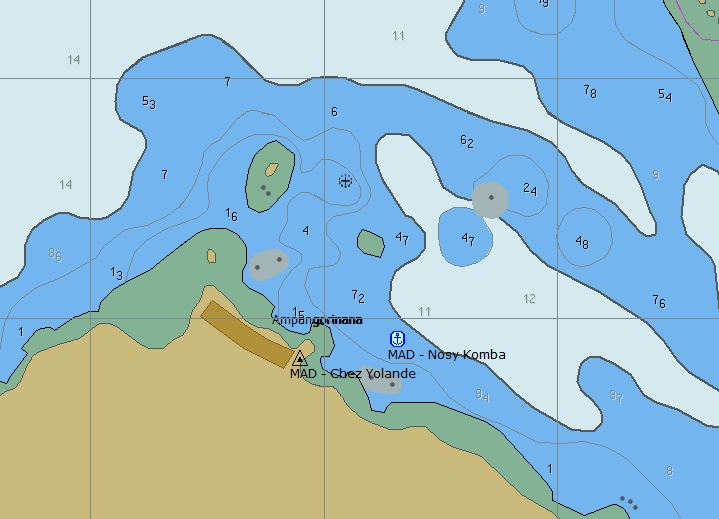
2016 Adina - 13°26.529S 48°21.141E 8m,Sand. Beach dinghy by 'Chez Yolande' restaurant near 13 26.5837S 48 20.9492E. Yolande is a lively lovely Malagsy lady married to a frenchman - she used to cruise so loves cruisers! She will change money, has free fresh water, free shower, will give you a guide, watch your dinghy etc. Reciprocate and eat at her restaurant - famous for her pepper steak. Be warned she's hard to tie down for 5 minutes. Komba is a tourist village but many enjoy it as local life goes on happily alongside. You can see and feed tame lemurs - park fee is 2000Ar per person. You really don't need a guide, just ask for directions to the park entrance, often Yolande will ask her grandson Lancelot to show you the way. For a walk in the mountains, ask Yolande to introduce you to Yvonne. Yvonne set up a school in the mountain and uses money from her tours to finance the school. Yvonne is a wonderful lady well into her retirement and will give you a guide (10,000Ar per person); easy walk with a few uphills, good views and interesting to hear how they used plants to treat various ailments. Anchorage is rolly at spring tide but otherwise breeze from the west in the afternoon and calm breeze from the east in the evening. 2013 Wapiti - The anchorage here is rather exposed but the village and island is very pleasant. We left the dinghy at Chez Yolande and had a couple of very good meals there. Walked most of the way up the mountain, which is easy walking. The little lemur park at a cost of 2000Ar is well worth a visit. Lots of carvings and fabrics, some to quite high standards. 2016 Tintin - 13°26.61S 48°21.21E in 10m, mud, very good holding. Only 5 nms or 1 hour from Hell Ville made this a favourite spot of ours that required a couple of visits. Nosy Komba means “Island of Makis” and true to its name we saw the black lemurs called Macaco. There are 12 Villages scattered along the coast and up in the mountains, the largest village being Ampangorina and we spent 5 wonderful days anchored off this village. There are no cars, no motor bikes or electricity and the village has a very chilled and laid-back ambience. We spent our days exploring the village, jungle, the small deserted islands nearby, watching the woman embroidering beautiful linen tablecloths in “point Richelieu” style and trying the local cuisine..absolutely delicious "OH" and the local Vanilla rum. From freshly caught Barramundi in Vanilla Sauce to delicious Calamari and Prawns cooked in local spices, we were in seafood paradise. Despite regular tourists visiting daily, the Malagasy way of life remains untouched in this village. The woman go across to Hell Ville to buy the material to make these beautiful works of art. They can take a couple of days to 3 weeks depending on design and size. Hard to believe that the following are all grown on this small island: bananas, pineapples, mangoes, papayas, soursop, pine trees, lychees, guava, soursop, salad vegetables, tomatoes, carrots, cassava, potatoes, pumpkins, and there are also vanilla, coffee and pepper plantations. There are also 188 varieties of tropical flora, and 70 medicinal plants all over the island plus an Arboretum, composed of a number of imported trees from different parts of the world including Australia. 2016 Camomile - Later that afternoon we motored the 10 miles around to and arrived just in time to see this stunning sunset behind one of the off shore islands. The next morning we went ashore with Kevin and Jacqui of Tintin to explore. The village was very authentic and pretty. At first it looked like peoples washing blowing in the wind but we realised it was beautiful hand embroidered tablecloths for sale. These ladies are doing their washing in one of the troughs that has a fresh water fill from the mountain above. Their houses don’t have electricity or running water. We didn’t ask about the toilets! This isn’t one of those contrived villages where every one goes home after work, these are really houses where they all live. It looks like one decent puff of wind and they would be blown down but they are fairly strong. All the cooking is done outside on open fires. This is her kitchen in front of her house. They were so lovely, its a bit touristy but very pretty. After lunch we took a guide up into the forest to find some lemurs. The first thing we were shown was a ylang ylang tree whose flowers are used to make perfume namely Channel No5 they had a delightful aroma. We walked further up and saw this beautiful chameleon on a tree and wild pineapples growing alongside the path. Our guide was calling’ maki, maki, maki’ and opening a banana he had brought with us. Then they appeared, first two, then two more and four above us. Such gentle creatures. Lemurs, roughly cat sized, are well known in northern Madagascar. The males are black and the females are chestnut brown. The guide was holding out banana to them and gave me some to hold up ready to give them. Soon I had a couple on my shoulders looking for their piece of banana, they were very gentle. There were some mums with babies further up the tree but they didn’t want to come down. It was very funny watching them jump from tree to tree. So many of our photos have half a lemur in them. We were also taken to see some tortoises and a boa constrictor Back on the beach this local boat was anchored. It’s made almost entirely in local materials, the hull is made of wood, the mast is a tree trunk and the sail is made of a very tough cotton. Further up the beach was a local boat builder and Bill was fascinated to see the various stages of build. We headed back to the dinghies. On the beach there were some men building a local house, bet they don’t have a risk assessment! Not a hard hat, safety shoe or high vis jacket in sight. On the Saturday Camomile and Norsa sailed to Nosy Komba for Norman and Sara to see the little village there. Sara and I went up into the lemur forest to see the lemurs again. 2015 Totem - 13°26.591S,48°21.181E,35,Sand,NE of the Northern point. Rolly in the afternoon. Pretty spot. 2014 Inifini - S13deg26.605min/ E048deg21.231min. By late morning we were motoring to Nosy Komba, about 5 miles away. We've anchored in 35', run the watermaker, are still catching up to emails, and decided to put off exploring until tomorrow. Since it's Happy Hour, we're tasting a local rum we just bought. Called Cuvee Noire ("Black Vintage"), it's a dark rum which apparently won a Silver Medal at the 2012 Renaissance Rum Festival in Miami Beach. Cost: $3.09USD/bottle. Hmmm. We started the morning by getting to the beach shortly after 0900. We had read there was a lemur park on the island and wanted to go see it. The local village is built just at the beach and the trail that leads thru it has numerous small storefronts displaying handmade products, mostly embroidered tablecloths and wood carvings. There was a small sign pointing the way to the lemur park, and we paid 2000Ar each for entry. A young boy named John soon accompanied us and became our self-designated guide; he worked for tips. We wound up a hill, stopped at a tree, and the lemurs were right there on cue. They eat bananas, which John and the other guides had thoughtfully brought along, and we had a great picture opportunity with them sitting on our shoulders. Continuing our walk, there was one boa, several large tortoises, and a couple of beautiful chameleons. Other lemurs climbed thru the trees and came down looking for more food from us, obviously used to human interaction. Although not that informational in a signage or lecture sense, it was a wonderful way to get introduced to just a few of the 100 (some sources quote 60) lemur species endemic to Madagascar. Leaving the park, we went thru the artisans gallery of shops. Many of them have the same things for sale, and prices are negotiable. Lunch was at Chez Yolande; this small restaurant/hotel turned out to be quite the find. We met both sons of the owner (on holiday in France), one serving us (Ceril) and his brother the cook. The food was delicious (special note was the outstanding mud crab), prices reasonable, and the setting relaxing enough to encourage us to stay for hours. Ceril is studying hospitality management, and his service and attitude are first rate. You can pull your dinghy directly to the small beach in front of the restaurant, and cold mountain water is available by hose to fill jerry jugs or do laundry. (Ceril's Mom is an ex-yachtie and the family certainly knows how to make cruisers feel welcome.) We returned to the boats in the afternoon, after making plans to return for dinner. That was possibly a bit premature, as we all were still full from lunch. However, we dinghied back and Sue had grilled fish with vanilla sauce and I the filet of zebu; Stuart and Sheila chose somewhat lighter fare! Thoroughly enjoyable, so much so that we arranged for a custom dinner of Romazava, a traditional Malagasy dish, for tomorrow evening. Chez Yolande will cook pretty much anything you ask for, although advance notice is required for many of the traditional dishes as they take so long to prepare. Lemurs, delicious food, good company, nice setting....it's been a fine day. 2007 Ocelot - S13°26.5 E48°21.1 40' (12m) sand/mud Nice tablecloths, carvings, walks, lemurs. Nearby bustling Nosy Be is Nosy Komba, (S13°26.5 E48°21.1) a lovely little island with several villages, handicrafts for sale (carvings and drawn-thread work especially), and friendly people. Be careful of the rocks to starboard as you enter the bay, as they sometimes don't show very well. There's a nice forest walk, and lemurs to see, touch, and feed. There is a tiny ($1) fee to see the lemurs (which are wild), but it's worth it, as it provides incentive for the people to continue to protect these lovely, gentle animals. Take bananas if you want to feel a small silky creature on your shoulder! Follow the signs up the hill to the "maki" as they are called. The lemur guides speak English and are quite knowledgeable about this local species, the Black Lemur. Above the botanical park the path continues up and up to some nice forest and a few view points. Oh, and there are a couple little bars ashore if you want to kick back with a cool beer. We stopped here several times, sometimes spending the night, or at times just as a day sail from Hellville. |
|
Lokotobe National Park, Nosy Be (13°24.818S 48°20.393E)
2016 Adina - (13 24.818S,48 20.393E) 8m,Sand. Quiet, peaceful place on the edge of Lokotobe National Park. Walking ashore on paths." 2015 Totem - 13°24.567S,48°20.586E,26,Sand, Entered cautiously as there are some shallow spots, but easy enough. Wind funnels between Nosy Be/Komba in the afternoon and evening |
|
Tani Kely (13°29.278S 48°14.24E)
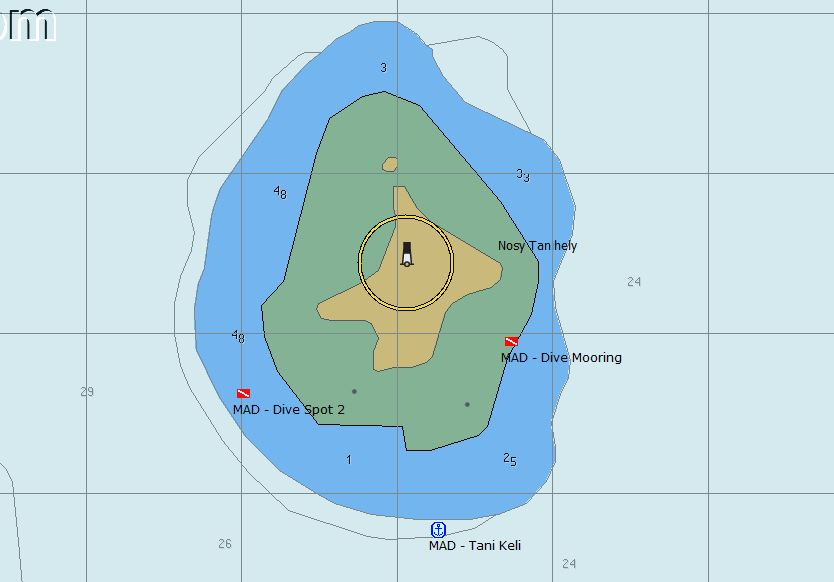
2016 Adina - 13°29.278S 48°14.24E 17m,Sand. Sand bank on south of Tani Kely. Daytime stop. Snorkelling. 10,000Ar per person." 2016 Tintin - 13°29.013S and 48 14.363E, 6m, sand, day anchor only. Nosy Tanikely also called “the island of the small earth “ is less than an hour from Hell Ville. The island is a protected marine reserve and one of the best snorkelling sites in the area, with “ok” coral (we have been very spoilt in the Maldives), numerous fish and large turtles. It costs 10,000 Ar ($4.24 Aus) per person and is the most visited island of Nosy Be. Day trippers come here for a swim, snorkel and photo session. It is so weird after having the waters for snorkelling all to ourselves in the Maldives (3 months) and Chagos (1 month) to suddenly be confronted with 20 snorkelers coming straight towards us splashing away and scaring all the fish… It was just great to be back in the water and definitely an island worth coming to visit whilst in Nosy Be. 2015 Totem - 13°29.000S,48°14.369E,60,Sand / Bommies,On east side. Much sand with more coral more north or south. Park ranger directed us to a mooring instead of anchoring. 2007 Ocelot - S13°29.2 E48°14.3 14' (4m) sand Only clear water we found. Petite Tani Keli (S13°29.2 E48°14.3) is a beautiful stop en route to or from Russian Bay, or a day trip on its own from Nosy Be. As this island has the clearest water along this part of the coast we stopped here to do a bit of snorkeling and to scrub the hull. Holding wasn't great, though, and we struggled to find depth over sand, not coral (which we won't anchor on). Mid-day the area can be busy with day-trippers from the hotels on Nosy Be, but you may be lucky and get it all to yourself! We didn't stay overnight, but if you do, be sure to allow for the inevitable wind shift! 2016 Camomile - Thursday 1st September Camomile left Nosy Komba for Nosy Sakatia stopping at Nosy Tanikeli on the way. It’s part of the national park and you have to pay AR10,000 per person. We anchored at 13 29.275S 048 14.209E on a bit of a shelf. We had 16.5m under our keel but only intended to stay for a few hours so weren’t too concerned. There aren’t many places to snorkel in Madagascar and the coral has been bleached but we decided to get in. This would probably be our last snorkel until the Caribbean next year. The first thing that struck us was the water was quite chilly compared to the Seychelles or Maldives. Then I spotted a turtle swimming gracefully around the coral looking for tasty morsels. At first I didn’t want to go too close and frighten it but it wasn’t bothered about us. I was able to get closer and closer. It was almost a metre long from head to tail. I swam with it for about 20 minutes just watching it. Magical. 2014 Inifini - S13deg29.016min/E048deg14.352min. Last night we experienced the dreaded Nosy Komba Roll, which was bad enough to prevent us from sleeping soundly. Shortly after first light, we raised anchor and departed, glad to get away from the constant beam-to motion that was so uncomfortable. We motored the 5 mi to Tanikely National Park, and took a mooring in 35' water. There were a few moorings further in, but depth would become an issue. The water was crystal clear to over 40', and I took the opportunity to use our hookah rig and change out the MaxProp zinc anode. Schools of fish swam around us, some of the larger ones actually bumping our hull! At the beach, we paid 10000Ar each for the Park entry fee and walked to the old light house structure. Built in 1908, it no longer is functional, but there is a small museum with placards in 4 languages, and we felt it a good place to learn about the history of the area, as well as imagining school children learning and enjoying a picnic lunch. There are two varieties of lemurs on the small island, but feeding them is prohibited. Dark skinks scampered everywhere, and the view from the light house was awesome. We snorkeled after lunch, accompanied a turtle for about 10 min, saw a small gray shark, and lots of beautiful kinds of fish. A nice place to visit, and anchoring is allowed in sandy areas just in front of the beach (about 35'-40' depths); this is considered a day anchorage as it's somewhat exposed. 2013 Two Oceans – Tanikely is a small island and a marine park which is popular for its beauty and the reef around it. We anchored on a patch with white sand on the island’s south and went into the water. This time the bloggers had it right; the snorkeling IS good. Apart from the usual tropical fish we were glad to see two turtles grazing, seemingly unafraid of the two humans above them. Park boat came to collect the 10000 ariary fee for each of us. As the afternoon sea breeze came we realized that there was no real protection around the island and chose to go back to Hellville. Encouraged by the example set by the local mariners I came into the anchorage under sail only, using the engine just for batteries charging. |
|
Nosy Munoko (13°43.390S 48°11.195E)
2016 Adina - 13°43.390S 48°11.195E 15m,Mud. Beautiful spot, very well sheltered. Sadly locals in the village ashore seemed jaded when we visited, perhaps too many visitors although we only saw two boats during our three day stay, one being a day trip. 3000Ar per person for a poor 15min tour in which you are shown two tortoises, a baobab and some thin black lemurs. Some serious mud on the chain when it came up." 2016 Tintin - 13°43.364S 48°11.265E,13m, mud, good holding, very protected. We arrived here in the late afternoon after sailing from Nosy Komba and anchored in the small sheltered bay. This remote island is just stunning with a small pristine forest that spills out onto sandy white beaches and amazing views of the mainland mountain ranges. Throughout the days we were here we watched dolphins play, whales swim by and Dhows and Pirogue sailed from the island to the mainland and then back again, transporting people, goods and ravinala leaves for building roofs. The traditional and very small village on Mamoko Island still has a monarchy in place, with a Queen as head of the island's small village population. The village sustains itself through fishing and trading with visiting yachts. Lucky for us we were the only yacht here and therefore had this beautiful place all to ourselves. We also had our own private tour guides, ”all” the children from the village (approx, 8). The villagers have absolutely nothing, and I mean nothing, so we gave basic medical supplies, colour and lead pencils, crayons, body soap, talcum powder, baby clothes, bibs and children's T-shirts to villagers. We bought a fresh lobster for $4 and cooked it for lunch, our first time killing a live lobster and then cooking it…delicious. Again we did not want to leave another beautiful spot, however 10 days away from “civilisation” meant we were running out of fresh food, plus there are so many other places we want to visit during our 3 months in Madagascar. |
|
Nosy Kisimani (13°34.747S 48°05.139E)
2016 Adina - (13°34.747S 48°05.139E) 9m,Mud. Initially we anchored inside the small bay at 13ø34.1722S 48ø05.7075E. However the stories of lots of mosquitoes very quickly proved true and with the anchorage being very close to the village, we moved out to this spot. Anchorage is well sheltered. Very peaceful and quiet." 2014 Inifini - (S13deg34.702min/E048deg05.253min. This is a beautiful bay. At low tide there is 360 degree protection from swell, and low hills block the wind. A few canoes came by to trade, and we ended up with fresh bananas, limes and calamari. We walked one of the nearby beaches, picking up some small, but lovely, shells. There is no internet or cell phone signal here, and not much activity. A very peaceful place. This morning as we were raising anchor to go back to Crater Bay, internet and some provisions, another pirogue stopped by and offered what Sue described as the largest Madagascar lobster she's ever seen; maybe the largest one she has seen anywhere! We politely declined, but it's good to know the big fellows are out there. |
|
Russian Bay, Mainland (13°32.190S 47°59.918E)
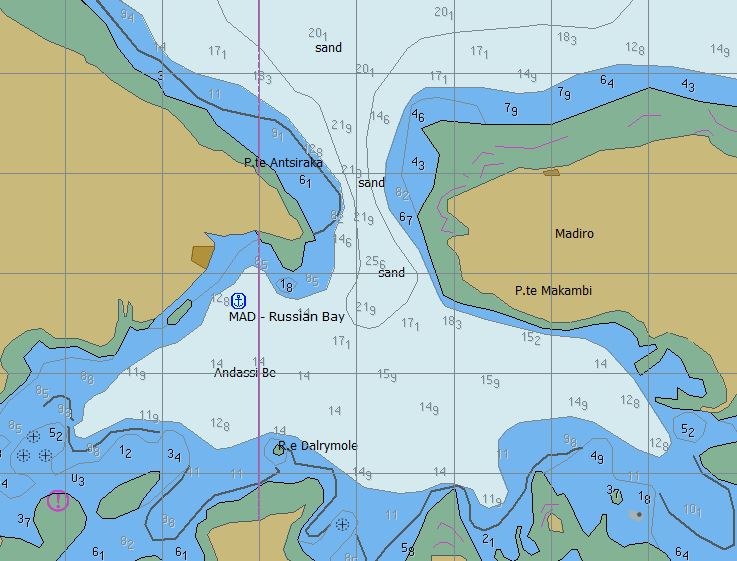
2016 Adina - 13°32.190S 47°59.918E 17m,Mud. Study charts here as there is reef coming out and near the entrance. Swell sometimes comes in from north but otherwise well sheltered in prevailing sea and land breezes. A local called Paul will visit your boat. He has a book with 9 excursions which are walks you can do with him, many including a trip in his dhow and lunch made by his wife. Very friendly and can speak English - highly recommended! An Austrian called Andre married to a Malagasy lives ashore and impromptu sundowners often take place at his house. He sells warm beer and is grateful for anyone who brings him a cold beer. If enough fish are bought in by cruisers he will sometimes do a meal (around 11,000Ar a head) and makes bread. There are two beautiful black lemurs which he feeds around 4.30pm. A great spot to explore, relax and meet up with other cruisers. A popular cruiser hang out and rightly so. A local man who speaks English offers guided walks and sailing trips on his dhow with lunch prepared by his wife. Further along the beach an Austrian has made Russian Bay his home and welcomes cruisers with meals and warm beers. The easy life, it’s very relaxing. For us it was time to head south. The truth is we know how easily you can get stuck in these cruiser hubs – it’s fun, it’s easy, it’s wonderfully social. But we’ve always said we’re on this trip to see things, we have one shot at this, exploring is our priority. 2015 Yolo - Russian Bay is just a day sail south of Hellville and some yachts went back and forth in the area several times. There are lots of small islands in the Hellville area to entice cruisers with their delights. 2015 Totem - 13°32.163S,47°59.828E,41,Clay, Excellent holding and generally good protection, though some swell rolls in the entrance and some fetch within the harbor. 2016 Tintin - 13°32.147S 47°59,954E, muddy, 10 meters. After a couple of nights anchored off Nosy Sakatia Lodge we headed across to Russian Bay, also known as Bay Ambavatoby a beautiful bay located between the island of Nosy Be and Nosy Iranja on mainland Madagascar. The bay's name dates back to 1905 during the Russo-Japanese war when a Russian warship anchored here. They were there to attack any passing Japanese ships, but the crew took to life in Madagascar and realised that they did not wish to wage war nor to return to Russia. Their ship was hidden in the upper reaches of Russian Bay and twice emerged to trade with pirate vessels that used to frequent the Mozambique Channel. The ship eventually ran out of fuel for its boilers and sunk in the bay years later. The last Russian sailor died in 1936. The soldiers graves and the ships remains can still be seen today. Paul is the local “tour guide” and will come out to your boat or meet you ashore at happy hour to discuss his tours and costs. He has a folder full of interesting tours, we chose the sail across the bay in a Pirogue*, then a walk to a very small village, followed by a coconut wine tasting then back across the bay for a seafood lunch cooked by his wife on the beach, consisting of barracuda cooked in pepper, coconut rice and salads. Paul lives with his wife and 2 sons the eldest has gone to school in Nosy Be. The Madagascar outrigger pirogues have their origin from two main regions, the Indonesian/Borneo, with 2 two float canoe and Sri Lanka, with a single float canoe. Pirogues are not usually intended for overnight travel but are light and small enough to be easily taken onto land. The design also allows the pirogue to move through the very shallow water of marshes and be easily turned over to drain any water that may get into the boat. We did see many of these small, lightweight Pirogues miles off shore and 2 capsized in the Bay of Bombeteka. The land around this bay is owned we were told by overseas investors planning to build a resort, airport and marina. To date nothing has happened thank goodness. The locals living here do not own their land, they cannot afford to buy any land its just too expensive. The malagasy people just set up a home (a hut, possibly a few goats or Zebu if lucky) and hope that if they have lived there for more than 7 years it will be very hard to move them on. One of the neighbours near to Paul is an Austrian guy called Andreas who is married to a Malagasy woman, however now lives with her sister. He came here over 10 years ago to explore by foot this region, and has never left. He has a small bar with a variety or homemade flavoured rums and warm beer, no fridge for keeping beers cold. What is unique about Andreas is that he will cook a 1kilo bread in the oven on order, plus calls out on the VHF to all the yachts anchored in the bay his “Menu for the Day”. Our first night eating ashore included octopus, fish, rice and salads by candle light, we were joined by over 7 yachts. When you go to Andreas’s for sundowners, to have a meal or just for a walk you will most likely bump into a lemur or 2, puppies, goats, ducks and chickens. He is very self sufficient, with a well for water, no electricity and pops across regularly to Hell Ville for supplies by Pirogue. The Sailing Regatta Party, 2 full days of beach party fun was held whilst we were there. Russian Bay went from only 5 yachts to over 33 yachts for the Regatta. Beautiful Dhows boats are a daily sight here in the North West of Madagascar. They are of Arab origin and their extraordinary history goes back over a 1000 years stretching from southern India to the North West of Madagascar through Yemen, Djibouti, Kenya, Tanzania and up to Comoros. Dhow with its lateen, a triangular sail mounted at an angle. They are very strong and are made for transport. Their shallow draft enables them, like pirogues (outrigger) to sneak in anywhere. This area in the North West of Madagascar is the last region in the world where hundreds of Dhows still navigate mainly with sail propulsion. In the past they transported weapons, pearls, gold and slaves, nowadays they transport still by sail all the traditional building materials coming out of the bush and the forest including ravinala leaves used for roofs and walls, mangrove poles, timber, rafters and also rice, coconuts, oranges, bananas, dried fish, zebus, goats, ducks and chickens. They are truly beautiful to watch as they glide pass. 2016 Camomile - In the afternoon we left Hellville for the last time and sailed back to Russian bay. Our anchorage there was 13 32.19S 047 59.95Ein 14.4M of water. Good holding over sand. Russian bay is named as such because in 1905 during the Russo – Japanese war a Russian fleet spent nine weeks harboured there. The crew of one of the ships are buried in the cemetery up behind Hellville. A beautiful and remote place opposite Nosy Be the bay provides excellent, all-round shelter. One morning Bill and I took the dinghy for a ride around the bay and were amazed by the bird life in the trees. Just outside the entrance is a beautiful beach which we sat on for an hour or so and swam in the sea. (Camera had another wobble and lost photos) We stayed there for the rest of the week and by the weekend there were 34 boats anchored in the bay because there was a regatta that weekend. Everyone had a great evening on the saturday and Andre worked hard putting on a bbq. The party continued Sunday morning as Andre was selling scrambled eggs and fresh bread with jam and coffee. I passed on the coffee but the bread was nice. There were games organised on the beach and then at midday a dozen or so of the yachts took part in a race back to Crater bay. The following day we started our passage south. The people in Madagascar are very poor but resourceful. They build their houses from materials gathered from the forest and their boats are totally made of natural materials. With a few exceptions the boats or dhows don’t have any engines and rely on the wind. Fortunately there are good winds here. In the early morning there’s the last of the night breeze blowing offshore and then most mornings a sea breeze strikes up towards the land at about 10am or 11am and goes on as late as 5pm or 6pm so the fishermen go out with one and come back with the other. Their sails are made of anything from rice bags sewn together to traditional heavy cotton sails with lots of varieties in between. Some have been fortunate to be given an old sail from a yacht and I say to those following us ‘don’t throw away any sails or sail material, bring it here’. Our friends on Adina gave away a sail and were given a live chicken in exchange! The Malagasy are very accomplished sailors and we often find they will try and race us when we’re sailing off shore and one of them very nearly beat us! While there a group of us went for a sail with a local guy called Paul in his traditional dhow to the other side of the bay for a wonderful walk. It was very basic and basically just bit of wood held together with bits of string but felt very secure. After about an hour the sail was taken down, wrapped up and Paul paddled the last bit. We all just perched on the side and across the branches laid across the outrigger. While we went for our walk the dhow just sat waiting for us with a large rock as an anchor. We came across a group of houses but everyone was out leaving just their herd of zebu's behind. We continued on up the hill. We came across another little house on the top of the hill. Despite being at the top of the hill the guy was building himself a canoe We walked back to the dhow and sailed back to the anchorage for lunch cooked by Paul’s wife. A really great day. 2014 Inifini - S13deg32.181min/E047deg59.834min. We motored over to Russian Bay this morning from Sakatia. Can you see a pattern here? No wind to talk about, lots of current, and the necessity of an iron genoa. Charts are accurate for the entry, although I'd suggest favoring the west side until the range line (on Navionics and Garmin, not on our CM93 charts) is reached. We dropped anchor in 40' and enjoyed lunch. In the late afternoon, we went into the small bar/restaurant/store and met its owner, an Austrian named Andre, and enjoyed a warm beer (as Andre explained, "the English way") and talking with him. Not too many fishermen are coming in and out so far, but we'll go exploring by dinghy tomorrow. Of note, we're not getting internet here, and are a bit far for VHF communication to Hellville (about 18 mi). 2013 Two Oceans – We sailed to Russian bay, a huge one full of potential anchorages. Going by a blog we read and following the example of a few other yachts, we anchored just past the entrance on the west side. The snorkeling was supposed to be good but maybe our standards were spoilt by some other places we’ve been to so we were not impressed. I decided to preempt the nightly easterlies and went to one of the bays on the east. Peace and quiet here; big fish broke our line and disappeared and a small one went into our freezer. 2007 Ocelot - S13°32.0 E48°00.8 37' (11m) sand/mud Shoals quickly - watch tide. Many cruisers enjoyed Russian Bay (S13°32.0 E48°00.8) for the walks guided by a local named Paul, and the camaraderie of the South African couple that lives there. Lisa does wash, and can supply you with drinking water and cool beers. We were late in the season (late October) and still had to make South Africa before the beginning of cyclone season so we didn't explore this large bay to the extent it deserved. There are several anchorages in the bay. We anchored in the northern end, just near the entrance. Lisa's place is to the south, farther in. Apparently Russian Bay got it's name because a Russian warship used to base here, sailing out to pirate passing freighters before it ran out of fuel. |
|
Nosy Ankazoberavina (13°29.31S 47°58.70E)
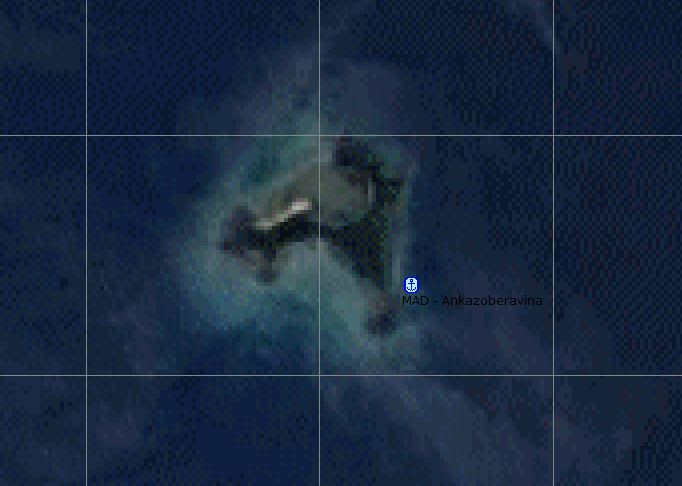
2017 Alba - |